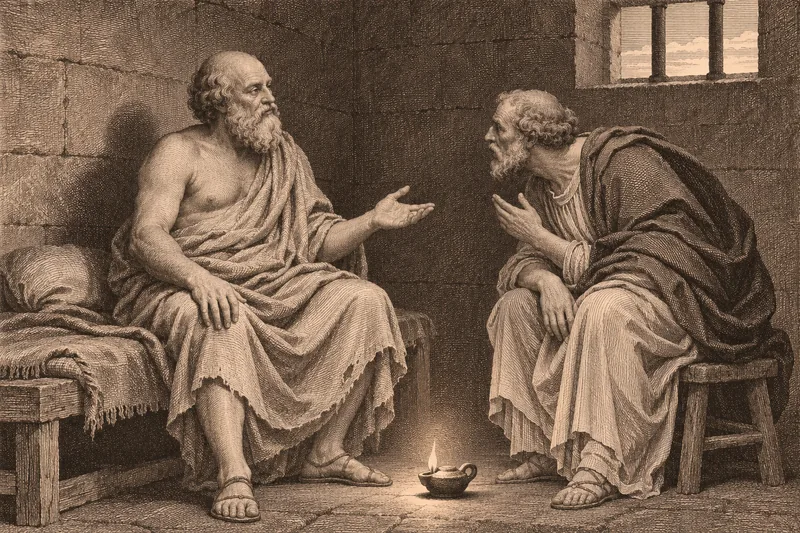
Socrates 43a What brings you here at this hour, Crito?1 Isn’t it still early?
Crito Very early.
Socrates About what time is it?
Crito Dawn is only just beginning.
Socrates I’m surprised the prison guard agreed to admit you.
Crito He knows me by now, Socrates,2 because I visit so often. Besides, I have done him a small favor.
Socrates Did you arrive just now, or have you been here long?
Crito Quite a while.
Socrates 43b Then why sit beside me without a word, instead of waking me straightaway?
Crito No, by Zeus, Socrates. I would not want such sleeplessness and distress myself. But I have also been marveling for some time at how peacefully you sleep, and I deliberately left you asleep so that you could spend the time as pleasantly as possible. Often throughout your life I have thought you fortunate in your temperament, but never more than in this present calamity, which you bear with such ease and gentleness.
Socrates After all, Crito, at my age it would be out of place to resent having to die now.
Crito 43c Others your age find themselves in troubles like these, Socrates, but their years do nothing to keep them from resenting their present lot.
Socrates True enough. But what has brought you so early?
Crito I bring painful news, Socrates—not for you, it seems to me, but painful and heavy for me and all your friends. I think I shall be among those who bear it most heavily.
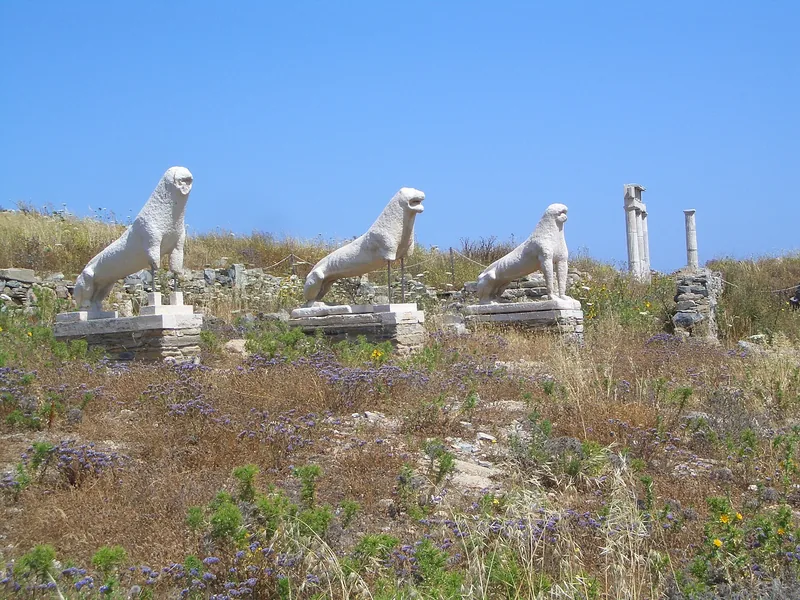
Socrates What news? Has the ship returned from Delos3—the ship whose 43d arrival means I must die?
Crito It has not arrived yet, but I expect it today, judging by the reports of some people who have come from Sounion4 and left it there. Their news makes it clear that it will arrive today, so your life must end tomorrow, Socrates.
Socrates Then may fortune favor us, Crito. If that is what pleases the gods, let it happen. Still, I don’t expect the ship today.
Crito 44a What makes you judge that?
Socrates I’ll explain: I must die the day after its arrival, I believe.
Crito That is what the officials responsible5 tell us.
Socrates Then I expect it tomorrow, not on the day now dawning. I judge this from a dream I had a little earlier tonight. It seems you chose a good moment to leave me asleep.
Crito What did you dream?
Socrates I thought a woman approached me, beautiful and lovely to look at, 44b dressed in white. She called to me and said:
“Socrates, on the third day you would reach fertile Phthia.”6
Crito An extraordinary dream, Socrates.
Socrates A clear one, rather, so it seems to me, Crito.
Crito All too clear, apparently. But, dear Socrates, listen to mea even now and save yourself. For if you die, I shall suffer more than one misfortune: I shall lose a friend whose equal I shall never find, and many who do not know either of us well will think 44c that I neglected you, although I could have saved you if I had been willing to spend money. Yet what reputation could be more shameful than one for valuing money above friends? For the many7 will not believe that you yourself refused to leave when we were eager to help.
Socrates But why should we care so much about the opinion of the many, dear Crito? After all, the most reasonable people, whose views deserve more attention, will judge events as they actually turn out.
Crito 44d Yet you can see, Socrates, that we have to care about the opinion of the many too. Our present circumstances themselves show that the many can inflict not the slightest evils but almost the greatest, when someone has been slandered among them.
Socrates If only the many could inflict the greatest evils, Crito, so that they could also bestow the greatest goods: that would be a fine thing. As it is, they can do neither: they cannot make anyone wise or foolish, but act at random.
Crito 44e Let that stand, but tell me this, Socrates: are you anxious for me and your other friends, afraid that if you leave here, the informers8 will make trouble for us for stealing you out, and we shall be forced to lose our entire property, or a substantial sum, or suffer something else besides? Because if you fear anything 45a of that kind, put it aside. Surely it is just for us to face this danger in saving you, and a greater one if need be. Listen to me, and do as I ask.
Socrates Those things worry me, Crito, and much else too.
Crito Then don’t fear them. For the men who are prepared to save you and get you out don’t even want much money. Besides, don’t you see how cheaply these informers can be bought, and how little money we would need for them? 45b My money is available to you, and I think it is enough. Then, if concern for me makes you unwilling to spend mine, these visitors are ready to spend theirs: one of them, Simmias9 the Theban, has already brought enough for this very purpose, and Cebes and a great many others are ready too. So, as I say, don’t let these fears make you give up saving yourself, and don’t be troubled by what you said in court,10 that you would not know what to do with yourself if you left. For there are plenty 45c of other places where people will welcome you, wherever you go; and if you want to go to Thessaly,11 I have guest-friends there who will hold you in high regard and keep you safe, so that nobody in Thessaly troubles you. Besides, Socrates, I don’t think what you are attempting is just: you are betraying yourself when you could be saved, and striving to bring upon yourself precisely what your enemies would strive for, and have striven for, in their wish to destroy you. Moreover, I think you are betraying your own sons:12 you 45d could nurture and educate them, yet you mean to go away and leave them, and as far as you are concerned, whatever happens to them will happen. They will probably meet the sort of fate that orphans usually meet in their orphanhood. For a man should either have no children or share the toil of nurturing and educating them, but you seem to me to be choosing the laziest course.b You ought to choose what a good and courageous man would choose, especially when you claim to care for excellence throughout your life. For I feel ashamed 45e for you and for us, your friends, fearing that people will see a kind of cowardice on our part in everything that has happened to you: in the way the case came to court when that could have been avoided; in the course of the trial itself; and, as a final mockery of the whole affair, in the appearance that this chance has slipped away 46a from us through our own worthlessness and cowardice, since neither we nor you yourself saved you, although that was entirely possible if we were of the slightest use. So take care, Socrates, that these things do not bring shame upon you and us as well as misfortune. Make your decision—or rather, the time for deciding is over; the decision should already be made. And there is only one plan: everything must be done this coming night. If we wait any longer, it will be impossible; the chance will be gone. So please, Socrates, listen to me, and do exactly as I ask.
Socrates 46b Dear Crito, your eagerness would be worth a great deal if it were rightly directed; otherwise, the greater it is, the more troublesome. So we must examine whether we ought to do this or not, because I have always been the same in this, not just now: I yield to nothing in myself except the argument that seems best to me when I reason it through. I cannot discard my earlier arguments just because this fate has overtaken me, but find them much as they were, 46c and respect and honor the same ones as before. Unless we can offer better arguments in our present circumstances, be sure that I shall not agree with you, even if the many use their power to frighten us like children with bogeymen, sending chains, deaths and seizures of property beyond our present troubles. How, then, could we examine the matter most reasonably? By first returning to the argument you raise about opinions? Were we always right to say, or were we not, 46d that we should attend to some opinions but not others? Or was it right before I had to die, but now it has become obvious that we were talking merely for the sake of talking, and it was really a game and nonsense? I want to examine with you, Crito, whether the argument looks different to me in my present condition or remains the same, and whether we shall dismiss it or follow it. I think people who supposed they had something to say used to put it like this, just as I did a moment ago: among the opinions people 46e hold, some should count for a great deal, others should not. By the gods, Crito, doesn’t that seem right to you? For you, at least so far as human circumstances go, are not facing death 47a tomorrow, and our present calamity would not distort your judgment. Consider it, then: doesn’t it seem sound to say that we should value some human opinions and not others, rather than all of them, and the opinions of some people rather than everyone? What do you say? Isn’t that right?
Crito It is right.
Socrates So we should value good opinions, but not bad ones?
Crito Yes.
Socrates And good opinions belong to the wise, bad ones to the foolish?
Crito Of course.
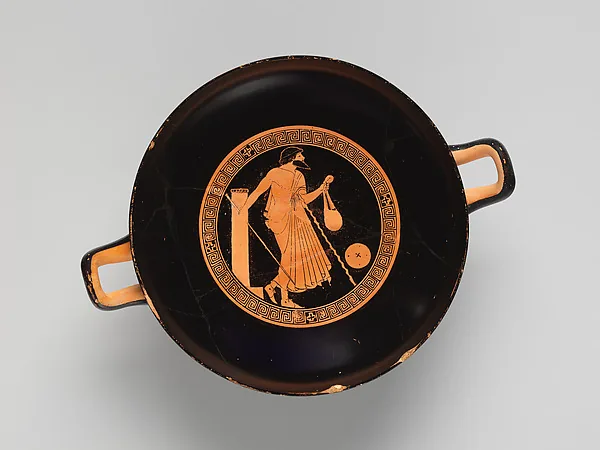
Socrates Now, how did we put the following case? When a man trains 47b and makes it his business, does he attend to everyone’s praise, criticism and opinion, or just to those of the one man who happens to be his doctor or physical trainer?
Crito Just that one man.
Socrates Then it is this one man’s criticism he should fear and his praise he should welcome, rather than those of the many.
Crito Clearly.
Socrates So his actions, training, eating and drinking must follow the judgment of that one man, the instructorc who understands the matter, rather than the judgment of everyone else together.
Crito That is so.
Socrates 47c Good. But suppose he disobeys that one man, dismisses his opinion and praise, and values what the many say, though they understand nothing about it. Won’t he suffer some harm?
Crito Certainly he will.
Socrates What is that harm? Where does it fall? What part of the disobedient man does it affect?
Crito His body, plainly, because that is what it ruins.
Socrates You are right. Then the same applies elsewhere, Crito, without going through every case. In particular, with just and wrongful actions, shameful and honorable ones, good and bad ones—the matters we are now considering—is it the opinion of the many 47d that we should follow and fear, or that of the one who understands, if there is such a person, before whom we should feel more shame and more fear than before everyone else together? If we do not follow him, we shall ruin and maim what justice improves and wrongdoing destroys. Or is there no such thing?
Crito I think there is, Socrates.
Socrates Consider, then: if we follow the opinion of those who do not understand and destroy what health improves and disease ruins, is life worth living 47e once that is ruined? We are speaking of the body, aren’t we?
Crito Yes.
Socrates Then is life worth living with a body that is wretched and ruined?
Crito Not at all.
Socrates But is it worth living when that is ruined which wrongdoing maims and justice benefits? Or do we think that this part of 48a us, whatever it may be, with which wrongdoing and justice are concerned, is worth less than the body?
Crito Not at all.
Socrates More valuable, then?
Crito Much more.
Socrates Then, my good friend, we should not be so very concerned about what the many will say of us, but about what the one who understands justice and wrongdoing will say, and what truth itself will say. So your first proposal was mistaken in this respect: you proposed that we should care about the opinion of the many on what is just, honorable and good, and on their opposites. “But the many can kill us,” someone might say.
Crito 48b That is clear too. Someone certainly might, Socrates.d
Socrates You are right. Yet, my dear friend, the argument we have gone through still seems to me much as it did before. Now consider another: does our agreement still stand that our highest concern should be living well, rather than simply living?
Crito It still stands.
Socrates And does our agreement still stand that living well, living honorably and living justly are the same?
Crito It does.
Socrates Then, on the basis of our agreements, we must consider whether it is just for me to attempt to leave without 48c the Athenians releasing me. If it proves just, let us try; otherwise, let us leave it alone. As for your considerations about spending money, reputation and nurturing children, might these really be the concerns of people who kill without a thought and would bring people back to lifee if they could, equally without sense—the many, Crito? But since the argument leads us this way, perhaps we need consider only what we were just saying: whether we shall act justly in paying money and giving thanks to those 48d who will take me out, and in taking me out and being taken out ourselves, or whether we shall truly be doing wrong in all of this. If our actions prove wrongful, surely we must not give greater weight to whether staying here quietly means death or any other suffering whatever than to the prospect of doing wrong.
Crito What you say seems sound, Socrates, but consider what we are to do.
Socrates Let us examine it together, my friend. If you can object to anything 48e I say, object, and I shall be persuaded by you. Otherwise, dear Crito, please stop repeating that I must leave here against the wishes of the Athenians, because I care very much about persuading you before I act, rather than acting against your will. Consider whether the starting point of our inquiry 49a satisfies you, and try to answer each question according to your real belief.
Crito I shall try.
Socrates Do we say that we must never willingly do wrong, or that we must do wrong in some ways but not others? Or is doing wrong never either good or honorable, as we have often agreed in the past and were saying just now? Or have all our earlier agreements drained away in these few days, and have we, old men of our age, spent all this time talking seriously together 49b without realizing that we were no different from children? Or is what we said then entirely true: whether the many agree or not, and whether we must suffer worse things than these or gentler ones, doing wrong is nonetheless always bad and shameful for the person who does it? Do we say so, or not?
Crito We do.
Socrates Then we must never do wrong.
Crito Certainly not.
Socrates So when we suffer wrong, we must not return wrong for wrong, as the many believe we should, since we must never do wrong.
Crito 49c Apparently not.
Socrates And what of doing evil, Crito? Should we do it, or not?
Crito Surely we should not, Socrates.
Socrates And when we suffer evil, is it just to do evil in return, as the many say, or is it not just?
Crito Not just at all.
Socrates Because doing harm to people is no different from doing wrong.
Crito You are right.
Socrates Then we must neither return wrong for wrong nor do harm to anyone, whatever we suffer at their hands. And take care, 49d Crito, that in agreeing to this you are not agreeing against your own belief. For I know that only a few people believe this or ever will. So those who believe it and those who do not cannot deliberate together; they must despise one another when they see one another’s decisions. So consider very carefully whether you share this view and agree with it, and whether we should begin our deliberations from here: that it is never right to do wrong, to return wrong for wrong, or, when we suffer harm, to defend ourselves by doing harm in return. Or do you withdraw and refuse this starting point? 49e For this has long been my belief and remains so now, but if you have reached a different view, tell me and teach me. If you stand by our earlier conclusions, listen to the next point.
Crito I stand by them and agree. Go on.
Socrates Then here is my next point—or rather, my next question: if what someone has agreed to do for another is just, must he carry it out, or deceive the other person?f
Crito He must carry it out.
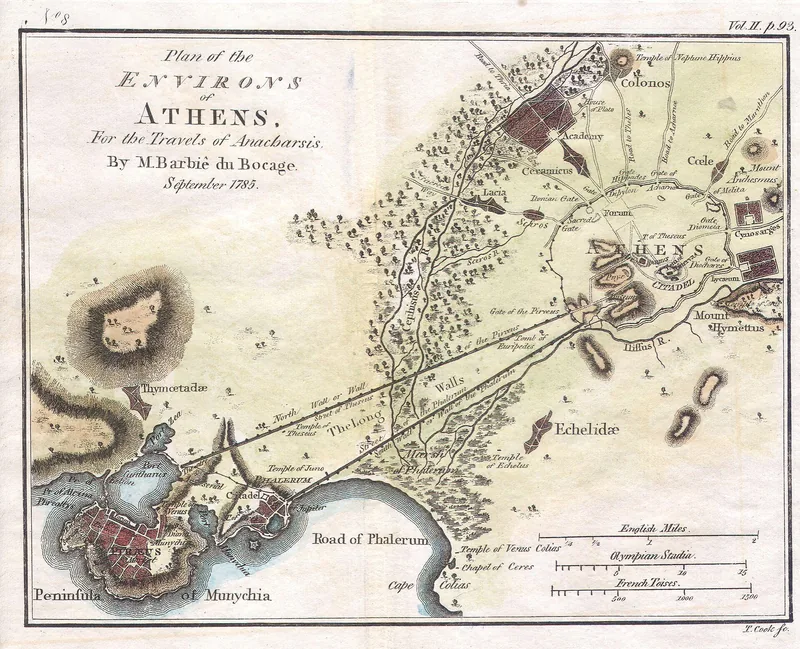
Socrates Look at the matter in that light. If we leave here without 50a persuading the city, do we harm anyone—and those we should harm least—or not? And do we stand by the just agreements we made, or not?
Crito I cannot answer what you are asking, Socrates, because I don’t understand.
Socrates Consider it this way. Suppose we were about to run away from here, or whatever we ought to call it, and the Laws13 and the community of the city came and stood over us and asked, “Tell me, Socrates, what are you planning to do? By this 50b action you are attempting, do you mean anything other than to do your part in destroying us, the Laws, and the whole city? Or do you think a city can survive without being overturned when its court judgments have no force, but private individuals invalidate and destroy them?” How shall we answer that, Crito, and other questions like it? For there would be plenty to say, especially for an orator, in defense of this law that is being destroyed, which requires judgments delivered in court to remain binding. 50c Or shall we answer, “Because the city did us wrong and judged our case incorrectly”? Is that what we shall say, or something else?
Crito That, by Zeus, Socrates.
Socrates Then suppose the Laws said, “Socrates, was that also part of our agreement with you, or did you agree to stand by whatever judgments the city delivered?” If their words surprised us, perhaps they would say, “Don’t be surprised at what we say, Socrates. Answer us, since you are accustomed to asking questions and answering them. Come now: what complaint 50d against us and the city makes you attempt to destroy us? First, didn’t we give you birth? Wasn’t it through us that your father married your mother and begot you? Tell us, then: do you find anything unsound in those of us who are the laws concerning marriage?” “I find no fault,” I would answer. “What about the laws concerning a child’s nurture and education, the education you yourself received? Did those of us appointed to this task not give sound instructions when we told your father to educate you in 50e music14 and gymnastics?” “They did,” I would answer. “Very well. Since you were born, nurtured and educated, could you deny, to begin with, that you were our offspring and slave, both you and your ancestors? If that is so, do you think that you and we have an equal claim to justice, and that whatever we attempt to do to you, you are justified in doing back to us? With your father, or a master if you had one, you had no equal claim to justice that allowed you to retaliate—when abused, 51a to answer back, when struck, to strike back, and many other things of that kind—yet with your country and the Laws you will have that right? So if we try to destroy you, thinking it just, you will try in turn to destroy us, the Laws, and your country as far as you can, and claim to be acting justly—you who truly care for excellence? Or are you so wise that you have failed to notice that your country deserves more honor and reverence, and is more sacred, than your mother, father and all your other ancestors, 51b and stands higher in the esteem of gods and sensible people? You must revere your country, yield to it and soothe it in its anger more than you would your father, and persuade it or do what it orders. If it orders you to suffer something, you must bear it quietly, whether blows or imprisonment; and if it leads you into war to be wounded or killed, you must do this too. Justice requires it. You must not give way, retreat or abandon your post, but in war, in court and everywhere, you must do what your 51c city and country order, or persuade it of what is truly just. But using force against your mother or father is impious; against your country, far more so.” What shall we say to that, Crito? Do the Laws speak the truth, or not?
Crito I think they do.
Socrates “Consider, then, Socrates,” the Laws might perhaps say, “that, if we speak the truth, what you now attempt to do to us is unjust. For we gave you birth, nurtured you, educated you, and shared with you and all the other citizens every good thing 51d we could. Nevertheless, by giving every Athenian this freedom, we openly declare that anyone who wishes, once he has passed the scrutiny for citizenship15 and seen how the city is run and what we, the Laws, are like, may take his belongings and leave for wherever he likes if he is dissatisfied with us. Not one of us Laws obstructs or forbids any of you who dislikes us and the city from taking his belongings and going wherever 51e he wishes, whether to a colony16 or to settle elsewhere as a resident foreigner. But whoever stays, seeing how we judge cases and otherwise administer the city, has, we say, already agreed by his actions to do what we order. We say that anyone who disobeys does wrong in three ways: he disobeys us who gave him birth; he disobeys us who nurtured him; and, after agreeing to obey us, he neither obeys nor persuades us if we are doing something improperly. 52a We offer him the choice, instead of harshly commanding him to do what we order: he may persuade us or do what we order, yet he does neither. These are the charges, Socrates, that we say you too will face if you carry out your intention—and among Athenians you will be not the least open to them but among the most.” If I then asked, “Why is that?” they might justly rebuke me, saying that I have made this agreement with them more fully than most Athenians. For they might say, 52b “Socrates, we have strong evidence that you were satisfied with us and the city. For you would never have stayed here so much more than all the other Athenians unless you had been exceptionally satisfied. You never left the city for a festival except once at the Isthmus,17 or went anywhere else except on military service, never traveled otherwise as other people do, and never felt a desire to discover another city or other laws: we 52c and our city were enough for you.g So strong was your preference for us and your agreement to live as a citizen under us; and among other things, you had children here, showing your satisfaction with the city. Moreover, at the trial itself you could have proposed exile as your penalty if you wished, and with the city’s consent done then what you now attempt against its will. At the time you made a proud show of not resenting death if you had to die, and you preferred death, as you said, to exile; but now you feel no shame before those words and no respect for us, the Laws, whom you attempt to corrupt.h You are acting 52d as the most worthless slave would act, attempting to run away in breach of the agreed terms and agreements under which you undertook to live as a citizen here. So first answer this very question: are we speaking truthfully when we say that you agreed through your actions, not your words, to live as a citizen under us, or are we not?” What shall we answer, Crito? Surely we must agree?
Crito We must, Socrates.
Socrates “Then surely,” they would say, “you are breaking the agreed terms and agreements you made with 52e us? You made this agreement without compulsion or deception, not forced to decide quickly but over seventy years, during which you were free to leave if we displeased you and you thought the agreements unjust. Yet you chose neither Lacedaemon18 nor Crete, whose good laws you are always praising, nor any other 53a Greek city or any barbarian one. You left this city less often than the lame, the blind and other crippled people, so much more satisfied were you with the city than other Athenians, and plainly with us, the Laws, too: who could be satisfied with a city apart from its laws? And now will you refuse to keep your agreements? You will keep them if you listen to us, Socrates, and you will not make yourself ridiculous by leaving the city. For consider what benefit you will bring yourself or those friends 53b of yours by breaking these agreements and committing these offenses. It is fairly clear, after all, that your friends will themselves risk exile and the loss of their city, or the loss of their property, while you, if you go to one of the nearest cities, Thebes or Megara19—both have good laws—will, to begin with, arrive as an enemy of their civic order, Socrates. Everyone who cares for his own city will look on you with suspicion, thinking that you corrupt the laws, and you will confirm the jurors’ opinion, making it seem that they judged 53c your case correctly: someone who corrupts laws would surely be thought very likely to corrupt young and foolish people. Will you then avoid cities with good laws and the most respectable people? If you do, will your life be worth living? Or will you approach them and shamelessly carry on conversations—about what, Socrates? The things you talk about here: that excellence and justice, lawful practices and laws are what people should value most? Don’t you think Socrates’s conduct would 53d look disgraceful? You ought to think so. But will you leave these places and go to Crito’s guest-friends in Thessaly? For there, certainly, disorder and self-indulgence are at their greatest. Perhaps they would enjoy hearing the ridiculous story of your escape from prison: how you put on some disguise, taking a leather cloak or one of the other things runaways usually dress themselves in, and altered your appearance. But will nobody say that you, an old man with probably 53e only a little life remaining, dared to cling so greedily to life that you broke the greatest laws? Perhaps not, if you offend nobody; otherwise, Socrates, you will hear many things unworthy of you. So you will live by fawning upon everyone and serving them as a slave. Doing what but feasting in Thessaly, as though you had traveled to Thessaly for a dinner? And what will become of those arguments about 54a justice and the other forms of excellence? But do you want to live for your children’s sake, to nurture and educate them? What then? Will you take them to Thessaly and nurture and educate them there, making foreigners of them so that they can enjoy that benefit too? Or will you leave them here, where they will be better nurtured and educated because you are alive, although you are not with them? For your friends will care for them. Will they care for them if you go away to Thessaly, but not if you go away to Hades?20 If those who call themselves your friends are worth 54b anything, you must surely believe they will. But listen to us who nurtured you, Socrates, and value neither children nor life nor anything else above justice, so that when you reach Hades you can offer all this in your defense before the rulers there. For doing what you propose does not appear better for you here, or more just or more pious, nor for anyone close to you; nor will it be better when you arrive there. As matters stand, you will leave as someone wronged, 54c if you do leave, by human beings and not by us, the Laws; but if you escape after shamefully returning wrong for wrong and doing evil in return, breaking your agreements and agreed terms with us and bringing harm upon those you should harm least—yourself, your friends, your country and us—we shall be angry with you during your life, and our brothers there, the Laws in Hades, will give you no friendly welcome, knowing that you attempted to do your part in destroying us. But do not let 54d Crito persuade you to follow his advice rather than ours.” Be sure, my dear friend Crito, that these are the words I seem to hear, as people in a Corybantic trance21 seem to hear the flutes. And the sound of these words hums within me and keeps me from hearing other words. Be sure that, given my present beliefs, anything you say against this will be said in vain. Still, if you think you can accomplish something more, speak.
Crito But I have nothing to say, Socrates.
Socrates 54e Then let it rest, Crito, and let us act this way, since the god is guiding us this way.


