1 In this book I am writing the lives of King Alexander and Julius Caesar, who brought down Pompey.1 Their deeds are so numerous that my only preface will be a request to readers: if I leave some famous achievements unrecorded and give most of the others in outline rather than exhaustive detail, they should not find fault.
For I am writing lives, not histories, and the most conspicuous achievements do not always reveal virtue or vice; often a minor incident, a remark, or a joke gives a clearer glimpse of character than battles that leave tens of thousands dead, the largest armies drawn up for battle, or cities under siege.
So, just as painters capture a likeness through facial features and the look in the eyes, where character shows itself, while paying little attention to the rest of the body, I must be allowed to look more deeply into the signs of the soul and through them portray each man's life, leaving his great achievements and struggles to others.
2 Everyone agrees that Alexander descended from Heracles through Caranus on his father's side and from Aeacus through Neoptolemus on his mother's.2 People say that Philip II fell in love with Olympias during their shared initiation into the mysteries at Samothrace: he was still a youth, and she an orphan girl.3 He then arranged their marriage after winning over her brother Arymbas.
Before the night when they entered the bridal chamber together, the bride dreamed that thunder sounded and a thunderbolt struck her womb. A great fire blazed up from the blow, then broke into flames that spread in every direction and died away.
Some time after their marriage, Philip dreamed that he was pressing a seal onto his wife's womb; the design on the seal, as he thought, was a lion.
The other seers regarded the dream with suspicion, believing that Philip needed to guard his marriage more closely, but Aristander of Telmessus said the woman was pregnant, for no one seals up anything empty, and that she was carrying a boy with a spirited, lionlike nature.
A snake was also once seen stretched out beside Olympias as she slept. This, they say, did more than anything to cool Philip's love and affection, so that he seldom came to sleep with her afterward, either because he feared she would use spells and potions on him or because religious scruple held him back from sleeping with a woman who, he believed, shared her bed with a higher being.
There is another account of these matters. From the earliest times, all the women of that region have been in the grip of Orphic rites and the ecstatic worship of Dionysus, under the names Clodones and Mimallones, and they share many practices with Edonian women and with the Thracian women near Mount Haemus, from whom the word thrēskeuein seems to have come as a name for excessive and overelaborate rituals;4 but Olympias sought these states of possession more zealously than the others and gave her divine frenzies a more barbaric expression.
She brought large tame snakes into the bands of worshipers. They often emerged from the ivy and sacred winnowing baskets and wound themselves around the women's ritual staffs and wreaths, terrifying the men.
3 Nevertheless, they say that after this apparition Philip dispatched Chaeron of Megalopolis to Delphi and received an oracle from the god instructing him to sacrifice to Ammon and revere him above all other gods, but warning that he would lose the eye he had pressed to a crack in the door when he spied the god lying with his wife in a snake's form.5
According to Eratosthenes, when Olympias sent Alexander off on his campaign, she told him alone the secret of his conception and urged him to cherish ambitions worthy of his birth, while other writers say she rejected the story out of religious scruple, asking, “Will Alexander never stop slandering me to Hera?”6
At any rate, Alexander was born on the sixth of Hecatombaeon, the month known in Macedonia as Lous, on the day when the Ephesian temple of Artemis was set on fire.7
Hegesias of Magnesia marked the occasion with a remark cold enough to put out that blaze. For he said it was only natural that the temple should burn, since Artemis was busy delivering Alexander.
All the Magi who happened to be staying in Ephesus took the disaster at the temple as a sign of another disaster.8 They rushed about, striking their faces and crying out that the day had given birth to ruin and great calamity for Asia.
Philip had just captured Potidaea when three reports reached him together: Parmenion had defeated the Illyrians in a great battle; Philip's horse had won the mounted race at Olympia; and Alexander had been born. He was naturally delighted, and the seers lifted his spirits still further by declaring that a child born alongside three victories would be invincible.
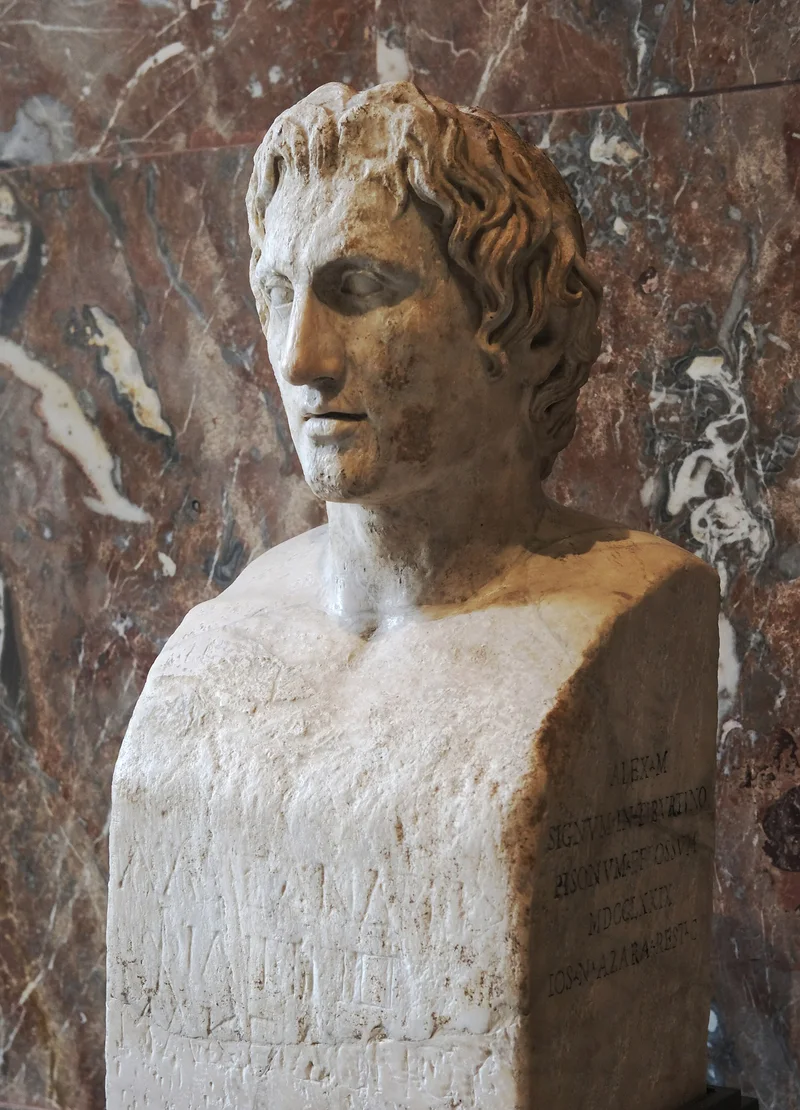
4 The statues by Lysippus give the closest likeness of Alexander's appearance, and Alexander himself approved of no other sculptor portraying him. For the artist preserved precisely the features that many of Alexander's successors and friends later imitated: his neck held high and tilted slightly left, and the liquid look of his eyes.
But Apelles, in his portrait of Alexander carrying a thunderbolt, failed to reproduce his coloring, giving him a darker, duller complexion.9 He was fair, they say, with a reddish flush to his fair skin, especially across his chest and face.
I have read in Aristoxenus's memoirs that his skin gave off a wonderfully sweet scent, and that a fragrance pervaded his mouth and his entire body, enough to fill his tunics.
Perhaps this came from his bodily constitution, which was intensely hot and fiery. For Theophrastus believes that fragrance develops when heat cooks moisture. That is why the dry, scorching regions of the inhabited world produce aromatic plants in the greatest abundance and of the finest quality: the sun draws off the moisture that lies on the surface of bodies like raw material for decay.
Alexander's bodily heat seems to have made him both fond of drink and quick-tempered.
His self-control was apparent while he was still a child: although headlong and fiercely driven in other matters, he was slow to respond to bodily pleasures and approached them with great restraint, while his ambition gave his outlook a gravity and nobility beyond his years. For he did not prize every kind of fame or fame from any source whatsoever, as Philip did, flaunting his eloquence like a sophist and stamping images of his Olympic chariot victories on his coins. But when people around Alexander tested him by asking whether he would compete in the stade race at Olympia—he was a fast runner—he replied, “If the other runners were kings.”10
He also evidently disliked athletes in general. At any rate, although he staged a great many contests, not only for actors in tragedy, flute players, and singers accompanying themselves on the cithara, but also for rhapsodes, every kind of hunting, and staff fighting, he showed no enthusiasm for offering prizes in boxing or the pankration.
5 While Philip was away, Alexander received envoys from the Persian king and became friendly with them. His warmth won them over, as did his questions, none of them childish or trivial: he asked about the distances along the roads, the journey into the interior, the king himself and his abilities in war, and the fighting strength and resources of the Persians, so that the envoys marveled and thought Philip's celebrated ability nothing beside the boy's drive and appetite for great undertakings.
At any rate, whenever news came that Philip had captured a famous city or won a celebrated battle, Alexander took little pleasure in hearing it, but would tell his companions, “Boys, Father will get there first in everything and leave me nothing great and glorious to achieve with you.”
For he coveted excellence and glory rather than pleasure or wealth, and thought that the more he received from his father, the less he would accomplish by his own efforts. He therefore believed that as his father's power expanded, opportunities for achievement were being spent on his father, and wanted to inherit a kingdom offering not money, luxury, and enjoyment, but struggles, wars, and contests for glory.
Naturally, many people cared for him as nurses, paidagogoi, and teachers,11 but Leonidas, a stern man and a relative of Olympias, supervised them all. He himself had no objection to being called a paidagogus, since the work was noble and distinguished, but others, out of respect for his standing and family connection, called him Alexander's foster father and guide.
The man who claimed the role and title of paidagogus was Lysimachus, an Acarnanian by birth. He lacked refinement in every other respect, but was well liked and ranked second because he used the name Phoenix for himself and called Alexander Achilles and Philip Peleus.
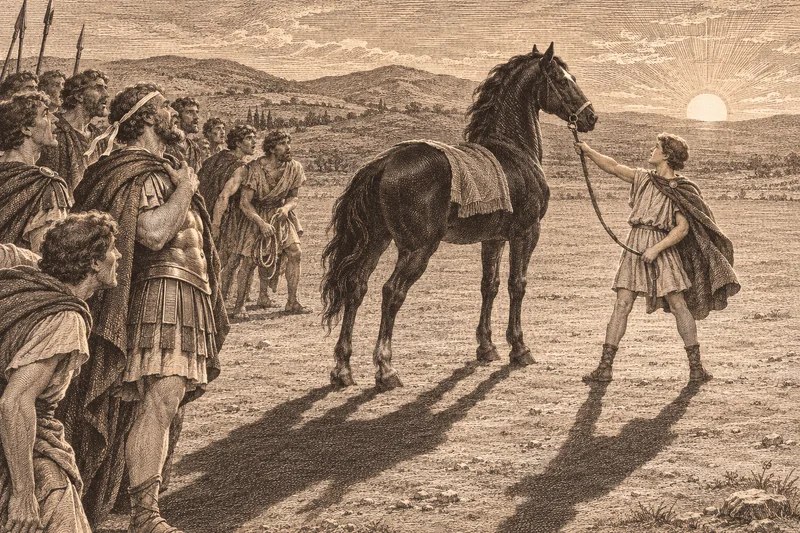
6 Philonicus of Thessaly brought Bucephalas to Philip and offered him for thirteen talents.12 They went down to the plain to try the horse, who seemed fierce and utterly unmanageable. He would take no rider and tolerate no voice from Philip's companions, rearing at every one of them.
Philip grew irritated and ordered them to take him away as utterly wild and unruly.
Alexander, who was there, said, “What a horse they're throwing away because they're too inexperienced and cowardly to handle him!”
Philip said nothing at first, but when Alexander kept making these remarks and growing distressed, he asked, “So you criticize men older than yourself, as though you knew more or were better at handling a horse?”
“This one, at least,” Alexander said, “I could handle better than anyone else.”
“And if you cannot, what penalty will you pay for being so rash?”
“By Zeus,” he replied, “I'll pay what the horse costs.”
This raised a laugh. They then agreed on the money at stake, and Alexander immediately ran up to the horse, took his rein, and faced him toward the sun. He had apparently noticed how the horse's own shadow, falling and shifting before him, frightened him.
He ran beside him briefly and stroked him. When he saw the horse brimming with spirit and energy, he quietly dropped his cloak, sprang up, and settled securely astride him. Drawing lightly on the bit with the reins, he checked him without blows or wrenching. But when he saw the horse no longer menacing him but eager to run, he let him go and urged him on with a bolder voice and a kick.
At first Philip and his companions watched in anxious silence. But when Alexander made the turn correctly and rode back proud and delighted, everyone else shouted aloud, while his father is said to have shed a few tears of joy.
As Alexander dismounted, Philip kissed his head and said, “My boy, find a kingdom that matches you, for Macedonia has no room for you.”
7 Philip saw that his son stubbornly resisted force but readily listened to reason about what he should do, so he tried persuasion in preference to commands. He had little confidence in leaving Alexander's direction and training to the teachers of music and general studies, believing that it required a greater undertaking and, in Sophocles's words, “many bridles for the task, and steering oars as well.”13
He therefore summoned Aristotle, the most renowned and learned philosopher, and paid him a handsome and fitting teaching fee. For he reestablished Stagira, Aristotle's native city, which he himself had laid waste, and brought home the citizens who had escaped or been enslaved.
He assigned them the Nymphaeum near Mieza as a place for study and discussion;14 Aristotle's stone seats and shaded walks are still shown there today.
Alexander seems to have received not only instruction in conduct and government but also a share in the secret, more profound teachings that philosophers call, in their special terminology, “acroamatic” and “epoptic,” and do not make widely available.
For after crossing into Asia, he learned that Aristotle had published some writings on these subjects and sent him a frank letter in defense of philosophy. Here is a copy:
“Alexander sends greetings to Aristotle. You were wrong to publish your acroamatic discourses. For what will set us apart from everyone else if the teachings we received become common to all? I would rather distinguish myself by knowledge of the highest things than by power. Be well.”
To soothe this ambition, Aristotle defended himself over those discourses by saying that they were both published and unpublished. For in fact his work on metaphysics offers nothing useful for teaching or learning; it was written as a reference for people with prior training.15
8 I believe Aristotle did more than anyone else to inspire Alexander's love of medicine. For Alexander not only loved its theory but also helped his friends when they were ill, prescribing treatments and diets, as his letters show.
He was naturally fond of literature and reading.
He regarded the Iliad as provisions for excellence in war and called it that.16 He took Aristotle's corrected version, known as the “casket copy,” and, according to Onesicritus, always kept it beneath his pillow alongside his dagger.
When other books were hard to obtain in the interior, he ordered Harpalus to send some.
Harpalus sent the works of Philistus, numerous tragedies by Euripides, Sophocles, and Aeschylus, along with dithyrambs by Telestes and Philoxenus.
At first Alexander admired Aristotle and, as he himself said, loved him no less than his father, because he owed his life to the one and a life well lived to the other.
Later he became more suspicious of Aristotle, though not enough to do him any harm; rather, his friendly attentions lost their former warmth and affection, revealing his estrangement.
Yet the ardent longing for philosophy, rooted in his nature and nurtured from the beginning, never left his soul. The honor he paid Anaxarchus, the fifty talents he sent Xenocrates, and his great regard for Dandamis and Calanus bear witness to it.17
9 During Philip's campaign against Byzantium, Alexander, then sixteen, was left in charge of affairs in Macedonia and entrusted with the royal seal. He subdued the Maedi, who had revolted, captured a city of theirs, drove out its barbarian inhabitants, settled it with a mixed population, and named it Alexandropolis.
He also took part in the fighting against the Greeks at Chaeronea, where he is said to have charged the Sacred Band of Thebes before anyone else.18
Even in my own time, people pointed out an ancient oak beside the Cephisus, called Alexander's oak, where he had camped then. The common grave of the Macedonians lies nearby.
These achievements naturally made Philip love his son so dearly that he was delighted when the Macedonians called Alexander king and Philip general; but the troubles at home, caused by Philip's marriages and love affairs, brought many grievances and bitter quarrels, as the kingdom shared, so to speak, the sickness of the women's quarters. Olympias's harsh temper made these worse: she was fiercely jealous and sullen, and goaded Alexander on.
Attalus provoked the most public quarrel at the wedding of Cleopatra, a young virgin whom Philip married after falling in love with her despite his age. For Attalus was her uncle, and, drunk at the feast, urged the Macedonians to pray that Philip and Cleopatra would produce a legitimate heir to the throne.
Furious, Alexander cried, “You scoundrel, do you take me for a bastard?” and hurled a cup at him.
Philip drew his sword and sprang up against Alexander, but, fortunately for both, anger and wine made him stumble and fall.
Alexander taunted him: “Gentlemen, here is the man who was getting ready to cross into Asia from Europe, and he's fallen over crossing between two couches!”
After this drunken quarrel, Alexander took Olympias to Epirus and settled her there, while he himself stayed among the Illyrians.
Meanwhile Demaratus of Corinth, a guest-friend of the family who enjoyed the freedom to speak frankly, paid Philip a visit. After the first greetings and courtesies, Philip asked whether the Greeks were living in harmony with one another.
Demaratus replied, “How fitting, Philip, that you should worry about Greece when you've filled your own house with such strife and misery!”
This brought Philip to his senses. He sent for Alexander and brought him home, persuading him through Demaratus.
10 Pixodarus, the satrap of Caria, was maneuvering to secure an alliance with Philip through a family connection.19 He wanted to marry his eldest daughter to Philip's son Arrhidaeus and sent Aristocritus to Macedonia to negotiate.
Once again, Alexander's friends and mother brought him rumors and slanders, claiming that Philip was establishing Arrhidaeus as heir to the throne through a splendid marriage and powerful connections.
Alarmed by these reports, Alexander dispatched the tragic actor Thessalus to Caria to tell Pixodarus that he should abandon the bastard, who was not in his right mind, and arrange the marriage with Alexander instead. Pixodarus much preferred this proposal to the earlier one.
But when Philip learned of it, he went to Alexander's room, taking Philotas, Parmenion's son and one of Alexander's close companions, with him. He rebuked Alexander sharply and abused him bitterly as base and unworthy of his advantages, if he was content to be the son-in-law of a Carian who was a slave to a barbarian king.
Philip wrote to the Corinthians ordering them to send Thessalus back in fetters. Of Alexander's other companions, he banished Harpalus, Nearchus, Erigyius, and Ptolemy from Macedonia. Alexander later recalled them and gave them the highest honors.
Pausanias killed Philip after suffering an outrage instigated by Attalus and Cleopatra and failing to obtain justice.a
Most of the blame fell on Olympias, who was accused of encouraging the angry young man and inciting him further.
Some accused Alexander as well. For they say that when Pausanias met him after that outrage and lamented what had happened, Alexander quoted the iambic line from Medea:
“The man who gave her in marriage, the husband, and the bride.”20
Nevertheless, Alexander sought out and punished those involved in the plot. He was also angry when Olympias treated Cleopatra brutally during his absence.
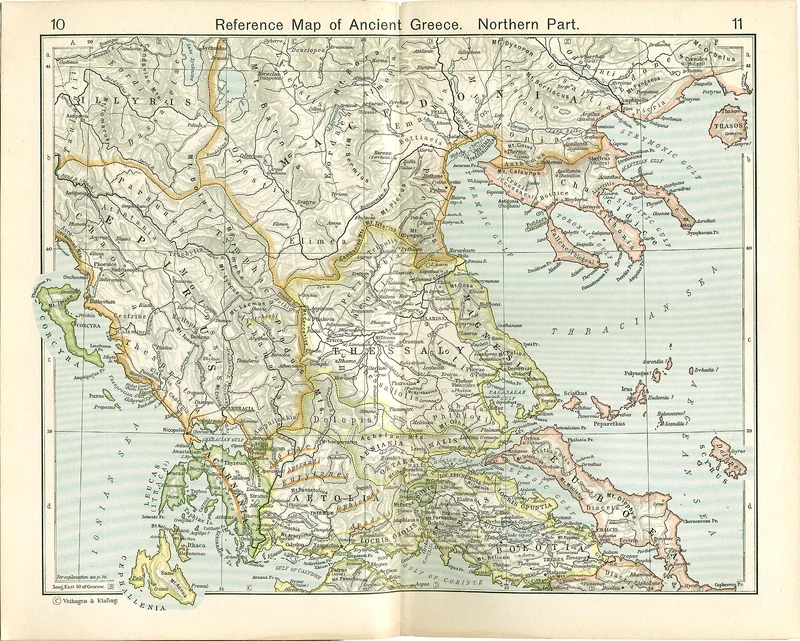
11 Alexander thus inherited the kingdom at twenty, with great envy, bitter hatred, and danger surrounding it. For the neighboring barbarian peoples would not endure their subjection and longed for their ancestral monarchies, while Philip, though he had conquered Greece by force, had had no time to yoke and tame it, but had merely changed and unsettled its affairs, leaving them in turmoil and upheaval because the situation was unfamiliar.
The Macedonians feared the crisis and thought Alexander should give up Greece altogether and make no further attempt at coercion, while gently winning back the rebellious barbarians and treating the first symptoms of revolt; but Alexander reasoned in the opposite way and set out to secure and preserve his kingdom through daring and greatness of spirit, believing that everyone would trample on him if he appeared to yield the least part of his resolve.
He therefore swiftly ended the unrest and wars among the barbarians by advancing with an army as far as the Danube, where he defeated Syrmus, king of the Triballi, in a great battle.
When he learned that Thebes had revolted and Athens sympathized with it, he immediately led his army through Thermopylae. He said Demosthenes had called him a child in the lands of the Illyrians and Triballi, then a youth on his arrival in Thessaly; he wanted to appear before him as a man at the walls of Athens.21
On reaching Thebes, he still offered the people a chance to reconsider their actions. He demanded that Phoenix and Prothytes be handed over and proclaimed that anyone who joined him would be safe.
But the Thebans demanded Philotas and Antipater in return and announced that anyone wishing to help liberate Greece should take their side. Alexander then ordered the Macedonians to attack.
The Thebans faced enemies many times their number and fought with courage and determination beyond what their strength allowed. But when the Macedonian garrison also came out of the Cadmeia and struck from behind, they were surrounded, and most fell in the fighting itself.
The city was captured, plundered, and demolished, chiefly because Alexander expected such a disaster to shock and cow the Greeks into keeping quiet, though he also made a show of satisfying his allies' complaints. For the Phocians and Plataeans had brought accusations against the Thebans.
He spared the priests, all the guest-friends of the Macedonians, Pindar's descendants, and those who had opposed the men who voted for revolt, then sold the rest into slavery, roughly thirty thousand people. More than six thousand had been killed.
12 Amid the many terrible sufferings that gripped the city, some Thracians forced their way into the home of Timocleia, a respected and chaste woman. While the others plundered her property, their commander raped and humiliated her, then questioned her about any gold or silver she had hidden.
She admitted that she had some, took him alone to the garden, and showed him a well. She said that as the city was being captured, she herself had thrown her most valuable possessions into it. While the Thracian bent over and peered down, she moved behind him and pushed him in, then threw many stones onto him and killed him.
When the Thracians brought her bound before Alexander, her appearance and the way she walked immediately revealed her dignity and greatness of spirit: she followed her captors undismayed and fearless.
Then the king asked who she was, and she answered that she was Theagenes's sister: he had fought Philip in defense of Greek freedom and died at Chaeronea while in command.
So, admiring both her answer and her deed, Alexander ordered that she go free with her children.
13 He made peace with the Athenians, although they had taken the disaster at Thebes very hard. For in their grief they abandoned the festival of the mysteries, which was already under way, and offered every kindness to those who fled to their city.22
But whether his anger had already had its fill, like a lion, or he wanted to place an act of mercy beside one of the utmost savagery and horror, he not only cleared the city of every charge but also urged it to watch affairs closely, since it would rule Greece if anything happened to him.
Later, however, the disaster of the Thebans is said to have grieved him often and made him gentler toward many people.
In general, he attributed both the deed he committed against Cleitus while drunk and the cowardly refusal of the Macedonians to face the Indians—as though they were abandoning his campaign and glory unfinished—to the wrath and vengeance of Dionysus.
Every Theban survivor who later approached him with a request obtained what he asked for. That is the story of Thebes.
14 When the Greeks gathered at the Isthmus and voted to campaign against the Persians with Alexander, they proclaimed him their leader.23
Many statesmen and philosophers came to congratulate him, and he expected Diogenes of Sinope, who was staying near Corinth, to do the same.24
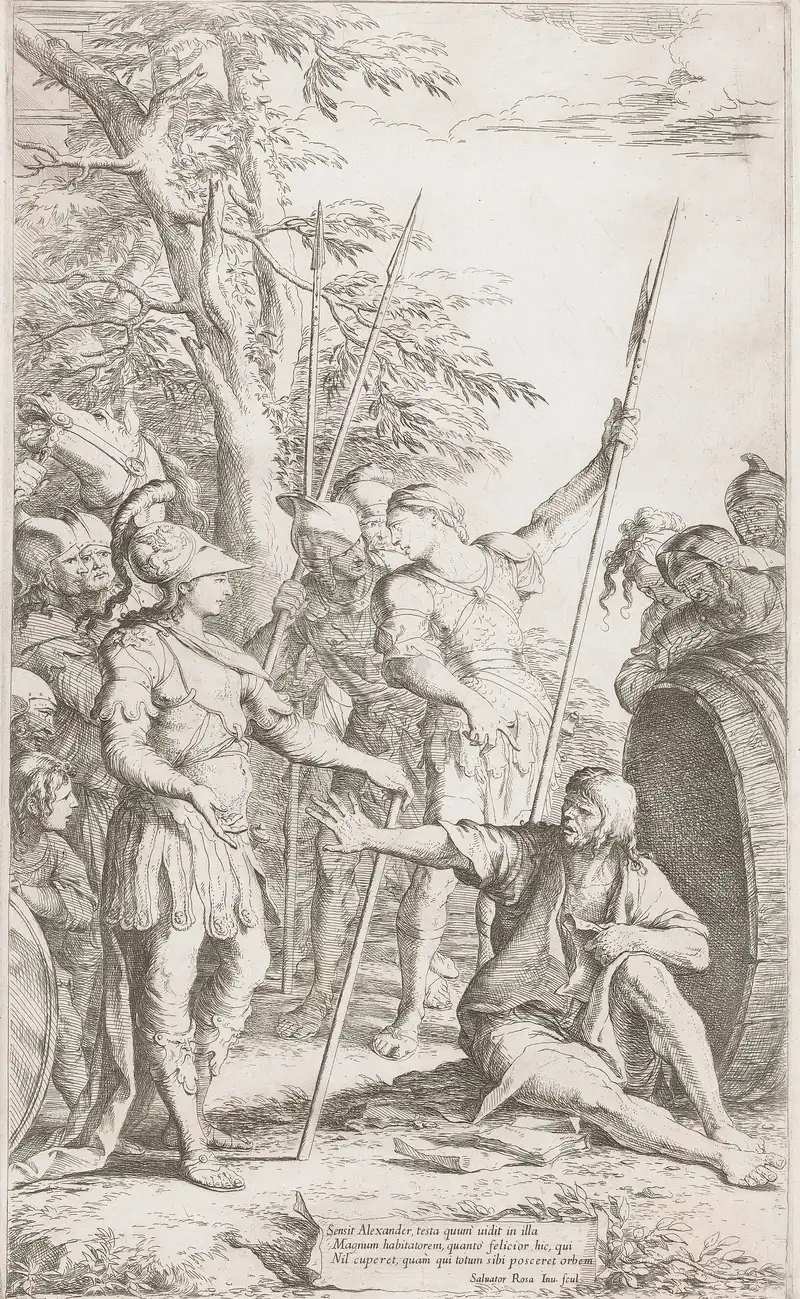
But Diogenes took very little notice of Alexander and spent his leisure in the Craneium, so Alexander went to see him himself. Diogenes happened to be reclining in the sunshine. As so many people approached, he sat up a little and looked straight at Alexander. Alexander greeted him and asked whether he needed anything.
“Move a little out of my sun,” he said.
They say the reply so affected Alexander, and he so admired the man's haughtiness and greatness despite being treated with contempt, that when his companions laughed and joked as they were leaving, he said, “Still, if I weren't Alexander, I'd be Diogenes.”
Wishing to consult the god about the campaign, he went to Delphi. He happened to arrive on inauspicious days, when custom forbids the delivery of oracles, and at first sent messages urging the prophetess to come. When she refused and cited the law, he went up himself and dragged her by force toward the temple.
As if his determination had defeated her, she said, “You are invincible, my boy.”
On hearing this, Alexander said he needed no further prophecy: she had given him the oracle he wanted.
As he set out on the campaign, other signs from the divine power seem to have appeared, and around that time the image of Orpheus near Leibethra—made of cypress wood—sweated profusely.
Everyone feared the omen, but Aristander told Alexander to take heart, since he would accomplish deeds worthy of song and wide renown, which would cost the poets and musicians celebrating them much sweat and toil.
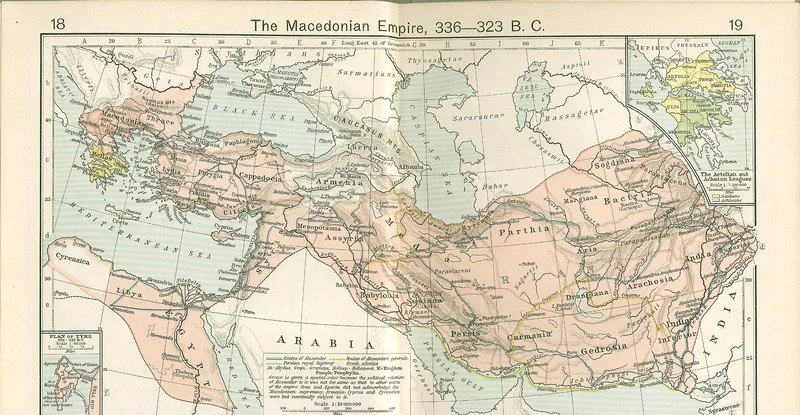
15 The lowest estimates put his army at thirty thousand infantry and four thousand cavalry, the highest at forty-three thousand infantry and five thousand cavalry.
Aristobulus reports that he had no more than seventy talents to provision them; Duris gives him supplies for just thirty days, while Onesicritus says that he also owed two hundred talents.25
Yet, despite beginning with such scant resources, he did not board his ship until he had examined his companions’ circumstances and assigned one a farm, another a village, another the income from a block of houses or a harbor.
When nearly all the royal property had been spent or allocated, Perdiccas, a Macedonian commander, asked, “And what are you leaving yourself, King?”
“My hopes,” Alexander answered.
“Then we who campaign with you will share those too,” said Perdiccas.
Perdiccas refused the estate assigned to him, and several of Alexander’s other friends followed his example. But Alexander readily gave to those who accepted and needed his gifts, distributing most of his possessions in Macedonia in this way.
With that eagerness and that frame of mind he crossed the Hellespont.
He went up to Troy, sacrificed to Athena, and offered libations to the heroes.26 After rubbing himself well with oil and running naked with his companions, as was customary, he placed a wreath on Achilles’s tombstone, calling him fortunate to have had a loyal friend in life and a great herald after death.b
As he walked around the city looking at its sights, someone asked whether he wanted to see Paris’s lyre.27 He said he cared very little about that one, but was looking for Achilles’s, on which Achilles had sung the renown and exploits of brave men.
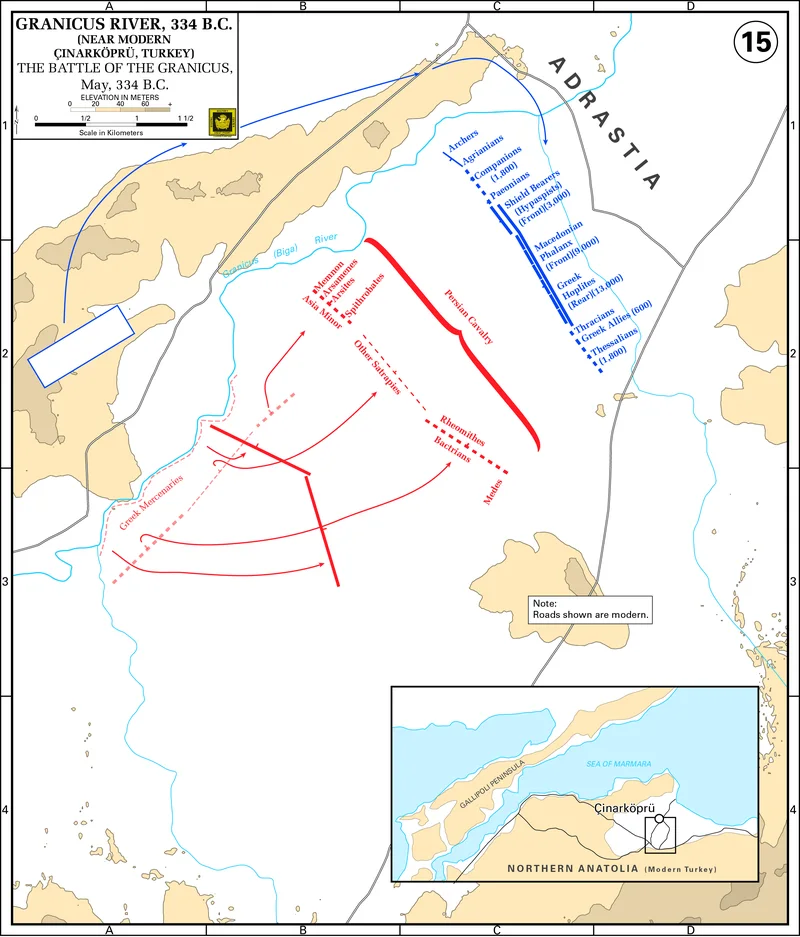
16 Meanwhile, the generals of Darius, the Persian king, had gathered a large force and drawn it up at the crossing of the Granicus. A battle was perhaps unavoidable there, as though at the gates of Asia, to win both entry and dominion, but most men feared the river’s depth and the rough, uneven banks on the far side, where they would have to fight their way ashore, while some thought they must respect the customary observance for the month, since the kings of Macedonia did not usually lead their army out during Daisius.28
Alexander settled that objection by ordering them to observe a second Artemisius; when Parmenion opposed taking the risk so late in the day, he said that the Hellespont would feel ashamed if, after crossing it, he feared the Granicus, and plunged into the current with thirteen cavalry squadrons.29
He rode into oncoming missiles toward precipitous banks packed with armed men and horses, through a current that swept him sideways and surged around him, seeming to command with frenzied recklessness rather than judgment. Still, he pressed on across and, with immense difficulty, secured a foothold on ground wet and slippery with mud. Before the men crossing behind him could form ranks, he was at once forced into a confused struggle, grappling individually with his attackers.
For the Persians pressed forward shouting, bringing horse against horse and fighting with spears, then with swords when their spears broke.
Many thrust their way toward Alexander, conspicuous by his shield and helmet crest, with a plume standing on either side, each remarkable for its size and whiteness.
A javelin struck beneath the overlapping part of his breastplate but left him unwounded. Two commanders, Rhoesaces and Spithridates, attacked together. He dodged Spithridates and struck first at the armored Rhoesaces, breaking his spear and reaching for his dagger.
As they grappled, Spithridates brought his horse alongside, rose swiftly in the saddle, and struck down with a curved Persian sword.c The blow sheared away the crest and one plume; the helmet barely withstood it, so that the blade’s edge just brushed his hair. Spithridates was lifting his weapon for another stroke when Black Cleitus drove a lance through his body. Rhoesaces fell at that instant, struck by Alexander’s sword.
While this perilous cavalry struggle continued, the Macedonian phalanx30 was crossing and the infantry forces were closing. But the Persians offered neither vigorous nor prolonged resistance: they turned and fled, except for the Greek mercenaries, who gathered beside a hill and asked Alexander to guarantee their safety.
Alexander, moved more by anger than calculation, led the charge himself and lost his horse to a sword thrust through the ribs—it was another horse, not Bucephalas. Most of those killed or wounded fell in this fighting, grappling at close quarters with desperate, experienced soldiers.
Reports put the Persian dead at twenty thousand infantrymen and two thousand five hundred cavalrymen.
Aristobulus puts the total deaths on Alexander’s side at thirty-four, including nine infantrymen.
Alexander ordered bronze statues of these men to be set up, and Lysippus made them.
To share the victory with the Greeks, he sent the Athenians in particular three hundred captured shields, and on the remaining spoils as a whole he ordered a most ambitious dedication to be inscribed: “Alexander, son of Philip, and the Greeks except the Spartans, from the barbarians living in Asia.”31
Of the drinking vessels, purple fabrics, and similar objects he captured from the Persians, he sent all but a few to his mother.
17 This battle immediately transformed the situation in Alexander’s favor: he gained possession even of Sardis, the stronghold of Persian rule over the coast, and the other places came over to him. Only Halicarnassus and Miletus resisted. After taking them by force and subduing all the surrounding territory, he was uncertain what to do next.
He often wanted to confront Darius and stake everything on the encounter, but often thought he should first use the coastal territories and their resources to train and strengthen himself, as it were, before advancing inland against him.
In Lycia, near Xanthus, there is a spring which, people say, spontaneously surged up and overflowed at this time, throwing out from its depths a bronze tablet inscribed with ancient characters. These declared that Persian rule would end when the Greeks overthrew it.
Encouraged by this, he hurried to clear the coast as far as Phoenicia and Cilicia. Many historians have made his swift passage along the Pamphylian coast a subject for sensational, grandiose writing: some divine good fortune, they say, made the sea yield to Alexander, though at other times it always swept violently in from the open water and only rarely uncovered the narrow ledges close beneath the steep, broken mountain cliffs.
Menander plainly jokes about the marvel in a comedy:32
“Now this is like Alexander! If I look for someone, he appears of his own accord; and if I need to cross some stretch of sea, naturally I shall be able to walk through it.”
Alexander himself, however, reports no such marvel in his letters. He says he had a road made through the place called the Ladder and passed that way after leaving Phaselis.33
This explains why he spent several days in the city. During his stay he noticed a statue of Theodectes, a native of Phaselis who was now dead, set up in the marketplace.
After dinner he went to it in a drunken revel and heaped it with wreaths, paying a playful tribute, not without grace, to the acquaintance he had formed with the man through Aristotle and philosophy.
18 After this he defeated the Pisidians who resisted and subdued Phrygia.
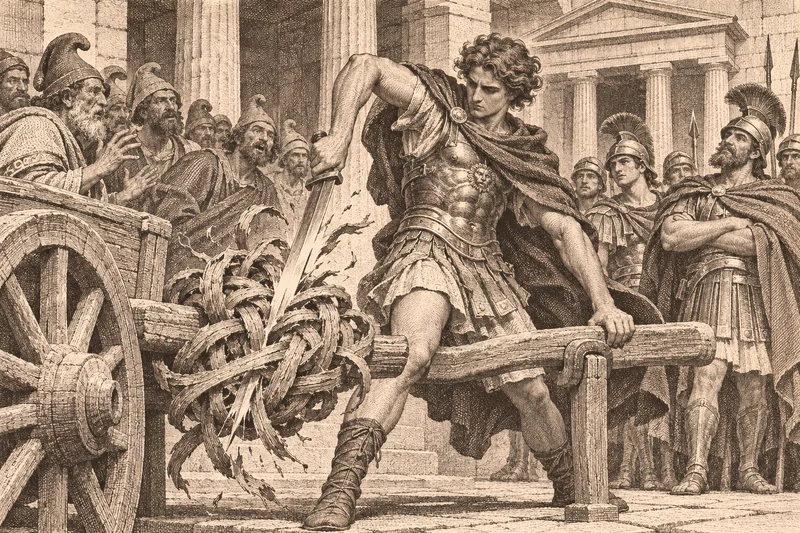
On taking Gordium, said to have been the home of Midas of old, he saw the famous wagon bound with cornel bark and heard the story the Phrygians believed about it: whoever undid the fastening was destined to be king over the inhabited world.34
Most writers say that, because the ends of the binding were hidden and its lengths wound repeatedly through one another in crooked loops, Alexander could find no way to undo it and sliced through the knot with his sword, exposing many ends.
Aristobulus, however, says he undid it quite easily: he pulled from the wagon pole the pin called the hestor, which secured the yoke’s binding, and then drew the yoke away.
From there he won over the Paphlagonians and Cappadocians.
News of Memnon’s death encouraged him still further to campaign inland, since this commander of Darius’s coastal forces had been expected to cause Alexander much trouble and countless obstacles and distractions.
Darius was already coming down from Susa, elated by the size of his force—for he led six hundred thousand men—and encouraged by a dream which the Magi interpreted to flatter him rather than according to its probable meaning. For he dreamed that a great fire was consuming the Macedonian phalanx, while Alexander waited on him wearing the clothes Darius himself had once worn as an astandes of the king, then entered the sacred precinct of Bel and disappeared.35
Through these images, it seems, the god was hinting that the Macedonians’ achievements would be brilliant and celebrated, while Alexander would master Asia, as Darius had when he rose from astandes to king, but would soon leave this life in glory.
19 Darius grew bolder still, judging Alexander’s long stay in Cilicia a sign of cowardice.
But illness had detained him: some say exhaustion brought it on, others that he became chilled through while bathing in the Cydnus.d
None of the other doctors dared to treat him, believing his condition beyond the power of any remedy and fearing accusations from the Macedonians if they failed; but Philip, the physician from Acarnania, recognized how bad his condition was and yet trusted in their friendship, thinking it shameful not to share his danger by risking everything to help him to the utmost, so he attempted treatment with a medicine and persuaded Alexander, eager to recover his strength for the war, to endure the treatment and drink the dose.
Meanwhile, Parmenion sent a letter from camp warning Alexander against Philip, alleging that Darius had persuaded the physician, with lavish gifts and marriage to his daughter, to kill Alexander. Alexander read it and put it beneath his pillow, showing none of his friends.
At the appointed time Philip came in with the companions and a cup of medicine. Alexander gave him the letter and eagerly took the medicine, without any suspicion.36
It was an astonishing scene, worthy of the theater: one reading, the other drinking, then both looking up at each other with very different expressions, Alexander’s bright, open face showing affection and trust, while Philip was distraught at the slander, now calling upon the gods and stretching his hands toward heaven, now throwing himself against the bed and urging Alexander to take courage and heed him.
For when the medicine first took hold of his body, it seemed to drive his strength back and bury it deep: his voice failed, and a faint left his senses dim and scarcely responsive.
But Philip soon revived him, and once he was better he appeared before the Macedonians, for their despondency did not lift until they saw him.
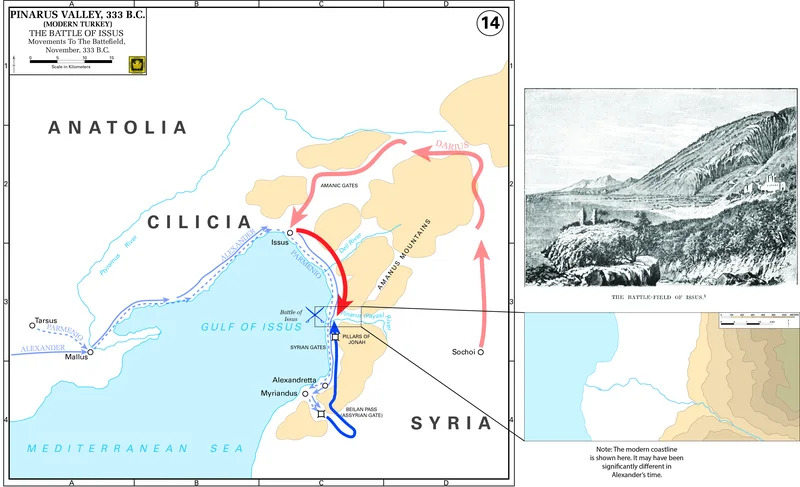
20 A Macedonian named Amyntas, who had fled his homeland, was serving in Darius’s army and knew Alexander’s character well. Seeing Darius intent on marching into the passes against Alexander, he begged him to stay where he was and fight with his overwhelming numerical advantage on broad, open plains.
Darius replied that he feared the enemy would run away before he reached them and Alexander would escape.
“But you can be confident on that point, King,” Amyntas said. “He will march against you, and is probably on his way already.”
Amyntas could not persuade him. Darius broke camp and marched into Cilicia while Alexander was advancing into Syria against him. They missed each other during the night and turned back, Alexander delighted by this turn of events and eager to meet him near the passes, Darius anxious to regain his former camp and extricate his force from the narrow ground.
For Darius had already recognized his mistake in entering terrain where the sea, mountains, and the Pinarus flowing through the middle made cavalry operations difficult, broke up the ground in many places, and favored the enemy’s smaller force.
Fortune supplied Alexander with the ground, but his generalship contributed more to victory than the advantages fortune gave him. For although vastly outnumbered by the Persians, he gave them no opening to surround him, but extended his right beyond their left, turned their flank, and routed those facing him, fighting in the front ranks and taking a sword wound in his thigh—inflicted by Darius, according to Chares, who says the two fought hand to hand.37
But Alexander, writing about the battle to Antipater and his circle, did not identify his attacker; he wrote that a dagger had wounded his thigh and that the wound caused no ill effects.
He won a brilliant victory and killed over one hundred and ten thousand of his opponents, but failed to catch Darius, who had gained a lead of four or five stades in his flight; he captured the chariot and bow, however, and returned.
He found the Macedonians carrying and driving away immense quantities of wealth from the Persian camp, although the Persians had come lightly equipped for battle and left the bulk of their baggage in Damascus; but the Macedonians had set aside Darius’s tent for Alexander, filled with splendid attendants, furnishings, and treasures.38
So he immediately took off his armor and headed for the bath. “Let us wash away the battle’s sweat in Darius’s bath,” he said.
“No, by Zeus,” said a companion, “in Alexander’s! For the property of the defeated must be the victor’s, in name and in fact.”
After seeing basins, pitchers, tubs, and perfume jars, all made of gold and lavishly decorated, in a room filled with the marvelous scent of spices and perfumed oils, he passed into a tent astonishing for its height and size and the splendor of its couches, tables, and the dinner laid for him, looked across at his companions, and said, “So this, it seems, is being a king.”
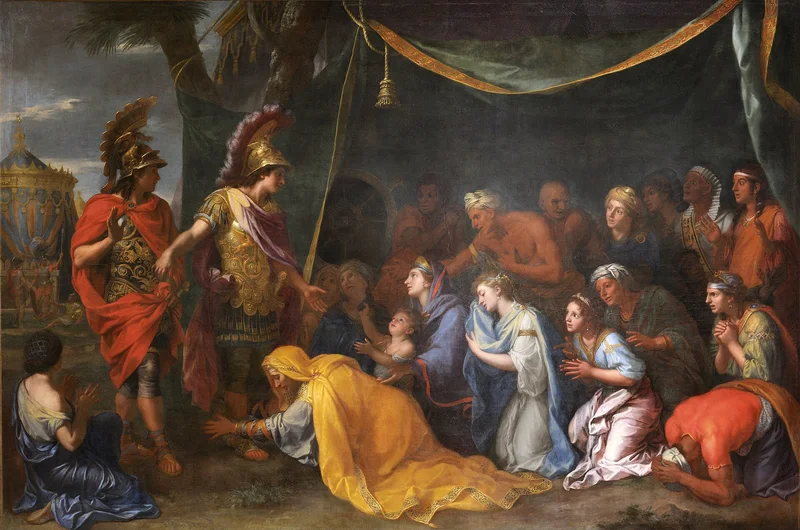
21 As he turned toward dinner, he was told that Darius’s mother, wife, and two unmarried daughters had been brought in as captives and, on seeing his chariot and bows, were beating their breasts and lamenting because they believed him dead.39
Alexander paused for a long time, more affected by their misfortune than by his own success, then sent the Macedonian officer Leonnatus to tell them that Darius had not died and they had nothing to fear from Alexander, for he was fighting Darius for supremacy, whereas they would retain everything they had been entitled to when Darius was king.
Kind and gentle as the women found his words, his deeds showed still greater humanity. For he allowed them to bury as many Persians as they wished, using clothing and ornaments from the spoils. He took away none of their attendants or honors, and they received larger allowances than before.
His finest and most kingly favor to these noble, chaste women in captivity was that they neither heard anything shameful nor suspected or expected it, but lived a life hidden from others’ talk and sight, as though guarded in sacred, inviolate virgins’ chambers rather than an enemy camp.40
And yet, they say, Darius’s wife was by far the most beautiful of all queens, just as Darius himself was the handsomest and tallest of men, and their daughters resembled them.
Alexander, however, apparently considered mastering himself more kingly than defeating his opponents, and neither touched these women nor, before his marriage, slept with any woman except Barsine. She had been widowed by Memnon’s death and captured near Damascus. She had a Greek education and a gentle disposition, and her father, Artabazus, was the son of a king’s daughter; Alexander slept with her after Parmenion, according to Aristobulus, urged him to take a beautiful, wellborn woman.
Seeing the outstanding beauty and stature of the other captive women, Alexander joked that Persian women made the eyes ache; but he set against their looks the beauty of his own self-control and chastity, and passed them by like lifeless statues.
22 Philoxenus, the commander of the coastal forces, wrote that a man from Tarentum named Theodorus was with him and had two exceptionally beautiful slave boys for sale, asking whether he should buy them.
Alexander was furious and repeatedly cried out to his friends, asking what shameful act Philoxenus had ever known him commit that he should sit there brokering such disgraces for him. He heaped abuse on Philoxenus in a letter and ordered him to send Theodorus to hell, merchandise and all.
He also rebuked Hagnon, an associate from Teos, for writing that he wanted to buy Crobylus, who was much admired in Corinth, and bring him to Alexander.41
On hearing that Damon and Timotheus, Macedonians serving under Parmenion, had raped some mercenaries’ wives, he wrote ordering Parmenion, if the accusations were proved, to punish and execute them like wild beasts born to destroy human beings.e
In this letter he wrote of himself in these exact words: “For you would find that I have not so much as seen Darius’s wife or wanted to see her, and have not even listened to people speaking of her beauty.”
He said that sleep and intercourse made him most aware that he was mortal, since fatigue and pleasure arose from the same weakness in his nature.
He also exercised the greatest restraint over his appetite, as he showed on many occasions, including in his words to Ada, whom he adopted as his mother and established as queen of Caria.42 To show her affection she sent him many fine dishes and pastries every day, and finally the cooks and bakers reputed to be the most skilled.
He said he needed none of these, for his tutor Leonidas had given him better cooks: a march through the night for breakfast, and a small breakfast for dinner.
“And this same man,” he said, “would come and unfasten the chests holding my bedding and clothes to check whether my mother had packed anything luxurious or unnecessary for me.”
23 He was also less inclined to wine than people imagined. That impression came from the time he took over every cup, talking more than drinking and always embarking on a long discussion, and he did this when he had ample leisure. For when action was called for, no wine, no sleep, no amusement, no lovemaking, no spectacle ever held him back, as they did other commanders.f
His life proves it: very brief though it was, he filled it with an immense number of the greatest deeds.
When he had leisure, he rose, sacrificed to the gods, and immediately ate breakfast sitting down. He then spent the day hunting, hearing cases, arranging military matters, or reading. On a march that required no great haste, he practiced archery as he went, or getting on and off a moving chariot.
He also often hunted foxes and birds for amusement, as we can gather from the Journals.43
After settling into his quarters, as he went to bathe or be rubbed with oil, he questioned those overseeing the bakers and cooks about whether the dinner preparations were in order.
He reclined and began dinner late, when it was already dark, and watched the table with extraordinary care to ensure that everyone was served fairly and attentively; as I have said, his talkativeness prolonged the drinking.
Although otherwise he was the most delightful king to spend time with and possessed every grace, on these occasions his grand boasts made him disagreeable, with a soldier’s swagger carried too far. He drifted into bragging himself and let his flatterers ride him as they pleased. They tormented the more cultivated people present, who wanted neither to compete with the flatterers nor to fall behind in praising him, since the first seemed shameful and the second involved danger.
After drinking he bathed and slept, often until noon; sometimes he slept through the whole day.
He himself showed such restraint over delicacies that he often distributed among his companions the rarest fruit and fish brought to him from the coast until he alone had nothing left.
His dinners, however, were always magnificent, and expenditure grew with his successes until it reached ten thousand drachmas.44 It stayed at that level, which became the prescribed amount for anyone entertaining Alexander.
24 After the battle at Issus, he dispatched men to Damascus, where they seized the Persians’ money, baggage, children, and wives. The Thessalian cavalry gained most, for they had shown exceptional courage in battle and he sent them expressly because he wanted them to profit; the rest of the army, too, was filled with wealth.
The Macedonians then had their first taste of gold, silver, women, and the Persian way of life, and, like hounds that have picked up a scent, were eager to pursue and track down the wealth of the Persians.
Yet Alexander thought he should first secure his control of the coast. The kings of Cyprus promptly came to place the island in his hands, and Phoenicia, apart from Tyre, was surrendered too.
He laid siege to Tyre with causeways, siege engines, and two hundred triremes at sea, and during the seven months it lasted he dreamed that Heracles held out a welcoming hand from the wall and beckoned him closer.45
In dreams, many Tyrians heard Apollo say he was going over to Alexander because he disliked what was happening in the city.
They treated the god as if they had caught a man red-handed deserting to the enemy: they wound ropes around his colossal statue, nailed it to its pedestal, and called him a partisan of Alexander.
Alexander had another dream. A satyr appeared, teasing him from a distance, then slipped away when he tried to catch him. At last, after much coaxing and chasing, Alexander caught him.
The seers divided the name and told him, plausibly enough, “Tyre will be yours.”46
People also point out a spring as the place where the satyr appeared in his dream.
During the siege he campaigned against the Arabs living near the Anti-Lebanon and fell into danger because of his tutor Lysimachus, who had followed him, saying he was no less capable than Phoenix and no older.
When they neared the mountains and left their horses to continue on foot, the others went far ahead, but Alexander, with evening closing in and the enemy nearby, refused to abandon Lysimachus as he flagged under the strain, and kept encouraging him and helping him along.
Before he realized it, he had become separated from the army with only a few men and was spending the night on difficult ground in darkness and bitter cold.
Then he saw many scattered enemy fires burning in the distance. Confident of his agility, and always relieving the Macedonians’ distress by his own exertions, he ran up to the men tending the nearest fire. He stabbed two Arabs sitting beside it with his dagger, seized a burning brand, and brought it back to his companions.
They kindled a large fire, immediately frightening some of their opponents into flight, routed others who approached, and passed the night safely. So Chares tells the story.
25 The siege ended as follows. Alexander was resting most of his force after its many earlier struggles and bringing only a few men against the walls to give the defenders no respite, when Aristander the seer offered a sacrifice, examined the signs, and ventured the bold assurance to those present that the city would certainly fall within that month.
This provoked jeers and laughter, for it was the month’s final day. The king saw his embarrassment and, always eager to uphold the prophecies, ordered them to reckon the date as the third day from the month’s end instead of the thirtieth.47 He gave the signal by trumpet and pressed the attack on the walls harder than he had first planned. The assault was fierce, and the men in camp could no longer hold back but rushed to join in and help; the Tyrians gave way, and he captured the city that day.
Afterward, as he laid siege to Gaza, the largest city of Syria, a bird dropped a clod of earth from above onto his shoulder. The bird perched on a siege engine and unwittingly became caught in the sinew netting used to twist the ropes.
The omen came true as Aristander had predicted, for Alexander suffered a wound to the shoulder but captured the city.
When he sent large quantities of spoils to Olympias, his sister Cleopatra, and his friends, he also sent Leonidas, his tutor, five hundred talents of frankincense and one hundred of myrrh, recalling a childhood hope.48
For Leonidas, it seems, had once told Alexander, when he scooped up incense in both hands and burned it at a sacrifice, “When you have conquered the land that grows aromatics, Alexander, you can burn incense as lavishly as this; for now, use your supplies sparingly.”
So Alexander now wrote to Leonidas: “We have sent you frankincense and myrrh in plenty, so that you can stop being stingy with the gods.”
26 A casket was brought to him which the men taking charge of Darius's treasure and baggage considered costlier than anything else they had found. He asked his friends what precious object they thought most suitable to place inside. Many people offered many suggestions, but he said he would put the Iliad inside for safekeeping.
Many trustworthy authorities attest this.
And if the Alexandrians' account, based on the writer Heraclides, is true, Homer seems to have been neither idle nor useless as his companion on campaign.
For they say that, after conquering Egypt, Alexander wanted to establish a large, populous Greek city and leave it bearing his name. On his architects' advice, he was just about to measure out and enclose a particular site. Then, asleep one night, he saw an extraordinary vision. A man with very white hair and a venerable appearance seemed to stand beside him and recite these lines:
Then there is an island in the pounding sea, off Egypt; they call it Pharos.49
So he immediately rose and made his way to Pharos, then still an island just above the Canopic mouth, though a causeway now joins it to the mainland.
When he saw how the site excelled in natural advantages (it is a strip of land, like an isthmus of fair width, separating a large lake from a stretch of sea that ends in a great harbor), he remarked that Homer had proved not only admirable in other respects but also an architect of consummate skill, and ordered them to draw a city plan suited to the site.
No chalk was available, so they used barley meal to trace a rounded outline on a plain of dark soil, with straight baselines bounding its inner curve like the hems of a cloak, drawing its breadth in evenly to give it that shape.50 The layout pleased the king, but then countless birds of every kind and size suddenly swept in from the river and lake, settling over the site like clouds and eating every speck of meal, so that even Alexander took alarm at the omen.
Yet the seers urged him to take heart, for the city he was founding would offer the richest resources and nourish people of every kind.g
He told the overseers to proceed with the work and set out himself for Ammon.
The journey was long, with many difficulties and hardships and two dangers: the lack of water over many days of desert travel, and the risk that a violent south wind would strike them as they crossed deep, boundless sand.
This was reportedly what had happened long ago to Cambyses's army:51 the wind raised a great mass of sand, tossed the plain into waves, and buried fifty thousand men, killing them.
Almost everyone weighed all these dangers, but once Alexander had set his course toward anything, turning him aside was difficult. For fortune yielded to his ventures and strengthened his resolve, while his fiery spirit carried his unconquerable will to win into action, forcing not only enemies but also terrain and circumstances to yield.
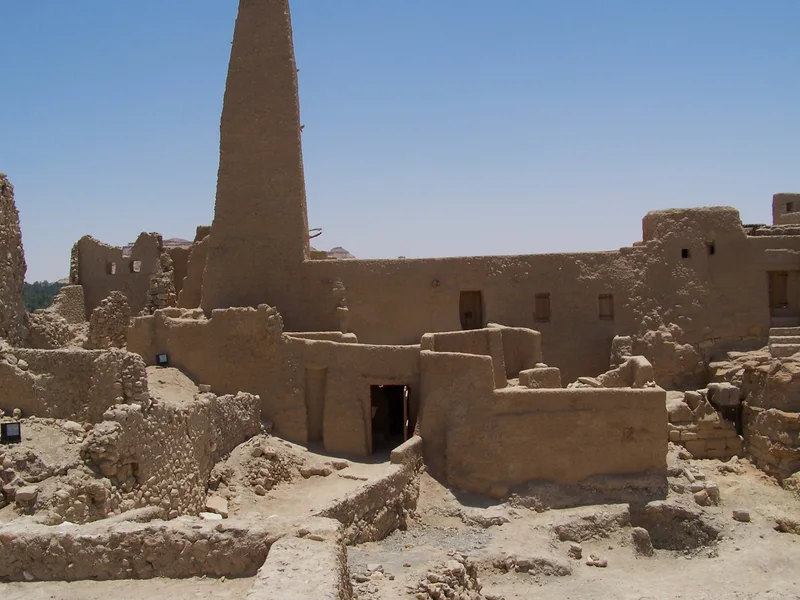
27 On this journey, at any rate, the god's timely help in their difficulties won greater belief than the oracles that followed; in a sense, this help also gave the oracles their credibility.
For first Zeus sent heavy rain and lasting showers, ending their fear of thirst and quenching the dryness of the sand, which grew damp and compact, leaving the air clearer and easier to breathe.
Then the landmarks on which the guides relied became indistinguishable, and the travelers, uncertain of the route, wandered apart. Ravens appeared and took over the lead, flying swiftly ahead when the men followed, but waiting for those who lagged or slowed down. Most astonishing of all, according to the historian Callisthenes, their cries called back anyone who strayed at night, and their cawing brought the travelers onto the route again.
After his desert crossing, Alexander reached the shrine, where Ammon's prophet greeted him on behalf of the god, as from his father; Alexander asked if any of the men who had murdered his father had eluded him. The prophet told him to speak no ill omen, since his father was not mortal, so Alexander rephrased his question: had he punished all of Philip's murderers?
Then he asked about his rule: did the god grant him dominion over all mankind? The god replied that he granted this and that Philip was fully avenged, so Alexander honored the god with splendid votive gifts and gave money to the men there.
Most writers give this account of the oracles, but in a letter to his mother Alexander himself says that some prophecies given to him were secret and that, on his return, he would recount them in person to her alone.52
Some say that the prophet meant to greet him affectionately in Greek with ō paidion, “my child,” but his foreign pronunciation changed the final sound to a sigma: he said ō paidios, substituting sigma for nu. Alexander was pleased with the slip, and people began saying that the god had called him Zeus's son.53
He is also said to have listened to the philosopher Psammon in Egypt and especially approved his statement that all human beings are ruled by god as their king, for whatever governs and holds power in each person is divine.
His own view and the way he expressed it were still more philosophical: the god is father to everyone alike, but claims the best as especially his own.
28 With barbarians he generally carried himself haughtily, like a man utterly persuaded that his birth and parentage were divine, but among Greeks he claimed divinity with moderation and restraint.
One exception was his letter to the Athenians about Samos: “I would not have given you a free and illustrious city, but you hold it because you received it from the man then called my lord and father.” He meant Philip.54h
Later, struck by an arrow and in severe pain, he said, “What is flowing, my friends, is blood, not ‘ichor, which courses through the blessed gods.’”55
Once a tremendous thunderclap startled everyone, and Anaxarchus the sophist,56 who was there, asked him, “Could you manage anything like that, son of Zeus?”
Alexander laughed. “No, because I don't want to frighten my friends, as you urge me to do when you sneer at my dinner for having fish on the tables instead of satraps' heads.”57
For Anaxarchus is said to have made that remark when the king sent some little fish to his companion Hephaestion, apparently belittling and mocking people who pursue distinction through great toil and danger, since their pleasures and enjoyments exceed those of others little or not at all.
These remarks, then, make it clear that Alexander himself was neither carried away nor swollen with pride, but used the belief in his divinity to enslave others.
29 Returning from Egypt to Phoenicia, he held sacrifices and processions for the gods, along with competitions for dithyrambic choruses and tragic plays, splendid not only in their preparations but also in the rivalry they inspired. For the kings of Cyprus served as choregoi,58 just as sponsors at Athens were allotted tribes, and competed with extraordinary ambition. The fiercest rivalry was between Nicocreon, king of Salamis, and Pasicrates, king of Soli.
For they had drawn the most celebrated actors as recipients of their sponsorship: Pasicrates had Athenodorus, and Nicocreon had Thessalus, whose success Alexander himself eagerly supported. He kept his preference hidden until the votes declared Athenodorus the winner. Then, apparently, as he left, he said he commended the judges, though he himself would gladly have surrendered part of his kingdom to be spared the sight of Thessalus losing.
When the Athenians fined Athenodorus for failing to appear in the competition at the Dionysia,59 he asked the king to write on his behalf; Alexander did not do so, but sent the sum of the fine from his own funds.
When the comic actor Lycon of Scarpheia, enjoying success onstage, inserted a line asking for ten talents into his comedy, Alexander gave him the money with a laugh.
Darius sent him a letter and friends asking him to accept ten thousand talents for the captives, hold the whole country west of the Euphrates, marry one of his daughters, and become his friend and ally.60 Alexander shared the proposal with his Companions.
“If I were Alexander, I would accept,” said Parmenion.
“And I, by Zeus,” said Alexander, “if I were Parmenion.”
But he wrote to Darius that he could expect every kindness if he came to him; otherwise Alexander would march against him at once.
30 He soon regretted this, however, when Darius's wife died in labor, and he was visibly distressed at losing so great an opportunity to show kindness. So he spared no expense on her burial.
Tireus, one of the bedchamber eunuchs taken prisoner alongside the women, escaped the camp and rode to Darius with news of his wife's death.
Darius struck his head and cried aloud: “Alas for the daimon of the Persians, if the king's wife and sister must not only be captured alive but lie dead without a royal burial!”61
“But as for her burial, King,” the chamberlain replied, “and every honor and due observance, you have no reason to blame the Persians' evil daimon. For while my lady Stateira lived, neither she nor your mother and children lacked any of their former comforts and honors except the sight of your light, which the lord Oromasdes62 will make shine brightly once more; nor did she lack any adornment in death—she was honored even by tears from her enemies. For Alexander is as kind a conqueror as he is a fearsome fighter.”
Hearing this, Darius was so shaken and grief-stricken that he fell prey to absurd suspicions.
He led the eunuch deeper into the tent and said, “If you have not also gone over to the Macedonians along with the fortunes of Persia, but I, Darius, am still your master, tell me, out of reverence for Mithras's great light and the royal right hand:63 can it be that I am mourning the least of Stateira's sufferings, while we endured more pitiful things when she lived, and would our misfortune have been more honorable had we met a cruel and grim enemy? For what decent connection between a young man and an enemy's wife could lead to such honors?”
As Darius continued, Tireus threw himself at his feet and begged him to speak no ill omen: he must neither wrong Alexander nor bring disgrace on his sister and wife now dead nor deprive himself of his greatest consolation amid his misfortunes—the belief that his conqueror stood above human nature—but must also admire Alexander for showing more self-restraint toward Persian women than courage against Persian men.
As the chamberlain invoked fearsome oaths to confirm this and spoke of Alexander's self-control and magnanimity in other matters, Darius went out to his companions, raised his hands toward heaven, and prayed: “Gods of our lineage and throne, grant above all that I may leave the fortunes of Persia restored to the prosperity in which I received them, so that, victorious, I may repay Alexander for the kindness he showed those dearest to me when I was defeated. But if the destined hour has come, when retribution and change demand an end to Persian rule, may no one but Alexander occupy the throne of Cyrus.”64
That, according to most historians, is how these things happened and what was said.
31 Alexander brought the whole region west of the Euphrates under his control and advanced against Darius, who was coming down with an army of a million men.
A Companion reported something he thought worth a laugh: the camp followers had split themselves into two sides in play. Each group had its own general and leader: they called one camp follower “Alexander” and the second “Darius.”
They had started by throwing clods of earth, then fought with their fists, and finally grew so heated in their rivalry that they resorted to stones and clubs, with large numbers involved and difficult to restrain.
On hearing this, the king ordered the two leaders to fight a duel. He himself armed the camp follower called Alexander, while Philotas armed the one called Darius. The army watched, treating the encounter as a kind of omen of what lay ahead. After a fierce fight, the camp follower called Alexander won; he received twelve villages and permission to wear Persian clothing. That is Eratosthenes's account.
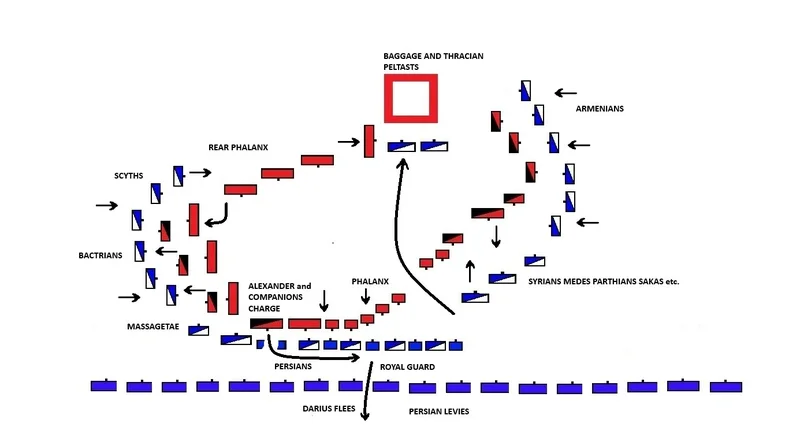
The great battle with Darius was fought not at Arbela, where most writers place it, but at Gaugamela.65
They say the name means “Camel's House” in the local language, because a king of long ago escaped his enemies on a swift camel, lodged it here, and set aside certain villages and revenues for its care.
A lunar eclipse occurred in Boedromion,66 around the start of the Mysteries at Athens.
On the eleventh night after it, with the armies within sight of each other, Darius kept his force under arms and went along the ranks by torchlight, while Alexander, as the Macedonians rested, stayed outside his tent with the seer Aristander, performing certain secret rites and sacrificing to Fear.67
The older Companions, Parmenion above all, saw the whole plain between Niphates and the Gordyaean mountains lit by Persian fires, while an indistinct clamor of mingled voices came from the camp like the sound of a boundless sea. Staggered by the numbers, they told one another what a vast and difficult undertaking it would be to confront so great a force in open battle and drive it back.
When the king finished his sacrifices, they approached him and urged a night attack, so that darkness would conceal the most terrifying feature of the coming battle.
He gave his famous answer: “I won't steal victory.”68
To some it seemed a vain, boyish reply, treating so great a danger as a game; to others, it showed both confidence in the present and sound judgment of the future, since he was denying Darius, if defeated, an excuse to summon his courage for another attempt by blaming this defeat on night and darkness, as he had blamed the earlier ones on mountains, narrow passes, and the sea.
For with forces and territory on that scale, Darius would not stop fighting for lack of weapons or men, but only when a clear and crushing defeat convinced him to abandon his confidence and hope.
32 After they left, he lay down in his tent and, they say, slept so deeply through the remaining hours of darkness, contrary to his habit, that the commanders who came at dawn were amazed and on their own authority gave orders for the soldiers to breakfast first.
Then, as time pressed, Parmenion entered, stood at the bedside, and called his name two or three times. Once he had roused him, he asked what had come over him: how could he sleep like a man who had already won, instead of one about to face the greatest battle of all?
“Why,” Alexander replied, smiling, “don't you think we have already won, now that we are free of wandering across a vast, ravaged country chasing Darius while he evades battle?”
He showed greatness and stood firm in judgment and courage, not just before battle but in the thick of danger.
For the fighting turned against Parmenion's left wing and threw it into confusion: the Bactrian cavalry struck the Macedonians in a roaring, violent charge, while the Persian commander Mazaeus sent horsemen around the outside of the phalanx to attack the baggage guards.
So Parmenion, alarmed by both developments, sent messengers to Alexander: unless he quickly sent substantial help from the front to the rear, they would lose the fortified camp and their baggage.
At that very moment Alexander was signaling the men around him to attack. When he heard Parmenion's message, he said that Parmenion had lost his senses and his power to reason, forgetting in his alarm that if they won they would gain the enemy's possessions too, but if they lost they must concern themselves not with property or slaves but with dying nobly and gloriously in battle.
He sent this reply to Parmenion and put on his helmet; he had worn the rest of his armor from the moment he left his tent: a belted Sicilian tunic and, over it, a linen breastplate made in two layers, taken among the spoils at Issus. The helmet, made by the craftsman Theophilus, was iron, yet shone like pure silver; an iron neck guard set with gems was fitted to it.
He carried a sword given by the king of Citium, remarkable both for its lightness and for its temper, and had trained himself to fight mainly with a sword. His cloak was more lavishly worked than the rest of his equipment, for it was a piece by Helicon, a craftsman of an earlier age, presented to him by the city of Rhodes as a mark of honor.i He wore it in battle as well.
While he rode along arranging part of the phalanx, encouraging the men, giving instructions, or inspecting them, he used another horse to spare Bucephalas, now past his prime; but when he went into action, Bucephalas was brought up, and he changed mounts and led the charge at once.
33 On this occasion he addressed the Thessalians and their fellow Greeks at greatest length. As they heartened him, shouting for him to lead them against the barbarians, he shifted the lance to his left hand and appealed to the gods with his right, praying, according to Callisthenes, that if he truly was born of Zeus they would defend and strengthen the Greeks.
Aristander the seer rode past in a white cloak and a golden wreath, pointing to an eagle soaring along above Alexander's head and directing its flight straight at the enemy.69 So the men who saw it took great courage, and with that courage, urging one another on, the cavalry galloped at the enemy and the phalanx surged after them like a wave.
Before the leading ranks could clash, the Persians gave way. A fierce pursuit followed, with Alexander driving the beaten troops toward the center, where Darius stood. For from afar he had picked out Darius through the troops drawn up before him, conspicuous deep within the Royal Squadron:70 a tall, handsome man standing in a lofty chariot, screened by a brilliant mass of cavalry, packed tightly around it and arrayed to meet the enemy.
But Alexander was a terrifying sight at close quarters, and when he drove the fugitives into the men standing firm, most panicked and scattered. The best and noblest, however, were cut down before their king and fell upon one another, obstructing the pursuit as they writhed around men and horses and tangled with them.
Darius saw every horror before him, with the troops drawn up in front collapsing back upon him. He could not easily turn the chariot and drive out: the wheels were caught among so many bodies, and the horses, hemmed in and hidden by the mass of the dead, reared and threw the driver into confusion. So he abandoned both chariot and weapons, mounted a mare that had recently foaled, they say, and fled.
It seems he would not have escaped then, however, had more horsemen from Parmenion not arrived to summon Alexander, reporting that a large force still held its ground there and the enemy refused to yield.
For Parmenion is widely accused of being sluggish and ineffective in this battle, either because old age had already begun to weaken his daring or because, as Callisthenes says, he resented and envied the unrestricted authority and pomp of Alexander's power.
At the time, however, the king, annoyed at being summoned, did not tell the soldiers the real reason, but sounded a recall as though he were holding back from further slaughter, with darkness already upon them. Riding toward the threatened part of the army, he learned on the way that the enemy had suffered a complete defeat and were fleeing.
34 After this outcome, Persian power seemed utterly destroyed. Alexander, acclaimed king of Asia, offered magnificent sacrifices to the gods and bestowed riches, estates, and commands on his friends.
Eager to win honor among the Greeks, he wrote that all tyrannies were to be abolished and the cities were to govern themselves;71 he instructed the Plataeans in particular to rebuild their city,72 because their ancestors had made their land available for the Greeks to fight for freedom.
He also sent a share of the spoils to the citizens of Croton in Italy, honoring the zeal and valor of the athlete Phayllus, who, during the Persian Wars, when the other Greeks of Italy had given up on the Greeks, sailed to Salamis with a ship fitted out at his own expense to share in their danger.73
Such was his welcome for every form of valor, his care and affection for noble deeds.
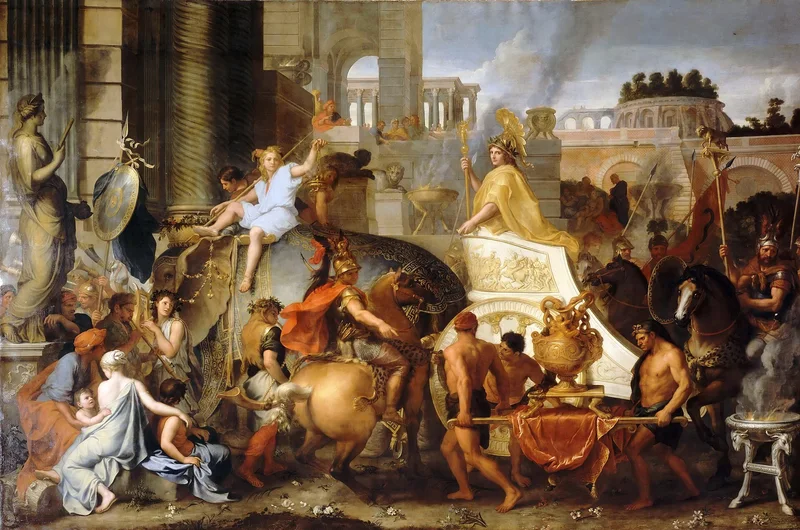
35 As he advanced through Babylonia, which immediately came wholly under his power, he was most amazed by a chasm from which fire rose continually as from a spring, and by a stream of naphtha nearby, so abundant that it pooled into a lake.74 In other respects naphtha resembles bitumen, but it takes fire so readily that, before a flame touches it, the glow around the flame ignites it, often setting the intervening air alight as well.
The Babylonians demonstrated its nature and power by lightly sprinkling the substance along the narrow street leading to the king's lodgings. Then, taking their stand at one end, they put torches to the wetted patches, for darkness was already falling. The first patches caught immediately; without any perceptible delay, as fast as thought, the fire reached the far end and the street became one continuous blaze.
Athenophanes, an Athenian, was among the attendants who regularly tended the king's body with oil rubs and baths, and tactfully steered his thoughts toward relaxation. At that moment a boy named Stephanus stood beside Alexander in the bathing room, very ugly and ridiculous in appearance, but a delightful singer.j Athenophanes said, “King, shall we test the substance on Stephanus? For if it takes hold of him without going out, I would call its power utterly irresistible and terrible.”
The boy too was somehow eager to offer himself for the experiment. The moment they coated him and touched him with a flame,k his body burst into such a blaze and was so completely engulfed that Alexander was utterly at a loss and terrified. Had there not happened to be many people nearby carrying vessels of bathwater, help could not have overtaken the spreading fire. Even then they only just managed to put him out, with his whole body a mass of fire, and afterward he was seriously ill.
Reasonably enough, then, some people who try to reconcile myth with truth say this was Medea's poison, which she smeared on the crown and robe in the tragedies.75 For, they say, the fire did not blaze up of itself or from those objects themselves; a flame was set near them, and it was drawn to them so swiftly that the contact escaped the senses.
For rays and streams of fire reaching other bodies from a distance give them only light and warmth, but in bodies with an airy dryness or a rich, lasting moisture, they gather, generate fire, and rapidly transform the material.
Its origin, however, presented a puzzle: […] or did the liquid instead seep out to feed the flame from earth whose nature was oily and capable of producing fire?l
For Babylonia is fiery hot,76 so that barley grains often spring from the earth and bounce away, as though inflammation made the ground throb, and in the fierce heat people sleep on water-filled skins.
Harpalus, left in charge of the region and eager to beautify the palace and walks with Greek plants, succeeded with the others, but ivy was the one plant the soil would not tolerate: it always killed the plant, which could not endure the conditions, for the soil was fiery hot and ivy loved the cool.
So perhaps faultfinders will complain less about digressions like these, provided they stay within bounds.
36 When Alexander took Susa, he found forty thousand talents in coined money in the royal palace, along with furnishings and luxuries beyond description. Among them, they say, were five thousand talents of purple cloth from Hermione,77 which had lain in storage for ten years short of two hundred yet kept its color fresh and vivid.
They say the reason was the use of honey when dyeing the purple cloth, and of white oil when dyeing the white, for honey and oil, too, are seen to keep a clear, shining brilliance after as long a time.78
The historian Dinon says that the kings also sent for water from the Nile as well as the Danube and kept it in the treasury alongside their other treasures, as if to confirm how great their empire was and that they ruled over all.79
37 Persis, however, was hard to enter because of its rugged terrain and was guarded by the noblest Persians, for Darius had already fled. A bilingual man, born to a Lycian father and a Persian mother, guided Alexander along a route that required only a short detour. This was the man, they say, whom the Pythia had foretold when Alexander was still a boy, saying that a wolf would guide him on his march against the Persians.80
So a great many captives were slaughtered there—for Alexander himself writes that he ordered the people slaughtered because he thought it served his interests—but they say he found as much coined money as at Susa, and that the other furnishings and treasure were carried away by ten thousand pairs of mules and five thousand camels.
He saw a huge statue of Xerxes81 that the crowd pushing into the palace had carelessly toppled. He stopped and spoke to it as to a living man: “Should we walk past and leave you lying there because you marched against the Greeks, or raise you up because in other ways you showed greatness of spirit and virtue?” After standing for a long time in silent thought, he finally walked on.
He wanted his soldiers to recover their strength, and since it was winter, he remained there for four months.
They say that when he first sat on the royal throne beneath its golden canopy,82 Demaratus of Corinth, a friend of his father's who was devoted to Alexander, shed an old man's tears and said that Greeks who died before seeing Alexander sitting on Darius's throne had been denied a great pleasure.83
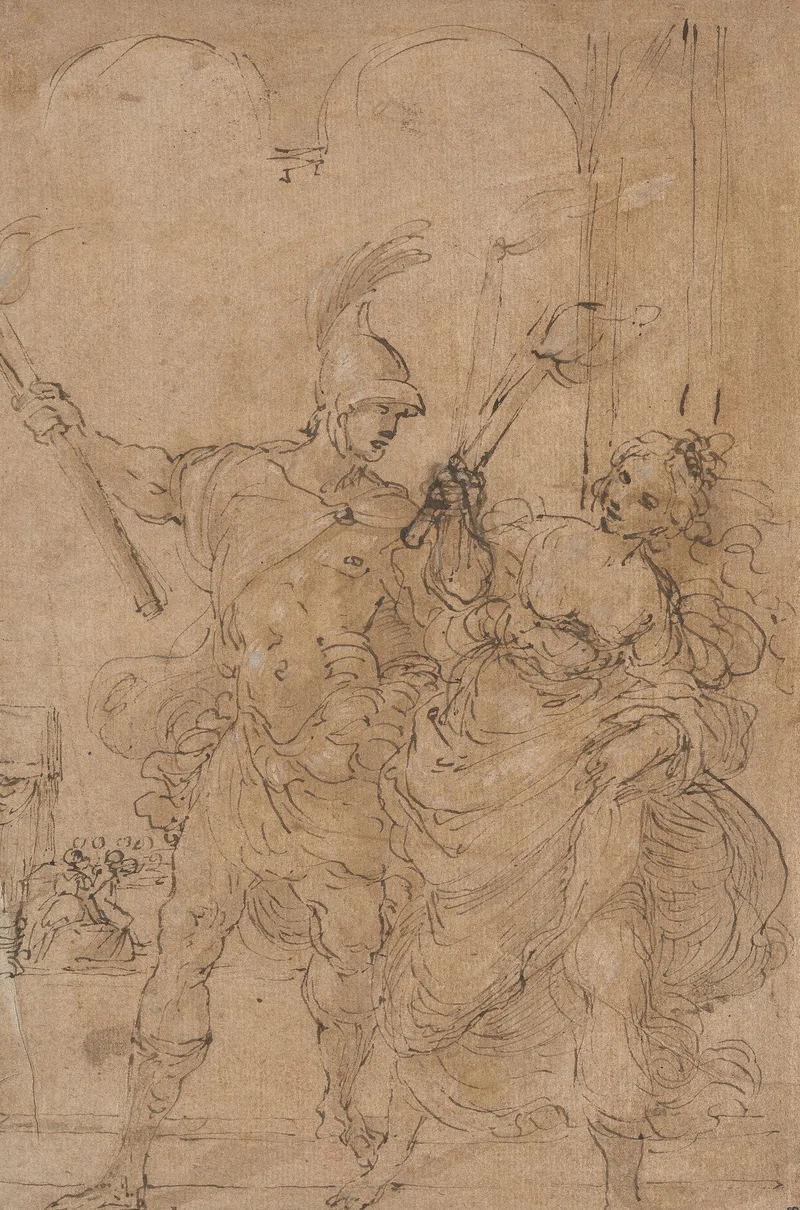
38 After this, as he prepared to march against Darius, he happened to give himself over to drunken merriment with his Companions, so that women who came to revel with their lovers joined them in drinking. The most celebrated was Thais, an Athenian and the courtesan of Ptolemy, who later became king.84 Partly praising Alexander with tact and partly joking with him, she was carried along by the wine into a speech worthy of her homeland's spirit but above her own station.
For she said that her luxurious revels that day in the proud palaces of Persia repaid the hardships of her wanderings through Asia. But it would give her still greater pleasure to go with the revelers and burn the house of Xerxes, who had burned Athens,85 lighting the fire herself while the king watched, so that people would say that the women in Alexander's train had exacted greater punishment from the Persians on behalf of Greece than those commanders who had fought them on land and sea.
Applause and uproar greeted these words, and his Companions urged him on so eagerly that the king was swept along, sprang up wearing a wreath, torch in hand, and led the way. His followers surrounded the palace with shouts and revelry, while the other Macedonians who heard about it came running joyfully with torches. For they hoped that burning and destroying the palace meant he was thinking of home and did not intend to settle among barbarians.
Some writers give this account of events; others say the burning was deliberate.
Everyone agrees, however, that he quickly regretted it and ordered the flames put out.
39 He was extraordinarily generous by nature, and as his fortunes grew, his generosity grew greater still. And he gave with a graciousness that alone makes a gift truly welcome. I will recall a few examples.
After killing an enemy, Ariston, commander of the Paeonians, showed Alexander the head. “Among our people, King,” he said, “a gift like this earns a golden cup.”
“An empty cup, certainly,” Alexander answered with a laugh, “but I'll drink to you from one brimming with unmixed wine.”86
A common Macedonian soldier was driving a mule loaded with the king's gold. When the animal tired, he lifted the load and carried it himself. The king saw him struggling badly and learned what had happened. Just as the man was about to put it down, he said, “Don't tire now, but carry it the rest of the way to your tent—for yourself.”
As a rule, he was more annoyed by people who refused his gifts than by those who asked for them.87 He wrote to Phocion, the Athenian statesman, that he would no longer consider him a friend if he kept rejecting his gifts.
He gave nothing to Serapion, one of the young ballplayers, because Serapion never asked for anything. So when Serapion came to play, he threw the ball to the other players.
“And you won't give it to me?” the king asked.
“Because you don't ask,” he answered. The king laughed at that and gave him many gifts.
He seemed to be angry with a certain Proteas, a man with a talent for jokes and drinking. His friends pleaded for him, and Proteas himself wept, until Alexander said they were reconciled.
“Then give me some proof first, King,” Proteas said.
Alexander ordered five talents paid to him.
A letter Olympias sent him shows the sheer scale of the riches he distributed among his friends and royal bodyguards.88m “Find other ways,” she says, “to benefit your friends and bring them honor; as things stand, you are making them all equal to kings and finding them friends in abundance, while leaving yourself deserted.”89
Olympias often wrote in this vein, and he kept her letters secret. Once, however, Hephaestion was reading an opened letter along with him, as he usually did. Alexander let him read, but slipped off his ring and pressed its seal against Hephaestion's lips.90
To the son of Mazaeus, formerly Darius's most powerful courtier, he offered a second satrapy, larger than the one he already held. The son declined. “King,” he said, “there used to be one Darius; now you have made many Alexanders.”
He gave Parmenion the house of the Persian courtier Bagoas near Susa, where clothing worth a thousand talents was reportedly found.
He also wrote instructing Antipater to keep a personal guard, since people were plotting against him.
He sent his mother many gifts, but would not allow her to meddle in affairs or interfere with military command, and when she protested, he met her harshness gently.
Once, though, after reading a long letter from Antipater accusing her, he said, “Antipater doesn't know that one tear from a mother wipes out ten thousand letters.”
40 When he saw that those around him had surrendered completely to luxury and were vulgar in their habits and extravagance—Hagnon of Teos wore boots fitted with silver nails; Leonnatus had many camels bring Egyptian dust for his exercises;91 Philotas owned hunting screens stretching a hundred stades; more men used perfumed ointment than ordinary oil when they went for rubdowns and baths; and they traveled with masseurs and bedchamber attendants—he reproved them gently, reasoning like a philosopher.
He said he was astonished that, after so many great struggles, they failed to remember that men who wear others down enjoy sweeter sleep than the men they wear down, or to see, when they compared their own lives with Persian lives, that nothing is more slavish than luxury or more kingly than hard work.
“Yet how,” he asked, “can anyone groom his own horse or polish a spear or helmet when his hands have lost the habit of tending his own precious body? Don't you know that our goal in conquest is to avoid doing what the conquered do?”
So he drove himself still harder on campaigns and hunts, enduring hardship and courting danger. A Spartan envoy who was present when he brought down a great lion said, “A fine fight for the kingship, Alexander, between you and the lion!”92
Craterus, a senior Macedonian commander, commemorated this hunt by commissioning and dedicating bronze statues at Delphi: the lion and dogs, the king fighting the lion, and Craterus himself coming to his aid; Lysippus modeled some, and Leochares the rest.93
41 Alexander thus faced danger to train himself and spur others toward excellence, but his friends, eager now for luxury and leisure because of their wealth and self-importance, resented the wandering and the campaigns and gradually began to revile and abuse him. At first he took this very gently, saying that it was kingly to do people good and have them speak ill of you.
Yet his smallest attentions to his close friends showed great affection and respect. I will give a few examples. He wrote reproaching the Macedonian officer Peucestas because, after a bear had bitten him, he had written to the others but said nothing to Alexander. “At least write now,” he says, “and tell me how you are, and whether any of your fellow hunters abandoned you, so they can be punished.”
He wrote to Hephaestion and the men with him, who were away on business, that during some amusement with a mongoose Craterus had stumbled onto Perdiccas's short spear and been wounded in the thighs.
After Peucestas recovered from an illness, Alexander wrote to thank Alexippus, the physician.
During Craterus's illness, a dream vision prompted Alexander to offer certain sacrifices on his behalf and tell Craterus to do the same.
He also wrote to the physician Pausanias, who wanted to treat Craterus with hellebore,94 expressing his anxiety and advising him how to administer the medicine.
He had Ephialtes and Cissus, the first to report Harpalus's flight and desertion, put in chains, accusing them of lying about the man.
When he was sending the old and infirm home, Eurylochus of Aegae entered his name among the sick. Found to be perfectly well, he admitted his love for Telesippa and his intention to follow her as she left for the coast.
Alexander asked what people the woman belonged to. When he learned that she was a free courtesan,95 he said, “You have me on your side in love, Eurylochus. But see that we persuade Telesippa with words or gifts, since she is freeborn.”
42 It is remarkable that he found time to write his friends letters about such matters as these: ordering a search for a slave belonging to the Macedonian officer Seleucus who had escaped to Cilicia; praising Peucestas for capturing Nicon, Craterus's slave; and writing to Megabyzus96 about a slave sheltering in a sanctuary,97n telling him to call the man outside and arrest him if he could, but never to touch him within the sanctuary.
They say, too, that when he first judged capital cases, he held his hand over one ear as the accuser spoke, reserving it clear and unprejudiced for the man on trial.98 Later, however, the flood of accusations hardened him: the true ones opened a path for the false. Above all, when anyone spoke ill of him, he lost his reason and became harsh and implacable, for he prized his reputation above his life and kingship.
At this time he was marching against Darius, expecting to fight him again.
But when he heard that the Persian officer Bessus had arrested Darius, he sent the Thessalians home, adding a gift of two thousand talents to their pay.
The pursuit proved long and punishing—for he rode three thousand three hundred stades in eleven days—and most of his men gave out, chiefly for lack of water.o
There some Macedonians met him with mules carrying skins of water from the river. It was noon already; when they saw Alexander suffering badly from thirst, they filled a helmet at once and held it out to him. He asked whom the water was for.
“Our own sons,” they said. “But as long as you live, we can father others, even if we lose these.”
He took the helmet at these words, but when he looked around and saw every horseman near him leaning forward, eyes fixed on the water, he passed it back without drinking, praising the men. “For if I drink alone,” he said, “these men will lose heart.”
Seeing his self-control and greatness of spirit, the horsemen shouted for him to lead on without fear and lashed their horses; for, they said, with such a king they counted themselves neither weary nor thirsty nor mortal at all.
43 So all shared the same eagerness, but only sixty, they say, broke into the enemy camp beside him. They rode over quantities of silver and gold scattered on the ground and passed many wagons carrying children and women, careering about without drivers, to pursue the fugitives in front, believing Darius was among them. They found him at last, lying in a wagon, his body pierced by many javelins and his life nearly gone.
Even so, he asked for a drink, and after drinking cold water said to Polystratus, the Macedonian who had given it to him, “My good man, my misfortune is complete: I have received a kindness that I cannot repay. But Alexander will repay you, and the gods will repay Alexander for treating my mother, wife, and children with kindness; through you I give him this right hand.”99 With these words he grasped Polystratus's hand and died.
When Alexander arrived, his distress was plain. He unfastened his cloak, spread it over the body, and wrapped him in it.
Later, when he caught Bessus, he had him torn apart. He had two upright trees bent together and fastened part of Bessus's body to each, then released them, so that each sprang back with force and tore away its allotted share.
At the time, however, he sent the body, prepared with royal honors, to Darius's mother and enrolled Darius's brother Exathres among the Companions.
44 He himself went down into Hyrcania with his strongest troops. There he saw an inlet of the sea that seemed no smaller than the Black Sea, but whose water was fresher than that of other seas. He could learn nothing definite about it, but thought it most likely an overflow from Lake Maeotis.100
Yet the natural philosophers had not missed the truth: many years before Alexander's campaign, they had recorded that of the four gulfs running inland from the outer sea, this one, called both the Hyrcanian and the Caspian Sea, lay farthest north.101
Here some barbarians unexpectedly came upon the men leading his horse Bucephalas and seized him. Alexander took this very badly and sent a herald to threaten to kill them all, children and wives included, unless they sent back his horse. But when they arrived with the horse and surrendered their cities, he treated everyone kindly and paid the captors a ransom for the horse.
45 He next marched into Parthia and, during a pause, wore barbarian dress for the first time,102 either wishing to adapt himself to local customs, since familiarity and kinship do much to tame people, or quietly testing whether the Macedonians would accept proskynesis,103 gradually accustoming them to tolerate changes in his way of life and his departure from their own.
He did not, however, adopt the Median costume, which was altogether barbarian and outlandish, nor wear trousers, a sleeved coat, or a tiara104; instead, he devised a well-judged blend of Persian and Median dress, less showy than the Median and more imposing than the Persian.p
At first he wore it when meeting the barbarians or his Companions indoors; later he appeared in public dressed this way, riding out and conducting business.
The sight distressed the Macedonians, but admiration for his other qualities made them feel they should give way in some things that brought him pleasure or glory. For in addition to all the rest, an arrow had lately struck his lower leg, breaking off a piece of his fibula that fell out, and on another occasion a stone had struck his neck, clouding his sight for a considerable time; yet he went on exposing himself unsparingly to danger.
He even crossed the Orexartes, which he took for the Tanais,105 routed the Scythians, and chased them for a hundred stades while suffering from diarrhea.
46 Most writers say that an Amazon visited him here,106 including Clitarchus, Polyclitus, Onesicritus, Antigenes,107 and Ister; Aristobulus, Chares the eisangeleus,108 Ptolemy, Anticlides, Philo of Thebes, Philip of Theangela, and, besides these, Hecataeus of Eretria, Philip of Chalcis, and Duris of Samos, however, call the story an invention.
Alexander himself seems to support them, for in a letter giving Antipater a detailed account of everything, he reports that the Scythian king had offered his daughter to him in marriage, but mentions no Amazon.
One story says that, many years later, Onesicritus read the fourth book of his history, containing the account of the Amazon, to Lysimachus, the Macedonian commander who was by then king.
Lysimachus gave a quiet smile and asked, “Where was I then?”
Disbelieving this story would leave us admiring Alexander no less, and believing it no more.
47 Afraid that the Macedonians would give up before the campaign was over, he left the bulk of the army in place and addressed his best troops, whom he had with him in Hyrcania—twenty thousand foot soldiers and three thousand cavalrymen. The barbarians, he told them, now saw them as in a dream, but if they merely threw Asia into confusion and withdrew, the barbarians would immediately attack them as though they were women.
Nevertheless, he allowed anyone who wished to leave to do so, calling them to witness that he was being abandoned with his friends and those willing to serve while he was conquering the inhabited world for the Macedonians. This is almost the exact wording of his letter to Antipater, which adds that, when he said this, they all cried out for him to lead them wherever in the inhabited world he wished. Once these men had answered his test, the main body no longer needed much persuasion but followed readily.
He now modeled his own way of life still more closely on that of the local peoples and brought their customs nearer to Macedonian practices, believing that, when he was far away, intermingling and fellowship would bring stability through goodwill more effectively than force. For this reason he selected thirty thousand boys, ordered them to learn to read and write Greek and train with Macedonian weapons, and appointed many overseers.109
His marriage to Roxane110 came from love—he had seen her, beautiful and in the bloom of youth, dancing at a drinking party—but it also seemed well suited to the circumstances. For the marriage bond reassured the barbarians, and they grew intensely fond of Alexander because, supremely restrained in such matters, he refused to touch outside lawful marriage even the one woman who had conquered him.
Among his leading friends, he saw that Hephaestion approved and changed his dress along with him, whereas Craterus held to ancestral customs, so he dealt with the barbarians through Hephaestion and with the Greeks and Macedonians through Craterus. He loved Hephaestion most and honored Craterus most, believing, as he always said, that Hephaestion loved Alexander and Craterus loved the king.111
So they nursed a hidden grudge against each other and often clashed. Once in India they even drew swords and came to blows. As their friends came to each man's aid, Alexander rode up and berated Hephaestion in public, calling him a reckless fool and a madman if he could not see that, once Alexander was taken away from him, he was nothing.
He also rebuked Craterus bitterly in private.
He brought the two together and reconciled them, swearing by Ammon and the other gods that they were the men he loved most of all, but if he ever learned of another quarrel between them, he would kill both, or whoever had started it.
We are told that afterward neither said nor did anything against the other, even as a joke.
48 Philotas, Parmenion's son, stood high among the Macedonians, for he was considered brave and hardy, and no one except Alexander was so generous or so devoted to his friends. For instance, they say that when a friend asked him for money, he ordered it paid; when the steward replied that he had no money, Philotas said, “What? Have you neither a cup nor a cloak?”
Yet he made such an oppressive show of pride, wealth, personal grooming, and extravagant living, beyond what suited a private man, and now imitated dignity and grandeur so clumsily and falsely, without grace or charm, that he incurred suspicion and envy; even Parmenion once told him, “My son, be less great for my sake.”112
For a very long time, too, damaging reports about him had been reaching Alexander himself. For after Darius's defeat in Cilicia, when the treasure around Damascus was captured, a good-looking woman from Pydna named Antigone was found among the many prisoners brought into camp. Philotas took her. Like a young man talking over wine to a woman he desired,q he indulged in much frank military boasting, claiming that the greatest deeds were his and his father's and calling Alexander a mere boy who owed his title of ruler to them.
The woman repeated this to an acquaintance, who passed it on, as one would expect, to someone else, until the story reached Craterus. He took her secretly to Alexander. After hearing her, Alexander ordered her to keep meeting Philotas and come to him with everything she learned from the man.
49 Philotas had no idea he was being plotted against in this way, and in Antigone's company he uttered many angry boasts and indiscreet speeches against the king.
Alexander, though he had received strong evidence against Philotas, endured it silently and restrained himself, either trusting Parmenion's loyalty to him or fearing the standing and power of father and son.
At this time, though, Limnus, a Macedonian from Chalastra, was plotting against Alexander and invited Nicomachus, a young man he was in love with, to take part.
Nicomachus refused and told his brother Cebalinus about the approach. Cebalinus went to Philotas and told him to bring them both to Alexander, as they had urgent and important matters to put before him.
For some reason—we do not know why—Philotas would not bring them in, saying that the king was occupied with more important business. He did this twice.
Since Philotas now treated them with contempt, they turned to another man, who brought them before Alexander.r First they reported Limnus's plot, then quietly let Alexander know that Philotas had ignored their two approaches. This infuriated Alexander.
And when the man sent to arrest Limnus killed him as he resisted, Alexander grew still more alarmed, believing he had lost the means of proving the conspiracy.
Embittered against Philotas, he drew the man's longstanding enemies to him. They now openly declared that the king was being careless to suppose that a man from Chalastra like Limnus could attempt such a daring act on his own; he was a subordinate, or rather a tool set in motion by some higher authority, and the plot must be sought among those who had the most to gain by keeping it hidden.
The king opened his ears wide to this talk and these suspicions, and they began piling up countless accusations against Philotas.
He was therefore arrested and interrogated under torture,113 with the Companions supervising while Alexander listened behind a drawn curtain.
They say that, as Philotas directed his pitiful, abject cries and pleas to Hephaestion and the others, Alexander said, “So soft and unmanly, Philotas—and you attempted something so momentous?”
Once Philotas was dead, Alexander immediately sent to Media to kill Parmenion as well, a man who had accomplished much alongside Philip II, who had been the only one among the older friends, or the most insistent, to urge Alexander across into Asia, and who had already seen two sons out of three die on campaign before he was killed along with the third.
These acts made many of his friends fear Alexander, above all Antipater, who secretly sent envoys to the Aetolians to give and receive pledges.
For the Aetolians feared him over the expulsion of the inhabitants of Oeniadae;114 on hearing of it, he had said that not the sons of the Oeniadae but he himself would punish the Aetolians.
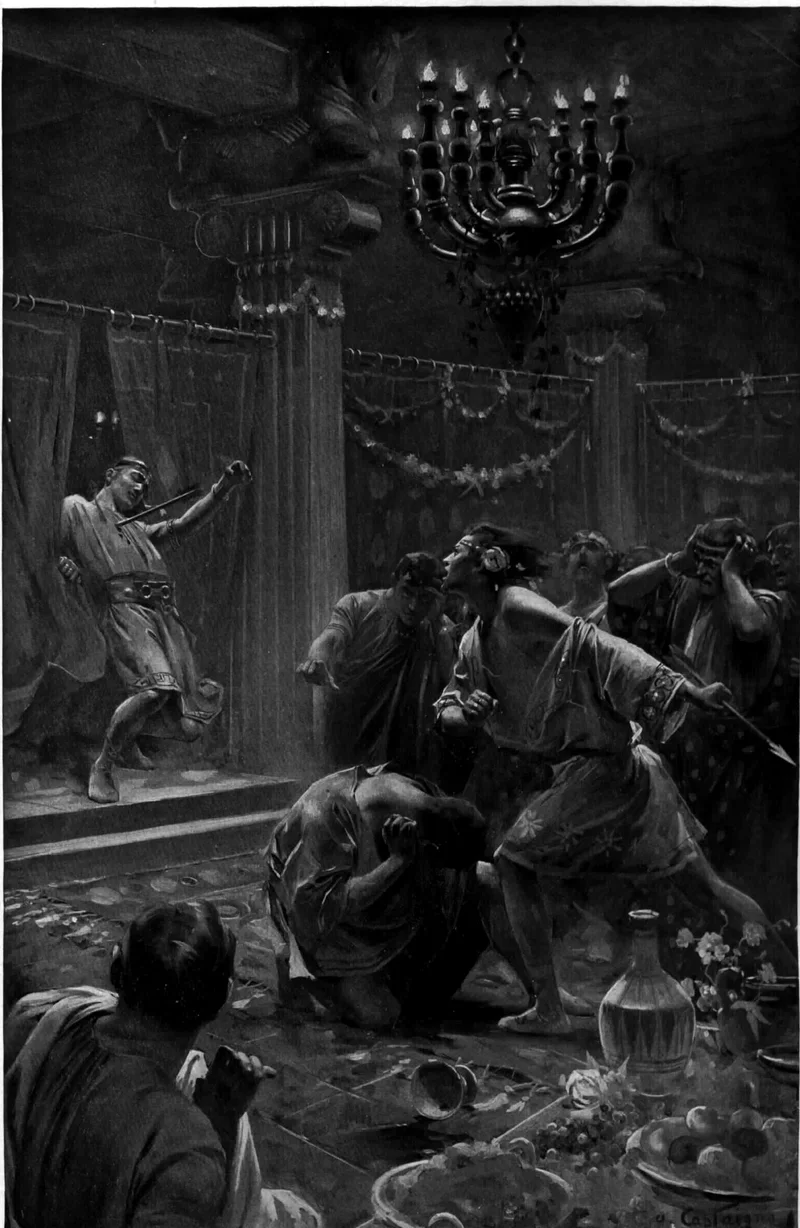
50 Soon afterward came the affair of Cleitus: in a bare account it sounds more savage than the affair of Philotas, but when we weigh both its cause and its timing, we find that the king acted not deliberately but through a kind of misfortune, his anger and drunkenness giving Cleitus’s daimon its opportunity.115
It happened this way. Some men arrived from the coast bringing Greek fruit for the king. He admired its ripeness and beauty and summoned Cleitus to see it and have a share. Cleitus happened to be sacrificing, but left the sacrifice and went. Three of the sheep that had received libations followed him.116
When the king heard this, he consulted the seers Aristander and Cleomantis the Spartan. They pronounced it a bad omen, and he ordered them to make an averting sacrifice for Cleitus without delay.
For two days earlier he too had dreamed a strange vision: Cleitus appeared to him seated in black robes with Parmenion’s sons, all of them dead.117
But Cleitus came straight to dinner without waiting for the averting sacrifice. The king had sacrificed to the Dioscuri.118
A wild drinking bout began, and someone sang verses by a poet named Pranichus—or, according to some, Pierion—written to shame and ridicule the commanders recently defeated by the barbarians.
The older men took offense and abused both poet and singer, while Alexander and his circle listened with pleasure and called for more.
Cleitus, already drunk and naturally harsh-tempered and headstrong, was angriest of all. He said it was wrong to insult Macedonians before barbarians and enemies: despite their misfortune, these men were far better than those laughing at them.
Alexander said Cleitus was defending himself by calling cowardice misfortune.
Cleitus sprang up. “Yet this cowardice saved you, son of gods, when you were already exposing your back to Spithridates’s sword! Macedonian blood and these wounds have raised you so high that you disown Philip and make yourself Ammon’s son.”
51 Alexander flared up at this. “You villain,” he said, “do you think you can keep speaking about me like this and stirring up division among the Macedonians, and escape punishment?”
“We have our punishment already, Alexander,” Cleitus replied, “when our hardships earn rewards like these, but we count fortunate those who died before seeing Macedonians flogged with Median rods and having to beg Persians for access to the king.”119
As Cleitus spoke so freely, Alexander’s circle rose against him and showered him with insults, while the older men tried to quiet the uproar.
Alexander turned to Xenodochus of Cardia and Artemius of Colophon. “Don’t you think the Greeks walk among the Macedonians like demigods among wild beasts?”120
Cleitus would not give way. He told Alexander to say openly whatever he wished, or else stop inviting free men who spoke their minds to dinner and live among barbarians and slaves, who would bow down before his Persian belt and his tunic striped with white.
Alexander could no longer contain his anger. He hurled one of the apples lying nearby, struck Cleitus, and looked for his dagger.
Aristophanes, a bodyguard, had already slipped it away, and the others crowded around Alexander, pleading with him.
He leaped up and shouted in Macedonian for the hypaspists—a signal of grave trouble.121 He ordered the trumpeter to sound and punched him when he hesitated and refused.
So the trumpeter later earned great credit for doing more than anyone to prevent turmoil in the camp, but Cleitus still would not yield, and his friends barely managed to force him out of the dining room.
But he came back through another doorway, reciting these lines from Euripides’s Andromache122 with brazen contempt:
“Alas, what a bad custom rules in Greece!”
At this Alexander seized a spear from a guard and drove it through Cleitus as he approached, drawing aside the curtain over the doorway.
Cleitus fell with a groan and a roar, and Alexander’s anger left him at once. When he recovered his senses and saw his friends standing speechless, he managed to pull the spear out of the corpse, but as he tried to stab himself in the neck, the bodyguards caught his hands and carried him forcibly into his bedroom.
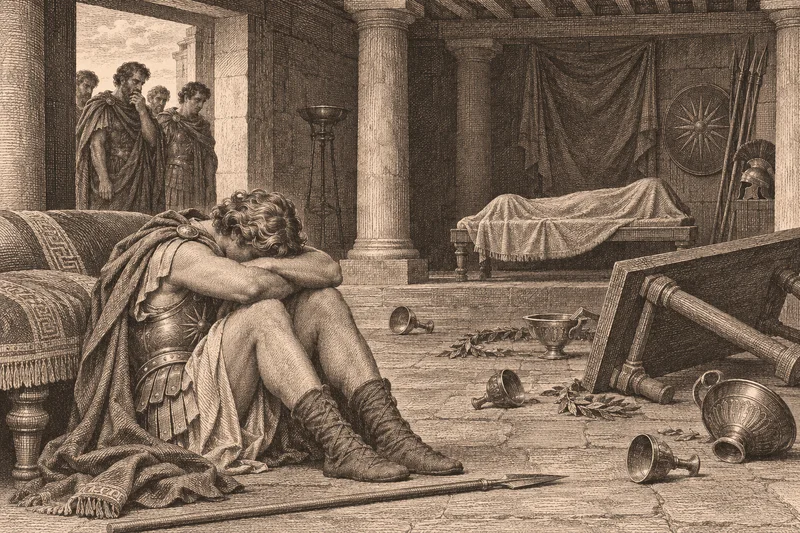
52 When he had spent the night in bitter tears and lay speechless the next day, exhausted by his cries and lamentations and letting out deep groans, his friends took fright at his silence and forced their way in.
He rejected what the others said, but when the seer Aristander brought up the vision of Cleitus and the omen, saying that all this had long been fated, he seemed to relent.
So they brought in Callisthenes, the philosopher and Aristotle’s kinsman, together with Anaxarchus of Abdera. Callisthenes tried to reach his grief with considerate, gentle words, approaching it indirectly to avoid causing pain, but Anaxarchus, who had followed his own path in philosophy from the outset and acquired a reputation for contempt and indifference toward his associates,s shouted as soon as he entered:
“This is Alexander, the man the inhabited world now watches, and here he lies sprawled, weeping like a slave, afraid of human law and censure, when he himself should be men’s law and their standard of justice, since victory has given him rule and mastery, and he should not live as a slave, mastered by an empty opinion.
“Don’t you know,” he said, “that Zeus seats Dike and Themis beside him so that whatever the ruler does is lawful and just?”123
With arguments of this kind Anaxarchus eased the king’s suffering but made his character in many respects more arrogant and lawless. He also won extraordinary favor for himself and further prejudiced the king against Callisthenes’s company, already unwelcome because of his austerity.
They say that once, when the talk at dinner turned to seasons and climate, Callisthenes sided with those who thought their present country colder and more wintry than Greece.
Anaxarchus opposed him and argued fiercely.
“Still, you must admit this country is colder than Greece,” Callisthenes said, “for there you passed the winter in a threadbare cloak, while here you recline wrapped in three rugs.”124
This gave Anaxarchus further cause for anger.
53 Callisthenes also offended the other sophists and flatterers: young men sought him out for his eloquence, while older men were no less pleased with his orderly, dignified, self-sufficient life, which lent weight to his stated reason for leaving home—that he had come to Alexander out of an ambition to bring his fellow citizens back and repopulate his native city.125
His reputation aroused envy, but he also supplied his detractors with material against him. He usually declined invitations, and when he joined a gathering, his solemnity and silence suggested that he neither approved of nor enjoyed the proceedings, so that Alexander himself said of him:
“I hate a sophist who has no wisdom for himself.”126
They say that once, at a dinner with many guests, Callisthenes was asked over the wine to praise the Macedonians and spoke so fluently on his theme that the guests stood up, applauded, and threw their wreaths at him.127
Alexander then remarked, quoting Euripides:
“Given fine material for a speech, speaking well is no great task.”128
“But show us what you can do,” he said, “by denouncing the Macedonians, so that learning their faults may make them better.”
Callisthenes accordingly began his recantation, speaking at length and frankly against the Macedonians and declaring that civil strife among the Greeks had caused Philip’s rise to greatness and power. He added:
“Amid civil discord, honor falls even to the vilest.”129
This aroused deep and bitter hatred among the Macedonians, and Alexander said that Callisthenes had displayed not his skill as a speaker but his hostility toward them.
54 The writer Hermippus, then, says this was the account Stroebus, Callisthenes’s reader, gave Aristotle.
He also reported that Callisthenes, sensing the king’s estrangement, said to himself twice or three times as he went away:
“Patroclus died as well, though he was far better than you.”130
Aristotle seems, then, to have had good reason to say that Callisthenes possessed great power as a speaker but no judgment.
Yet by firmly refusing to bow down, as a philosopher should, and by speaking openly, alone, about everything that secretly angered the oldest and best Macedonians, he saved the Greeks from great shame and Alexander from greater, turning him away from the practice, but destroyed himself, since he seemed to have coerced the king rather than persuaded him.
Chares of Mytilene reports that at a drinking party Alexander drank from a phiale and passed it to a friend.131 The man took it, stood facing the hearth, drank, bowed down first, then kissed Alexander and reclined again.
As each guest did this in turn, Callisthenes took the bowl while the king was talking to Hephaestion and not watching. He drank and approached for the kiss.
But the courtier Demetrius, nicknamed Pheidon, said, “King, do not kiss him: he alone has failed to bow down to you.”
Alexander drew back from the kiss, and Callisthenes said loudly, “Then I leave one kiss poorer.”
55 As this estrangement grew, Alexander first believed Hephaestion’s claim that Callisthenes had agreed with him to bow down and then broken their agreement.
Next, men like Lysimachus and Hagnon132 kept pressing their charges: the sophist, they said, went about full of pride, as if he had brought down a tyranny,t and young men flocked around him and courted him as the one free man among all those tens of thousands.
So when Hermolaus and his associates were exposed in a plot against Alexander, the accusations of Callisthenes’s detractors began to sound true.133 They said that, when someone asked how a man could win the greatest fame, he had answered, “By killing the man with the greatest fame,” and that he had urged Hermolaus on to the deed, telling him not to fear the golden couch but to remember that he would approach a human being who could fall ill and be wounded.
Yet none of Hermolaus’s accomplices named Callisthenes, even under the most extreme torture.
In letters sent immediately to his officers Craterus, Attalus,134 and Alcetas, Alexander himself reports that under torture the pages admitted they alone had acted and nobody else had known.
But in a later letter to Antipater135 he implicated Callisthenes too: “The Macedonians stoned the pages to death,136 but I shall punish the sophist myself, together with those who sent him and those who shelter in their cities men plotting against me.”
In these words, at least, he openly reveals his hostility to Aristotle, for Callisthenes had been raised in Aristotle’s household because of their kinship: his mother Hero was Aristotle’s niece.u
As for his death, some say Alexander hanged him;v others, that he fell ill and died in fetters.
Chares, however, says he remained under guard in chains for seven months after his arrest so that he could be tried before the council with Aristotle present, but died, having become enormously fat and infested with lice, at the time Alexander was wounded in India.
56 These events, however, came later. Demaratus of Corinth, already an old man, was eager to make the journey to Alexander. When he saw him, he declared that Greeks who died before seeing Alexander sitting on the throne of Darius had been denied a great pleasure.
He did not enjoy the king’s goodwill for long, however. Illness carried him off, and he received a magnificent funeral. The army heaped up a burial mound, immense around its base and eighty cubits high,137 and a richly decorated four-horse chariot took his remains down to the coast.
57 As he prepared to cross into India, Alexander saw that the mass of plunder had made his army heavy and slow to move. At dawn, when the wagons stood packed, he burned his own and those of the Companions first, then ordered the Macedonians’ wagons to be set alight as well.138
The plan proved more drastic and alarming than its execution.
For only a few were upset, while most, with ecstatic shouts and war cries, shared necessities with those who lacked them and themselves burned and destroyed whatever they did not need, filling Alexander with energy and eagerness.
By now he was also terrifying and relentless in punishing offenders. For after appointing Menander, one of the Companions, to command a fortress, he killed him when he refused to stay, and he himself shot dead with arrows Orsodates, one of the barbarians who had rebelled.
A ewe gave birth to a lamb whose head bore the shape and color of a tiara, with testicles on either side.139 Revolted by the omen, Alexander was purified by the Babylonians he habitually took along for such rites.140 He told his friends that he was troubled on their account, not his own, fearing that once he was gone the divine power would hand his rule to an ignoble, feeble man.w
But a better omen dispelled his gloom.
For Proxenus, a Macedonian who supervised the keepers of the royal bedding, was digging a site for the king’s tent beside the Oxus when he uncovered a spring of greasy, fatty liquid.141 Once the first flow was bailed out, clear, pure oil welled up: its smell and taste seemed no different from olive oil, and its sheen and oiliness were exactly the same, although no olive trees grew in the country.
The Oxus itself is also reported to have exceptionally soft water that leaves bathers’ skin oily.
Yet Alexander’s letter to Antipater makes clear how wonderfully pleased he was: he ranks this among the greatest things the god had done for him.
The seers interpreted it as a sign of a glorious campaign, though arduous and difficult, for the god had given human beings oil as a help in their labors.
58 So he encountered many dangers in battle and suffered grievous wounds, but shortages of necessities and the harsh climate caused the heaviest losses in his army.
Aspiring to overcome fortune by daring and power by valor, he thought nothing impregnable for the bold and nothing secure for the timid.
They say that, while he was besieging the sheer, inaccessible rocky stronghold held by Sisimithres, with the soldiers losing heart, he asked Oxyartes how much courage Sisimithres himself had.
Oxyartes said no man was more cowardly.
“Then you are telling me we can take the rock,” Alexander replied, “since what commands it is no stronghold.”
He accordingly took it by terrifying Sisimithres.
When he assaulted another equally sheer rock, he urged on the younger Macedonians and called to a soldier named Alexander: “You, at least, must show courage for your name’s sake as well.”142 When the young man fell fighting brilliantly, his death cut Alexander deeply.
At the place called Nysa, the Macedonians hesitated to advance, for a deep river lay before it. Alexander came up and said, “Why, wretch that I am, did I never learn to swim?” He now wanted to cross, shield in hand.
After he called off the fighting, envoys arrived from the besieged cities to petition him. They were struck first by the sight of him in armor, without attendants;x then, when a cushion was brought for him, he told the oldest envoy to take it and sit down. His name was Acuphis.
So Acuphis, marveling at his magnanimity and kindness, asked what Alexander wanted them to do to gain his friendship.
“They must make you their ruler,” Alexander said, “and send us a hundred of their best men.”143
Acuphis laughed. “But I will govern better, King, if I send you the worst instead of the best.”
59 They say Taxiles ruled a part of India no smaller than Egypt and exceptionally rich in pasture and fruit, and that he was a man of wisdom.
When he greeted Alexander, he said, “Why must we wage war and fight each other, Alexander, if you have come neither to take away our water nor to deprive us of necessary food, the only things sensible men are obliged to fight over?
“As for everything else that people call wealth and possessions, if I have more, I am ready to give; if less, I am willing to accept kindness and be grateful.”
Alexander was delighted by this and took his hand. “Do you really think such words and kindness will let our meeting pass without a fight? That will do you no good, for I will compete with you and fight you with favors, so that, kind as you are, you cannot surpass me.”
After receiving many gifts and giving more, he ended with a toast and a gift of a thousand talents in coin. This greatly displeased his friends but made many Indians feel more kindly toward him.
Since the most formidable Indian fighters traveled from city to city as mercenaries, defending them vigorously and causing Alexander great harm, he made a truce with them in one city, then intercepted them on the road as they departed and killed every one.144
This act clings like a stain to his military record; in other respects he fought lawfully and as a king should.
The philosophers caused him no less trouble than these men, denouncing the kings who joined him and stirring the free peoples to revolt. So he hanged many of them too.
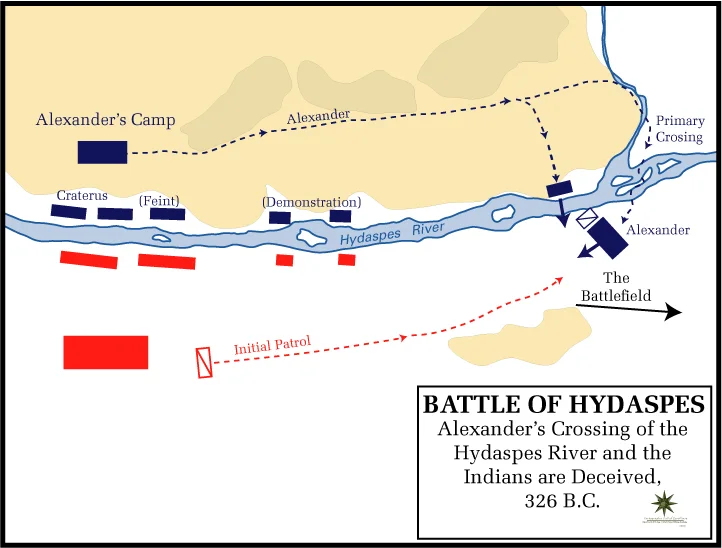
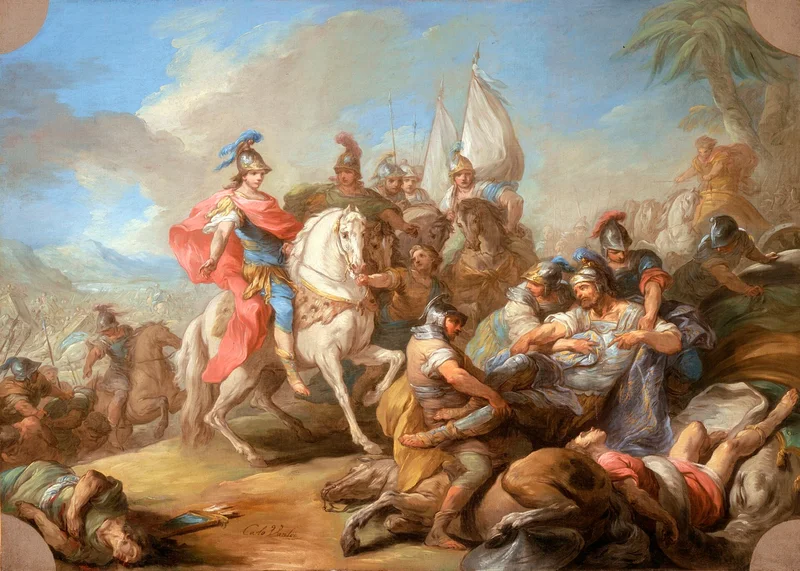
60 Alexander himself recorded in his letters how the campaign against the Indian king Porus unfolded.145 He says that the Hydaspes flowed between their camps and Porus kept constant watch on the crossing, with his elephants stationed opposite it. Day after day, therefore, Alexander had his camp make a great din and uproar, accustoming the Indians to it so that they would feel no alarm.
On a stormy night with no moon, he took some of the infantry and his finest cavalry, moved far from the enemy, and crossed to a small island. There rain fell in torrents, and many whirlwinds and thunderbolts struck the encampment; yet, although he saw some men being killed and burned up by lightning, he left the little island and headed for the far bank.
Storm-driven and swollen, the Hydaspes broke a great gap in its bank, and much of its current poured through it. The ground between gave them no firm foothold, slipping away and breaking up all around.
It was here, they say, that he exclaimed, “Athenians, would you believe what dangers I am enduring to earn your esteem?”
But Onesicritus is the source of that story.146
Alexander himself says they abandoned the rafts and crossed the breach in armor, wading to their chests. Once across, he rode twenty stades ahead of the infantry, reckoning that if the enemy attacked with cavalry he would prove greatly superior, but if they brought their phalanx forward his infantry would have time to join him. One of these things happened.
For when a thousand cavalrymen and sixty chariots engaged him, he routed them, took every chariot, and killed four hundred of the horsemen.
Porus then realized that Alexander himself was across the river and advanced with his entire force, apart from the men he left to obstruct the Macedonians who were crossing.
Alarmed by the elephants and the enemy’s numbers, Alexander himself charged at one wing and ordered Coenus, a Macedonian commander, to attack their right. Both wings broke, and the troops forced back kept retreating toward the elephants and crowding around them. From then on the fighting was a confused melee, and only at the eighth hour did the enemy abandon the struggle.147 This, then, is the account the battle’s author himself gives in his letters.
Most historians agree that Porus stood a span above four cubits148 and that his size and bulk made him as well proportioned to his elephant as a horseman to his horse. Yet the elephant was enormous.
It showed remarkable intelligence and care for the king, fiercely warding off and beating back assailants while Porus still had his strength; when it sensed that the mass of missiles and wounds had exhausted him, it feared he would slip off, gently lowered itself onto its knees, and used its trunk to grasp each javelin and ease it from his body.
When Porus was captured, Alexander asked what treatment he wanted.
“As befits a king,” he replied.
Alexander asked if he wanted to add anything.
“Everything is contained in ‘as befits a king.’”
Alexander therefore not only left him ruling his former realm as satrap149 but also added land he had conquered from independent peoples; it is said to have contained fifteen nations, five thousand substantial cities, and very many villages.
Over another territory three times as large he appointed Philip, one of the Companions, as satrap.
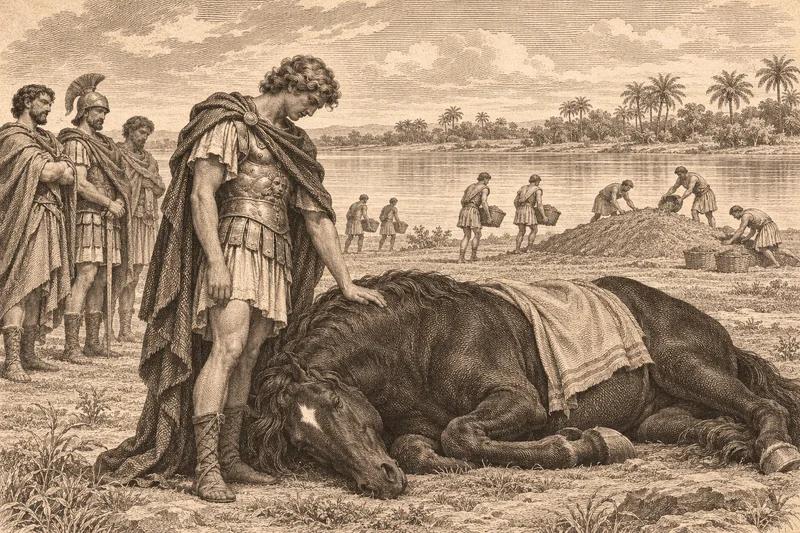
61 Bucephalas also died after the battle with Porus, though not immediately: according to most writers, he died later from his wounds while under treatment, but Onesicritus says old age had left him exhausted, for he was thirty when he died.
Alexander grieved deeply, feeling that he had lost a close companion and friend, and founded a city beside the Hydaspes in the horse’s memory, naming it Bucephalia.150
People also say that when he lost Peritas, a dog he had raised and loved, he founded a city named for the dog.
The writer Sotion says he heard the story from Potamon of Lesbos.151
62 The struggle with Porus, however, dulled the Macedonians’ courage and checked their further advance into India. For after barely repulsing Porus, who had faced them with twenty thousand infantry and two thousand horsemen, they fiercely resisted Alexander when he pressed them to cross the Ganges as well: they had learned that the river was thirty-two stades wide and a hundred fathoms deep,152 and that masses of armed men, horses, and elephants hid the opposite bank from view.
For the kings of the Gandarites and Praesii were said to be waiting with eighty thousand cavalry, two hundred thousand infantry, eight thousand chariots, and six thousand war elephants. And this was no boast.
For Androcottus,153 who became king not long afterward, gave Seleucus five hundred elephants and swept across all India with six hundred thousand troops, subduing the entire country.
So at first Alexander locked himself in his tent, where he lay in misery and anger, feeling no gratitude for what had been achieved unless he crossed the Ganges,y but regarding withdrawal as an admission of defeat.
But when his friends offered reasonable words of consolation and his soldiers stood at the entrance begging him with tears and cries, he relented and broke camp, devising many deceptive and sophistical ways of enhancing his fame.
For he had oversized armor and horse mangers made, along with heavier bits, and left them scattered behind him.
He also set up altars for the gods, and to this day the kings of the Praesii honor them and offer Greek sacrifices whenever they cross the river.
Androcottus, then a youth, saw Alexander himself, and he is said to have often remarked later that Alexander came very close to taking control of the country, because wickedness and low birth had made its king both hated and despised.
63 From there Alexander set out to see the outer sea.154 He had many oared transport boats and rafts built and let the rivers carry him slowly downstream. His voyage brought neither idleness nor peace: he landed, attacked cities, and conquered everything.
But among the people called the Mallians, said to be the most warlike people in India, he was nearly cut to pieces.
For he drove the men from the walls with missiles and was the first up a ladder onto the wall. When the ladder shattered and the Mallians standing beneath the wall began striking him from below, he crouched, with very few men beside him, and hurled himself into their midst, landing upright by chance.
As he brandished his weapons, the Mallians thought they saw a blaze and an apparition moving before his body. They therefore scattered in flight at first. But once they saw him with just two shield-bearers, they rushed him: some stabbed through his armor with swords and spears at close quarters as he fought back, while a man a little farther away shot an arrow from his bow with such driving force that it pierced the breastplate and lodged in the bones of his chest.
Alexander buckled under the blow, and the archer drew an Indian sword and charged. Peucestas and Limnaeus stepped in front of Alexander to defend him. Both were wounded; Limnaeus died, but Peucestas stood firm, and Alexander killed the Indian. After suffering many wounds and, last of all, a blow to the neck from a pestle, he braced himself against the wall and kept his eyes on his attackers.z
At this point the Macedonians poured around him, lifted him up, already unaware of his surroundings, and carried him to his tent. A report of his death immediately swept the camp.
With great difficulty and effort they sawed through the wooden arrow shaft and finally managed to remove his breastplate; then they began cutting out the arrowhead embedded in one of his bones. It is said to have measured three fingerbreadths across and four in length.155
Its removal therefore made him faint repeatedly and nearly killed him, but he recovered.
Though out of danger, he was still weak and spent a long time on a prescribed diet and treatment; when he heard the Macedonians clamoring outside in their longing to see him, he took up a cloak and appeared before them.
After sacrificing to the gods, he embarked again and continued downstream, conquering extensive territory and large cities.
64 He took ten Gymnosophists prisoner,156 those chiefly responsible for persuading Sabbas, the Indian ruler, to rebel and for causing the Macedonians the most trouble. They had a reputation for formidable, terse answers, so he set them puzzling questions. He threatened to execute first the man who gave an incorrect answer, and then the others in the same way. He appointed the oldest of them as judge.
He asked the first which were more numerous, in his view: the living or the dead.
“The living,” he replied, “because the dead no longer exist.”
The second had to say whether land or sea bred the bigger animals.
“The land,” he answered, “because the sea forms part of it.”
He asked the third which animal was most cunning.
“The one human beings have yet to discover,” he said.
When he questioned the fourth about his reason for making Sabbas rebel, the answer was: “I wanted him to live honorably or die honorably.”
He asked the fifth whether he thought day or night had come first.
“Day,” he said, “by one day.”157 When the king expressed surprise, he added that puzzling questions must have puzzling answers.
Turning to the sixth, Alexander asked how someone could win the greatest love.
“By having the greatest power without inspiring fear,” he said.
Of the three left, one was asked how a mortal could become a god.
“By accomplishing what no human being can accomplish,” he said.
Another was asked whether life or death was stronger.
“Life,” he replied, “since it bears so many miseries.”
To the last he put the question of how long a man should live.
“As long as he does not think death better than life.”
Then Alexander turned to the judge and ordered him to pronounce his verdict.
He declared that each had answered worse than another.157
“Then you will be the first to die,” said Alexander, “for judging like that.”
“Not so, King,” he replied, “unless you lied when you said you would first execute whoever answered worst.”
65 So he gave them gifts and let them go, but sent Onesicritus to the sages with the highest reputations, who lived quietly on their own, to ask them to visit him. Onesicritus was a philosopher who had studied with the Cynic Diogenes.158
Onesicritus says that Calanus159 ordered him with great insolence and harshness to remove his tunic and listen to him naked, refusing otherwise to speak to him even if he came from Zeus, whereas Dandamis was gentler and, after hearing at length about Socrates, Pythagoras, and Diogenes, said they seemed naturally gifted to him but had lived in too much awe of the laws.
Others say Dandamis said nothing beyond this: “What made Alexander come so far to get here?”
Taxiles did, however, persuade Calanus to visit Alexander. His name was Sphines, but he greeted everyone he met with the Indian word cale instead of “greetings,” so the Greeks called him Calanus.
He is also said to have shown Alexander an image of his empire.
For he laid a dried, stiffened hide in their midst and put his foot on its edge. Pressed down at that point, it rose elsewhere. He went around it, pressing down one part after another and showing the same thing happening, until he stood in the center and held it down; then the whole hide lay still. The image was meant to show that Alexander should press hardest on the center of his empire and not wander far away.
66 The river journey to the sea lasted seven months. Taking his ships into Ocean, he sailed to an island he named Scillustis, though others called it Psiltucis. After landing there he sacrificed to the gods and examined the sea and coastline as far as he could. Then he prayed that no one after him would go beyond the limits of his expedition, and turned back.
He ordered the ships to sail around with India on their right, with Nearchus in command and Onesicritus as chief helmsman,160 while he himself went overland through the territory of the Oreites. He suffered desperate shortages and such heavy losses that he brought back less than a quarter of his fighting force from India. Yet he had had one hundred twenty thousand infantry and fifteen thousand cavalry.
But severe illnesses, wretched food, and parching heat killed them, with famine taking the greatest number. They were crossing uncultivated country whose inhabitants led miserable lives and owned only a few poor sheep. Accustomed to feeding on sea fish, these had foul, stinking flesh.
So he struggled across this country in sixty days, and on reaching Gedrosia immediately had everything in abundance, supplied by the nearest satraps and kings.
67 So, after letting his army recover here, he set off through Carmania in a revel that lasted seven days.161 Eight horses drew him slowly along as he and his Companions feasted without pause, day and night, on a dais fixed to a high, conspicuous rectangular frame, while countless wagons followed, carrying his other friends and commanders, wreathed and drinking: some were shaded by purple and embroidered coverings, others by leafy branches kept fresh and green.
You would have seen no light shield, no helmet, no pike; instead, all along the road the soldiers dipped bowls, rhyta, and Thericlean cups161 into great jars and mixing bowls and drank to one another, some while marching, others reclining. Music filled the air everywhere: panpipes and flutes, singing and plucked strings, and the Bacchic revels of women.
This disorderly, meandering march also had its wanton Bacchic games, as though the god were there in person accompanying the revel.
When he reached the royal residence in Gedrosia, he again let the army recover, holding a festival.
According to one account, he was drunk while watching a contest between choruses, and his beloved Bagoas won with his dancing, then walked across the theater in his finery and sat beside him. The sight set the Macedonians clapping and shouting for Alexander to kiss him, until he embraced him and kissed him warmly.
68 Here Nearchus and his men came inland to join him. Alexander was delighted, and after hearing the full story of their voyage, he wanted to sail the Euphrates downstream with a great fleet, then around Arabia and Libya and through the Pillars of Heracles into the inner sea.162 Ships of every kind were under construction near Thapsacus, and sailors and helmsmen were being brought together from all quarters.
But the hardships of the inland campaign, his wound among the Mallians, and reports of heavy losses in the army led men to doubt that he had survived: his subjects were stirred to revolt, and his generals and satraps indulged in widespread injustice, greed, and insolence. Altogether, unrest and revolution spread everywhere.
Even Olympias and Alexander’s sister Cleopatra had risen against Antipater and divided the realm: Olympias took Epirus, Cleopatra Macedonia. Alexander said on hearing this that his mother had chosen better, for the Macedonians would not endure a woman’s rule.
He therefore sent Nearchus out to sea again, determined to fill the entire coast with war, while on his own journey down he punished the corrupt generals.
He personally killed Oxyartes, one of Abulites’s sons, running him through with a pike, but when Abulites brought him only three thousand talents in coined money without having provided any of the essentials, he ordered the silver laid before the horses. When they would not taste it, he said, “What use to us, then, are these provisions of yours?” and imprisoned Abulites.
69 In Persia he first paid the women the customary money: whenever the kings visited, they gave each woman a gold piece. For this reason, they say, some kings rarely visited Persia, and Ochus163 never went there at all, so miserly that he made himself an exile from his homeland.
Then he found Cyrus’s tomb broken open and had the culprit executed, although the man, Polymachus, was a Pellaean of some standing. He read the inscription and ordered a copy cut beneath it in Greek letters.
It said: “Man, whoever you are, wherever you have come from—for I know you will come—I am Cyrus, who gained the Persians their empire. So do not begrudge me this scant earth that encloses my body.”
These words moved Alexander deeply as he reflected on uncertainty and change.
Here Calanus, who had been troubled for a short time by a bowel complaint, asked for a pyre to be built for him. He was brought to it on horseback, prayed, poured a libation over himself, and offered some of his hair. As he climbed onto the pyre, he clasped hands with the Macedonians present and urged them to spend that day in pleasure and get drunk with the king; he said he would soon see the king himself in Babylon.
After these words he lay down and covered himself. As the flames drew near, he did not stir: he kept the position in which he had lain down and made an auspicious sacrifice of himself, following the ancestral custom of the sages of that country.
Many years later another Indian did the same at Athens while accompanying Caesar;164 people still show his monument and call it “the Indian’s tomb.”
70 After leaving the pyre, Alexander gathered many of his friends and commanders for dinner and announced a contest in drinking unmixed wine, with a crown as the prize. Promachus drank the most, reaching four choes;165 he received the victor’s crown, worth a talent, and survived another three days.aa
Chares says that forty-one of the other drinkers died when intense cold overtook them in their drunkenness.
At Susa he celebrated his Companions’ marriages—himself marrying Darius’s daughter Stateira and giving the noblest women to the noblest men—and held a further joint wedding feast for the Macedonians already married, at which, they say, nine thousand guests were invited and each received a gold bowl for libations166; he displayed astonishing splendor in every other respect too and himself paid the creditors what the debtors owed, the entire outlay falling one hundred thirty talents short of ten thousand.
Antigenes the One-eyed falsely registered himself as a debtor, brought a man to the bank who claimed to have lent him money, and had the sum paid out. When his lie came to light, the king angrily banished him from court and stripped him of his command.
But Antigenes was outstanding in war. As a young man, during Philip’s siege of Perinthus, he was hit in the eye by a catapult bolt, but would neither let anyone remove it nor leave the fight until he had driven the enemy back in battle and shut them inside the walls.
He therefore took his present disgrace very hard; grief and despair had clearly brought him to the point of killing himself. Fearing this, the king put aside his anger and told Antigenes to keep the payment.
71 The thirty thousand boys he had left behind to study and train now appeared strong in body and handsome in looks, and displayed remarkable ease and agility in their exercises; Alexander was delighted, but the Macedonians were dejected and afraid that their king would pay them less attention.
Therefore, when he sent the weak and maimed down to the coast, they called it an insult and an outrage: after wearing men out in every kind of service, he was now discarding them in disgrace and throwing them back on their homelands and parents, no longer as he had received them. They therefore told him to dismiss them all and judge all Macedonians useless, since he had these young Pyrrhic dancers,167 with whom he would march out and conquer the inhabited world.
Alexander took this badly and in his anger poured abuse on them. He drove them away and gave the guard posts to Persians, appointing his bodyguards and rod-bearers from their ranks.167
When the Macedonians saw these men escorting him while they themselves were shut out and insulted, they were humbled; on reflection, they realized that jealousy and anger had almost driven them mad.
At last they came to their senses and approached his tent unarmed, wearing only tunics.168 With shouts and tears they placed themselves in his hands and asked him to treat them as base, ungrateful men. He refused to receive them, though he was already softening. They would not leave, but endured two days and nights standing there like this, lamenting and calling on him as their lord.
He came out on the third day and, seeing them so pitiable and humbled, wept for a long time. Then he reproached them mildly, spoke kindly to them, and discharged the men no longer fit for service with magnificent gifts. He wrote to Antipater that they were to sit wearing wreaths in places of honor at the front, at every contest and in every theater. He also put the orphan children of dead soldiers on the pay lists.
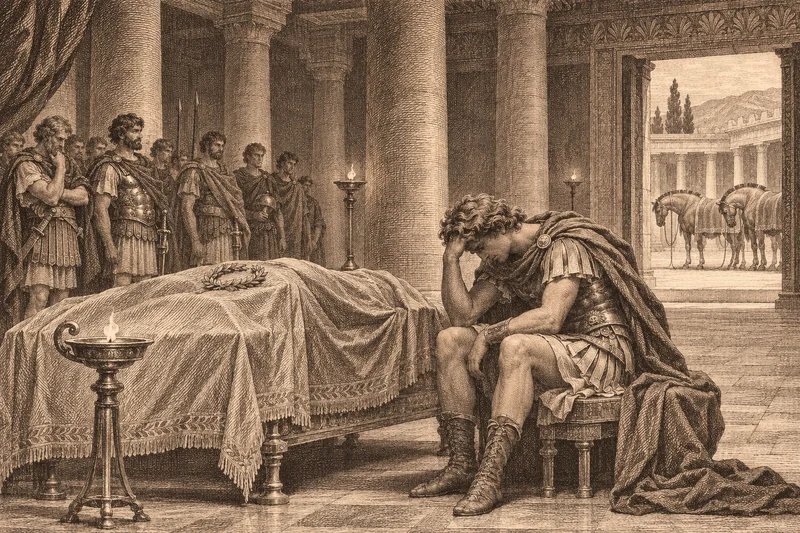
72 After reaching Ecbatana in Media and settling the urgent business, he returned to theaters and festivals, for three thousand performers had arrived from Greece.
Hephaestion happened to have a fever at the time. But as a young soldier he could not bear a strict regimen, and the moment his physician Glaucus left for the theater, he ate a boiled rooster for breakfast, drained a large cooling bowl of wine, fell gravely ill, and died soon afterward.
Alexander’s grief over this loss was beyond all reason. He immediately ordered all the horses and mules clipped in mourning and stripped the neighboring cities of their battlements.169 He crucified the wretched physician and, for a long time, forbade flutes and every other kind of music in the camp, until an oracle from Ammon directed him to honor Hephaestion as a hero and offer sacrifices to him.169
Seeking relief from grief in warfare, he went out as though to hunt and track human beings and conquered the Cossaean people, slaughtering every male past boyhood. This was called a funeral offering to Hephaestion.169
He intended to devote ten thousand talents to the tomb, the funeral, and everything adorning them, and wanted the design’s artistry and originality to surpass its cost; of all the craftsmen, he most wanted the designer Stasicrates, who promised grandeur, daring, and ostentation in his innovations.
For on an earlier occasion Stasicrates had told him that no mountain lent itself better than Athos in Thrace to being shaped into a human figure.170 If Alexander gave the order, he would fashion Athos into a statue for him, the most enduring and conspicuous of all, cradling in its left hand a city inhabited by ten thousand people, and pouring a river from its right as a libation, in a plentiful stream down to the sea.ab
Alexander had declined that offer, but now spent his time devising and planning with his craftsmen things far stranger and more costly.
73 As Alexander advanced toward Babylon, Nearchus, who had rejoined him after sailing through the great sea into the Euphrates, said he had met some Chaldaeans who urged Alexander to stay away from Babylon.171 He paid no attention and went on; near the walls, he saw many ravens fighting and striking one another, some falling beside him.
Next came a report that Apollodorus, the commander at Babylon, had offered a sacrifice concerning him, and he summoned Pythagoras the seer. When Pythagoras did not deny what he had done, Alexander asked what the sacrificial signs had been.
Pythagoras said the liver had no lobe.171
“Ah!” said Alexander. “A powerful sign.”
He did Pythagoras no harm, but regretted ignoring Nearchus. He spent most of his time camping outside Babylon and sailing about the Euphrates.
Many signs troubled him. For a tame donkey attacked the largest and most beautiful of the lions he kept and kicked it to death.
Another time he stripped to be rubbed with oil and was playing ball; when the time came to dress again, the young men playing with him saw someone sitting silently on the throne in the royal robe and diadem.
When asked who he was, the man remained speechless for a long time.
At last he recovered his senses: he was called Dionysius, he said, and was Messenian by birth. He had been brought here from the coast on the grounds of some charge against him and had spent a long time in chains. Just now, the god Sarapis171 had appeared before him, released his chains, led him here, and ordered him to wear the robe and diadem, take his seat, and say nothing.
74 After hearing this, Alexander had the man put to death, as the seers directed, but he himself grew despondent, now despaired of the divine, and became suspicious of his friends. He most feared Antipater and his sons: Iolas served as chief cupbearer, while Cassander had only recently arrived.
When Cassander saw some barbarians prostrating themselves, having been raised as a Greek and never seen anything of the kind, he laughed rather rashly.
Alexander flew into a rage, gripped Cassander’s hair with both hands, and slammed his head hard against the wall.
Later, when Cassander tried to say something in answer to the men accusing Antipater, Alexander cut him off.
“What are you saying—that these men have traveled so far without suffering any wrong, merely to bring false charges?”
Cassander replied that their very distance from the evidence was a sign that their charges were false. Alexander laughed aloud.
“Those sophistries of Aristotle’s pupils,” he said, “arguments for either side! You will howl if you turn out to have wronged these men in the slightest.”
They say that fear entered Cassander’s soul with such force and stained it so indelibly that, many years later, when he was already king of the Macedonians and ruler of Greece, the sudden sight of Alexander’s image while he was walking through Delphi and examining the statues made him shudder and shake all over; dizzy at the sight, he could barely recover.
75 Alexander had now yielded to his fears about the divine, and his mind was so troubled and anxious that he turned every strange or unusual occurrence, however small, into a portent and a sign; the palace was full of men making sacrifices, performing purifications, and practicing divination.
It is terrible, then, to disbelieve in the divine and treat it with contempt, but superstition is terrible too: like water that always runs down to lower ground, it filled Alexander, now terrified, with folly.
Nevertheless, when the god’s oracles about Hephaestion arrived, he set his grief aside and again turned to sacrifices and drinking.
He gave Nearchus and his companions a lavish dinner, then bathed, as he usually did before sleep. At Medius’s invitation, he went to revel with him.
He drank there throughout the following day and developed a fever; he had neither drained a cup of Heracles nor suddenly felt agonizing pain between the shoulders as though a spear had struck him, but some writers thought they had to include these details, fabricating, as though for a great drama, a tragic and moving finale.
Aristobulus says that, while suffering a raging fever, he became desperately thirsty and drank wine; this brought on delirium, and he died on the thirtieth of Daesius.
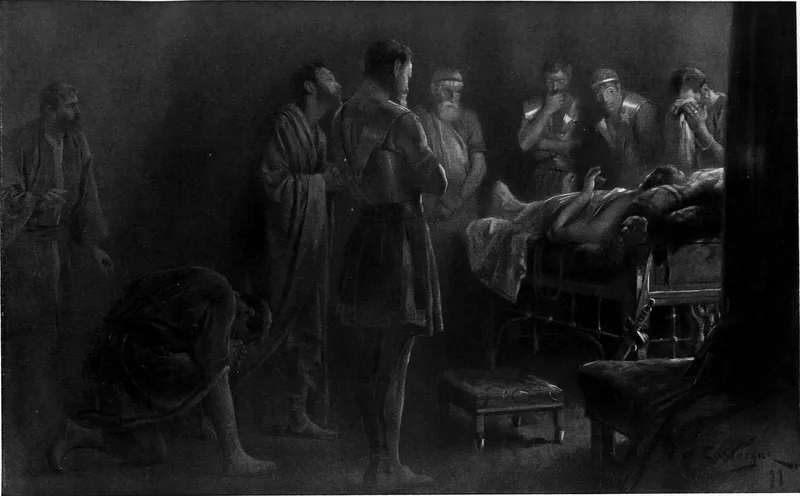
76 The journals record his illness as follows.172 On the eighteenth of Daesius, a fever led him to sleep in the bathing room.
The next day he bathed, moved to his bedroom, and played dice with Medius all day.
Then, late in the day, he bathed, made his sacrificial offerings to the gods, and ate; throughout the night he was feverish.
On the twentieth he bathed once more and made the customary sacrifice, then lay in the bathing room and gave his time to Nearchus and his men, listening to their account of the voyage and the great sea.
The twenty-first followed the same pattern, but his fever burned higher.ac
He had a bad night, and all the next day the fever remained fierce.
He was moved to lie beside the great pool; there he discussed with his officers how to select and appoint men to lead the units without commanders.
On the twenty-fourth, though the fever was fierce, he was carried to the sacrifices and performed them. He told his senior commanders to remain in the courtyard, and the taxiarchs and pentacosiarchs172 to spend the night outside.
They carried him to the palace across the river on the twenty-fifth, where he slept briefly, though the fever stayed with him.
When the commanders came, he could not speak; the twenty-sixth found him in the same state.
The Macedonians therefore believed him dead. They came to the doors shouting and threatening the Companions until they made them give way. The doors were opened, and they all passed his bedside in single file, wearing their tunics.
That day Python, Seleucus, and their companions were sent to the sanctuary of Sarapis to ask whether they should bring Alexander there.
The god’s answer was to leave him in place.
He died toward evening on the twenty-eighth.
77 Most of this is set down in precisely these words in the journals.
No one suspected poisoning at the time, but in the sixth year afterward, they say, information was brought forward and Olympias executed many men and cast out the remains of Iolas, who was already dead, alleging that he had poured in the poison.
Those who say Aristotle advised Antipater on the deed and that the poison was supplied entirely through Aristotle cite a certain Hagnothemis, who, they say, told the story after hearing it from King Antigonus. According to this account, the poison was icy cold water from a certain rock at Nonacris, gathered like a fine dew and stored in a donkey’s hoof; no other container could hold it, for its cold and biting force broke through them all.
But most regard the entire poisoning story as a fabrication, and they have substantial evidence: during the strife among the commanders his body lay untended for many days in hot, stifling places, yet showed no trace of such decay, remaining clean and fresh.
Roxana happened to be pregnant and was honored by the Macedonians for that reason, but in her bitter jealousy of Stateira she lured her into coming with a forged letter. Once she had her there, she killed both her and her sister, dropped both bodies into a well, and filled it with earth. Perdiccas knew of this and helped her.
For he immediately held the greatest power, dragging Arrhidaeus along with him like a mute extra playing the king.ad
Arrhidaeus was born to Philinna, an obscure, common woman,ae and a bodily illness had stunted his understanding. This illness had not arisen naturally or spontaneously; on the contrary, they say that as a boy he plainly showed a winning character with no lack of nobility, but later Olympias harmed him with poisons and destroyed his mind.


