1 It would mean a great deal to me, gentlemen,1 if you judged me in this case as you would judge yourselves if you had suffered the same thing. For I know very well that if you took the same view of others as of yourselves, every one of you would be angry at what has happened, and you would all think the penalties for men who do such things too light. 2 This would be the view not just among you but throughout Greece,2 because for this wrong alone, under both democracy and oligarchy, the weakest can exact the same punishment from the most powerful, so that the lowest stands on the same footing as the highest. So, gentlemen, everyone considers this outragea the most dreadful of all. 3 As for the severity of the penalty, then, I think you all share the same view, and none of you is so indifferent as to think that those responsible for such acts should be forgiven or deserve only a light penalty.
But I think, 4 gentlemen, that I must show that Eratosthenes3 seducedb my wife and corrupted her, disgraced my children, and committed an outrage against me by entering my house; that there was no other hostility between us; and that I did this neither for money, to turn myself from a poor man into a rich one, nor for any other gain except punishment in keeping with the laws.
5 So I will give you the whole story of my affairs from the beginning, leaving nothing out and telling the truth, because I believe my only hope of saving myself is to tell you everything that happened, if I can.
6 For, Athenians,c when I decided to marry4 and brought a wife into my house, at first I behaved so as neither to upset her nor to give her too much freedom to do whatever she wanted. I watched her as closely as I could and kept an eye on her, as was reasonable.
But when a baby5 was born to me, I began to trust her and put everything of mine in her hands, thinking a childd was the strongest bond between us.
At first, then, 7 Athenians, she was the best of all wives: she was a capable, thrifty housekeeper and managed everything carefully.
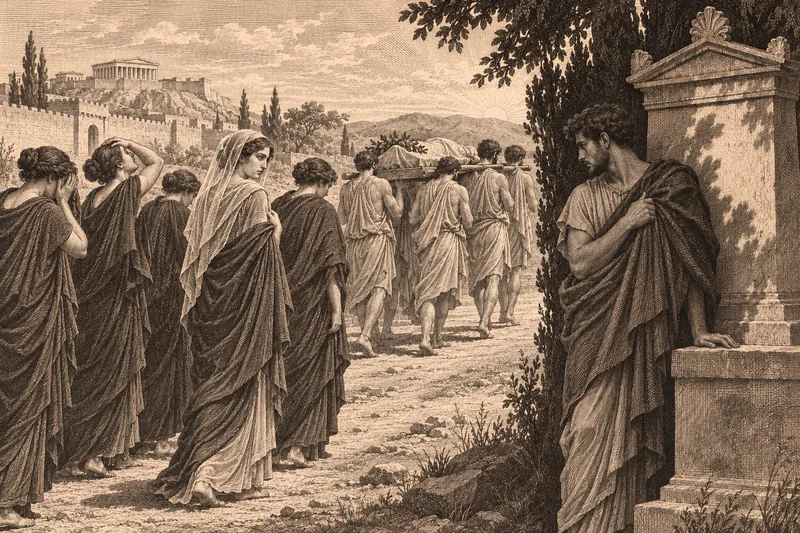
But when my mother6 died, her death became the cause of all my troubles. 8 For this man saw my wife following the funeral procession7 and in time corrupted her: he watched for the slave woman8 on her way to the marketplace9 and, by making overtures, brought my wife to ruin.
9 First, gentlemen—for I need to tell you these details too—I have a small house with two floors, with equal space upstairs and downstairs for the women’s rooms10 and the men’s rooms. When our baby was born, his mother nursed him.e So that she would not risk falling as she went down the stairs whenever he needed a bath, I lived upstairs, and the women downstairs.f 10 This became so usual that my wife often went downstairs to sleep beside the baby, to give him the breast and keep him from crying. Things went on like this for a long time, and I never suspected anything, but was so foolish that I thought my wife was the most faithful woman in the city.
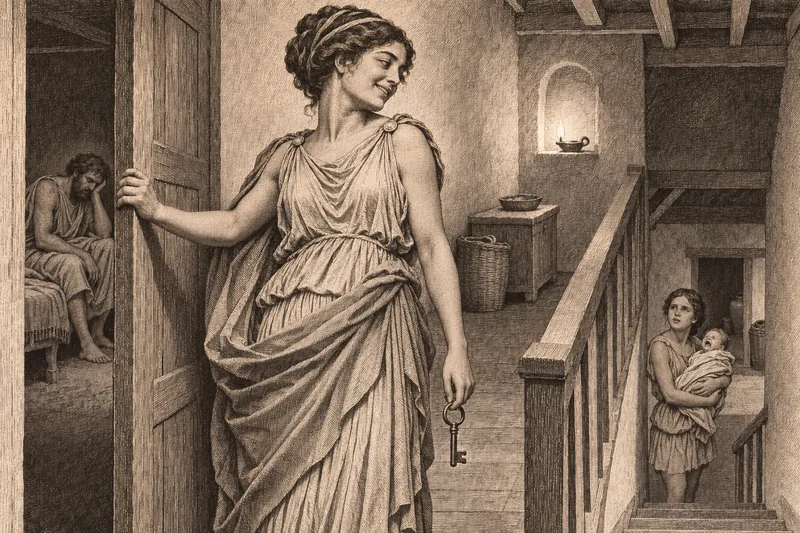
11 As time passed, gentlemen, I came home unexpectedly from the farm. After dinner the baby was crying and fussing, because the slave woman was deliberately upsetting him to make him do so: the man was in the house— 12 I learned all this later. I told my wife to go and give the baby the breast so that he would stop crying. At first she refused, as though she were delighted to see me home after a long absence. But when I grew angry and told her to go, she said, “So you can make advances to the slave girl here! You were dragging her aroundg before, too, when you were drunk.”
I laughed, 13 while she got up and went out, shut the door, pretending it was a joke, and took the key with her.h I gave it no thought and suspected nothing; after coming home from the farm, I was glad to sleep.
14 Toward daybreak she came and opened the door. When I asked why the doors had made a noise in the night, she said the lamp by the baby had gone out, and she had then relit it at the neighbors’. I said nothing and believed that was what had happened. But I thought she had white-lead makeup11 on her face, gentlemen, although her brother had been dead less than thirty days.i Even so, I said nothing about it and left the house in silence.
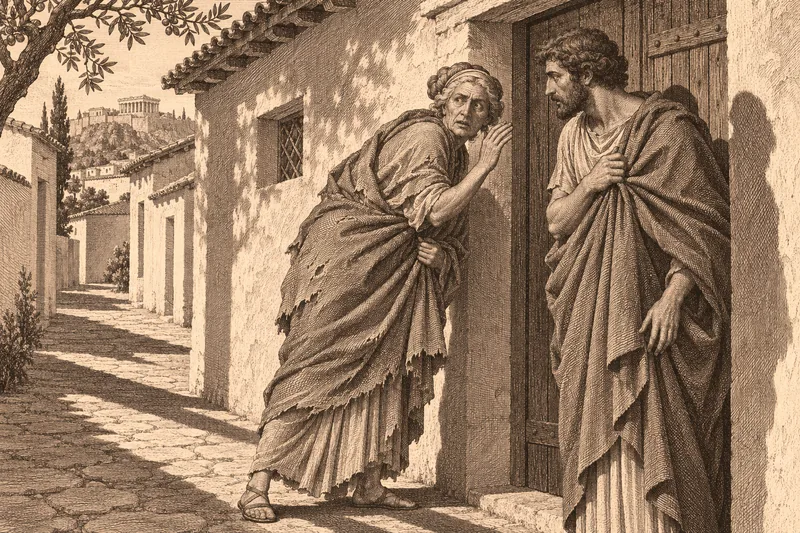
15 Some time after this, gentlemen, while I was still quite unaware of my troubles, an old woman12 came up to me. She had been sent secretly by a woman13 Eratosthenes had seduced, as I heard later. This woman was angry and felt wronged because he no longer visited her as before, and she kept watch until she discovered the reason.
So the old woman watched for me near my house, came up to me, and said, “Euphiletus,14 don’t think I have come to you out of any desire to meddle: 16 the man who is committing this outrage against you and your wife happens to be an enemy of ours. So if you take the slave woman who goes to the marketplace and serves you, and question her under torture,15 you will find out everything. The man doing this,” she said, “is Eratosthenes of Oe,16 who has corrupted not only your wife but many others too: that is his craftj.”
17 After saying this, gentlemen, she left, but I was immediately shaken. Everything came into my mind, and I was full of suspicion. I thought of how I had been locked in the bedroom, remembered that the inner and outer doors had made a noise that night, which had never happened before, and that I had thought my wife was wearing white-lead makeup. All this came into my mind, and I was full of suspicion.
18 I went home and told the slave woman to follow me to the marketplace. I took her to one of my friends and told her I had found out everything that was happening in the house. “So,” I said, “you can choose whichever of two things you like: to be whipped and sent to the mill,17 never to be free of suffering like this, or to tell the whole truth, suffer no harm, and have my forgiveness for what you have done wrong. Don’t tell any lies; tell the whole truth.”
19 At first she denied it and told me to do whatever I liked, because, she said, she knew nothing. But when I mentioned Eratosthenes and said he was the man visiting my wife, she was terrified, thinking I knew everything exactly. Then she fell at my knees18 20 and got my promise that she would suffer no harm. She revealed how he had first approached her after the funeral, how she had finally brought his message to my wife, how my wife had been persuaded in time, by what means she let him in, and how my wife had gone to the sanctuary with his mother19 at the Thesmophoria20 while I was at the farm. She gave a detailed account of everything else that had happened.
When she had told me everything, 21 I said, “Then make sure no one hears of this. Otherwise, nothing we have agreed on will hold. I want you to let me see them in the act, because I have no use for words: I want the deed itself made plain, if things really are like this.” 22 She agreed to do this.
Four or five days passed after that, ⟨…⟩k as I will show you with strong evidence. First, though, I want to tell you what happened on the last day.
Sostratus21 was a close friend of mine. I met him coming in from the country after sunset. 23 Knowing that he would find none of his friends at home when he arrived at that hour, I invited him to eat with me. We came to my house, went upstairs, and had dinner. When he was satisfied, he left, and I went to sleep.
Eratosthenes came in, gentlemen, and the slave woman woke me and told me at once that he was inside. I told her to look after the door, went silently downstairs and out, and called on one friend after another. I found some at home, but others were out of town. 24 I took as many as I could of those who were there and set off. We got torches from the nearest shop and went in; the slave woman had opened the door and made it ready. We pushed open the bedroom door: those of us who went in first saw him still lying beside my wife, while those who came after saw him standing naked on the bed.
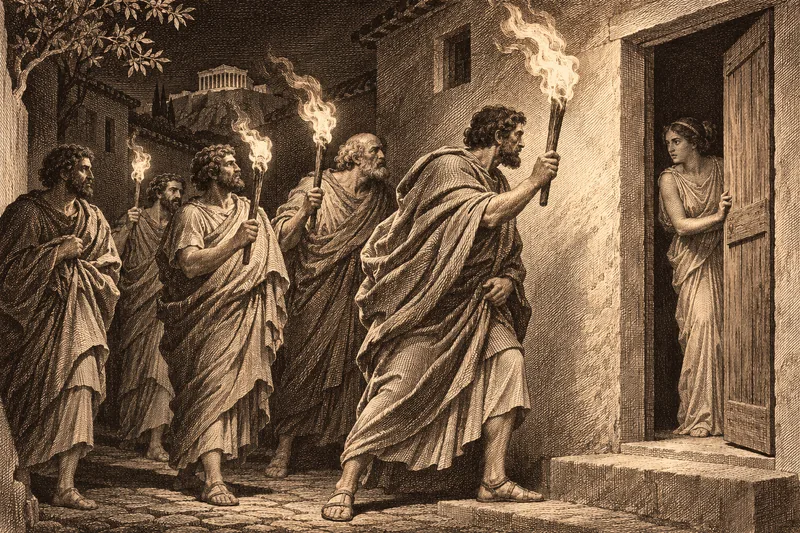
25 I struck him, gentlemen, and knocked him down. I pulled his hands behind his back and tied them, and asked why he was committing this outrage by coming into my house. He admitted he was in the wrong, but begged and pleaded with me not to kill him and to take money22 instead.
But I said, “It is not I who will kill you, 26 but the law of the city, which you broke and valued less than your pleasures, choosing to commit this offense against my wife and my children rather than obey the laws and behave decently.”
27 So, gentlemen, he suffered what the laws prescribe for men who do such things. He was not dragged in from the street, nor did he take refuge at the hearth,23 as these men say. For how could he have, when he fell as soon as I struck him in the bedroom, I twisted his hands behind his back, and so many men were inside that he could not escape them? He had no blade, no club, nothing else with which he could have fought off the men who had come in.
28 But I think you know too, gentlemen, that people who act unjustly will not admit that their enemies are telling the truth, but lie and use tricks like these to make their listeners angry with those who act justly. So first, read the law.
Eratosthenes did not dispute it, gentlemen, but admitted he was in the wrong; he begged and pleaded not to die and was ready to pay money. But I would not agree to the amount he proposed: I insisted that the law of the city should have greater authority, and I obtained the redressl you considered most just and prescribed against men who do such things. Now, witnesses25 to this, come forward.
30 [Witnesses]
Read me this other law too, the one from the pillar on the Areopagus.26
[The law is read]
You hear, gentlemen, that the court of the Areopagus itself, charged with trying murder cases both by ancestral right and in our own time, is expressly told not to convict of murder a man who catches an adulterer with his own wife and inflicts this punishment. 31 And so firmly did the lawgiver27 consider this right in the case of wedded wives that he prescribed the same redress in the case of concubines,28 who have lower standing. Yet it is clear that if he had had a harsher punishment than this in the case of wedded wives, he would have imposed it. But since he could find no harsher punishment in their case, he thought the same should apply to concubines too. Read me this law as well.
32 [The law is read]
You hear, gentlemen, that it orders anyone who violates a free adult or childm by force to pay double damages;29 if he does this to a woman in one of the cases where killing is allowed, he is liable to the same penalty. Thus, gentlemen, the lawgiver considered those who use force deserving of a lighter penalty than those who persuade: he condemned those who persuade to death, but set double damages for those who use force. For he thought that those who act by force are hated by those they have used force against, 33 while those who persuade so corrupt the women’s souls that they make other men’s wives more attached to themselves than to their husbands, gain control of the entire household, and leave it uncertain whether the husbands or the adulterers have fathered the children. That is why the lawgiver made death their penalty.
34 So, gentlemen, the laws have not only acquitted me of wrongdoingn but have also ordered me to obtain this redress; it is for you to decide whether they are to have force or count for nothing. 35 For I think every city makes laws so that, whenever we are uncertain about something, we can turn to them and find out what we must do. These laws, then, tell those who have been wronged in such cases to obtain this redress. 36 I ask you to take the same view as they do. Otherwise, you will give adulterers such freedom from punishment that you will encourage thieves30 to call themselves adulterers too, since they will know very well that if they claim to be adulterers and say they enter other men’s houses for that purpose, no one will touch them. For everyone will know that they must put the laws on adultery aside and fear your vote instead, because it has greater authority than anything else in the city.
37 But consider this, gentlemen: they accuse me of telling the slave woman on that day to go and fetch the young man. In the case of the man who had corrupted my wife, gentlemen, I would have thought myself justified 38 in catching him by any means at all. For if I had sent for him when words had been spoken but nothing done, I would have been doing wrong; but if I had caught him by any means at all after everything had happened and he had come into my house many times, I would have thought I was acting sensibly.
39 But consider that they are lying about this too. You will see it easily from this: as I told you before, gentlemen, Sostratus was a friend of mine and we were close; we met as he was coming in from the country around sunset, and he ate with me. When he was satisfied, he left.
40 Now first, gentlemen, consider this: if I had been plotting against Eratosthenes that night, which would have been better for me—to eat somewhere else myself, or to bring someone home to eat with me? For that would have made Eratosthenes less ready to venture into the house. Then do you think I would have let my dinner guest go, leaving myself alone and without help, or told him to stay so he could join me in punishing the adulterer?
41 Next, gentlemen, don’t you think I would have sent word to my friends in the daytime and told them to gather at the nearest friend’s house, rather than run around at night the moment I found out, not knowing who would be home and who would be out? I went to see Harmodius31 and so-and-so,o who were out of town—I hadn’t known—and found others not at home. I took whoever I could and set off.
42 Yet if I had known beforehand, don’t you think I would have got slaves ready and sent word to my friends, so I could go in as safely as possible—for how did I know whether he too had a blade?—and carry out the punishment with as many witnesses as possible? As it was, I knew nothing of what was going to happen that night and took with me whoever I could. Now, witnesses to this, come forward.
43 [Witnesses]
You have heard the witnesses, gentlemen. Now consider the case for yourselves in this way: ask whether there has ever been any hostility between Eratosthenes and me apart from this. You will find none: 44 he had never brought a malicious public prosecution32 against me, tried to drive me out of the city, or sued me privately; he knew of no wrongdoing of mine that made me want to kill him for fear someone might discover it; nor did I hope to get money from anywhere if I did this. For some people plot one another’s deaths for reasons like these.
45 In fact, we were so far from having traded insults or had a drunken quarrel or any other dispute that I had never even seen the man before that night. What would I have been trying to achieve, then, by running such a risk if he had not done me the greatest wrong of all? 46 And would I have committed an impious act33 with witnesses I had called in myself, when, if I really wanted to kill him wrongfully, I could have kept every one of them from knowing?
47 So, gentlemen, I do not think this punishment was a private one, on my own behalf, but one on behalf of the whole city. For men who do such things will commit fewer offenses against others when they see what prizesp await offenses like these, if they see that you too take the same view.
48 Otherwise, it would be far better to erase the existing laws and make others that impose the penalties on men who watch over their own wives and give men who want to offend against them plenty of freedom from punishment. 49 That would be far more just, after all, than letting the laws set a trap for citizens: the laws tell a man who catches an adulterer to treat him however he likes, yet trials have become more dangerous for those who are wronged than for those who dishonor other men’s wives in defiance of the laws. 50 For I now risk my life, my property, and everything else because I obeyed the laws of the city.