His accusers were persuasive. He calls them liars.
Clear modern English. Nothing lost. Nothing softened.
Start with our modern Apology for a defense you can hear: sharp, direct, and ready to challenge the people who hold Socrates’s life in their hands.
“Apology” here means a defense: this is the speech Socrates gave at his trial.
The accusation lands.
Our translation · Apology 17a
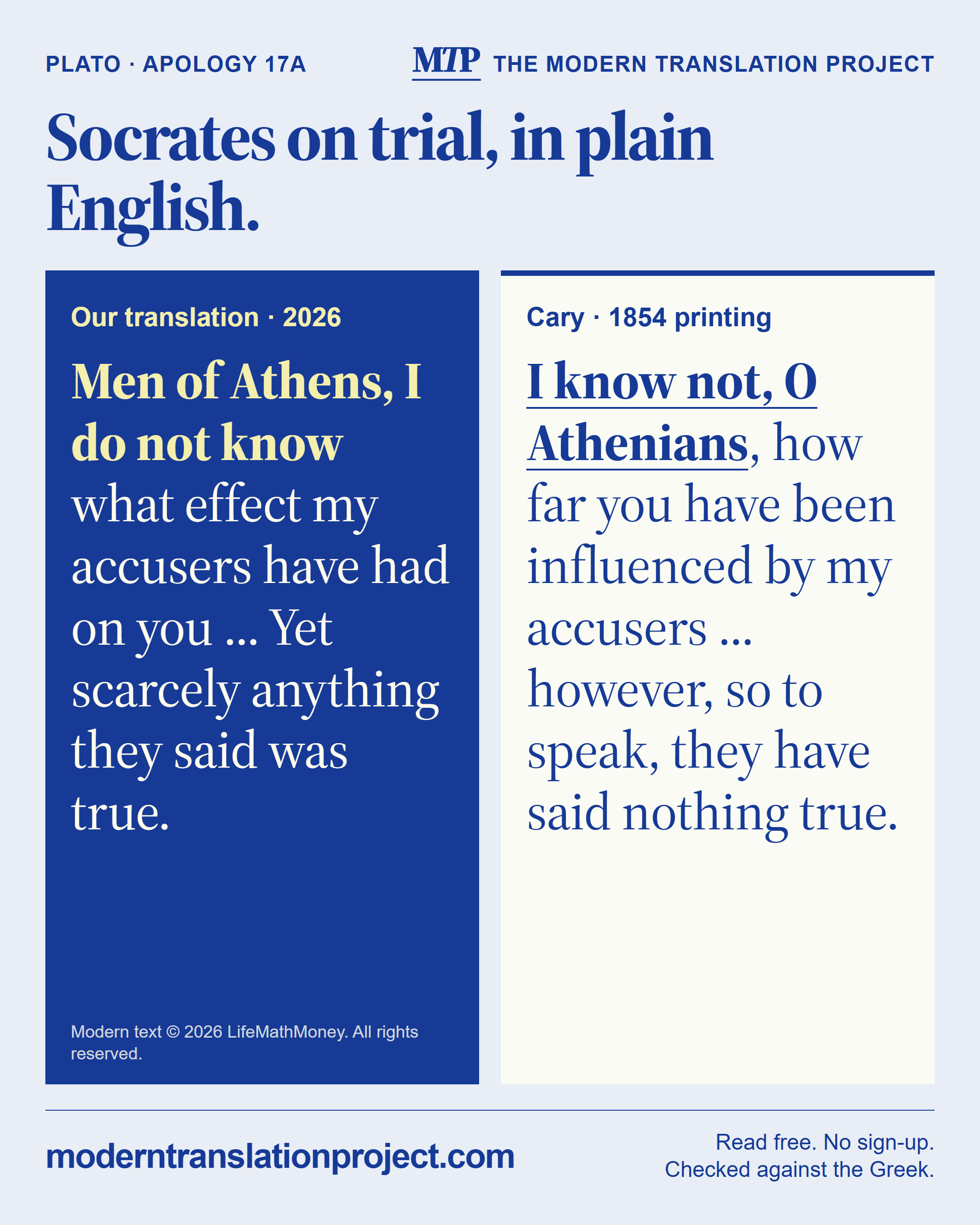
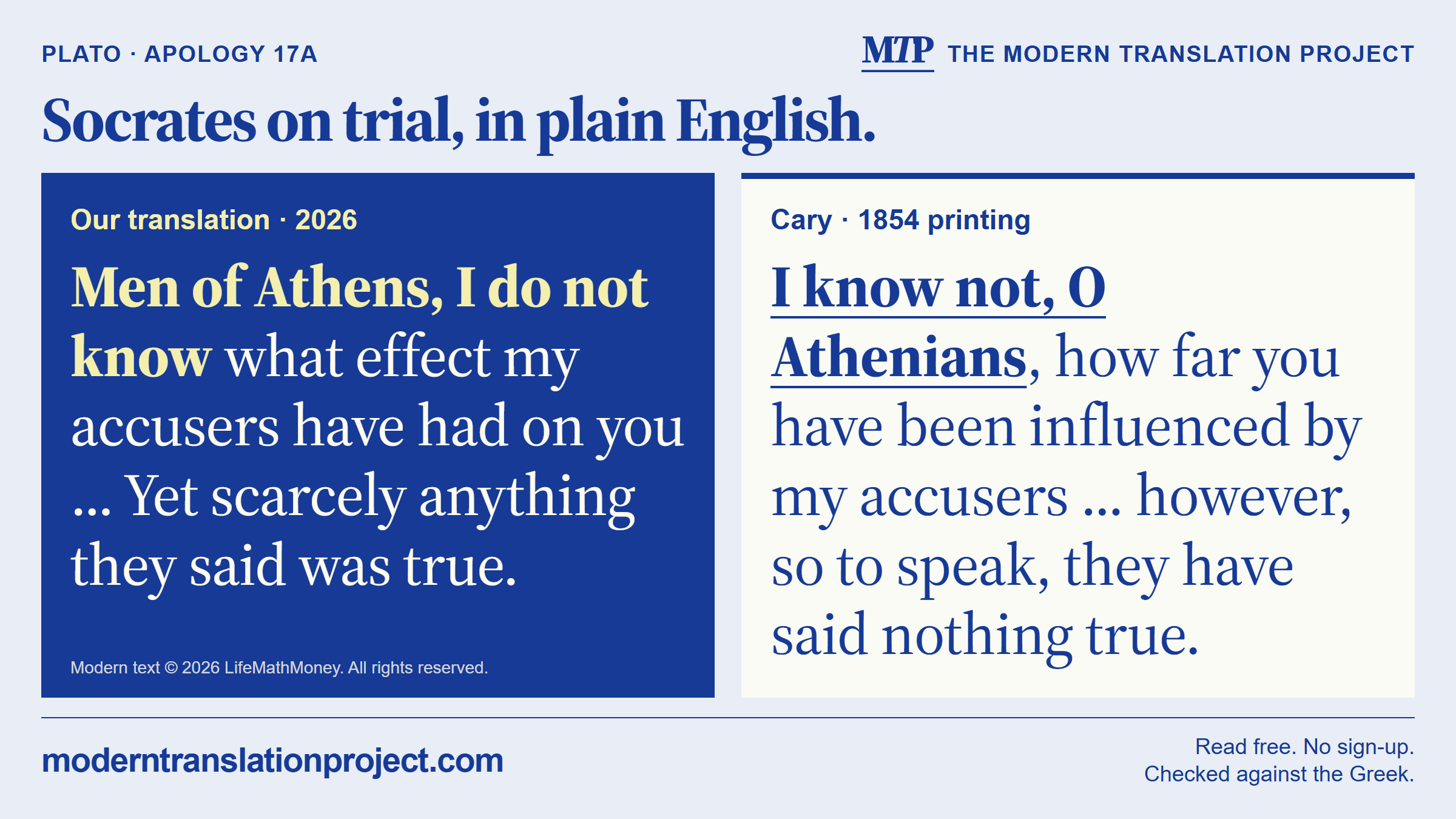
Men of Athens, I do not know what effect my accusers have had on you, but their words were so persuasive that even I almost forgot who I was. Yet scarcely anything they said was true.
Jowett · 1892 edition
How you, O Athenians, have been affected by my accusers, I cannot tell; but I know that they almost made me forget who I was—so persuasively did they speak; and yet they have hardly uttered a word of truth.
Same opening. Ours gives the punchline a sentence of its own: “Yet scarcely anything they said was true.”
Complete translation, with explanatory notes. Free to read, no sign-up.
Why start with ours?
The opening lands: “Yet scarcely anything they said was true.”
At 39c, Jowett’s “I would fain prophesy” becomes “I want to prophesy.” Hear Socrates warn the jurors who condemned him.
Short notes explain the people, places and charges behind the trial.
See the difference
Before death, a prophecy.
Our translation · Apology 39c
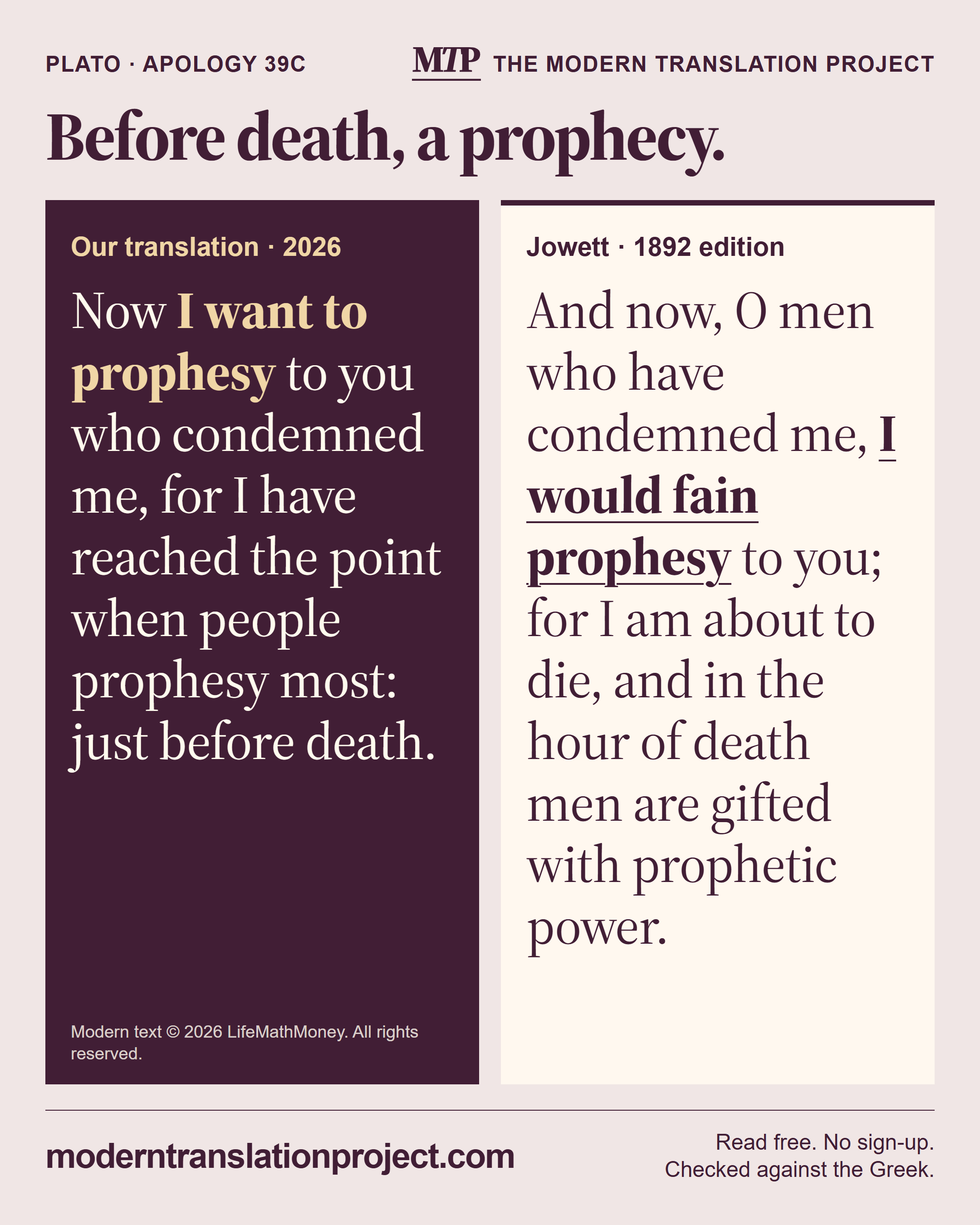
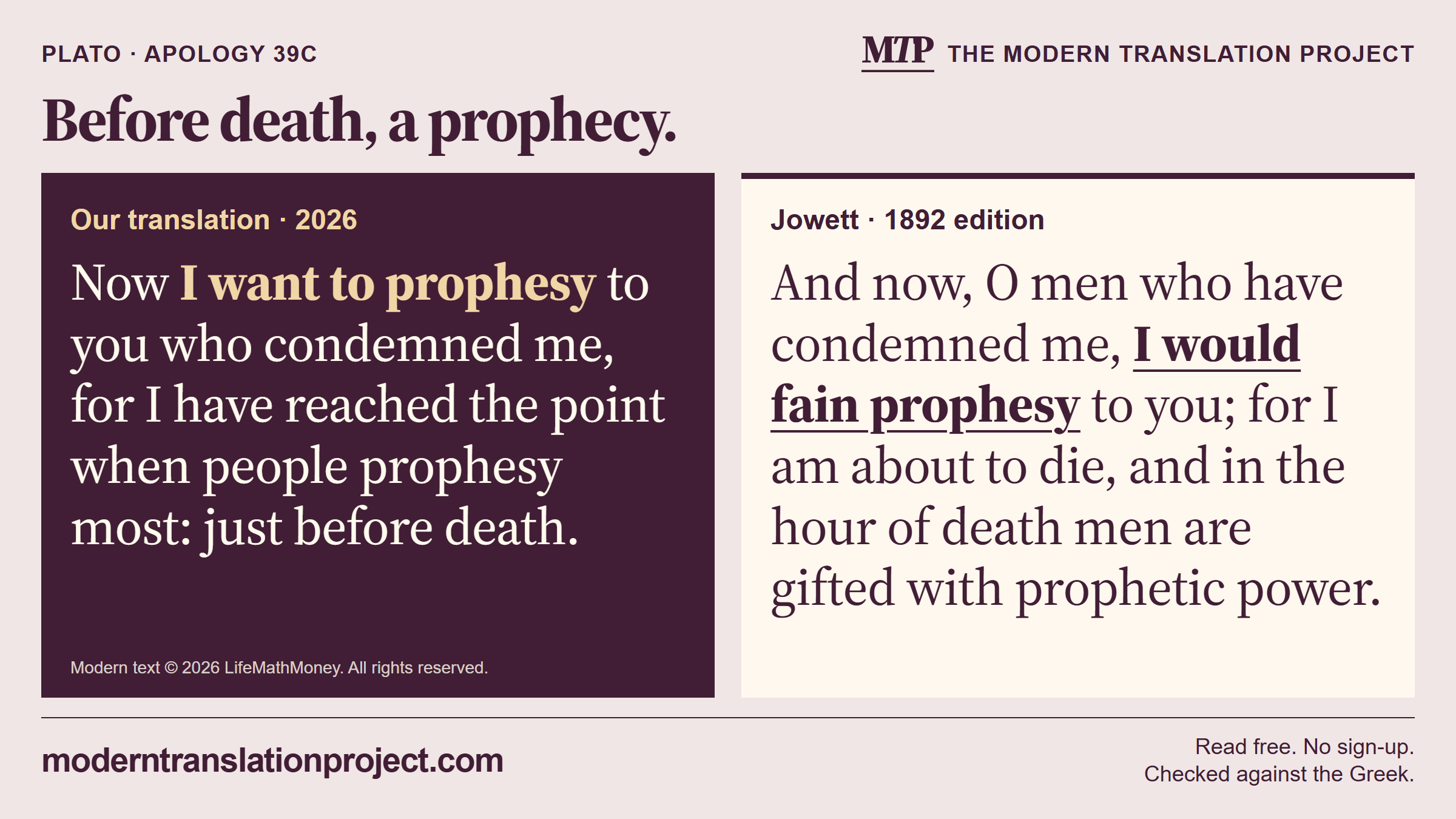
Now I want to prophesy to you who condemned me, for I have reached the point when people prophesy most: just before death.
Jowett · 1892 edition · Apology 39c
And now, O men who have condemned me, I would fain prophesy to you; for I am about to die, and in the hour of death men are gifted with prophetic power.
Socrates turns to the jurors who condemned him. Jowett (1892) writes “I would fain prophesy to you”; our translation says “Now I want to prophesy to you who condemned me.” The direct opening carries his challenge into the final words: “just before death.”
Check the original
Compare five translations of the same passage.
Read the openings aloud. In ours, the accusation turns in a short sentence of its own; the older versions carry it through one long sentence.
Our translation · Apology 17a
Men of Athens, I do not know what effect my accusers have had on you, but their words were so persuasive that even I almost forgot who I was. Yet scarcely anything they said was true.
Clear, spoken English, checked line by line against the Greek, with short notes for every person and place.
Check the original
Benjamin Jowett
Jowett · 1892 edition · Apology 17a
How you, O Athenians, have been affected by my accusers, I cannot tell; but I know that they almost made me forget who I was—so persuasively did they speak; and yet they have hardly uttered a word of truth.
Jowett gives the opening the sweep of a formal speech. Choose it if you enjoy long, balanced sentences.
Edition and copyright
First published 1871; the hosted text follows the 1892 third edition with Standard Ebooks spelling updates.
First published 1871 (The Dialogues of Plato, 1st ed., per Jowett’s preface); this text follows the 3rd edition of 1892. Translator Benjamin Jowett died in 1893 (VIAF; Library of Congress name heading “Jowett, Benjamin, 1817-1893”). Public domain in the US, UK and EU.
How you, men of Athens, have been affected by my accusers, I do not know; but I, for my part, almost forgot my own identity, so persuasively did they talk; and yet there is hardly a word of truth in what they have said.
Fowler spells out the contrast between the jury and Socrates. The long sentence and formal phrasing reward a slower read.
Edition and copyright
First published 1914 (Loeb Classical Library 36, 1914; year confirmed on the title page of an early printing on Internet Archive). Translator Harold North Fowler died in 1955 (Wikipedia; Rutgers Database of Classical Scholars). Public domain in the US, UK and EU.
I know not, O Athenians, how far you have been influenced by my accusers: for my part, in listening to them I almost forgot myself, so plausible were their arguments: however, so to speak, they have said nothing true.
Cary’s is the oldest version here, with nineteenth-century phrasing such as “I know not.”
Edition and copyright
First published 1848; the hosted text uses the 1854 printing.
First published 1848 (Bohn’s Classical Library, vol. 1; date from library catalogue records on Internet Archive). Translator Henry Cary died in 1870 (Library of Congress name heading “Cary, Henry, 1804-1870” in those records). Public domain in the US, UK and EU.
I cannot tell what impression my accusers have made upon you, Athenians: for my own part, I know that they nearly made me forget who I was, so plausible were they; and yet they have scarcely uttered one single word of truth.
Church uses familiar words in one long spoken sentence: the easiest of the older versions.
Edition and copyright
First published 1880 (Macmillan; title page in Internet Archive scan trialanddeathofs00platiala, a later printing of the same translation; the repaginated scan trialdeathofsocr0000plat_n9f5 is the 1886 Golden Treasury edition). Translator Frederick John Church died 1888 (library catalogue heading “Church, F. J. (Frederick John), 1854-1888”). Public domain in the US, UK and EU.
The unexamined life is not worth living for a human being.
Benjamin Jowett · 1892 (3rd ed.)
… the unexamined life is not worth living …
Harold North Fowler · 1914
… the unexamined life is not worth living …
Henry Cary · 1854
… a life without investigation is not worth living for …
F. J. Church · 1880
… an unexamined life is not worth living …
The truth is hard to believe · Apology 38a
The Modern Translation Project · 2026
But that is how things are, gentlemen, as I say, though persuading you is difficult.
Benjamin Jowett · 1892 (3rd ed.)
Yet I say what is true, although a thing of which it is hard for me to persuade you.
Harold North Fowler · 1914
This is as I say, gentlemen, but it is not easy to convince you.
Henry Cary · 1854
Such however is the case, as I affirm, O Athenians, though it is not easy to persuade you.
F. J. Church · 1880
But that is the truth, my friends, though it is not easy to convince you of it.
Step into the book
Plato presents the defense speech of Socrates, a philosopher on trial in Athens, in present-day Greece. “Apology” here means a defense, not an expression of regret. He addresses a jury of about 500 Athenian citizens.
Read the opening aloud. Socrates claims he is no polished speaker while giving a very effective introduction.
Notice the distinction between what Socrates says his accusers claim and what he claims himself.
Read beyond the verdict. His response to the sentence is part of the work, not a separate apology.
References such as 17a are Stephanus numbers: standard page-and-letter labels used across editions of Plato, not the page numbers of your copy.
Complete translation, with explanatory notes. Free to read, no sign-up.
Questions readers ask
Which Apology translation is easiest to read?
Start with our modern Apology. Direct speech, a sharply timed opening and notes for every person and place carry you from the accusation to Socrates’s last challenge.
Is Jowett’s Apology worth reading?
Yes, if you enjoy a rhetorical voice: “O Athenians” and long, rising sentences. For a first read, start with ours and keep Jowett beside it to compare.
Can I read Plato’s Apology free online?
Yes. Our complete modern text and the Jowett, Fowler, Cary, and Church translations are free to read here, with no sign-up.
Does Apology mean Socrates is saying sorry?
Here the title means a defense speech. Socrates is responding to accusations in court, rather than apologizing in the everyday sense.
Should I read Apology before Crito and Phaedo?
That is a useful order for following Socrates’s last days: the defense, the discussion of escape, and the final day in prison. Euthyphro can come first as an encounter before the trial.
Was this modern Apology translated by AI?
Yes. It’s drafted from the original Greek by an AI translator and checked line by line against the Greek by a second AI.
Have a passage to discuss, a correction to suggest, or a work you want us to add? Email admin@lifemathmoney.com. Include the work and section so we can examine the passage.