Clear modern English. Nothing lost. Nothing softened.
To their first readers, these books were written in the living language of their own day: lively, direct, sometimes funny, sometimes shocking. They sound stiff and old-fashioned to us because the English translations we inherited are old.
We translate them into the English we speak today, working from the original Greek and Latin and checking every line against it. The result reads easily, keeps everything the author wrote, and often brings out meaning the older versions blurred or left out.
Easy to read.
Follow the argument in clear, natural sentences.
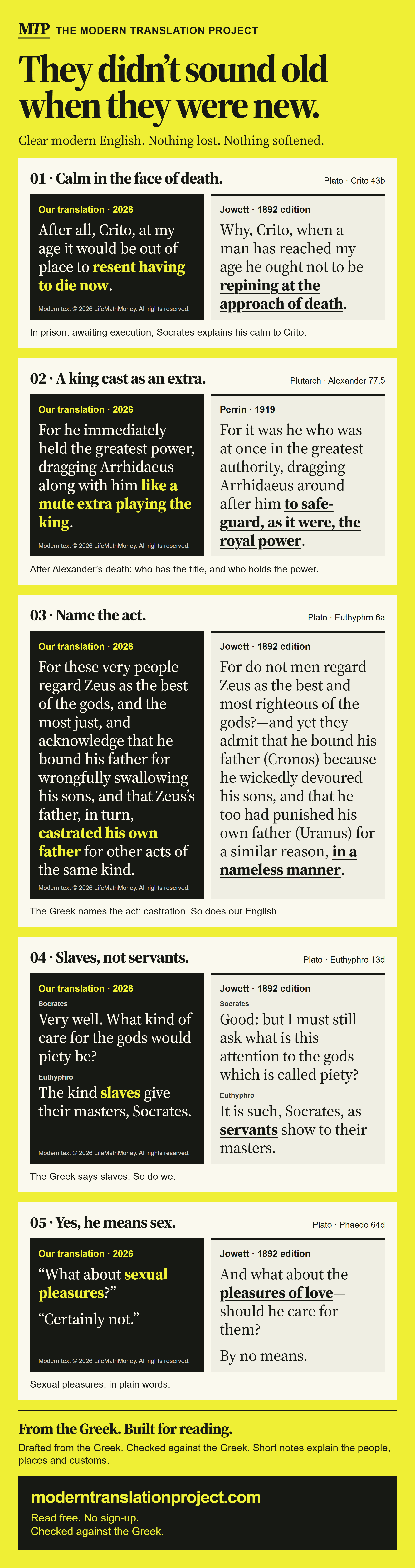
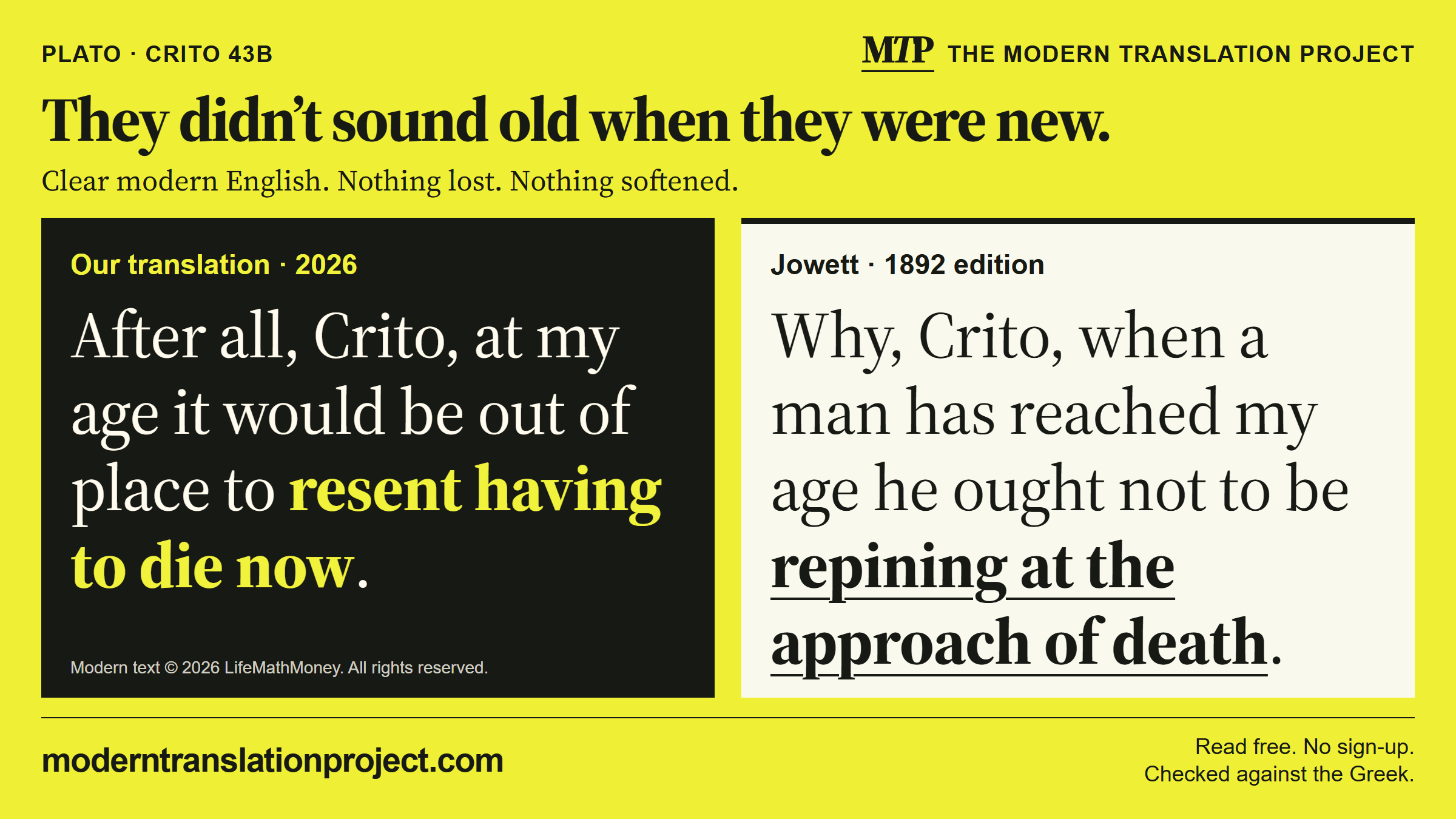
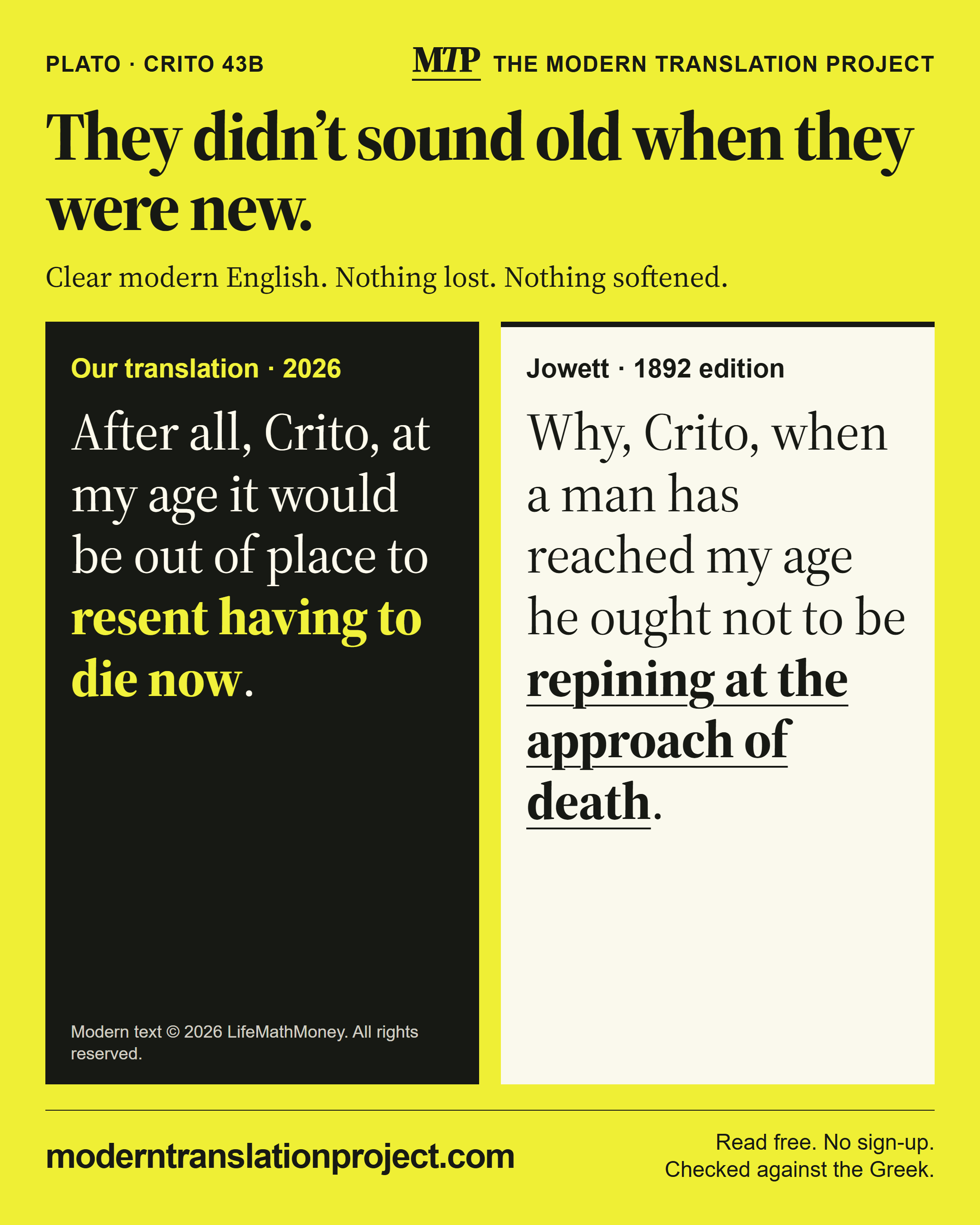
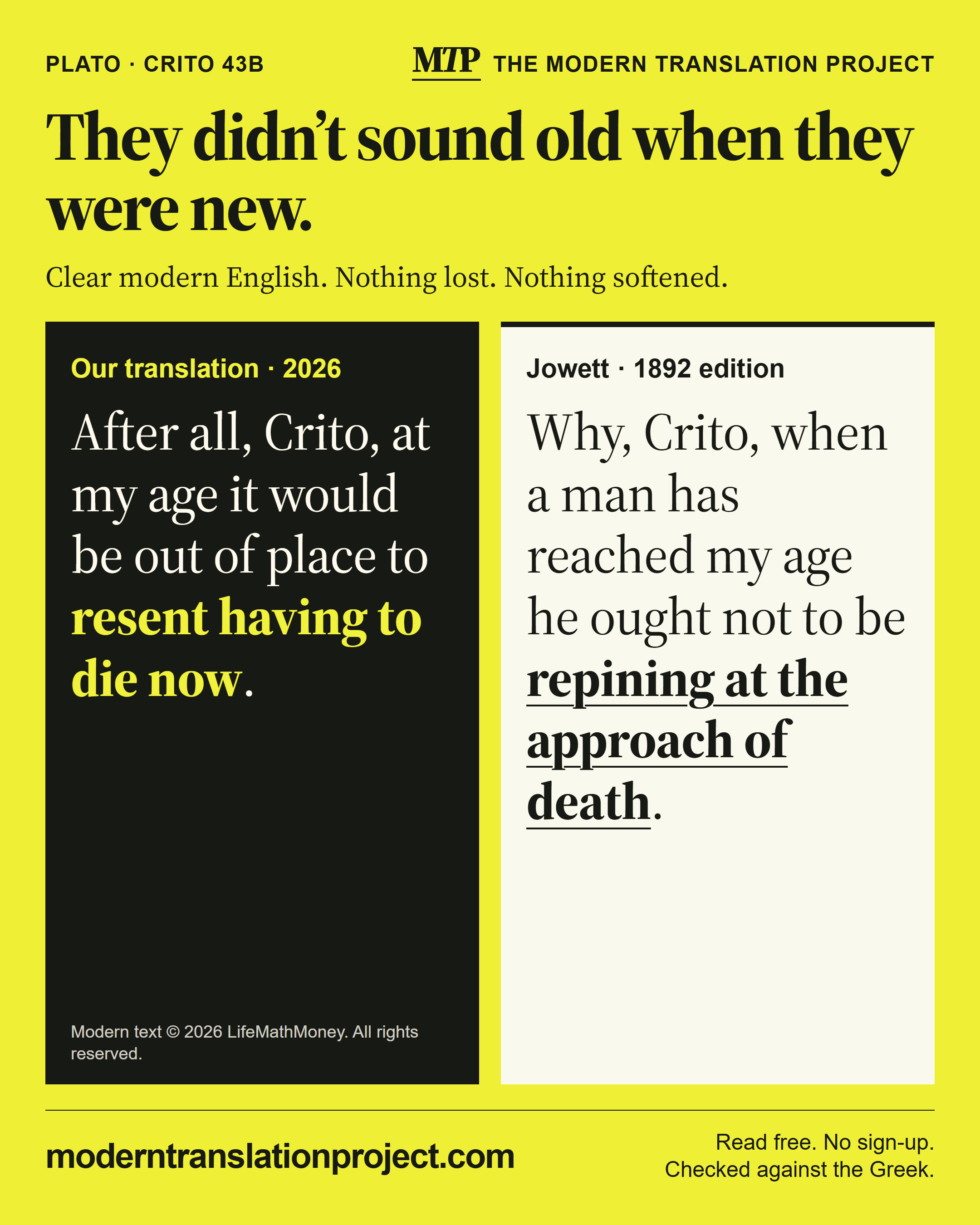
Calm in the face of death.
Our translation · Crito 43b
After all, Crito, at my age it would be out of place to resent having to die now.
Jowett · 1892 edition
Why, Crito, when a man has reached my age he ought not to be repining at the approach of death.
Socrates has just woken in prison, calm, with his execution close.
Jowett (1892) has him speak of “repining at the approach of death.” Ours says “resent having to die now.” You hear his composure in words you use today.
Check the original
More comparisons
Understand the warning as soon as he says it.
Our translation · Phaedo 89c–d
“What?” I asked.
“Becoming haters of arguments, as some become haters of people,” he said, “since nothing worse could happen to someone than coming to hate arguments. Hatred of arguments and hatred of people arise in the same way.
Jowett · 1892 edition
Of what nature? I said.
Lest we become misologists, he replied, no worse thing can happen to a man than this. For as there are misanthropists or haters of men, there are also misologists or haters of ideas, and both spring from the same cause, which is ignorance of the world.
Same Greek sentence, two translations. Jowett (1892) opens with “misologists” and brings in “ignorance of the world” early, from Plato’s next sentence. Ours says “haters of arguments,” so the warning lands the first time you read it.
Check the original
Nothing lost; more comes through.
We translate from the original, not from older English versions, so nothing is dropped, and meaning that older versions flattened comes back.
Who has the title, and who holds the power.
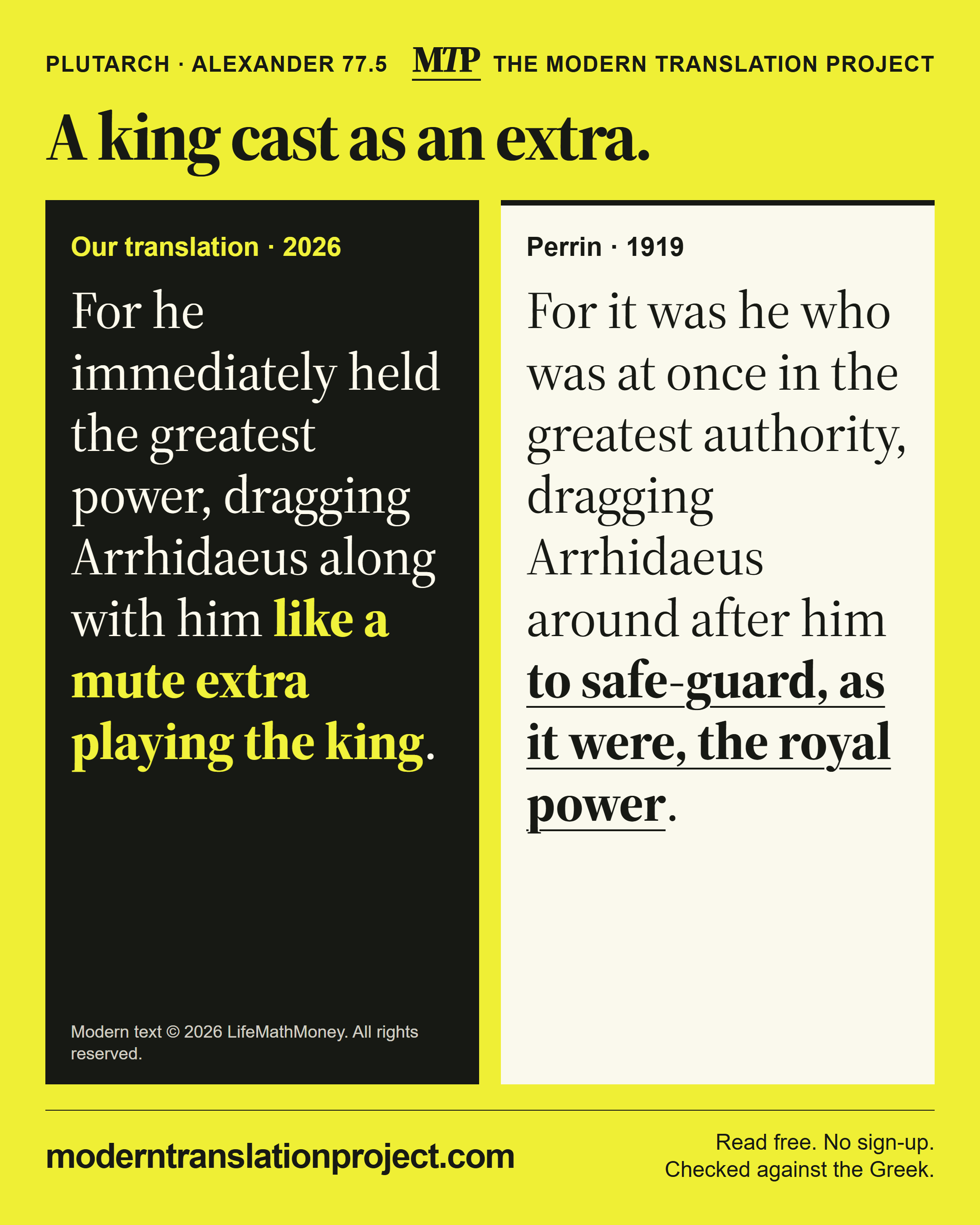
Our translation · Alexander 77.5
For he immediately held the greatest power, dragging Arrhidaeus along with him like a mute extra playing the king.
Perrin · 1919
For it was he who was at once in the greatest authority, dragging Arrhidaeus around after him to safe-guard, as it were, the royal power.
After Alexander’s death, Perdiccas holds the power and Arrhidaeus has the title of king.
Plutarch’s word, doryphorēma, literally means “spear-carrier.” In the Greek theatre it was the term for a mute extra: an actor on stage with no lines. Perrin (1919) takes it as a guard, “to safe-guard, as it were, the royal power.” Ours keeps the stage image: Arrhidaeus is dragged along “like a mute extra playing the king,” with the title but no say.
Check the original
Nothing softened.
Sex, violence and slavery stay explicit.
Name the act.
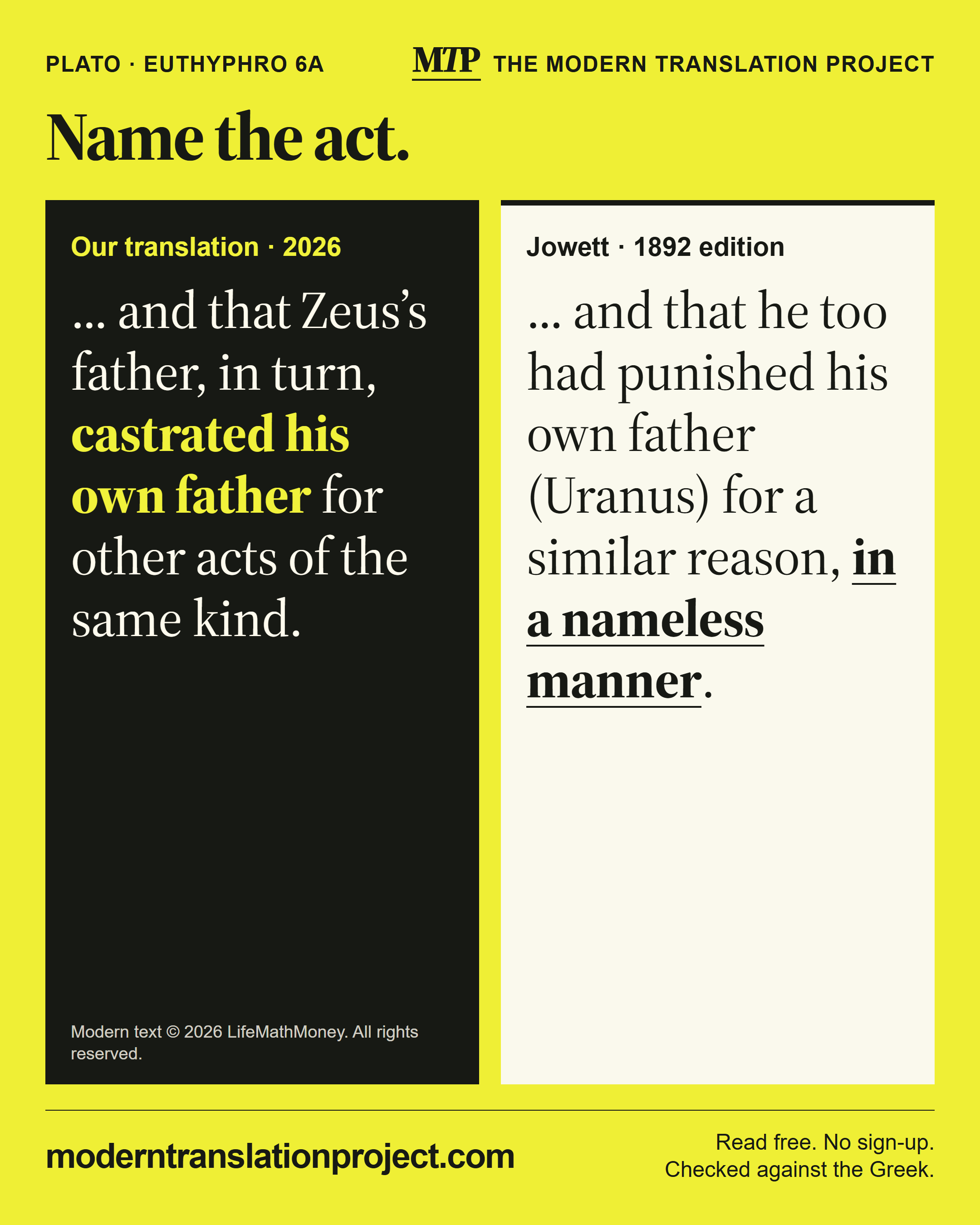
Our translation · Euthyphro 6a
For these very people regard Zeus as the best of the gods, and the most just, and acknowledge that he bound his father for wrongfully swallowing his sons, and that Zeus’s father, in turn, castrated his own father for other acts of the same kind.
Jowett · 1892 edition
For do not men regard Zeus as the best and most righteous of the gods?—and yet they admit that he bound his father (Cronos) because he wickedly devoured his sons, and that he too had punished his own father (Uranus) for a similar reason, in a nameless manner.
Euthyphro defends prosecuting his own father by pointing to the gods’ family violence. Jowett (1892) leaves the act “nameless.” Plato names it, and so do we: “castrated his own father.”
Check the original
More comparisons
Slaves, not servants.
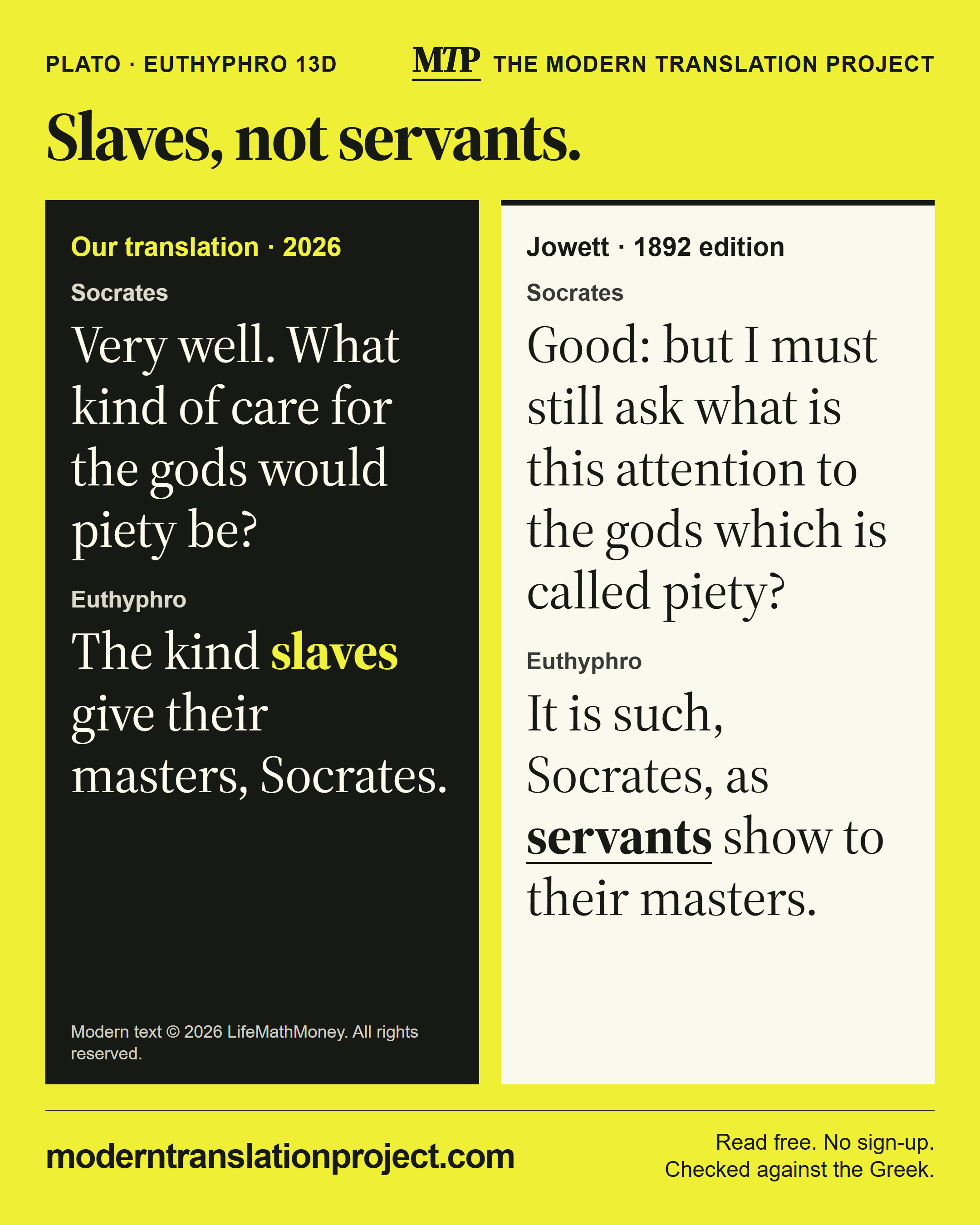
Our translation · Euthyphro 13d
The kind slaves give their masters, Socrates.
Jowett · 1892 edition
It is such, Socrates, as servants show to their masters.
Jowett (1892) turns the Greek δοῦλοι, slaves, into “servants.” Ours keeps “slaves.”
Check the original
Sexual pleasures, in plain words.
Our translation · Phaedo 64d
“What about sexual pleasures?”
“Certainly not.”
Jowett · 1892 edition
And what about the pleasures of love—should he care for them?
By no means.
Socrates asks whether a philosopher should care about bodily pleasures. Jowett (1892) says “the pleasures of love.” Ours says what the Greek says: “sexual pleasures.”
Check the original
Five comparisons, ours on the left: easy to read, nothing lost, nothing softened.
Short notes explain the people, places and customs as you read, so you don’t have to stop and look things up.
Compare for yourself.
Every work keeps its classic translations, each credited to its translator. Switch between them at any time, compare them side by side, or put the original Greek beside ours.
Listen as well as read.
Our translations are also read aloud, in two voices: choose a male or a female narrator and press play at the top of the page.
How we make them.
Each translation is drafted by an AI translator from the original text, with the classic public-domain translations as references to help avoid errors, though the English itself is newly written.
A second AI then checks it against the original, line by line, and the two argue out every disagreement until the wording is settled.
When we find a kind of mistake, we write a rule for it and recheck everything it could affect.
Spotted something? Email admin@lifemathmoney.com. Every report is checked against the original.
What’s coming.
More works are on the way, starting with the great books of Greece and Rome, and later classics from other traditions, including India’s.
Questions readers ask
Why do older translations sound so old?
Because they are old. The free translations most people find online were made in the 1800s and early 1900s, in the formal English of their own day. The authors themselves wrote in the living language of their time.
How do you make sure it’s accurate?
Every line is checked against the original Greek or Latin, and when we find a kind of mistake, we fix it everywhere it could occur.
Yes. Every work keeps its classic translations, each credited to its translator. Switch between them at any time, or compare them side by side with ours.
Is it free?
Yes. Every work on the site is free to read, with no sign-up.
Can I quote it?
Yes. You’re welcome to quote passages of up to 1,000 words with credit and a link. The Copyright page explains the rest.
I found a mistake. What do I do?
Email admin@lifemathmoney.com with a link to the page and the passage. Every report is checked against the original.