Complete translation, with explanatory notes. Free to read, no sign-up.
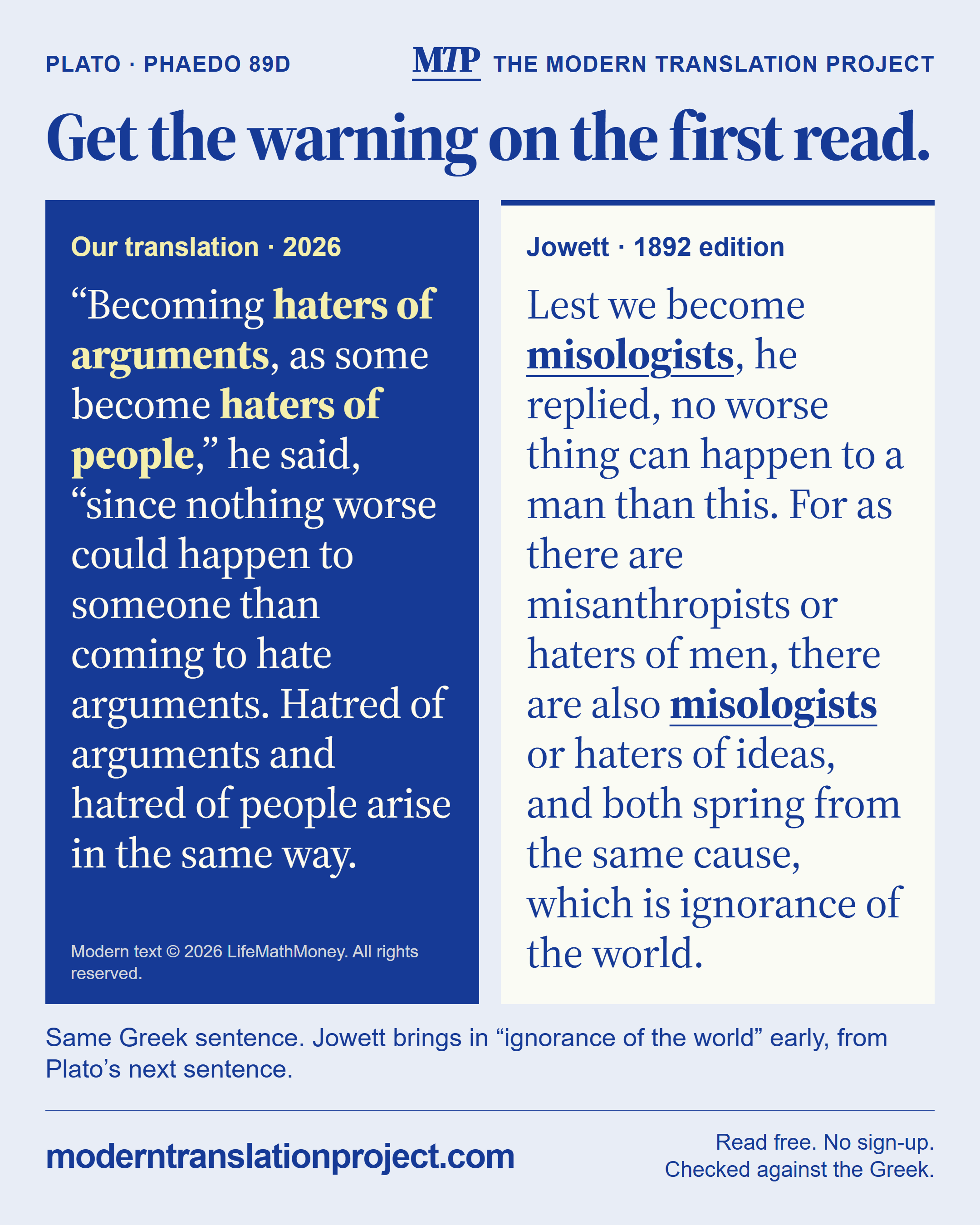
Understand the warning as soon as he says it.
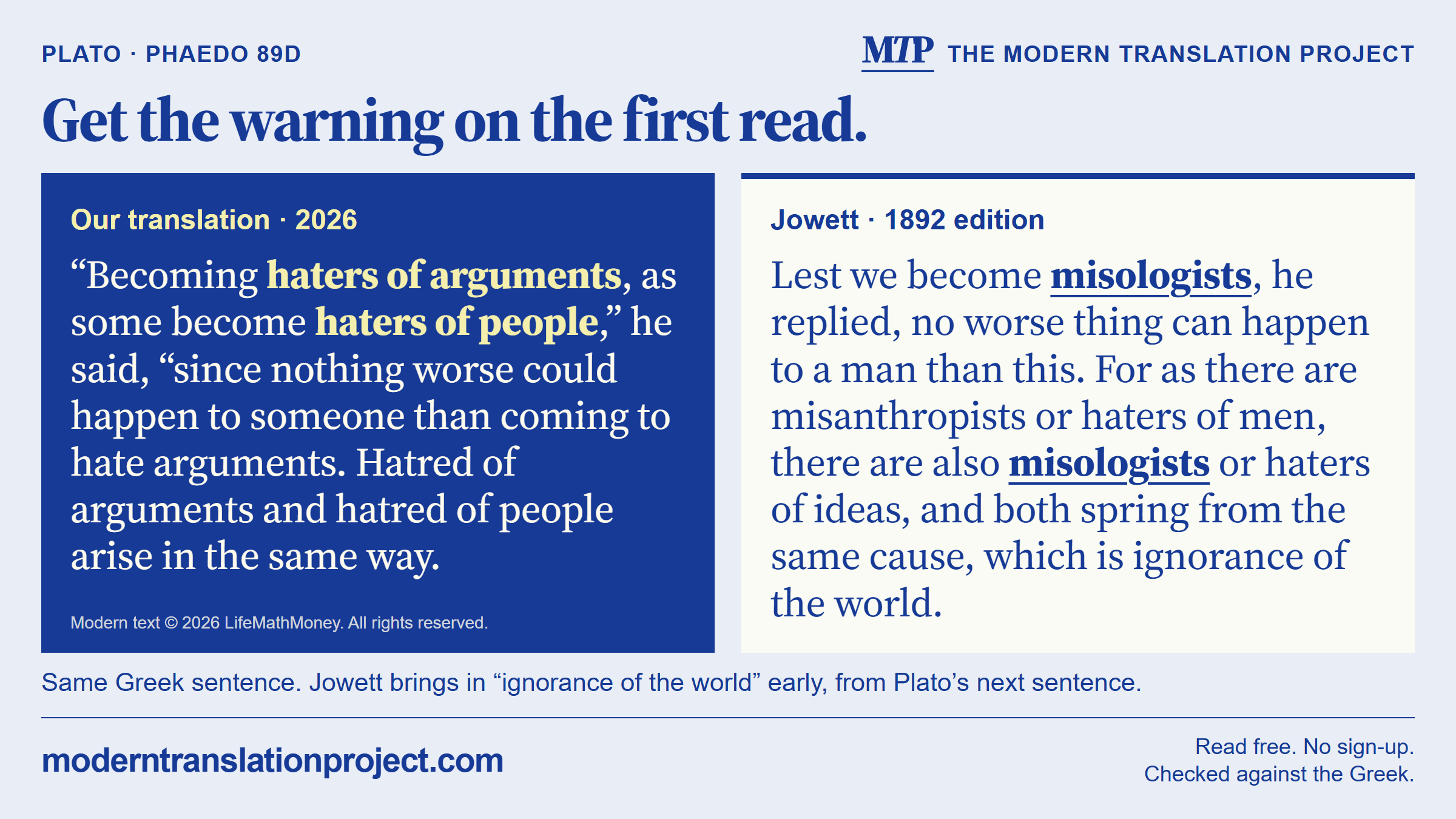
Our translation · Phaedo 89c–d
“What?” I asked.
“Becoming haters of arguments, as some become haters of people,” he said, “since nothing worse could happen to someone than coming to hate arguments. Hatred of arguments and hatred of people arise in the same way.
Jowett · 1892 edition
Of what nature? I said.
Lest we become misologists, he replied, no worse thing can happen to a man than this. For as there are misanthropists or haters of men, there are also misologists or haters of ideas, and both spring from the same cause, which is ignorance of the world.
Same Greek sentence. Jowett (1892) says “misologists” and brings in “ignorance of the world” early, from Plato’s next sentence. Ours says “haters of arguments” and follows Plato’s order.
Check the original
Why start with ours?
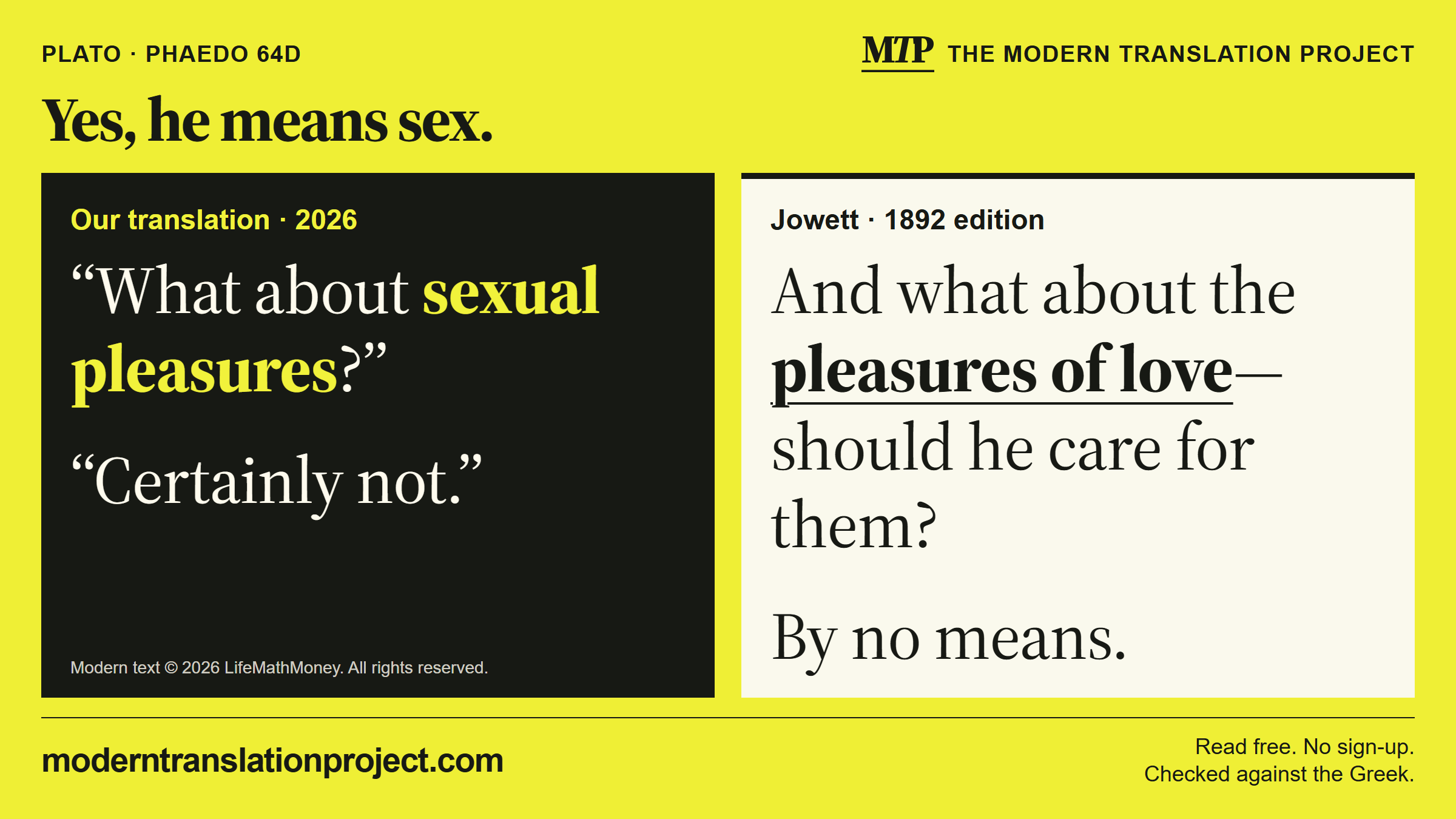
At 64d, “sexual pleasures” says it plainly where Jowett (1892) writes “pleasures of love.”
At 89d, “haters of arguments” where Jowett writes “misologists”: the warning lands the first time.
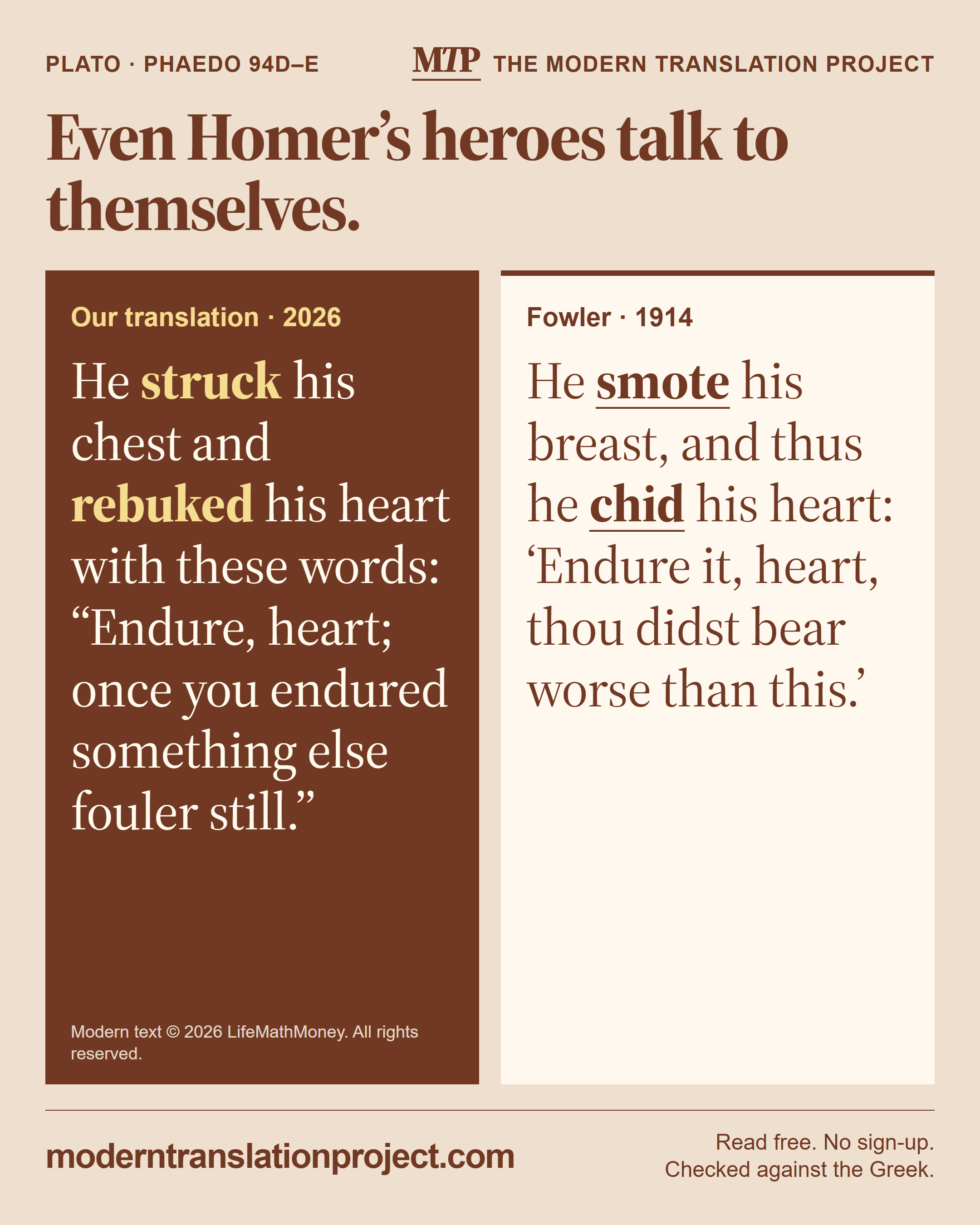
At 94d–e, Homer’s Odysseus “struck” his chest and “rebuked” his heart, where Fowler (1914) has “smote” and “chid.”
Short notes explain the people, places and ideas as you go.
See the difference
Yes, he means sex.
Our translation · Phaedo 64d
“What about sexual pleasures?”
“Certainly not.”
Jowett · 1892 edition · Phaedo 64d
And what about the pleasures of love—should he care for them?
By no means.
Socrates asks Simmias whether a philosopher should pursue bodily pleasures. Jowett (1892) calls these “the pleasures of love”; our translation calls them “sexual pleasures.” The Greek τὰς τῶν ἀφροδισίων names sex, and our English puts the subject in plain view.
Check the original
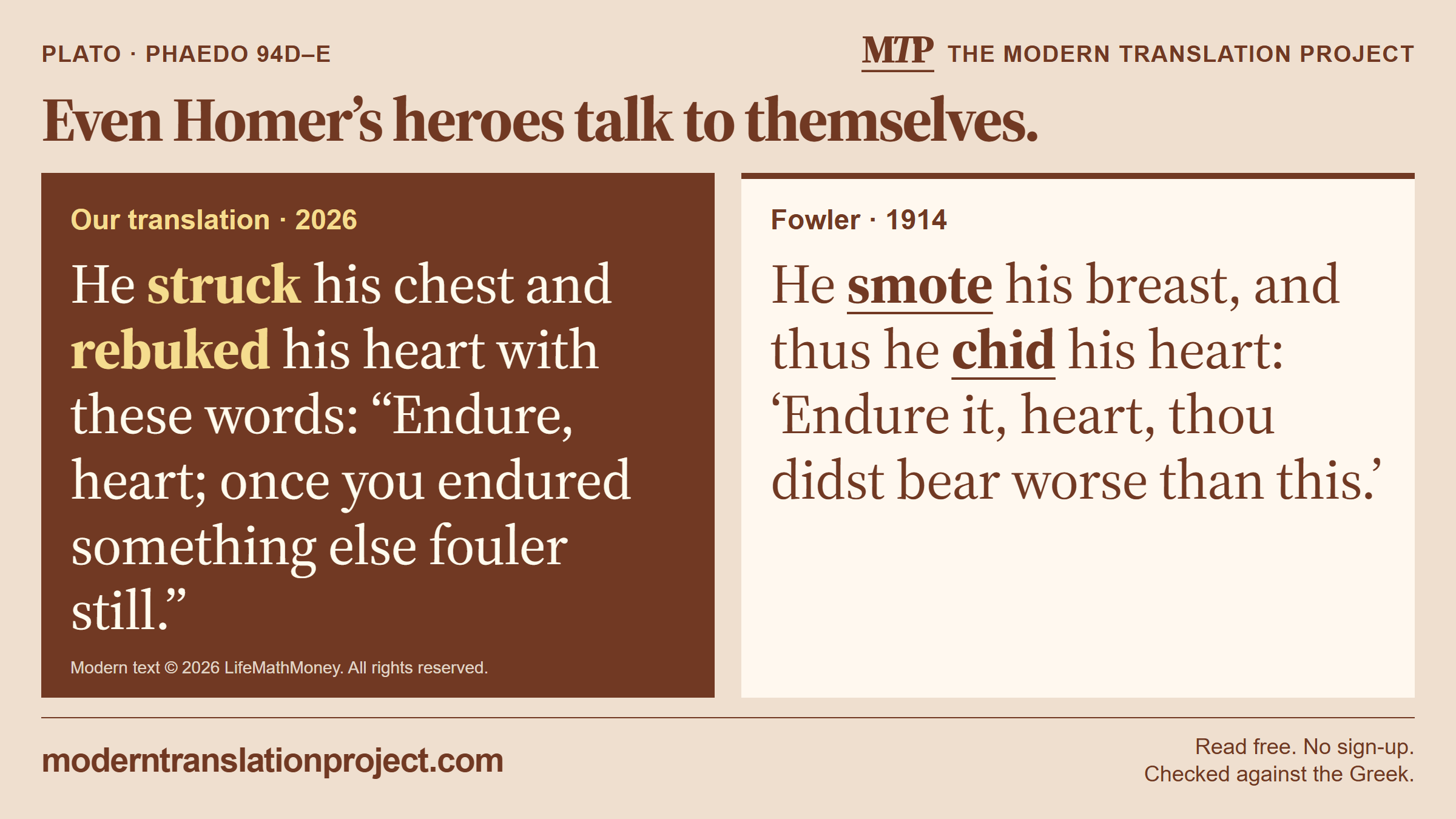
Even heroes talk to themselves.
Our translation · Phaedo 94d–e
He struck his chest and rebuked his heart with these words: “Endure, heart; once you endured something else fouler still.”
Fowler · 1914 · Phaedo 94d–e
He smote his breast, and thus he chid his heart: ‘Endure it, heart, thou didst bear worse than this.’
Socrates quotes Homer: Odysseus tells his heart to endure. Fowler (1914) uses “smote,” “chid” and “thou didst.” Our translation uses “struck,” “rebuked” and “you endured.” Hear the blow, the rebuke and the command in familiar English.
Check the original
Compare five translations of the same passage.
“Things that exist” makes the question easier to follow. Socrates is dividing them into the visible and the unseen.
Our translation · Phaedo 79a
“Shall we suppose, then,” he said, “that there are two kinds of things that exist, the visible and the unseen?”
Clear, spoken English, checked line by line against the Greek, with short notes for every person and place.
Check the original
Benjamin Jowett
Jowett · 1892 edition · Phaedo 79a
Well, then, added Socrates, let us suppose that there are two sorts of existences—one seen, the other unseen.
Jowett is concise and balanced: “one seen, the other unseen.” His “existences” makes the idea more abstract.
Edition and copyright
First published 1871; the hosted text follows the 1892 third edition with Standard Ebooks spelling updates.
First published 1871 (The Dialogues of Plato, 1st ed., per Jowett’s preface); this text follows the 3rd edition of 1892. Translator Benjamin Jowett died in 1893 (VIAF; Library of Congress name heading “Jowett, Benjamin, 1817-1893”). Public domain in the US, UK and EU.
“Now,” said he, “shall we assume two kinds of existences, one visible, the other invisible?”
Fowler sets the question out clearly, in a formal voice.
Edition and copyright
First published 1914 (Loeb Classical Library 36, 1914; year confirmed on the title page of an early printing on Internet Archive). Translator Harold North Fowler died in 1955 (Wikipedia; Rutgers Database of Classical Scholars). Public domain in the US, UK and EU.
“We may assume then, if you please,” he continued, “that there are two species of things, the one visible, the other invisible?”
Cary keeps the courteous “if you please.” Here “species” means kinds.
Edition and copyright
First published 1848; the hosted text uses the 1854 printing.
First published 1848 (Bohn’s Classical Library, vol. 1; date from library catalogue records on Internet Archive). Translator Henry Cary died in 1870 (Library of Congress name heading “Cary, Henry, 1804-1870” in those records). Public domain in the US, UK and EU.
Let us assume then, he said, if you will, that there are two kinds of existence, the one visible, the other invisible.
Church is close and readable, keeping the courteous “if you will.”
Edition and copyright
First published 1880 (Macmillan; title page in Internet Archive scan trialanddeathofs00platiala, a later printing of the same translation; the repaginated scan trialdeathofsocr0000plat_n9f5 is the 1886 Golden Treasury edition). Translator Frederick John Church died 1888 (library catalogue heading “Church, F. J. (Frederick John), 1854-1888”). Public domain in the US, UK and EU.
Crito, we owe Asclepius a rooster. Pay what we owe, and don’t neglect it.
Benjamin Jowett · 1892 (3rd ed.)
Crito, I owe a cock to Asclepius; will you remember to pay the debt?
Harold North Fowler · 1914
Crito, we owe a cock to Aesculapius. Pay it and do not neglect it.
Henry Cary · 1854
Crito, we owe a cock to Æsculapius; pay it, therefore, and do not neglect it.
F. J. Church · 1880
Crito, he said, I owe a cock to Asclepius; do not forget to pay it.
Remembering Socrates · Phaedo 118a
The Modern Translation Project · 2026
… was the best of all we knew in his time, and also the wisest and most just.
Benjamin Jowett · 1892 (3rd ed.)
… he was the wisest and justest and best.
Harold North Fowler · 1914
… the best and wisest and most righteous man.
Henry Cary · 1854
… the best of all of his time that we have known, and moreover, the most wise and just.
F. J. Church · 1880
… who was the wisest and justest, and the best man that I have ever known.
Step into the book
Phaedo, one of Socrates’s companions, tells Echecrates the story of the philosopher’s last day in prison in Athens, in present-day Greece.
Phaedo and Echecrates are speaking in another Greek city. The story contains a conversation about whether the soul survives death, so watch who is speaking inside it.
Distinguish the soul’s survival from the separate question of what the soul is like. The dialogue uses several arguments, not one continuous proof.
At 79a, keep the proposed visible/unseen division separate from the conclusions later drawn from it.
Follow each argument separately: what does it claim, and what reasons support it?
References such as 79a are Stephanus numbers: standard page-and-letter labels used across editions of Plato, not the page numbers of your copy.
Complete translation, with explanatory notes. Free to read, no sign-up.
Questions readers ask
Which Phaedo translation is best for beginners?
Start with our modern Phaedo. Familiar phrasing, audible wordplay and notes for the people, places and philosophical terms help you follow Socrates’s final conversation.
Can I read the Phaedo free online?
Yes. The complete modern, Jowett, Fowler, Cary, and Church versions are free to read here, with no sign-up.
Is Jowett’s Phaedo a good choice?
Yes, if you like concise, balanced English such as “one seen, the other unseen.” For a first read, start with ours and keep Jowett beside it to compare.
Do I need to read Apology and Crito before Phaedo?
You can start with Phaedo, but Apology and Crito give the trial and prison setting. Reading them first can make the final-day conversation easier to place.
What does eidē mean in Phaedo 79a?
At 79a, εἴδη means kinds: Socrates proposes two kinds of things that exist, the visible and the unseen. Elsewhere, when Plato uses the term for unchanging realities, our translation uses “Forms.” Translation notes help you follow the distinction.
How is the modern Phaedo translated and checked?
It’s drafted from the original Greek by an AI translator and checked line by line against the Greek by a second AI.
Have a passage to discuss, a correction to suggest, or a work you want us to add? Email admin@lifemathmoney.com. Include the work and section so we can examine the passage.