Clear modern English. Nothing lost. Nothing softened.
Start with our modern Euthyphro for a conversation that gets uncomfortable fast.
A man is prosecuting his father, certain he understands what the gods want. Then Socrates begins asking questions.
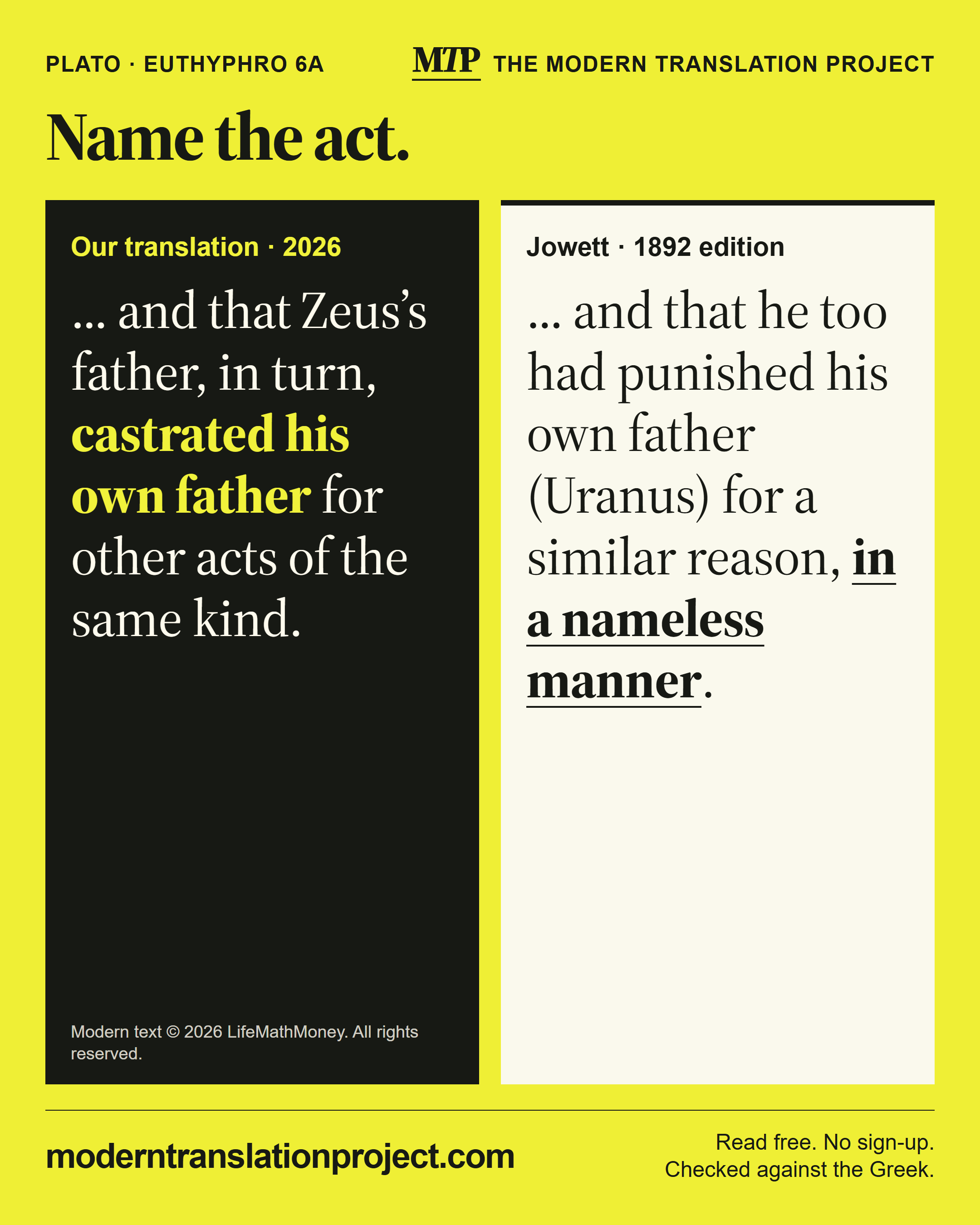
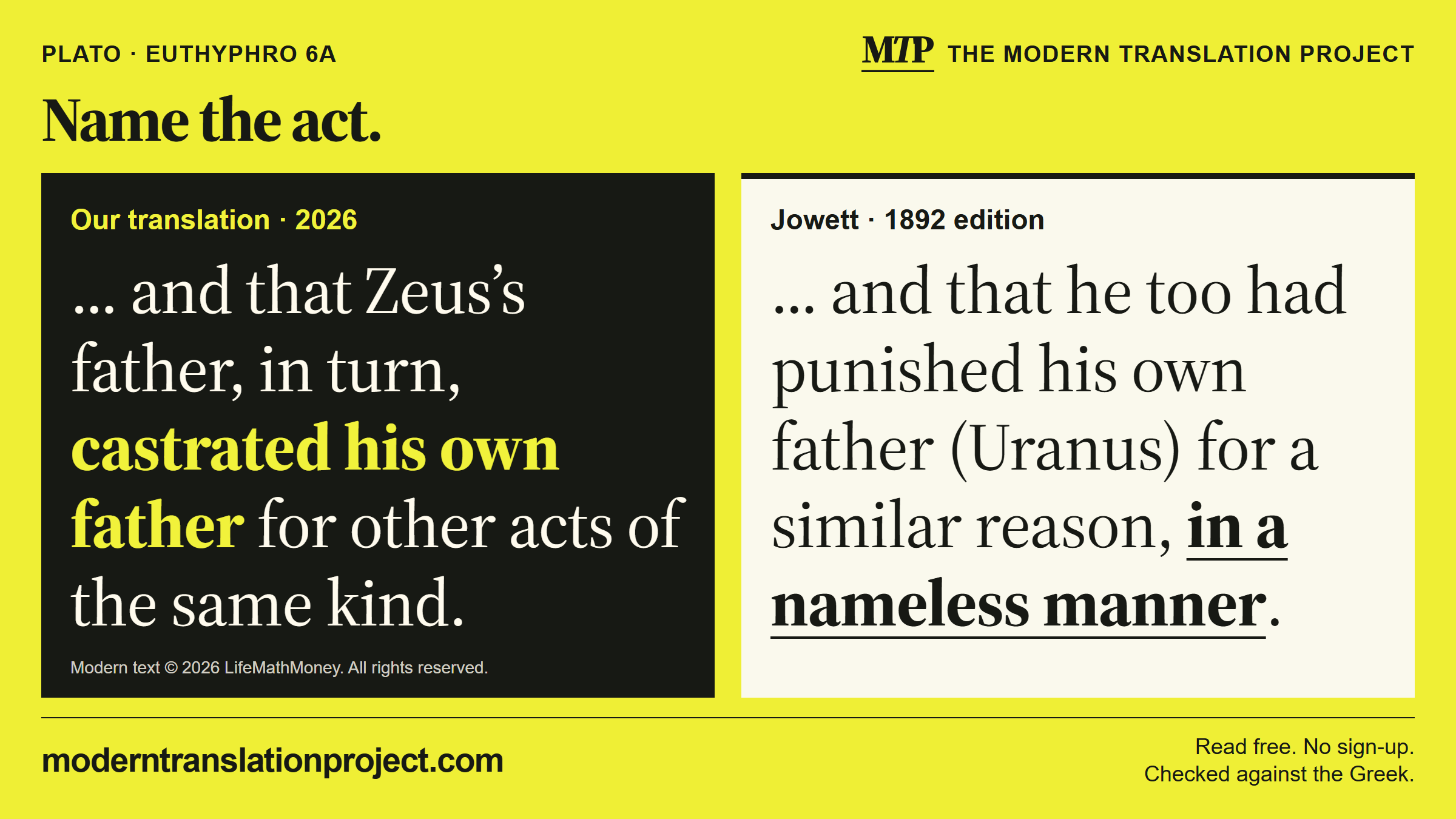
Name the act.
Our translation · Euthyphro 6a
For these very people regard Zeus as the best of the gods, and the most just, and acknowledge that he bound his father for wrongfully swallowing his sons, and that Zeus’s father, in turn, castrated his own father for other acts of the same kind.
Jowett · 1892 edition
For do not men regard Zeus as the best and most righteous of the gods?—and yet they admit that he bound his father (Cronos) because he wickedly devoured his sons, and that he too had punished his own father (Uranus) for a similar reason, in a nameless manner.
Jowett (1892) leaves the act “nameless.” Plato names it, and so do we.
Complete translation, with explanatory notes. Free to read, no sign-up.
Why start with ours?
The famous question is easy to hear: “…do the gods love the pious because it is pious, or is it pious because they love it?”
Short notes explain every god, person and place as you read.
See the difference
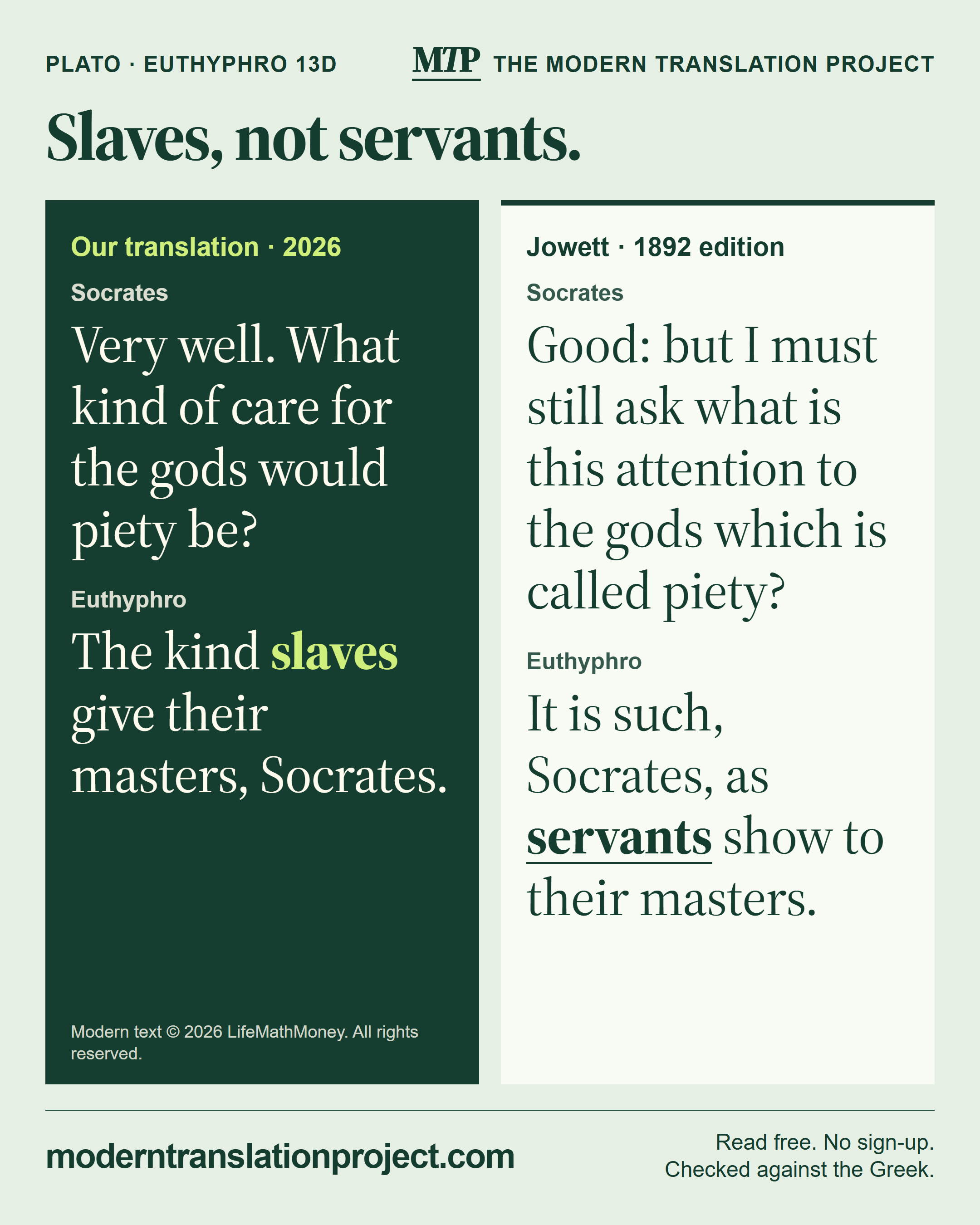
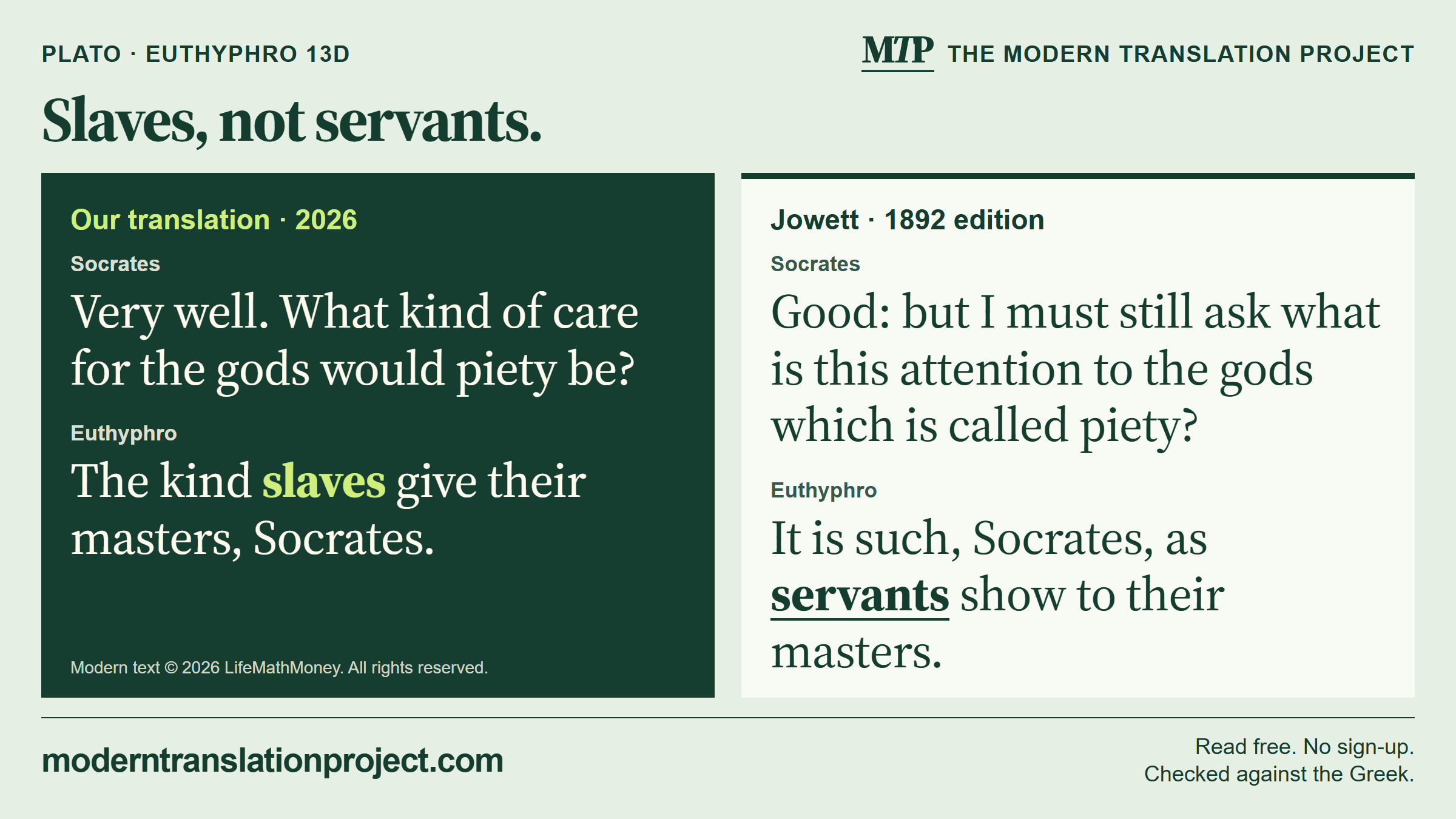
Serving the gods. As slaves?
Our translation · Euthyphro 13d
Socrates
Very well. What kind of care for the gods would piety be?
Euthyphro
The kind slaves give their masters, Socrates.
Jowett · 1892 edition · Euthyphro 13d
Socrates
Good: but I must still ask what is this attention to the gods which is called piety?
Euthyphro
It is such, Socrates, as servants show to their masters.
Socrates asks what kind of care for the gods would count as piety. Jowett (1892) has Euthyphro answer “as servants show to their masters.” Our translation says “The kind slaves give their masters.” The Greek δοῦλοι names slaves, making the social relationship in his analogy explicit.
Check the original
Compare five translations of the same passage.
The question is simple to ask and hard to answer: which comes first, being pious or being loved by the gods?
Our translation · Euthyphro 10a
… do the gods love the pious because it is pious, or is it pious because they love it?
Clear, spoken English, checked line by line against the Greek, with short notes for every person and place.
Check the original
Benjamin Jowett
Jowett · 1892 edition · Euthyphro 10a
… whether the pious or holy is beloved by the gods because it is holy, or holy because it is beloved of the gods.
Jowett’s formal, balanced English: the classic Victorian Plato. Choose it if you enjoy a stately voice.
Edition and copyright
First published 1871; the hosted text follows the 1892 third edition with Standard Ebooks spelling updates.
First published 1871 (The Dialogues of Plato, 1st ed., per Jowett’s preface); this text follows the 3rd edition of 1892. Translator Benjamin Jowett died in 1893 (VIAF; Library of Congress name heading “Jowett, Benjamin, 1817-1893”). Public domain in the US, UK and EU.
Is that which is holy loved by the gods because it is holy, or is it holy because it is loved by the gods?
Fowler spells out both halves of this question. Clear and careful, if a little stiff.
Edition and copyright
First published 1914 (Loeb Classical Library 36, 1914; year confirmed on the title page of an early printing on Internet Archive). Translator Harold North Fowler died in 1955 (Wikipedia; Rutgers Database of Classical Scholars). Public domain in the US, UK and EU.
Is the holy loved by the gods because it is holy; or is it holy, because it is loved?
Cary’s is the oldest version here: compact, with nineteenth-century phrasing.
Edition and copyright
First published 1848; the hosted text uses the 1854 printing.
First published 1848 (Bohn’s Classical Library, vol. 1; date from library catalogue records on Internet Archive). Translator Henry Cary died in 1870 (Library of Congress name heading “Cary, Henry, 1804-1870” in those records). Public domain in the US, UK and EU.
Do the gods love holiness because it is holy, or is it holy because they love it?
Church is the plainest of the older versions. His question reads naturally aloud.
Edition and copyright
First published 1880 (Macmillan; title page in Internet Archive scan trialanddeathofs00platiala, a later printing of the same translation; the repaginated scan trialdeathofsocr0000plat_n9f5 is the 1886 Golden Treasury edition). Translator Frederick John Church died 1888 (library catalogue heading “Church, F. J. (Frederick John), 1854-1888”). Public domain in the US, UK and EU.
… do the gods love the pious because it is pious, or is it pious because they love it?
Benjamin Jowett · 1892 (3rd ed.)
… whether the pious or holy is beloved by the gods because it is holy, or holy because it is beloved of the gods.
Harold North Fowler · 1914
… Is that which is holy loved by the gods because it is holy, or is it holy because it is loved by the gods?
Henry Cary · 1854
… Is the holy loved by the gods because it is holy; or is it holy, because it is loved?
F. J. Church · 1880
Do the gods love holiness because it is holy, or is it holy because they love it?
Understanding the question · Euthyphro 10a
The Modern Translation Project · 2026
I don’t understand what you’re saying, Socrates.
Benjamin Jowett · 1892 (3rd ed.)
I do not understand your meaning, Socrates.
Harold North Fowler · 1914
I don’t know what you mean, Socrates.
Henry Cary · 1854
I don’t understand what you mean, Socrates.
F. J. Church · 1880
I do not understand you, Socrates.
Step into the book
Plato was a Greek philosopher; Socrates, the older thinker at the center of his dialogues, asks the questions.
Here he meets Euthyphro outside a court in Athens, a city in present-day Greece. Euthyphro is prosecuting his father and claims to understand piety: right conduct toward the gods.
At 10a, ask which fact explains which. Keep the two halves of the question separate before following Socrates’s examples of carrying, seeing, and loving.
Read each answer as Euthyphro’s answer at that moment, rather than as Plato’s final definition.
References such as 10a are Stephanus numbers: standard page-and-letter labels used across editions of Plato, not the page numbers of your copy.
Complete translation, with explanatory notes. Free to read, no sign-up.
Questions readers ask
Which Euthyphro translation is easiest to read?
Start with our modern Euthyphro for direct conversation, explicit wording and notes for every person and place. Follow the father’s prosecution into the famous question about what makes an act pious.
Is Jowett’s Euthyphro a good translation?
Yes, if you enjoy a formal, balanced voice: it’s the classic Victorian Plato. For a first read, start with ours and keep Jowett beside it to compare.
Where can I read Euthyphro free online?
Read the complete Euthyphro here, free and without signing up: our modern version and the full translations by Jowett, Fowler, Cary and Church.
Socrates asks whether the gods love something because it is pious, or whether their love makes it pious. The question tests a proposed definition; it is worth reading the exchange around it.
Do I need Greek to read Euthyphro?
No. The English dialogue is enough to begin. The Greek and plain gloss here let you compare one choice without expecting you to know the language.
Who translated the modern Euthyphro on this site?
It’s drafted from the original Greek by an AI translator and checked line by line against the Greek by a second AI.
Have a passage to discuss, a correction to suggest, or a work you want us to add? Email admin@lifemathmoney.com. Include the work and section so we can examine the passage.