The best translation of Plutarch’s Life of Alexander
The conqueror, seen up close.
Clear modern English. Nothing lost. Nothing softened.
Read the life of Alexander through the incidents, remarks and choices that reveal his character.
Clear modern English and short notes help you follow the campaigns and the people caught in them.
Plutarch tells you how to read him.
Our translation · Alexander 1.2
For I am writing lives, not histories, and the most conspicuous achievements do not always reveal virtue or vice. Often a minor incident, a remark, or a joke gives a clearer glimpse of character than battles that leave tens of thousands dead, the largest armies drawn up for battle, or cities under siege.
Perrin · 1919
For it is not Histories that I am writing, but Lives; and in the most illustrious deeds there is not always a manifestation of virtue or vice, nay, a slight thing like a phrase or a jest often makes a greater revelation of character than battles where thousands fall, or the greatest armaments, or sieges of cities.
Perrin (1919) packs it into one long sentence with “manifestation” and “revelation.” Ours says it in two.
Complete translation, with explanatory notes. Free to read, no sign-up.
Why start with ours?
Plutarch’s opening in two clear sentences: lives, not histories, and character shows in “a minor incident, a remark, or a joke.”
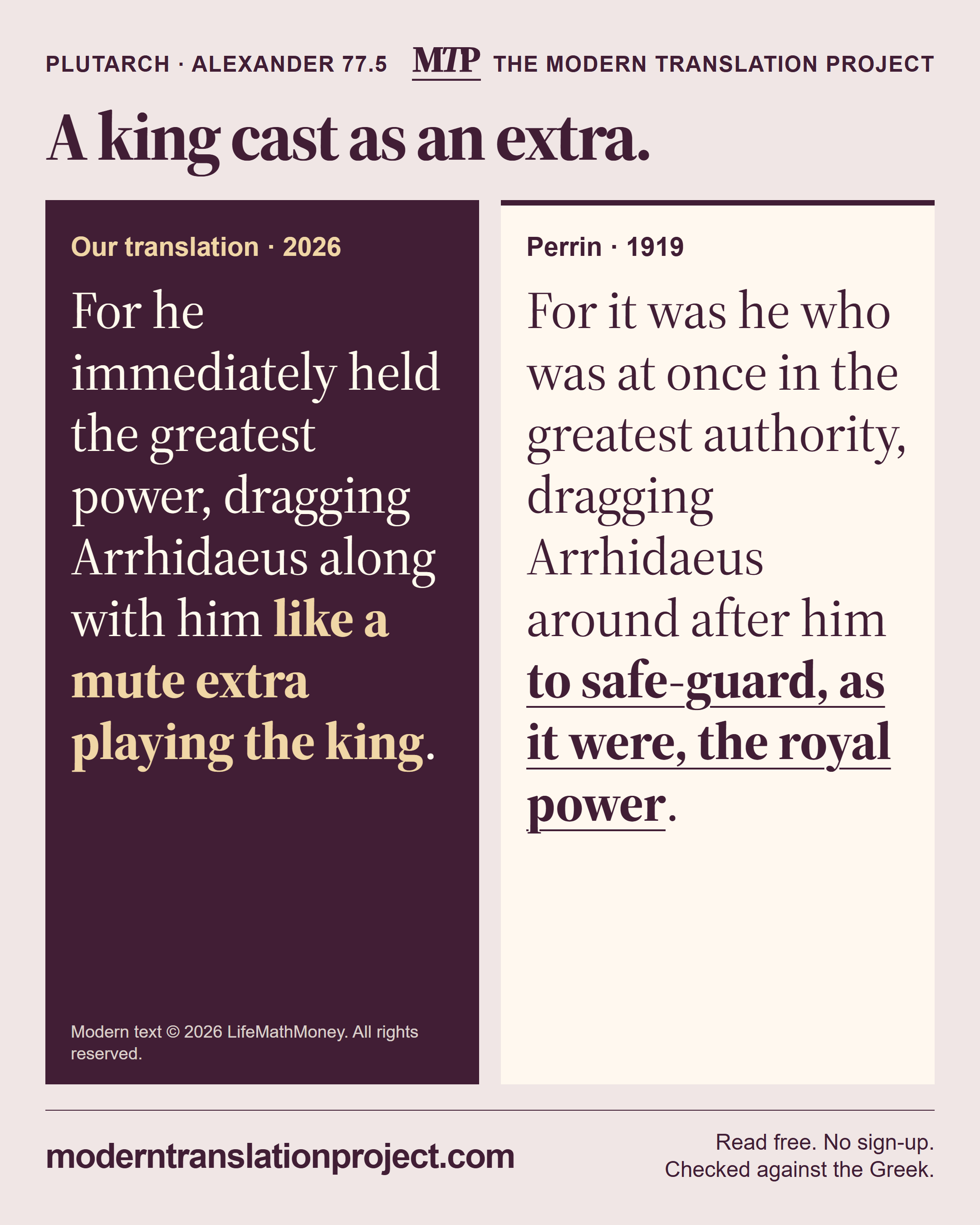
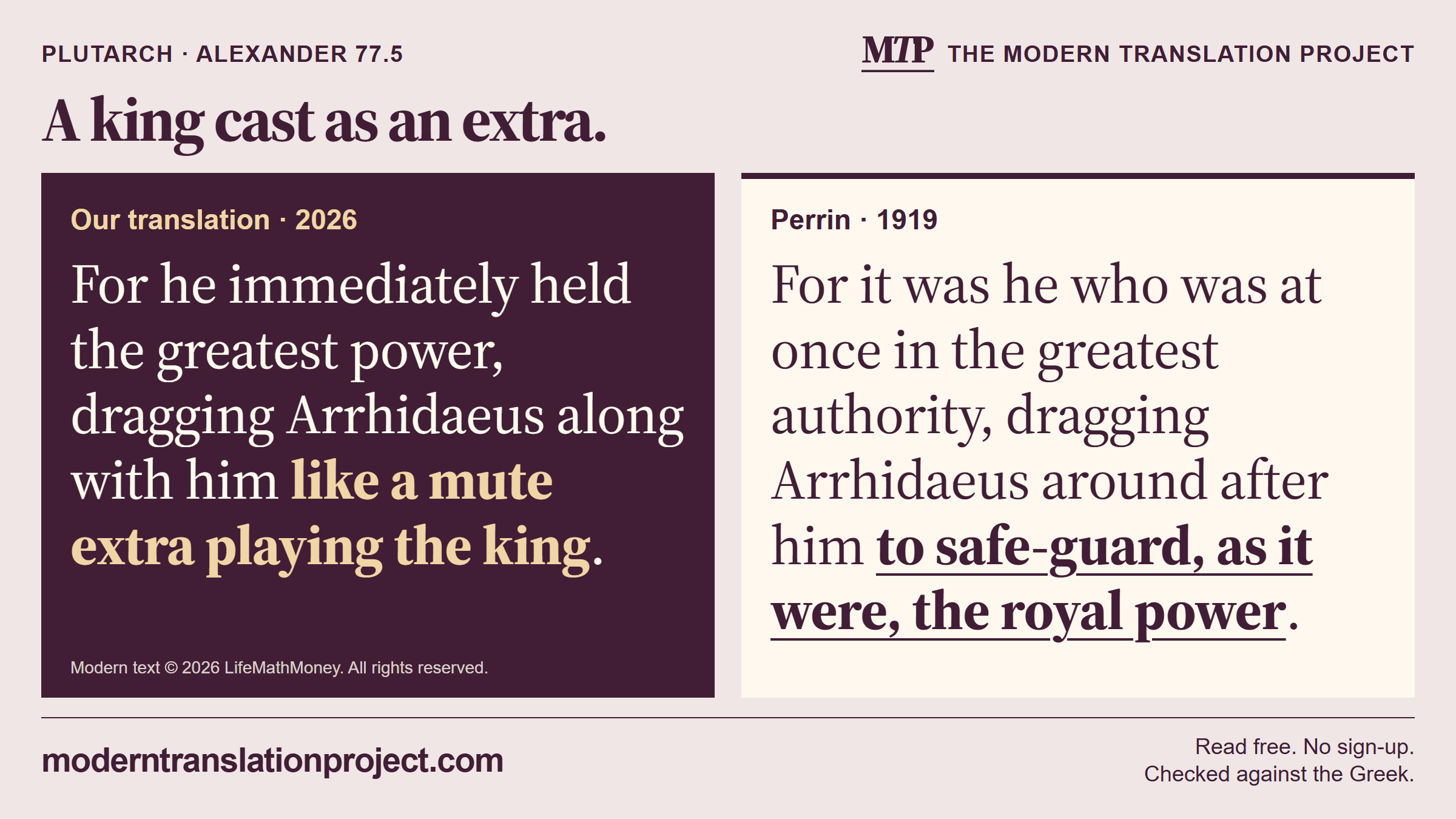
At 77.5, Arrhidaeus is dragged along “like a mute extra playing the king”: you see who has the title and who holds the power.
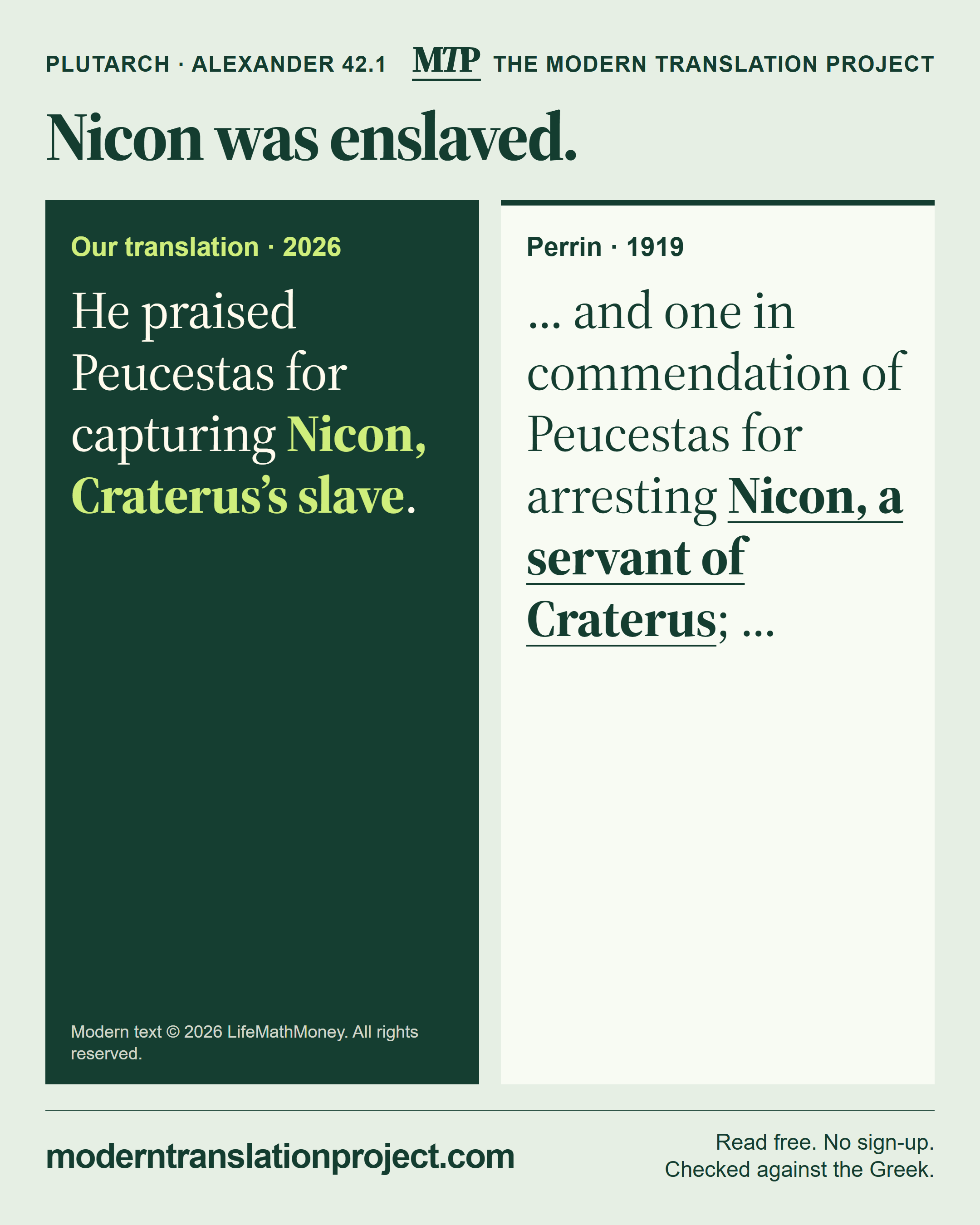
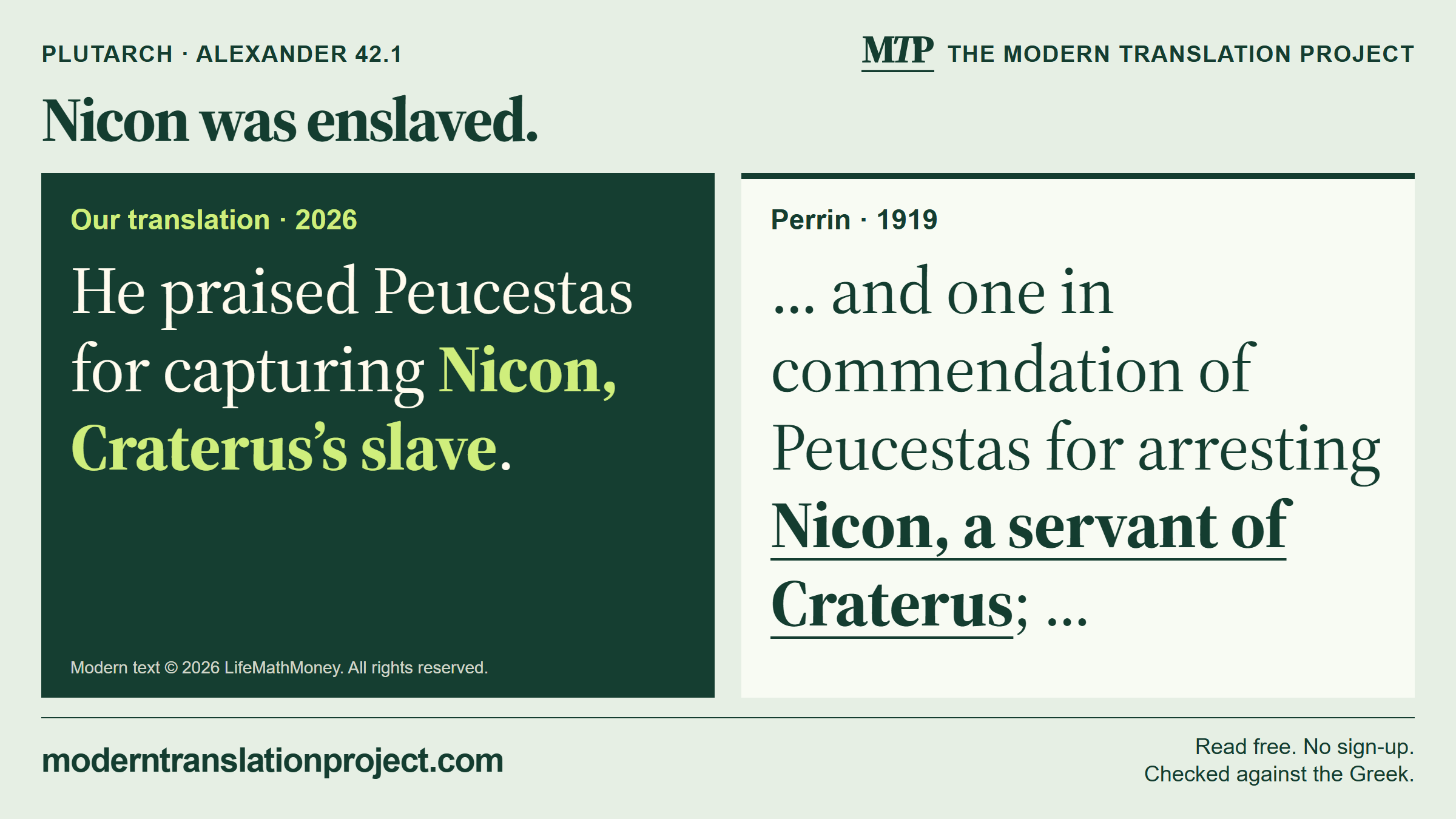
At 42.1, Nicon is “Craterus’s slave,” where Perrin (1919) writes “a servant of Craterus.”
Short notes place the people and campaigns on the map.
See the difference
A king cast as an extra.
Our translation · Alexander 77.5
For he immediately held the greatest power, dragging Arrhidaeus along with him like a mute extra playing the king.
Perrin · 1919 · Alexander 77.5
For it was he who was at once in the greatest authority, dragging Arrhidaeus around after him to safe-guard, as it were, the royal power.
After Alexander’s death, Perdiccas holds power and Arrhidaeus has the title of king. Perrin (1919) writes “to safe-guard, as it were, the royal power.” Plutarch’s word δορυφόρημα literally means “spear-carrier”; in the Greek theatre it was the term for a mute extra, an actor on stage with no lines. Ours keeps that image: “like a mute extra playing the king.” Arrhidaeus has the title but no say.
Check the original
Nicon was enslaved.
Our translation · Alexander 42.1
It is remarkable that he found time to write his friends letters about such matters as these: he ordered a search for a slave who belonged to Seleucus and had escaped to Cilicia. He praised Peucestas for capturing Nicon, Craterus’s slave. He wrote to Megabyzus about a slave sheltering in a sanctuary, telling him to call the man outside and arrest him if he could, but never to touch him within the sanctuary.
Perrin · 1919 · Alexander 42.1
For instance, he wrote one giving orders to seek out a slave of Seleucus who had run away into Cilicia; and one in commendation of Peucestas for arresting Nicon, a servant of Craterus; and one to Megabyzus about an attendant who had taken refuge in a sanctuary, bidding him, if possible, entice the slave outside the sanctuary and then arrest him, but not to lay hands upon him in the sanctuary.
Alexander writes about three slaves. Perrin (1919) calls Nicon “a servant of Craterus”; our translation says “Craterus’s slave.” The Greek δοῦλον names his enslaved status. You see immediately who owns him.
Check the original
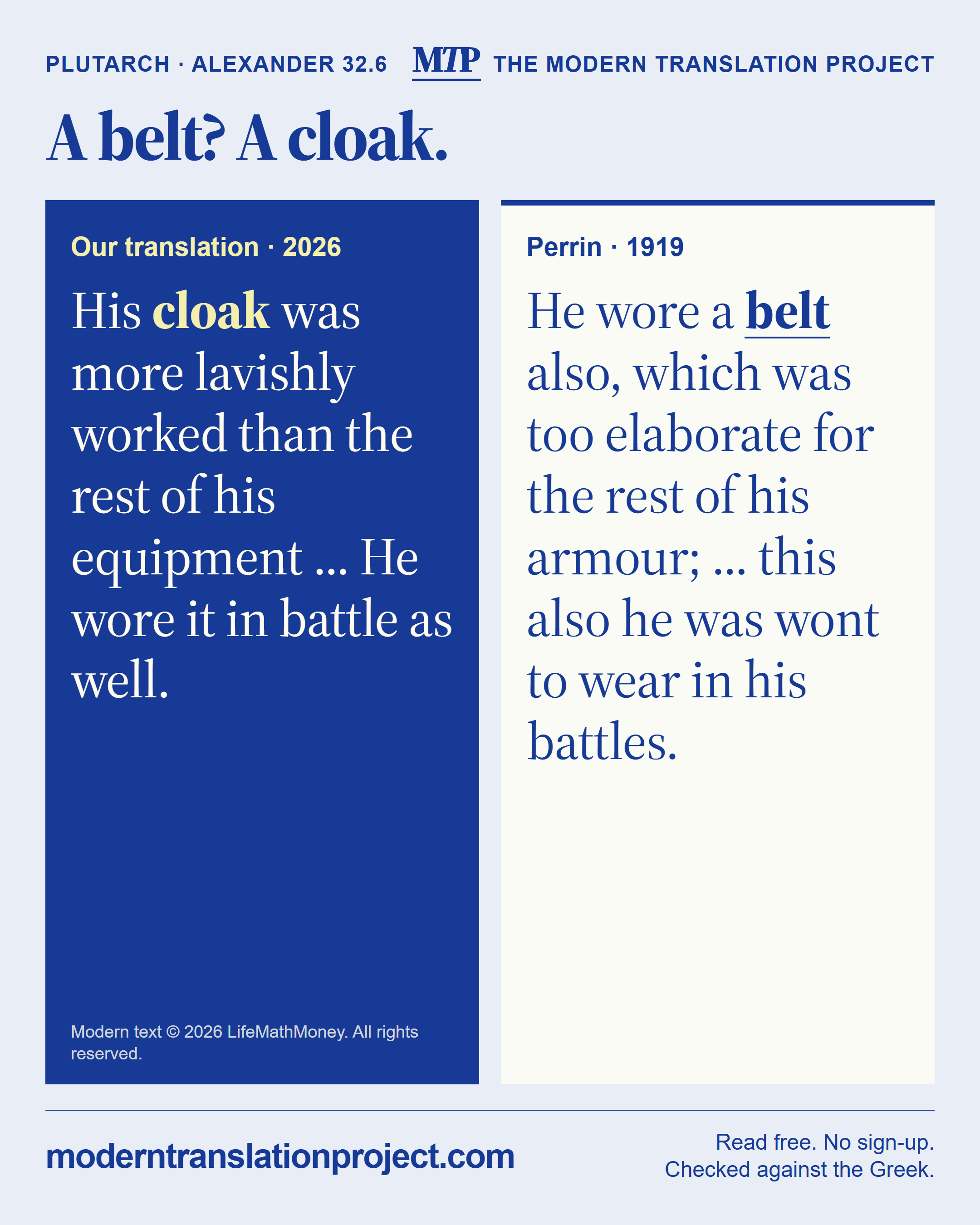
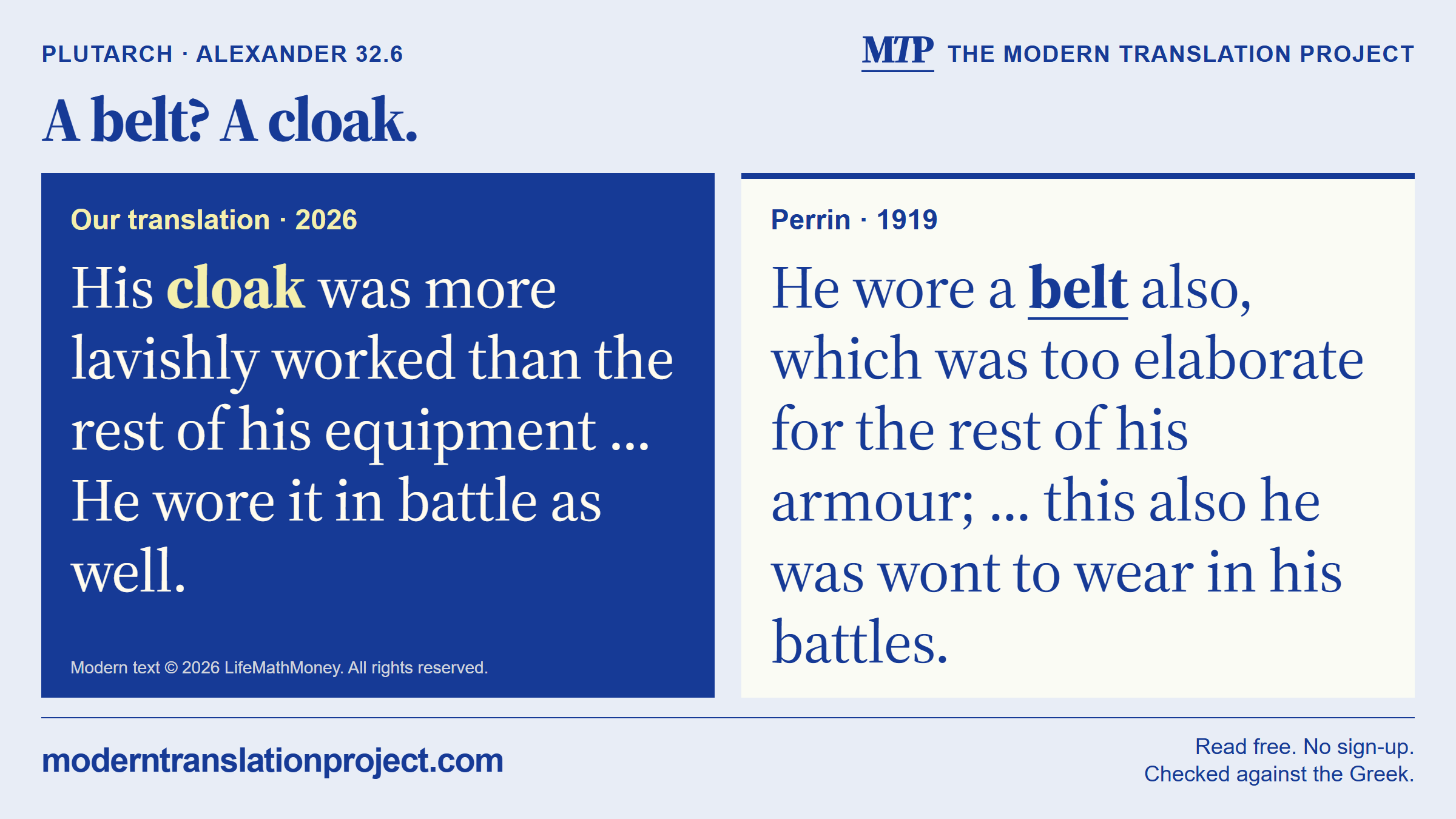
A belt? A cloak.
Our translation · Alexander 32.6
His cloak was more lavishly worked than the rest of his equipment, for it was a piece by Helicon, who lived in an earlier age, presented to him by the city of Rhodes as a mark of honor. He wore it in battle as well.
Perrin · 1919 · Alexander 32.6
He wore a belt also, which was too elaborate for the rest of his armour; for it was a work of Helicon the ancient, and a mark of honour from the city of Rhodes, which had given it to him; this also he was wont to wear in his battles.
Alexander dresses for battle. Perrin (1919) describes a “belt”; our translation describes a “cloak.” The Greek ἐπιπόρπωμα names a garment fastened with a brooch. Translation note t16 explains the choice, and the passage gives the maker, Helicon, and the city that presented it, Rhodes.
Check the original
Compare five translations of the same passage.
Plutarch tells you how to read him: character shows in small things. Perrin (1919) packs it into one long sentence; ours says it in two.
Our translation · Alexander 1.2
For I am writing lives, not histories, and the most conspicuous achievements do not always reveal virtue or vice. Often a minor incident, a remark, or a joke gives a clearer glimpse of character than battles that leave tens of thousands dead, the largest armies drawn up for battle, or cities under siege.
Clear, spoken English, checked line by line against the Greek, with short notes for every person and place.
Check the original
Bernadotte Perrin
Perrin · 1919 · Alexander 1.2
For it is not Histories that I am writing, but Lives; and in the most illustrious deeds there is not always a manifestation of virtue or vice, nay, a slight thing like a phrase or a jest often makes a greater revelation of character than battles where thousands fall, or the greatest armaments, or sieges of cities.
Perrin’s Loeb is accurate and formal, carrying each thought through long sentences.
Edition and copyright
1914–26 is the catalog date range for the Lives; Alexander is in volume 7 (1919).
First published 1914–26 (Loeb title pages, Perseus catalogue); translator died 1920 (Wikipedia). Public domain in the US, UK and EU.
I am writing biography, not history; and often a man’s most brilliant actions prove nothing as to his true character, while some trifling incident, some casual remark or jest, will throw more light upon what manner of man he was than the bloodiest battle, the greatest array of armies, or the most important siege.
Stewart and Long read smoothly and plainly for Victorian English.
Edition and copyright
Stewart–Long is the collection credit. The set was begun by George Long (died 1879) and completed by Aubrey Stewart; 1880–82 is its publication range. The hosted metadata does not identify the individual translator of Alexander.
First published 1880–82 (Bohn’s Standard Library); George Long died 1879 (Wikipedia) and Aubrey Stewart 1918 (Wikisource). Public domain in the US, UK and EU.
It must be borne in mind that my design is not to write histories, but lives. And the most glorious exploits do not always furnish us with the clearest discoveries of virtue or vice in men; sometimes a matter of less moment, an expression or a jest, informs us better of their characters and inclinations, than the most famous sieges, the greatest armaments, or the bloodiest battles whatsoever.
The Dryden translation as revised by Clough in 1859: stately older prose, lightly modernized.
Edition and copyright
The catalog records the 1859 revision; the hosted text uses the 1865 printing. Dryden is a collection credit, not a claim that he personally translated this Life.
First published 1683–86 (Dryden) and revised 1859 (Clough); Dryden died 1700 and Clough 1861 (Wikipedia). Public domain in the US, UK and EU.
… since we are not writing Histories but Lives. Nor is it always in the most distinguished atchievements that men's virtues or vices may be best discerned but very often an action of small note, a short saying, or a jest, shall distinguish a person's real character more than the greatest sieges or the most important battles.
The Langhornes’ 1770 version, with original spellings such as “atchievements.” For readers who like eighteenth-century English.
Edition and copyright
First published 1770; the hosted text is rebuilt from the 1792 printing, with 1798 used where needed. Original spelling and apostrophes are retained in this quotation.
First published 1770; every printing used is from 1798 or earlier, so no death year is needed (John Langhorne died 1779, William Langhorne 1772). The later revision by Francis Wrangham (1813) is not used.
For it is not Histories that I am writing, but Lives; …
Aubrey Stewart and George Long · 1880–82
… I am writing biography, not history; …
John Dryden and others, revised by A. H. Clough · 1865
It must be borne in mind that my design is not to write histories, but lives.
John Langhorne and William Langhorne · 1792
… since we are not writing Histories but Lives.
After Bucephalus: a kingdom to match · Alexander 6
The Modern Translation Project · 2026
My boy, find a kingdom that matches you, for Macedonia has no room for you.
Bernadotte Perrin · 1919
My son, seek thee out a kingdom equal to thyself; Macedonia has not room for thee.
Aubrey Stewart and George Long · 1880–82
My son, seek for a kingdom worthy of yourself: for Macedonia will not hold you.
John Dryden and others, revised by A. H. Clough · 1865
… my son, look thee out a kingdom equal to and worthy of thyself, for Macedonia is too little for thee.
John Langhorne and William Langhorne · 1792
Seek another kingdom, my son, that may be worthy of thy abilities; for Macedonia is too small for thee.
Step into the book
Plutarch (about AD 46–120) was a Greek writer living under Roman rule.
He wrote about Alexander (356–323 BC), king of Macedonia in the northern Greek world, whose campaigns reached Persia, in present-day Iran, and parts of what are now Pakistan and India. This is a life written to explore character, as Plutarch explains in the opening.
Read the opening before treating the Life as a military history. Plutarch tells you that character guides his selection.
Treat reported stories as reports. Watch whether Plutarch attributes a story to someone or presents it as his own account.
Choose Alexander from the Lives contents. Our modern translation here does not extend to the other biographies.
References such as Alexander 1.2 mean chapter 1, section 2; these chapter and section numbers help you find the same passage across editions.
Complete translation, with explanatory notes. Free to read, no sign-up.
Questions readers ask
Which Plutarch Alexander translation is easiest to read?
Start with our modern Life of Alexander for direct narrative, vivid images and notes for every person and place. The opening tells you what to watch for: character revealed in incidents, remarks and jokes.
Is Perrin’s Alexander a good translation?
Yes, if you want an accurate, formal Loeb voice. For a first read, start with ours and keep Perrin beside it to compare.
Can I read Plutarch’s Life of Alexander free online?
Yes. Our modern version and the Perrin, Stewart and Long, Dryden and Clough, and Langhorne versions of Alexander are free to read here, with no sign-up.
Does the modern translation cover all of Plutarch’s Lives?
The modern edition here is the complete Life of Alexander. You can read the other Lives in the classic translations available in the library.
Is Plutarch’s Alexander a history or a biography?
Plutarch calls his work a life, not a history. At the opening he explains why a small incident or a joke can matter more to his purpose than a major battle.
Who made this modern translation of Alexander?
It’s drafted from the original Greek by an AI translator and checked line by line against the Greek by a second AI.
Have a passage to discuss, a correction to suggest, or a work you want us to add? Email admin@lifemathmoney.com. Include the work and section so we can examine the passage.