Clear modern English. Nothing lost. Nothing softened.
Start with our modern Crito to follow a dangerous offer and the argument that decides it.
Crito has come to get Socrates out of prison. Socrates first wants to settle whether escaping would be right. Can an unjust sentence make escape the right thing to do?
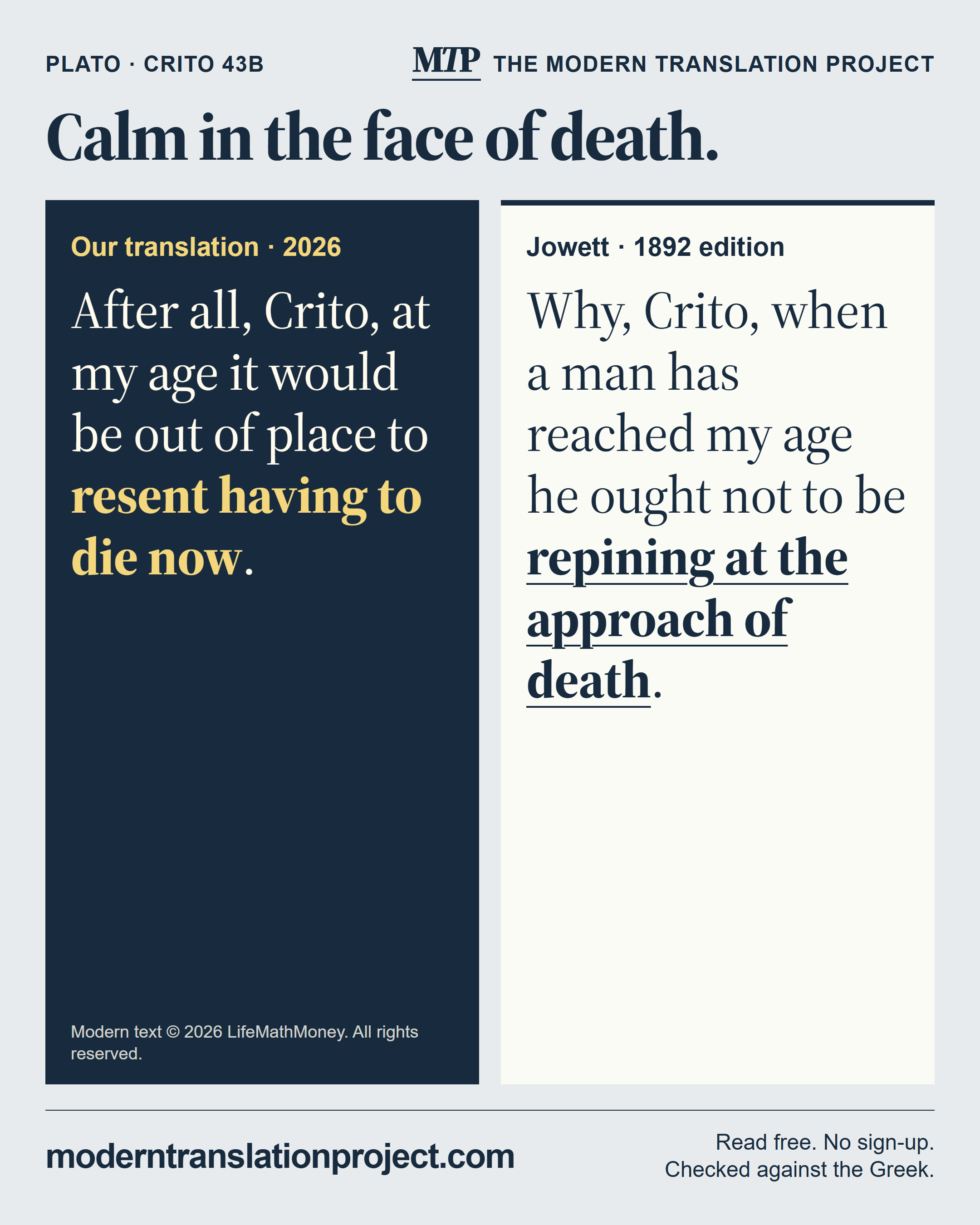
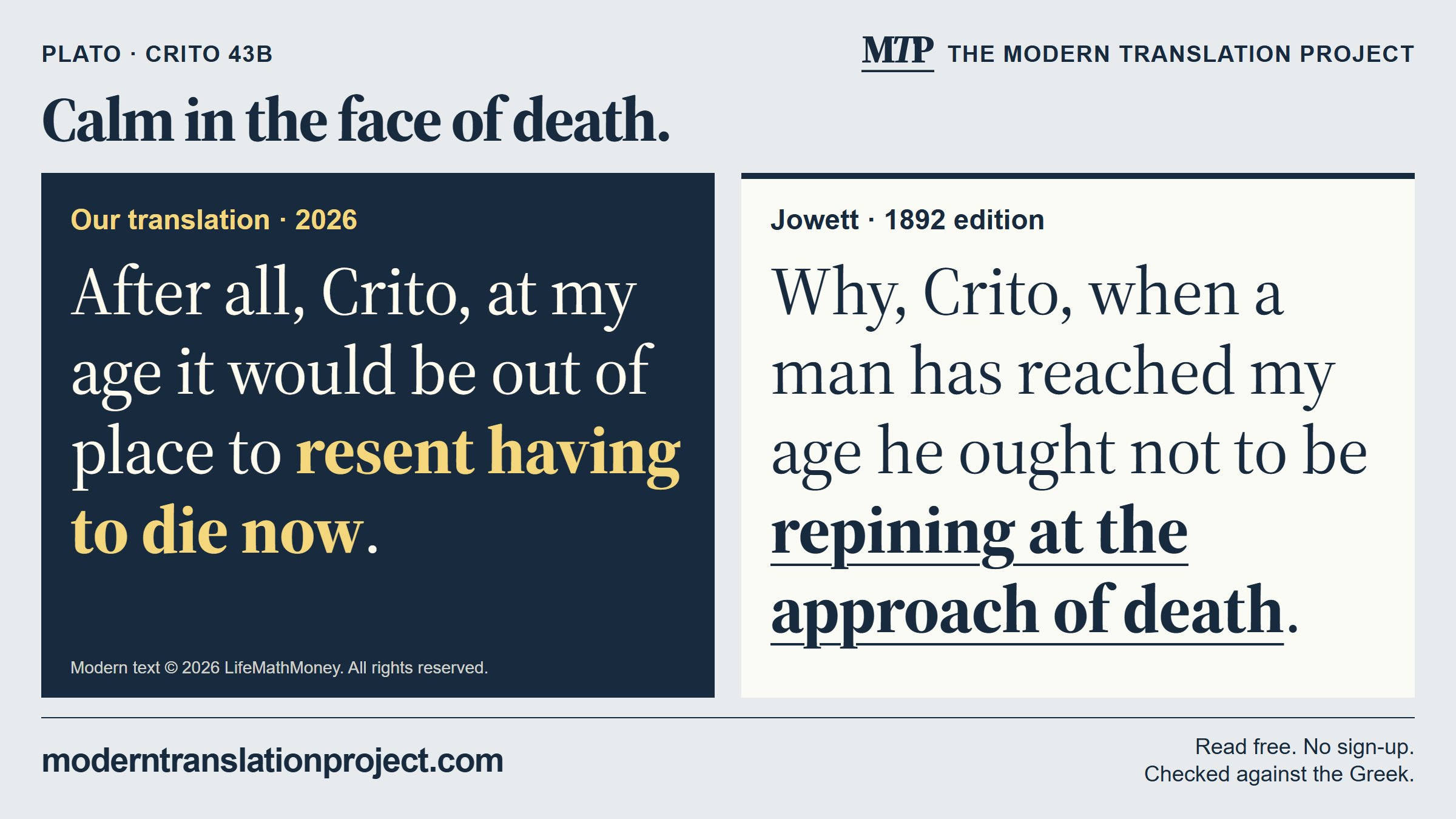
Calm in the face of death.
Our translation · Crito 43b
After all, Crito, at my age it would be out of place to resent having to die now.
Jowett · 1892 edition
Why, Crito, when a man has reached my age he ought not to be repining at the approach of death.
Socrates, calm as his death approaches, in words you use today.
Complete translation, with explanatory notes. Free to read, no sign-up.
Why start with ours?
At 43b, Jowett’s “repining” becomes “resent having to die now.” Socrates’s calm comes through in words you use today.
At 45a, “how cheaply these informers can be bought” makes Crito’s plan concrete.
At 49c, the rule is plain: “neither return wrong for wrong nor do harm to anyone, whatever we suffer at their hands.”
Short notes explain the people and places while you test the argument.
See the difference
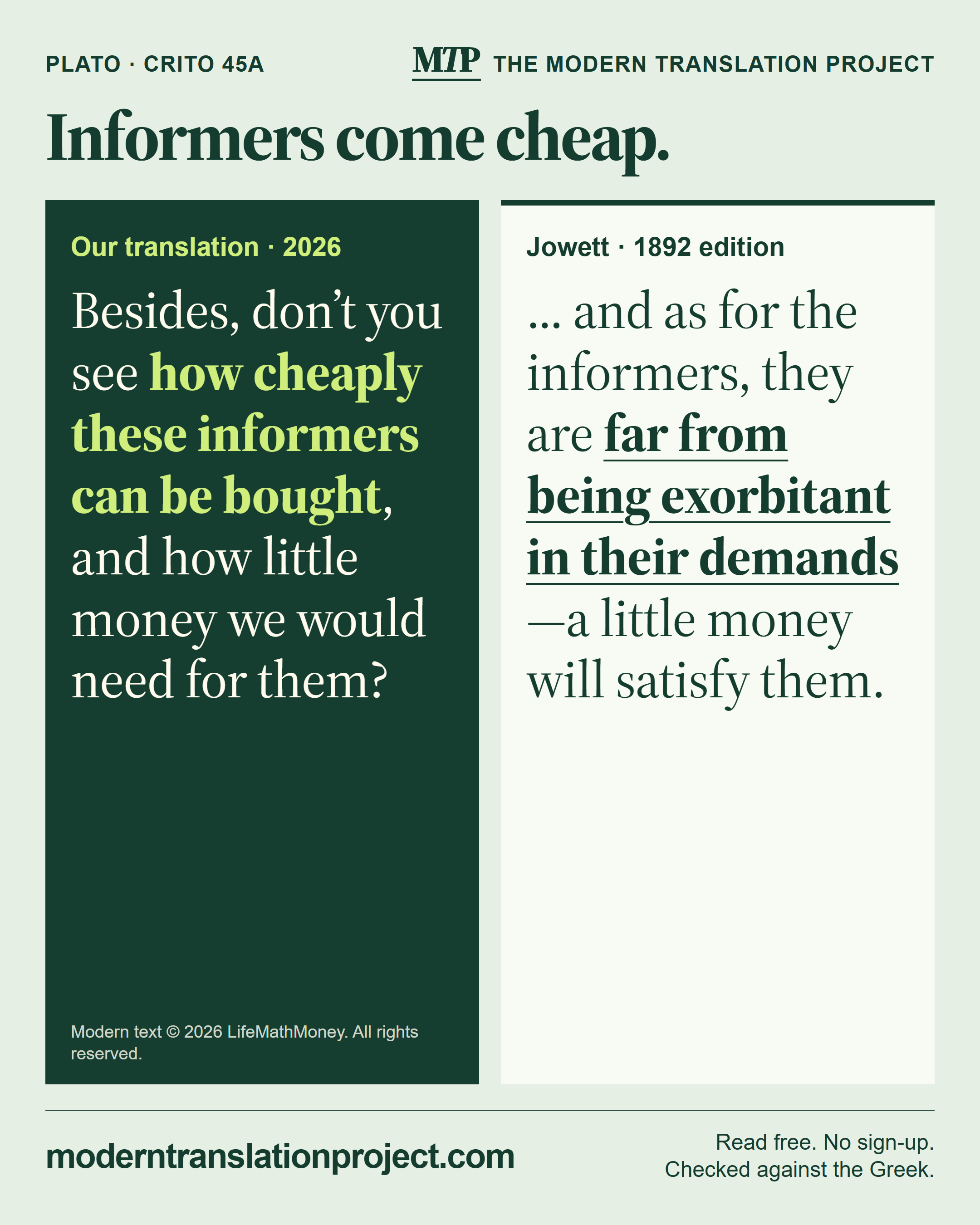
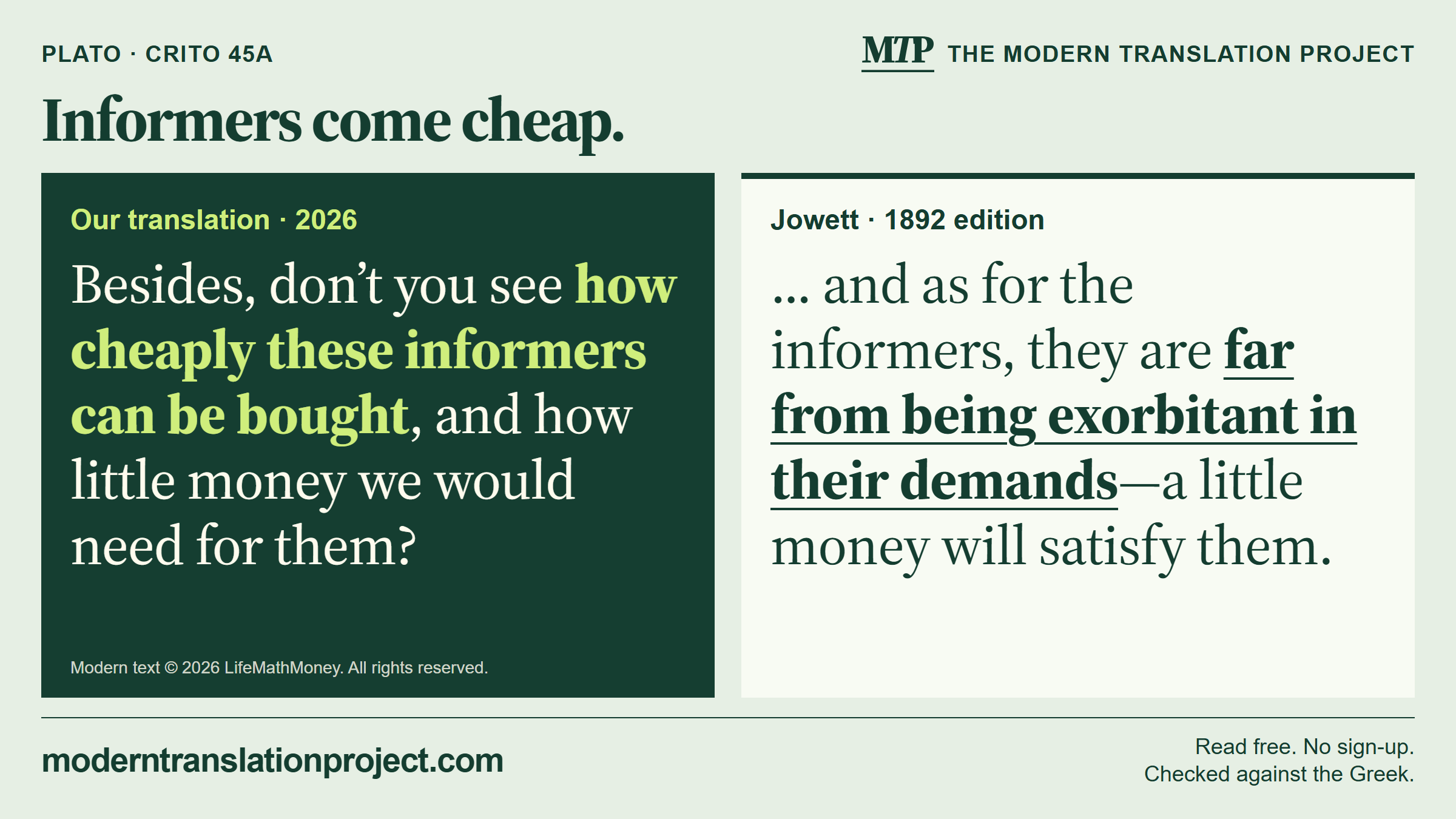
Informers come cheap.
Our translation · Crito 45a
Then don’t fear them. For the men who are prepared to save you and get you out don’t even want much money. Besides, don’t you see how cheaply these informers can be bought, and how little money we would need for them?
Jowett · 1892 edition · Crito 45a
Fear not—there are persons who are willing to get you out of prison at no great cost; and as for the informers, they are far from being exorbitant in their demands—a little money will satisfy them.
Crito says money can get Socrates out of prison and buy off the informers. Jowett (1892) writes “a little money will satisfy them.” Our translation asks “how cheaply these informers can be bought”: a direct, conversational challenge to Socrates’s fear.
Check the original
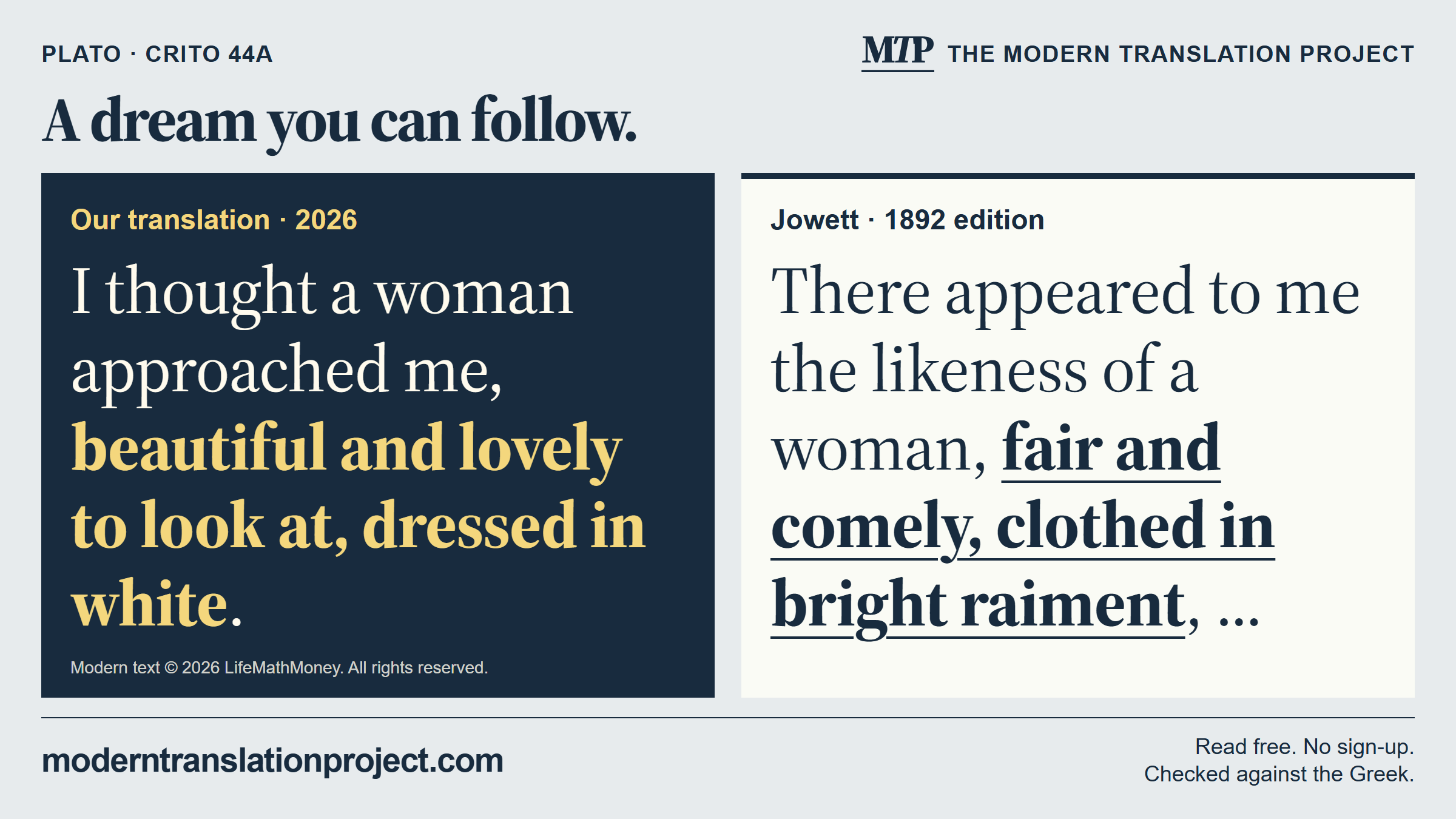
A dream you can follow.
Our translation · Crito 44a–b
I thought a woman approached me, beautiful and lovely to look at, dressed in white. She called to me and said: “Socrates, on the third day you would reach fertile Phthia.”
Jowett · 1892 edition · Crito 44a–b
There appeared to me the likeness of a woman, fair and comely, clothed in bright raiment, who called to me and said: O Socrates, “The third day hence to fertile Phthia shalt thou go.”
Awaiting execution, Socrates recalls a woman who visits him in a dream. Jowett (1892) writes “The third day hence”; our translation says “on the third day.” Note 6 explains Phthia, Achilles’ homeland, so you can follow the dream’s reference as well as its words.
Check the original
Compare five translations of the same passage.
Socrates rules out both retaliation and harming anyone. Compare how the five translations put it.
Our translation · Crito 49c
Then we must neither return wrong for wrong nor do harm to anyone, whatever we suffer at their hands.
Clear, spoken English, checked line by line against the Greek, with short notes for every person and place.
Check the original
Benjamin Jowett
Jowett · 1892 edition · Crito 49c
Then we ought not to retaliate or render evil for evil to anyone, whatever evil we may have suffered from him.
Jowett’s formal, balanced English: the classic Victorian Plato. His “render evil for evil” has a biblical ring.
Edition and copyright
First published 1871; the hosted text follows the 1892 third edition with Standard Ebooks spelling updates.
First published 1871 (The Dialogues of Plato, 1st ed., per Jowett’s preface); this text follows the 3rd edition of 1892. Translator Benjamin Jowett died in 1893 (VIAF; Library of Congress name heading “Jowett, Benjamin, 1817-1893”). Public domain in the US, UK and EU.
Then we ought neither to requite wrong with wrong nor to do evil to anyone, no matter what he may have done to us.
Fowler is clear and careful, though words such as “requite” can slow a first reading.
Edition and copyright
First published 1914 (Loeb Classical Library 36, 1914; year confirmed on the title page of an early printing on Internet Archive). Translator Harold North Fowler died in 1955 (Wikipedia; Rutgers Database of Classical Scholars). Public domain in the US, UK and EU.
It is not right, therefore, to return an injury, or to do evil to any man, however one may have suffered from him.
Cary’s is the oldest version here: compact and formal.
Edition and copyright
First published 1848; the hosted text uses the 1854 printing.
First published 1848 (Bohn’s Classical Library, vol. 1; date from library catalogue records on Internet Archive). Translator Henry Cary died in 1870 (Library of Congress name heading “Cary, Henry, 1804-1870” in those records). Public domain in the US, UK and EU.
Then we ought not to repay wrong with wrong or do harm to any man, no matter what we may have suffered from him.
Church is plain and close to everyday speech: the easiest of the older versions.
Edition and copyright
First published 1880 (Macmillan; title page in Internet Archive scan trialanddeathofs00platiala, a later printing of the same translation; the repaginated scan trialdeathofsocr0000plat_n9f5 is the 1886 Golden Treasury edition). Translator Frederick John Church died 1888 (library catalogue heading “Church, F. J. (Frederick John), 1854-1888”). Public domain in the US, UK and EU.
Complete translation, with explanatory notes. Free to read, no sign-up.
Questions readers ask
Which Crito translation should a beginner read?
Start with our modern Crito for present-day conversation and a clear sequence of reasons. Notes explain the people, places and references while you follow the question of escape.
Is Fowler’s Crito hard to read?
Its sentence structure is clear, but words such as “requite” can slow a first reading.
Can I read Crito free online?
Yes. Our modern Crito and the complete versions by Jowett, Fowler, Cary, and Church are free to read here, with no sign-up.
What does “return wrong for wrong” mean in Crito?
It means responding to someone’s wrongdoing by doing wrong yourself. Socrates asks Crito to accept that this is never right before discussing escape.
Should I read Crito after Apology?
Yes, that order gives useful context. Apology presents the defense in court; Crito takes place in prison after the sentence.
Who checked the modern translation of Crito?
It’s drafted from the original Greek by an AI translator and checked line by line against the Greek by a second AI.
Have a passage to discuss, a correction to suggest, or a work you want us to add? Email admin@lifemathmoney.com. Include the work and section so we can examine the passage.