Friend
309aThe numbers in the margin are the standard Stephanus page numbers, used to cite Plato everywhere. The Protagoras begins on page 309 of Stephanus’s 1578 edition, so it starts at 309a. Where have you come from, Socrates?1 Or is it obvious—you’ve been chasing after Alcibiades’s2 youthful beauty? When I saw him the other day, I thought he was still a beautifula man—a man all the same, Socrates, between ourselves, and his beard already filling in.
Socrates
So what? Aren’t you an admirer of Homer,3 309b who said that youth is most charming when the first beard appears—the very age Alcibiades is now?b
Friend
Well, how are things now? Have you just been with him? And how does the young man feel about you?
Socrates
He seemed friendly to me, especially today: he said a great deal in my support, helping me, and yes, I’ve just come from him. But I want to tell you something strange: although he was there, I paid him no attention and kept forgetting about him.
Friend
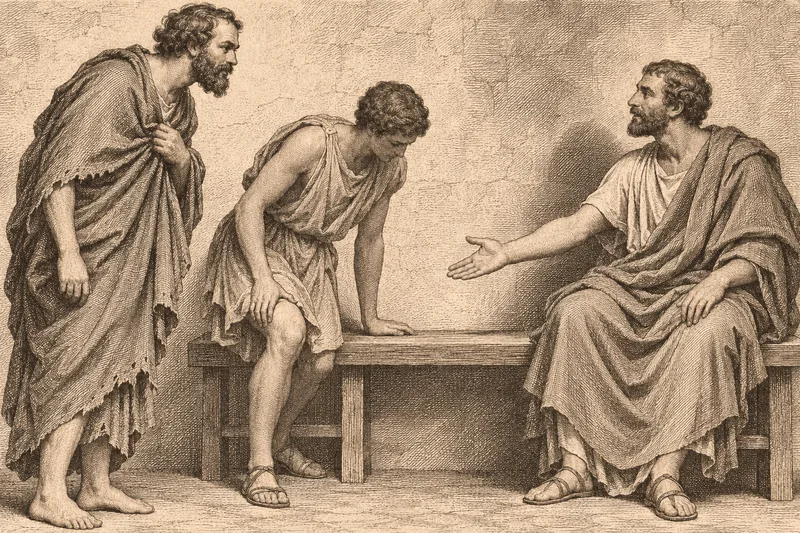
309c What could have happened between you and him that was so momentous? Surely you haven’t met anyone else more beautiful—at least not in this city.4
Socrates
Yes, much more beautiful.
Friend
What are you saying? A citizen5 or a foreigner?
Socrates
A foreigner.
Friend
From where?
Socrates
Abdera.6
Friend
And did this foreigner seem so beautiful to you that you thought him more beautiful than Cleinias’s7 son?
Socrates
Why wouldn’t what is wisest seem more beautiful, my dear fellow?
Friend
Have you come from meeting someone wise, then, Socrates?
Socrates
309d The wisest man alive, surely—if you think Protagoras8 is the wisest.
Friend
What! Protagoras is here?
Socrates
It’s his third day here already.
Friend
And you’ve just come from spending time with him?
Socrates
310a Yes, after saying and hearing a great deal.
Friend
Then why not sit here, have this slave9c get up, and tell us about your time together, unless something prevents you?
Socrates
Certainly. And I’ll be grateful if you listen.
Friend
And we to you, if you tell us.
Socrates
Then the gratitude would be mutual. Well, listen.
Last night, while it was still dark before dawn, Hippocrates,10 son of Apollodorus and brother of Phason, was pounding on my 310b door with his stick. As soon as someone opened it for him, he hurried straight in, calling loudly, “Socrates, are you awake or asleep?”
I recognized his voice. “It’s Hippocrates,” I said. “Not bad news, I hope?”
“Nothing but good,” he replied.
“That would be good news,” I said. “What is it, and why have you come at this hour?”
“Protagoras is here,” he said, standing beside me.
“Since the day before yesterday,” I said. “Have you only just heard?”
“By the gods,11 yes,” he said. “Last evening.”
310c At the same time, he felt for the little bed and sat down by my feet. “Last evening, yes, when I got back very late from Oenoe.12 You see, my slaved Satyrus13 had run away. I’d meant to tell you I was going after him, but something else made me forget. After I got back, when we’d had dinner and were about to go to bed, my brother told me that Protagoras was here. I tried to come straight to you even then, but then I thought it was too late at night. But as 310d soon as I woke from sleeping off my exhaustion, I got straight up and came here.”
Recognizing his courage and excitement, I said, “What’s that to you, then? Has Protagoras done you some wrong?”
He laughed. “By the gods, yes, Socrates,” he said. “He alone is wise and doesn’t make me wise.”
“But by Zeus,”14 I said, “if you give him money and persuade him, he’ll make you wise too.”
“Zeus and the gods,” he said, “if only it depended on 310e that! I wouldn’t spare any of my own money or my friends’. That’s exactly why I’ve come to you now: to have you speak to him on my behalf. For one thing, I’m rather young, and for another, I’ve never seen Protagoras or heard him say anything. I was still a child when he visited before.
“But everyone praises him, Socrates, and says he is the wisest of speakers. Why don’t we go to him, so that 311a we find him in? He’s staying, I hear, with Callias,15 son of Hipponicus. Come on, let’s go.”
“Not yet, my friend,” I said. “It’s early. Let’s get up and go out into the courtyard here, and pass the time walking around until it’s light. Then we’ll go. Protagoras usually stays indoors, so don’t worry: we’ll probably find him in.”
After that, we got up and walked around the courtyard. I 311b wanted to test Hippocrates’s resolve, so I examined him with questions.
“Tell me, Hippocrates,” I said. “You’re now planning to go to Protagoras and pay him a fee for yourself. What do you take him to be, and what do you intend to become? Suppose, for instance, you were planning to go to your namesake Hippocrates16 of Cos, one of the Asclepiads, and pay him a fee for yourself. If someone asked you, ‘Tell me, Hippocrates, in paying Hippocrates 311c a fee, what do you take him to be?’ what would you answer?”
“I’d say he was a doctor,” he replied.
“And what do you intend to become?”
“A doctor,” he said.
“And if you intended to go to Polyclitus17 of Argos or Phidias of Athens and pay them a fee for yourself, and someone asked you, ‘What do you take Polyclitus and Phidias to be, that you intend to pay them this money?’ what would you answer?”
“I’d say they were sculptors.”
“And what do you yourself intend to become?”
“Obviously, a sculptor.”
“Very well,” I said. “311d Now you and I are ready to go to Protagoras and pay him a fee for you, using our own money if it stretches far enough and we can persuade him with it, and spending our friends’ money too if it doesn’t. If someone asked us, when we were taking all this so seriously, ‘Tell me, Socrates and Hippocrates, what do you take Protagoras to be, that you intend to pay him money?’ what 311e would we answer him? What other name do we hear applied to Protagoras? Just as we hear Phidias called a sculptor and Homer a poet, what do we hear Protagoras called?”
“They call the man a sophist,18 of course, Socrates,” he said.
“So we’re going to pay him as a sophist?”
“Certainly.”
“Then suppose someone also asked you this: 312a ‘What do you yourself intend to become by going to Protagoras?’”
He blushed as he answered—there was already a glimmer of daylight, so I could see him. “If this is anything like the earlier cases, obviously I mean to become a sophist.”
“And by the gods,” I said, “wouldn’t you be ashamed to present yourself to the Greeks19 as a sophist?”
“By Zeus, yes, Socrates, if I’m to say what I think.”
“But perhaps, Hippocrates, you don’t expect your lessons with Protagoras 312b to be of that kind, but rather like those you had from your schoolteacher,20 lyre teacher, and athletic trainer? For you didn’t study any of those subjects as a craft, intending to become a professional, but for your education, as befits a layman and a free man.”
“Yes, certainly,” he said. “That’s more like the kind of learning I expect from Protagoras.”
“Then do you know what you’re about to do,” I said, “or have you missed it?”
“What do you mean?”
“You’re about to hand over your own soul21 312c to the care of a man you call a sophist. But I’d be surprised if you knew what a sophist actually is. And if you don’t know that, you don’t know what you’re entrusting your soul to, whether it’s something good or bad.”
“I think I do know,” he said.
“Then tell me: what do you think a sophist is?”
“I think,” he replied, “that, as the name suggests, he’s someone with knowledge of wise things.”e
“But,” I said, “you can say that about painters and carpenters too: they have knowledge of wise things. Yet 312d if someone asked us, ‘What are the wise things painters have knowledge of?’ we’d presumably tell him, ‘Those involved in producing likenesses,’ and so on with the others. But if someone asked, ‘What are the wise things a sophist has knowledge of?’ what would we answer him? What kind of work is he an expert in?”
“What could we call him, Socrates, but an expert at making people formidable speakers?”
“Perhaps that would be true,” I said, “but it wouldn’t be enough. Our answer still calls for a question: on what subject does the sophist make someone a formidable speaker? A lyre teacher, 312e presumably, makes someone a formidable speaker on the very subject he gives him knowledge of—playing the lyre. Isn’t that so?”
“Yes.”
“Very well. On what subject does a sophist make someone a formidable speaker?”
“Obviously, about whatever he also teaches him to know?”
“That seems likely. Then what is it that the sophist himself knows and teaches his pupil to know?”
“By Zeus,” he said, “now I can’t tell you.”
313a Then I said, “Well? Do you know what kind of danger you’re going into, putting your soul at stake? If you had to entrust your body to someone, risking its ending up in good or bad condition, you’d think long and hard about whether to entrust it to him, and call in your friends and relatives for advice, considering it for many days. But about your soul—which you value more than your body, and whose becoming good or bad determines whether everything goes well or badly for you—you haven’t consulted your father or your brother 313b or any of us, your friends, on whether to entrust it to this visiting foreigner. Instead, you hear about him in the evening, as you say, and come here at dawn, without discussing or seeking advice on whether you should entrust yourself to him or not. Yet you’re ready to spend your own money and your friends’, as though you’d already decided you must at all costs spend time with Protagoras, whom you don’t know, as you say, and 313c have never spoken to. You call him a sophist, yet plainly don’t know what a sophist is—the very person you’re about to entrust yourself to.”
When he heard this, he said, “So it seems, Socrates, from what you say.”
“Then, Hippocrates, is the sophist a sort of merchant22 or retailer of the goods the soul feeds on? That’s what he seems to me.”
“But what does the soul feed on, Socrates?”
“On lessons, presumably,” I said. “And we must take care, my friend, that the sophist doesn’t deceive us by praising what he sells, just as those who sell food for the body do—the 313d merchant and retailer. The sellers themselves presumably don’t know which of their goods are good or bad for the body, though they praise everything they sell; nor do their customers, unless one happens to be an athletic trainer or a doctor. In the same way, people who travel from city to city, selling and retailing lessons to anyone who wants them, praise everything they sell, though some of them too, my dear fellow, may not know which of their wares are good or bad 313e for the soul. The same goes for their customers, unless one happens to have medical knowledge of the soul. So if you know which of these things is good and which is bad, you can safely buy lessons from Protagoras or anyone else; but if you don’t, my dear fellow, take care 314a not to gamble with what you hold dearest and put it at risk.
“For there is far more risk in buying lessons than in buying food. You can buy food and drink from a retailer or merchant and carry it away in separate containers. Before you take it into your body by eating or drinking, you can put it down at home and call in an expert to advise you what to eat or drink and what not to, how much and when, so there is little 314b risk in buying it. But you can’t carry lessons away in a separate container: once you’ve paid, you must take the lesson into your soul itself and learn it, and go away either harmed or benefited.
“So let’s consider this with people older than ourselves, since we’re still too young to decide such an important matter. For now, though, let’s go and hear the man, as we set out to do; once we’ve heard him, let’s consult others too. Protagoras isn’t the only one there: 314c there’s Hippias23 of Elis, and I think Prodicus of Ceos, and many other wise men.”
We agreed on this and set out. When we reached the entrance, we stopped to discuss a question that had come up on the way. To avoid leaving it unfinished, and to settle it before we went in, we stood at the entrance talking until we agreed with each other.
I think the doorkeeper, a eunuch,24 overheard us; apparently, 314d with so many sophists about, he had grown irritated with people coming to the house. At any rate, when we knocked, he opened the door, saw us, and said, “Ah! Sophists. He’s busy.” With that, he slammed the door with both hands, putting all his energy into it.
We knocked again. With the door still shut, he answered, “You there, didn’t you hear that he’s busy?”
“But, my good fellow,” I said, “we haven’t come to see Callias, and we’re not sophists. Don’t worry: 314e we’ve come because we want to see Protagoras. So announce us.”
It took some doing, but at last the man opened the door for us.
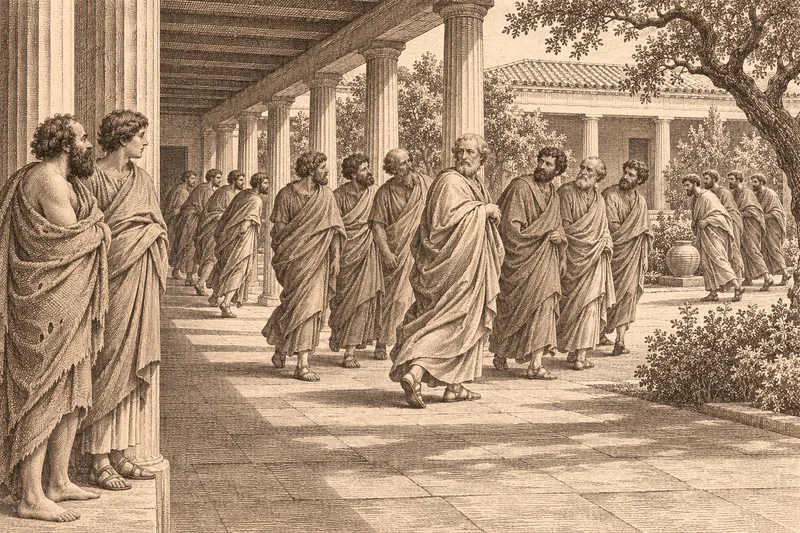
When we went in, we found Protagoras walking in the portico.25 Beside him walked, on one side, Callias, son of Hipponicus, and Callias’s half-brother on their mother’s side, 315a Paralus,26 son of Pericles, and Charmides,27 son of Glaucon; on the other, Pericles’s other son Xanthippus, Philippides,28 son of Philomelus, and Antimoerus29 of Mende, who has the highest reputation among Protagoras’s pupils and is studying professionally, intending to become a sophist.
Those following behind and listening to what was said seemed mostly to be foreigners—people Protagoras brings from all the cities he passes through, enchanting them with his voice like 315b Orpheus,30 while they follow the voice, enchanted—but there were some local people in the chorus too. It particularly delighted me to see this chorus: how carefully they made sure never to get in front of Protagoras and block his way! Whenever he and his companions turned around, these listeners split neatly and in order to either side, then circled around and took their places behind him again in perfect order.
As Homer says,
“Next I caught sight of”31
Hippias of 315c Elis, sitting on a high seat in the opposite portico. Around him on benches sat Eryximachus,32 son of Acumenus, Phaedrus33 of Myrrhinus, Andron,34 son of Androtion, and some foreigners, both fellow citizens of Hippias and others. They seemed to be asking Hippias various astronomical questions about nature and the heavens, while he, seated on his high seat, analyzed and explained the subjects of their questions to each of them.
And yes,
“I saw Tantalus35 too”—
for Prodicus of Ceos was here 315d too, as it turned out. He was in a room Hipponicus had previously used as a storeroom, but which Callias had now emptied out and turned into guest quarters because so many people were staying there.
Prodicus was still lying down, wrapped in sheepskins and blankets—a great many of them, from what I could see. On the couches nearby sat Pausanias36 of Cerameis and, with him, a boy still quite young, noblef 315e and good by nature, I think, and at any rate very beautiful to look at. I thought I heard that his name was Agathon,37 and I wouldn’t be surprised if he is Pausanias’s beloved.
There was this boy, and both Adeimantuses,38 the son of Cepis and the son of Leucolophides, and some others too, it seemed. I couldn’t make out from outside what they were discussing, although I very much wanted to hear Prodicus: he seems to me all-wise 316a and divine. But his deep voice produced a booming sound in the room that made his words indistinct.
We had only just entered when Alcibiades—the beautiful, as you call him, and I believe you—and Critias,39 son of Callaeschrus, came in behind us.
After coming in, then, we spent a little time looking at all this and went up to Protagoras. 316b I said, “Protagoras, Hippocrates here and I have come to see you.”
“Do you want to speak to me alone,” he asked, “or with the others present too?”
“It makes no difference to us,” I said. “Hear why we’ve come, then decide for yourself.”
“Why have you come, then?” he asked.
“Hippocrates here is a local man, the son of Apollodorus, from a great and wealthy family, and in natural ability he seems a match for others of his age. He seems to me to want 316c to make a name for himself in the city, and he thinks he could best achieve that by spending time with you. So now decide whether you think we should discuss this alone, in private, or with others present.”
“You’re right to think ahead on my behalf, Socrates,” he said. “A foreigner needs to be cautious when he goes to great cities and persuades the best of their young men to leave everyone else’s company—relatives and outsiders,g older and younger alike—and join him in the expectation of becoming better through 316d his company. Such things give rise to considerable envy, along with other kinds of hostility and plots.
“I maintain that the sophist’s art is ancient, but that the men of old who practiced it, fearing the resentment it aroused, used disguises and hid behind them: some behind poetry, like Homer, Hesiod,40 and Simonides; others behind initiations41 and oracular verses, like Orpheus and Musaeus and their followers. I’ve noticed some who also used athletic training, like Iccus42 of Tarentum and, still alive today and second to none as a sophist, 316e Herodicus43 of Selymbria, originally from Megara. Agathocles,44 your fellow citizen, a great sophist, used music as his disguise, as did Pythocleides of Ceos and many others. All these men, as I say, used these arts as screens because they feared envy.
“But I disagree with them 317a all on this point. I don’t think they achieved their purpose: they didn’t escape the notice of the people with power to act in their cities, the very people these disguises were meant for. The many,45 after all, notice practically nothing; they merely chant whatever these people proclaim. So trying to run away without being able to escape, and instead being clearly seen, is a very foolish thing to attempt 317b and is bound to make people much more hostile: they think such a person is a scoundrel as well as everything else.
“I’ve taken exactly the opposite path: I admit that I’m a sophist and that I educate people, and I think this is a better precaution than theirs—admitting it instead of denying it. I’ve thought out other precautions too, so that—with the god’s leave to say so—I come to no harm from 317c admitting I’m a sophist. Yet I’ve practiced this art for many years now. After all, I’ve lived many years altogether—I’m old enough to be the father of every one of you. So I would much prefer, if you’re willing, to discuss all this in front of everyone here.”
I suspected that he wanted to show off before Prodicus and Hippias and boast that we had come as loversh 317d of his, so I said, “Why don’t we call Prodicus and Hippias too, and the people with them, so they can listen to us?”
“Certainly,” said Protagoras.
“Would you like us to set up seating,” Callias asked, “so you can sit down and talk?”
We agreed that we should. All of us were delighted at the prospect of listening to wise men, and we took hold of the benches and couches ourselves and set up the seating by Hippias, since the benches were already there. Meanwhile Callias and Alcibiades 317e came back with Prodicus, whom they had got out of bed, and the people with him.
When we were all seated together, Protagoras said, “Now, Socrates, since these people are here too, you can tell us what you mentioned to me a little earlier on the young man’s behalf.”
318a I said, “My starting point is the same as before, Protagoras: why I came. Hippocrates here wants to spend time with you, and says he’d be glad to learn what will happen to him if he does. That’s all we have to say.”
Then Protagoras replied, “Young man, if you spend time with me, on the day you do so you’ll go home a better man, and the same will happen the next day: day after day you’ll keep improving.”
318b When I heard this, I said, “Protagoras, what you’re saying is no surprise; it’s to be expected, since even you, at your age and with all your wisdom, would become better if someone taught you something you didn’t know. But don’t put it like that. Suppose Hippocrates here suddenly changed his mind and wanted to spend time with that young man who has recently arrived, Zeuxippus46 of Heraclea. Suppose he went to him, as he has to you 318c now, and heard exactly what he’s heard from you—that every day he spent with him he’d become better and make progress. If he then asked him, ‘What do you mean I’ll become better at, and what will I make progress in?’ Zeuxippus would tell him it was in painting. And suppose he spent time with Orthagoras47 of Thebes, heard the same thing from him as from you, and asked what he’d become better at each day he spent with him: Orthagoras would say it was in playing the reed pipes. So answer this young man in the same way, and me as I ask on 318d his behalf: Hippocrates here, spending time with Protagoras, will go away a better man on the day he spends with him, and make similar progress every following day—in what, Protagoras, and concerning what?”
When Protagoras heard this, he said, “You ask a good question, Socrates, and I enjoy answering people who ask good questions. If Hippocrates comes to me, he won’t suffer what he would suffer with some other sophist. The others maltreati the young: 318e when young men have escaped the crafts, they drag them back against their will and thrust them into crafts, teaching them arithmetic, astronomy, geometry, and music”—as he said this he glanced at Hippias—“but if he comes to me, he’ll learn only what he’s come to learn. The lesson is good judgment in his own affairs, so that he can manage his own household as well as possible, 319a and in the affairs of the city, so that he can be as effective as possible in acting and speaking on its business.”
“Am I following your argument?” I said. “For you seem to be talking about the art of citizenship and promising to make men good citizens.”
“That is exactly the promise I make, Socrates,” he said.
“Then you have acquired an admirable art,” I said, “if you really have acquired it—for with you, at least, I will say only what I think. You see, Protagoras, I did not believe that this could 319b be taught, yet when you say it can, I do not see how I could disbelieve you. But I ought to explain why I think it cannot be taught or developed in one person by another:
“Like the other Greeks, I say that the Athenians are wise. Now, when we gather in the Assembly,48 I see that whenever the city has to undertake some building work, they send for builders to advise them about the buildings; when it concerns shipbuilding, they send for shipwrights, and they do the same in every other matter 319c they believe can be learned and taught. If anyone else tries to advise them, someone they do not consider a craftsman, they are no more willing to listen even if he is very handsome, rich, and wellborn. Instead, they laugh at him and shout him down until either he abandons his attempt to speak, overwhelmed by their shouting, or the archers49 drag him away or carry him out on the orders of the prytaneis. That is how they act in matters they believe belong to an art; but when they must deliberate on the running of the 319d city, anyone rises to advise them: carpenter, smith, shoemaker, merchant, shipowner, rich or poor, wellborn or lowborn alike. No one reproaches these men, as they did the others, for attempting to give advice without having learned from anyone or ever having had a teacher, because they clearly do not think it can be taught.
“And this is not just how things stand in the public affairs of the 319e city: in private too, our wisest and best citizens cannot pass on to others this excellencej that they possess. For Pericles, the father of these young men here, educated them thoroughly and well in subjects for which there are teachers, 320a but in the things in which he himself is wise, he neither educates them himself nor entrusts them to anyone else: they wander about grazing like animals let loose,k on the chance of stumbling upon excellence on their own. Or take Cleinias,50 the younger brother of Alcibiades here: this same Pericles was his guardian and, fearing that Alcibiades would corrupt him, pulled him away from his brother and placed him in Ariphron’s household to be educated. Before six months had passed, 320b Pericles handed him back to Alcibiades, at a loss what to do with him.l And I can name very many others who, though good themselves, have never made anyone better, either in their own households or outside them.
“So, Protagoras, when I look at these cases, I do not think excellence can be taught. But when I hear you say these things, I begin to change my mind and think there is something in what you say, because I believe you have gained much experience, learned many things, and discovered others for yourself. If, then, you can show us more clearly that 320c excellence can be taught, do not hold back: show us.”
“I will not hold back, Socrates,” he said. “But shall I show you by telling a story, as an older man speaking to younger ones, or by taking you through an argument?”
Many of those sitting beside him answered that he should proceed whichever way he wished.
“Then I think,” he said, “it would be more enjoyable to tell you a story.
“There was once a time when gods existed but mortal creatures 320d did not. When their appointed time to come into being arrived, the gods molded them inside the earth, mixing earth and fire with whatever combines with earth and fire. When they were about to bring them into the light, they instructed Prometheus51m and Epimetheus to equip them and distribute powers to each as appropriate.
“Epimetheus asked Prometheus to let him make the distribution himself. ‘When I have made the distribution,’ he said, ‘inspect it.’ Having persuaded him this way, he began distributing. He gave some strength without speed 320e and equipped the weaker ones with speed; some he armed, while for those he left unarmed by nature he devised another power to keep them safe. For those he clothed in small bodies, he provided escape on wings or an underground home, while those he made large he kept safe by their 321a very size. He distributed the other powers in the same way, balancing one against another. He devised all this, taking care that no kind should be wiped out.
“Once he had provided them with ways to escape destruction by one another, he devised protection against the seasons sent by Zeus, clothing them in thick hair and tough hides. These could ward off winter and withstand the heat, and were also to provide each creature, when it went to rest, with its own natural bedding. He also 321b shod some with hooves, others with tough, bloodless skin.n
“Next he provided different foods for different creatures: grass from the earth for some, fruit from trees for others, and roots for others. To some he gave other animals to devour as food, allotting few offspring to these and many to their prey, to ensure the survival of the species.
“Since Epimetheus was not particularly wise, he had unwittingly 321c used up all the powers on the irrational animals. The human race was still left unequipped, and he had no idea what to do. While he was at a loss, Prometheus arrived to inspect the distribution. He saw the other animals suitably supplied with everything, but humans naked, barefoot, without bedding or weapons. And the appointed day had already arrived when humans too had to emerge from the earth into the light.
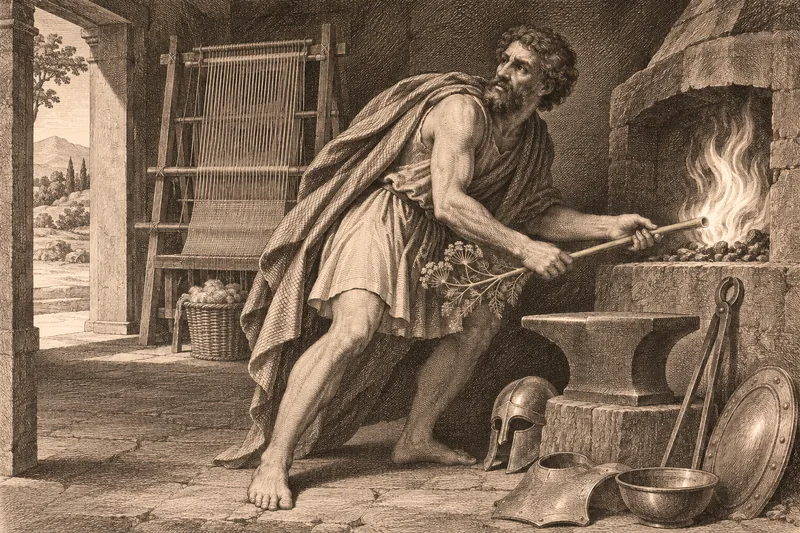
“So, at a loss to find a way of keeping humans safe, 321d Prometheus stole from Hephaestus52 and Athena their wisdom in the crafts, together with fire—for without fire no one could acquire it or make use of it—and gave it to humanity. In this way humans gained the wisdom needed for making a living, but they did not have civic wisdom, which was in Zeus’s keeping. Prometheus could not now enter the citadel, Zeus’s dwelling—and Zeus’s guards were terrifying besides—but he slipped unnoticed into the shared dwelling of Athena and Hephaestus, where 321e they practiced their crafts. He stole Hephaestus’s craft of working with fire and Athena’s craft as well, and gave them to humanity. As a result, humans gained ample means of 322a making a living, but later, as the story goes, punishment for theft53 overtook Prometheus because of Epimetheus.
“Once humans had received a share of the divine, they first acknowledged gods, alone among animals, because of their kinship with the gods,o and began setting up altars54 and statues of gods. Next, through their craft, they quickly articulated sounds and words, and devised houses, clothes, shoes, and bedding, and found food from the earth.
“Equipped in this way, humans at first 322b lived scattered about, and there were no cities. So wild animals were destroying them, because humans were weaker than the beasts in every respect. Their practical crafts gave them enough help in obtaining food but too little for war against wild animals: they did not yet have the art of citizenship, of which the art of war is a part. They therefore tried to gather together and save themselves by founding cities. But whenever they gathered, they did wrong to one another because they lacked the art of citizenship, so they scattered again and kept perishing.
“322c So Zeus, fearing that our whole race would perish, sent Hermes55 to bring humans a sense of shamep and justice, so that these would give cities order and be bonds that draw people together in friendship. Hermes asked Zeus how he should give justice and a sense of shame to humans. ‘Shall I distribute these as the arts have been distributed? They have been distributed like this: one person who has the art of medicine is enough for many who lack it, and the same holds for the other craftsmen. Shall I also place justice and a sense of shame 322d among humans in this way, or distribute them to everyone?’
“‘To everyone,’ Zeus said, ‘and let everyone share in them, because cities could not come into being if only a few shared in these, as they do in the other arts. And establish this law on my authority: put to death anyone unable to share in a sense of shame and justice, as a disease of the city.’
“That, Socrates, is how things stand, and why other people as well as the Athenians think only a few should give advice when the discussion concerns excellence in carpentry or another craft. If 322e someone outside those few offers advice, they will not tolerate it—as you say, and rightly, I say— but when they seek advice about civic 323a excellence, where the discussion must be guided throughout by justice and moderation,56q they rightly tolerate advice from anyone, since it is proper for everyone to share in this excellence at least, or there would be no cities. That, Socrates, is the reason.
“And so that you will not think you are being misled when I say that everyone really believes every man shares in justice and the rest of civic excellence, take this further evidence: In other kinds of excellence, as you say, if someone claims to be a good aulos player, or skilled in any other craft, when he is not, people either laugh 323b or get angry, and his family comes to admonish him as a madman. But in justice and the rest of civic excellence, even if they know someone is unjust, they regard his telling the truth against himself before a crowd as madness, though in the other case they considered telling the truth good sense.r They say everyone must claim to be just, whether he is or not, and anyone who does not lay claim to justice is mad: everyone without exception, they believe, 323c must share in it somehow or have no place among human beings.
“So this is why I say they rightly accept every man as an adviser on this excellence: they think everyone shares in it. Next I will try to show you that they believe it neither comes by nature nor arises spontaneously, but can be taught and comes through care to whoever acquires it. For when people think someone’s bad qualities come 323d from nature or chance, no one grows angry with that person or admonishes, teaches, or punishes him to make him different; they pity him instead. Who, for example, is foolish enough to attempt any of these things with people who are ugly, short, or weak? I think people know, after all, that qualities of this kind, attractive ones and their opposites, come to us by nature and chance. But when someone lacks the good qualities people think come through care, practice, and teaching, 323e and has the opposite bad qualities instead, that, I take it, is when anger, punishment, and admonition arise. Among these bad qualities are wrongdoing, impiety,57s and 324a everything, in a word, opposed to civic excellence. Here everyone grows angry with everyone else and admonishes them, evidently because they think excellence can be acquired through care and learning.
“If you consider, Socrates, what punishing wrongdoers means, that itself will teach you that people believe excellence can be developed: No one punishes a wrongdoer with his mind on the fact that he has done wrong, and for that reason, unless 324b he is taking unreasoning revenge like a wild beast. But someone who sets out to punish with reason does not exact a penalty for the wrong in the past—he cannot undo what has been done—but for the future, so that neither the wrongdoer himself nor anyone who has seen him punished will do wrong again. With that intention, he thinks excellence can be developed through education: at any rate, he punishes to deter. So everyone who exacts a penalty, 324c in private or in public, holds this view. Other people, and especially the Athenians, your fellow citizens, exact penalties from those they think do wrong and punish them. By this reasoning, then, the Athenians too are among those who believe excellence can be developed and taught. So I have sufficiently shown you, Socrates, both why your fellow citizens rightly listen to a smith or shoemaker advising them on civic affairs, and that they believe excellence can be taught and developed—at least as it 324d seems to me.
“There remains the difficulty you raise about good men: why do they have their own sons taught the other subjects that teachers provide, and make them skilled in those subjects, yet make them no better than anyone else in the excellence in which they themselves are good? On this point, Socrates, I will give you an argument now, rather than a story. Consider this: is there or is there not one thing that every citizen must share in, 324e if there is to be a city? Your difficulty can be resolved here or nowhere else. Suppose there is, and this one thing is not carpentry, metalworking, or pottery 325a but justice, moderation, and being pious—what I call, all taken together, one thing: a man’s excellence. Suppose everyone must share in this and, whatever else they wish to learn or do, must do so with it, never without it. Otherwise they must be taught and punished, whether child, man, or woman, until punishment makes them better; anyone who fails to respond to punishment and teaching must be driven 325b from the cities or put to death as incurable. If that is how things are and good men nevertheless have their sons taught everything else but this, consider how extraordinary these good men are! For we have shown that they consider it teachable both privately and publicly. Yet although it can be taught and cultivated, do they have their sons taught subjects where ignorance carries no death penalty, but neither have them taught it nor take every care where their children face death and exile for failing to learn 325c or be cultivated in excellence—and besides death, confiscation of property and, so to speak, the complete ruin of their households? We must suppose they do teach it, Socrates.t
“From earliest childhood to the end of life, they teach and admonish them. As soon as a child understands what is said, his nurse, mother, pedagogue,58 and 325d father himself strive to make him as good as possible. At every word and deed they teach him and point out that this is just and that unjust, this admirable and that shameful, this pious and that impious, and that he is to do this and not do that. If he obeys willingly, well and good; if not, they straighten him with threats and blows like a piece of wood that is warped and bent.
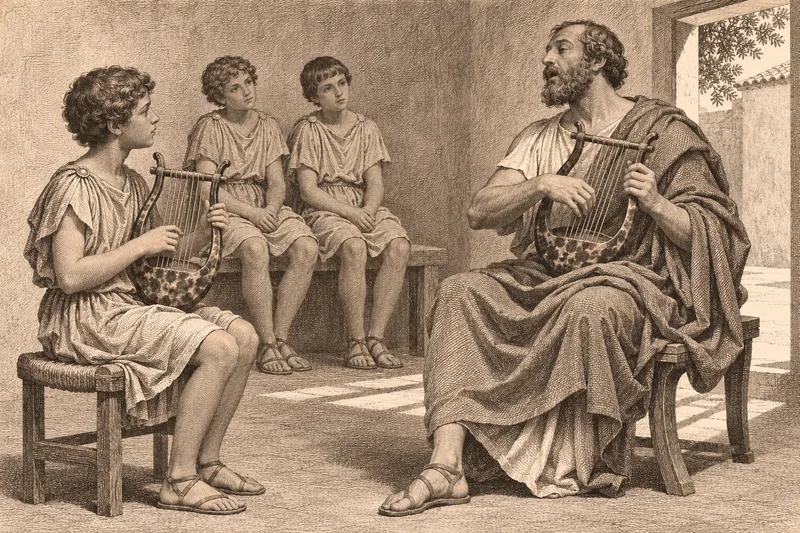
“After this they send him to teachers, instructing them to take far more care 325e over the boys’ good behavior than over their reading and writing or lyre-playing.59 The teachers take care of these things, and once the boys have learned their letters and are ready to understand writing as they previously understood speech, they put poems by good poets before them to read as they sit on their benches, and make them learn 326a the poems by heart. These contain many admonitions and many accounts, praises, and celebrations of good men of old, so that the boy will emulate and imitate them and long to become like them.
“The lyre teachers do the same sort of thing: they care for the boys’ moderation and see that the young do nothing bad. Besides this, once the boys have learned to play the lyre, they teach them poems by other good poets, the lyric poets, setting them to 326b lyre music. They make rhythms and harmonies familiar to the boys’ souls, so that they grow gentler and, with better rhythm and harmony, become better suited to speech and action; for all human life needs good rhythm and harmony.
“Besides all this, they send them to an athletic trainer60 so that, with their bodies in better condition, they can serve their sound minds 326c and will not be forced by poor physical condition to act like cowards in war or in other undertakings. Those with the greatest means do this mostu—the richest have the greatest means—and their sons start school at the earliest age and leave it at the latest.
“Once they leave their teachers, the city in turn makes them learn the laws and live by them as a pattern, 326d so that they will not act at random on their own. Instead, just as writing teachers draw lines with a stylus61 for boys who are not yet skilled at writing, then give them the tablet and make them write by following the lines, so the city draws laws in outline—the discoveries of good lawgivers of old—and makes its citizens follow them both when ruling and when being ruled. Anyone who steps outside these laws is punished, and this punishment is called euthynai62v both among you 326e and in many other places, because justice straightens people out. With so much care taken over excellence privately and publicly, are you surprised, Socrates, and puzzled about whether excellence can be taught? You should not be surprised at that, but far more surprised if it could not.
“Why, then, do many sons of good fathers turn out badly? Learn this too: there is nothing surprising about it, if what I said earlier is true—that in this matter, 327a excellence, no one can remain untrained if there is to be a city. If what I say is right—and it most certainly is—choose any other practice or subject of study you like and consider it.
“Suppose a city could not exist unless we were all aulos players, each playing as well as he could. Suppose everyone taught everyone else, privately and publicly, and rebuked anyone who played badly, without begrudging the teaching, just as no one now begrudges sharing what is just and lawful or 327b conceals it, as they do with other crafts. After all, I think we benefit from one another’s justice and excellence; that is why everyone eagerly explains and teaches everyone else what is just and lawful. If, then, we were just as eager and ungrudging in teaching one another to play the aulos, do you think, Socrates,” he said, “that good players’ sons would be any more likely to become good players than poor players’ sons? I do not think so: whichever father had a son born with the greatest gift for playing, that son 327c would grow up distinguished, while a son without the gift would remain obscure. Often a good player’s son would turn out poorly, and often a poor player’s son would turn out well. Yet they would all be competent players compared with untrained people who knew nothing of playing the aulos.
“Think of things now in the same way. The man who seems to you the most unjust of those brought up among laws and human beings would be a just man and a craftsman in justice if he had to be judged 327d against people with no education, no courts, no laws, and no constraint continually forcing them to care for excellence—wild people, like those the poet Pherecrates63 put onstage last year at the Lenaea.64 If you found yourself among people like that, as the misanthropes in that chorus65 did, you would be very glad to meet Eurybatus66 and Phrynondas, and would wail with longing for the wickedness of the people 327e here. But now you are spoiled, Socrates, because everyone is a teacher of excellence, as far as each can be, and no one seems to you to be one. It is just as if you looked for a teacher 328a of Greek: you would not find a single one. Nor, I think, would it be easy to find someone to teach our craftsmen’s sons the very craft they have learned from their father and his friends in the same trade, as far as those men could teach it—someone to teach them still more. I think, Socrates, it would be hard to find a teacher for these boys, but easy for those with no experience at all. It is the same with excellence and everything else; but if someone is even a little better 328b than we are at advancing people toward excellence, that is welcome.
“I think I am one of these people, and that I could help someone become admirable and good far more than other people could, giving value for the fee I charge and more besides, even in the pupil’s own judgment. That is why I have arranged to collect my fee in this way: when someone has learned from me, he pays the sum I ask, if he wishes; 328c if not, he goes to a sanctuary,67 swears how much he considers the lessons worth, and pays that amount.
“Such, Socrates,” he said, “is the story and argument I have given you to show that excellence can be taught and that the Athenians believe this, and that there is nothing surprising about good fathers having bad sons or bad fathers good ones. For even Polyclitus’s sons,68 who are the same age as Paralus and Xanthippus here, are nothing beside their father, and the same holds for other craftsmen’s sons. But these two, Paralus and Xanthippus, 328d do not yet deserve that accusation: there is still hope for them, because they are young.”
With this long display, Protagoras brought his speech to an end. For a long time I kept looking at him, still under his spell, as though he were going to say something more, eager to hear it. When I realized he really had stopped, I somehow managed to pull myself together, so to speak, looked at Hippocrates, and said:
“Son of Apollodorus, how grateful I am to you for urging me to come here: it means a great deal to me 328e to have heard what I have heard from Protagoras! For I used to think there was no human care through which good men become good, but now I am convinced. Only one small point stands in my way, which Protagoras will obviously explain without difficulty, since he has explained so much.
“For if you met with any of the 329a public speakers about these very subjects, you might well hear speeches like these from Pericles or another accomplished speaker. But if you asked one of them a further question, they would be like books, unable either to answer or to ask a question themselves. Instead, if someone asks even a small question about what they have said, they behave like bronze vessels that ring on and on when struck unless someone takes hold of them: asked a small 329b question, the orators stretch their speech into a long-distance race.69 But Protagoras here can give long, fine speeches, as he has shown, and can also give brief answers when questioned, and when he asks a question, wait for the answer and accept it—abilities few people possess.
“Now, Protagoras, I need only one small thing to have it all, if you will answer this question. You say excellence is teachable, and if anyone could persuade me, you do. 329c But satisfy my soul about the point that puzzled me as you spoke. You said that Zeus sent justice and a sense of shame to human beings, and time and again in your speech you spoke of justice, moderation, piety,70 and all these as though together they were one thing, excellence. So explain this to me precisely: is excellence one thing, with justice, moderation, and piety as its parts, or are all the things I have just 329d mentioned names for the same single thing? That is what I still want to know.”
“That is easy to answer, Socrates,” he said. “The things you are asking about are parts of excellence, which is one thing.”
“Are they parts,” I asked, “like the mouth, nose, eyes, and ears of a face,71 or like the parts of gold, which differ from one another and from the whole only in being larger or smaller?”
“The first way, I think, 329e Socrates: as the parts of the face relate to the whole face.”
“Then do people share in these parts of excellence,” I asked, “some in one and some in another, or must anyone who gets one have them all?”
“Certainly not,” he said, “since many people are courageous but unjust, and others just but not wise.”
“Then wisdom and courage too are parts 330a of excellence?” I asked.
“Most certainly,” he said. “And wisdom is the greatest of the parts.”
“And each is different from the others?” I asked.
“Yes.”
“And does each have a power of its own? Take the parts of the face: the eye is not like the ears, and its power is not the same. Nor is any other part like another, either in its power or in any other respect. So are the parts of excellence like this too, with no part like 330b another, either in itself or in its power? Or is it clear that this is how they are, if they match the example?”
“That is how they are, Socrates,” he said.
Then I said, “So no other part of excellence is like knowledge,w or like justice, or like courage, or like moderation, or like piety.”
“No,” he said.
“Come, then,” I said, “let us consider together what each of them is like. First, this: 330c is justice a thing, or no thing at all? I think it is a thing. What about you?”
“So do I,” he said.
“What, then, if someone asked you and me, ‘Protagoras and Socrates, tell me: this thing you have just named, justice—is this itself just or unjust?’ I would answer that it is just. How would you vote? The same way as me, or differently?”
“The same,” he said.
“Then justice is the sort of thing that is just: that is what I would say in answer to the 330d questioner. Wouldn’t you?”
“Yes,” he said.
“Then if he next asked us, ‘You also say there is such a thing as piety, don’t you?’ we would say we do, I think.”
“Yes,” he said.
“‘And you say this too is a thing?’ We would say so, wouldn’t we?”
He agreed to this too.
“‘Do you say that this very thing is by nature the sort of thing that is impious, or the sort that is pious?’ I would be indignant at the question,” I said, “and reply, ‘Speak no ill omen, man!72 Anything else could hardly be pious if 330e piety itself is not pious.’ What about you? Wouldn’t you answer in the same way?”
“Certainly,” he said.
“Then suppose he next questioned us like this: ‘What were you saying a little earlier? Did I hear you incorrectly? You seemed to say that the parts of excellence stand in such a relation to one another that none is like another.’ I would reply, ‘You heard the rest correctly, but you misheard if you think I said that too: Protagoras 331a here gave those answers, while I asked the questions.’ If he then said, ‘Is this man telling the truth, Protagoras? Do you say that no part of excellence is like another? Is that your claim?’ what would you answer?”
“I have to agree, Socrates,” he said.
“What, then, Protagoras, are we to answer him, having agreed to this, if he asks us next, ‘Then piety is not the sort of thing to be just, nor justice the sort to be pious, but rather not pious; and piety is not just, but unjust, 331b then, while justice is impious?’ What are we to answer? Speaking for myself, I would say both that justice is pious and that piety is just. And on your behalf too, if you let me, I would give these same answers: that justnessx is either the same as piety or extremely similar to it, and that justice is like piety and piety like justice more than anything else. But consider whether you forbid me to answer this way, or agree with me.”
“I don’t think, Socrates,” he said, “that it is quite so simple 331c that I can grant that justice is pious and piety just; I think there is a difference between them. But what difference does that make?” he said. “If you like, let us agree that justice is pious and piety just.”
“No,” I said, “for it isn’t this ‘if you like’ and ‘if you think so’ that I want to test, but you and me. By ‘you and me,’ I mean that I think the argument would be best 331d tested if we took the ‘if’ out of it.”
“Still,” he said, “justice does resemble piety somewhat, since anything resembles anything in some respect. White resembles black in some way, and hard resembles soft, and the same goes for the other things that seem most opposite to one another. Even the parts of the face, which we said before have different powers and are not like one another, do in some way resemble one another, and one is like another. So by this method 331e you could, if you wished, prove that these too are all similar to one another. But it is not right to call things similar because they have something similar about them, or dissimilar because they have something dissimilar about them, even if their point of similarity is very small.”y
Surprised, I said to him, “So you think the just and the pious are related in this way, with only a small point of similarity to one another?”
“Not quite 332a like that,” he said, “but not as I think you suppose either.”
“Well,” I said, “since you seem unhappy about this, let us leave it and examine another of the things you said. Do you call anything folly?”
He said he did.
“Isn’t wisdom completely opposite to that?”
“I think so,” he said.
“Now when people act rightly and beneficially, do you think they act with moderationz in doing so, or the opposite?”
“They act with moderation,” he said.
“Then 332b it is by moderation that they act with moderation?”
“Necessarily.”
“So those who don’t act rightly act foolishly, and do not act with moderation when they act that way?”
“I agree,” he said.
“Then acting foolishly is the opposite of acting with moderation?”
He said it was.
“Then what is done foolishly is done through folly, and what is done with moderation through moderation?”
He agreed.
“So if anything is done through strength, it is done strongly, and if through weakness, weakly?”
He thought so.
“And if with speed, swiftly, and if with slowness, 332c slowly?”
He said yes.
“And if anything is done in the same way, it is done by the same thing, and if in the opposite way, by the opposite thing?”
He agreed.
“Come, then,” I said, “is there anything admirable?”
He granted that there was.
“Does it have any opposite except the shameful?”
“No.”
“And is there anything good?”
“There is.”
“Does it have any opposite except the bad?”
“No.”
“And is there such a thing as high pitch in a voice?”
He said there was.
“Does it have any other opposite besides low pitch?”
He said it did not.
“So,” I said, “each opposite has just one opposite, not several?”
He agreed.
332d “Come, then,” I said, “let us review what we have agreed. Have we agreed that one thing has just one opposite, not several?”
“We have.”
“And that what is done in the opposite way is done by opposites?”
He said yes.
“And have we agreed that what is done foolishly is done in the opposite way to what is done with moderation?”
He said yes.
“And that what is done with moderation is done by moderation, and what is done foolishly by folly?”
332e He agreed.
“Then if it is done in the opposite way, it would be done by an opposite?”
“Yes.”
“And one is done by moderation, the other by folly?”
“Yes.”
“In opposite ways?”
“Certainly.”
“And so by things that are opposite?”
“Yes.”
“Then folly is the opposite of moderation?”
“So it seems.”
“Now do you remember that we earlier agreed that folly is the opposite of wisdom?”
He agreed.
“And that one thing has just one opposite §333a?”
“I agree.”
“So which of these claims shall we withdraw, Protagoras: that one thing has just one opposite, or the one which said that wisdom is different from moderation, that each is a part of excellence, and that besides being different they are dissimilar both in themselves and in their powers, like the parts of a face? Which shall we withdraw, then? These two claims are hardly musical: they neither sing in tune nor harmonize with one another. How could they sing in tune if one thing must have 333b just one opposite, not several, yet wisdom and moderation both appear to be opposite to folly, which is one thing? Isn’t that so, Protagoras,” I said, “or is it otherwise?”
He agreed, very reluctantly.
“So moderation and wisdom would be one thing? Earlier, too, justice and piety appeared to us to be nearly the same. Come, then, Protagoras,” I said, “let us not tire, but examine the rest as well. Do you think a person who does wrong 333c acts with moderation in doing wrong?aa”
“I would be ashamed to admit that, Socrates,” he said, “though many people do say so.”
“Shall I then address the argument to them,” I asked, “or to you?”
“If you like,” he said, “discuss this claim of the many73 first.”
“It makes no difference to me whether you believe it or not, provided you answer: my main concern is to examine the argument, though perhaps I, the questioner, and the person answering are being examined too.”
333d At first Protagoras made a show of reluctance with us—he objected that the argument was unpleasant—but then he agreed to answer.
“Come, then,” I said, “answer me from the beginning. Do some people, in your view, act with moderation when they do wrong?”
“Let us grant that,” he said.
“And by acting with moderation you mean thinking well?”
He said yes.
“And by thinking well, showing good judgment in doing wrong?”
“Let us grant that,” he said.
“Is that,” I asked, “if they fare well by doing wrong, or if they fare badly?”
“If they fare well.”
“Then do you say there are good things?”
“I do.”
“And are the things that are good,” I asked, “those that are beneficial to human beings?”
333e “Yes, by Zeus,” he said, “and I call things good even if they are not beneficial to human beings.”
Protagoras now seemed to me ruffled and agitated, ready to do battle as he answered.ab So, seeing him in this state, I cautiously asked in a gentle voice.
“Do you mean, 334a Protagoras,” I said, “things that benefit no human being, or things that are not beneficial at all? And do you call such things good?”
“Certainly not,” he said. “But I know many things that are harmful to human beings—foods, drinks, medicines, and countless others—and some that are beneficial. Some are neither one nor the other for human beings, but one or the other for horses; some benefit only cattle, some dogs; others benefit none of these, but benefit trees; and some are good for the roots of a tree but bad for its shoots. Take manure: when applied to the roots of all 334b plants it is good, but if you put it on their shoots and young branches, it destroys them all. Olive oil,74 too, is utterly bad for all plants and the bitterest enemy of the hair of every animal except human beings, yet it is an ally to human hair and the rest of the body. Good is so varied and diverse that even here the same oil is good for the outside of the 334c human body, yet as bad as can be for the inside. That is why all doctors forbid sick people to use oil except in the smallest possible quantity in what they are going to eat—just enough to quell the distaste aroused by the sensationsac that staple foods and accompaniments produce through the nostrils.”
When he said this, those present cheered in admiration of his speech. I said, “Protagoras, I happen to be a forgetful person, and if someone gives me a long speech, 334d I forget what the argument is about. Just as you would think you should speak to me more loudly than to others if I were hard of hearing and you were going to discuss something with me, so now that you have met a forgetful person, cut down your answers for me and make them shorter if I am to follow you.”
“How, then, do you want me to give brief answers?” he asked. “Should I answer you more briefly than I ought?”
“Not at all,” I said.
“But at the length I ought?” he asked.
334e “Yes,” I said.
“Then should I answer at the length I think I ought, or the length you think I ought?”
“Well, I have heard,” I said, “that on the same subjects you can both speak yourself and teach someone else to speak at length, if you wish, without ever running out of words, and also briefly, 335a so that no one can say it in fewer words than you. So if you are going to discuss things with me, use the second method with me: brief answers.”
“Socrates,” he said, “I have had contests of words with many people, and if I had done what you demand—conducted the discussion as my opponent demanded—I would never have appeared better than anyone, nor would Protagoras have made a name among the Greeks.”
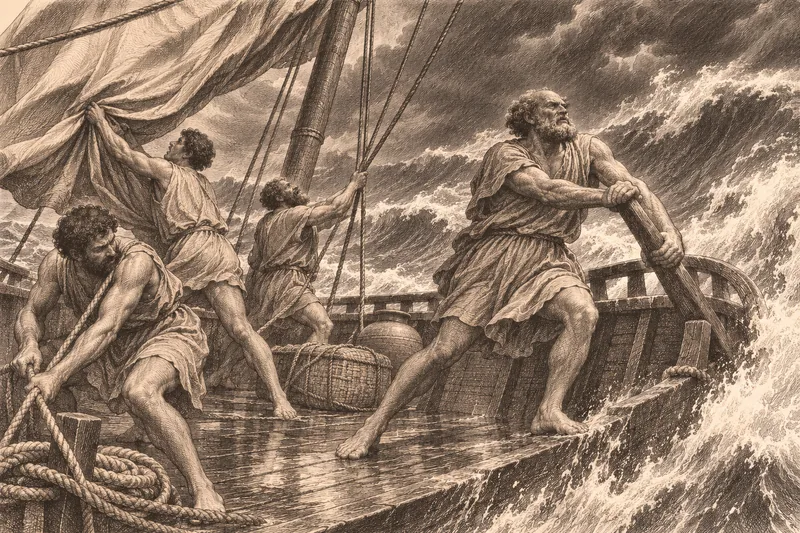
I realized that he was dissatisfied with his previous 335b answers and would not willingly carry on the discussion as the one answering, so I decided it was no longer my business to stay at these gatherings. “But, Protagoras,” I said, “I am not insisting that we continue our discussion against your wishes. Whenever you wish to discuss things in a way that I can follow, I will discuss them with you. You, as people say of you and you say yourself, can conduct a discussion both through long speeches and through brief answers 335c—you are wise—but I cannot manage these long speeches, though I wish I could. You, who can do both, should have made this concession to us so that the discussion could take place. But now you refuse, and I have business to attend to and could not stay while you draw out long speeches—I have to go somewhere—so I am leaving, though perhaps I would have enjoyed hearing these speeches of yours too.”
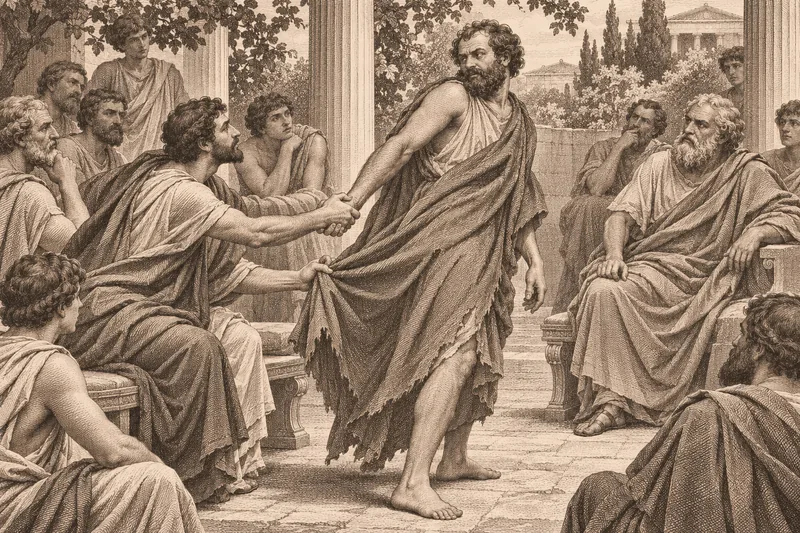
As I said this, I started to get up to leave. As I was rising, Callias caught my hand with his right hand 335d and seized this cloak of mine75 with his left. “We won’t let you go, Socrates,” he said, “because if you leave, our discussions won’t be the same. So I beg you to stay with us: I would rather hear you and Protagoras in discussion than anyone else. Please do us all this favor.”
I was already on my feet, ready to go out, when I replied, “Son of Hipponicus, I always admire your love of wisdom, and 335e now I praise it and love it as well, so I would like to do you a favor if you asked me something I could do. But what you are asking now is like asking me to keep pace with Crison76 of Himera, the runner, in his prime, or to race and keep up with one of the long-distance racers or day runners:77 336a I would tell you, ‘Far more than you do, I ask myself to keep pace with these runners, but I cannot. If you want to see Crison and me running together, ask him to slow down: I cannot run fast, but he can run slowly.’ So if you want to hear Protagoras and me, ask him to answer now as he did at first: briefly and to the very point of the question. 336b Otherwise what sort of discussion will we have? I thought that talking together in a discussion and making a public speech were different things.”
“But, you see, Socrates,” Callias said, “Protagoras seems to be making a fair claim when he asks to be allowed to discuss things as he wishes, and for you in turn to do so as you wish.”
At this Alcibiades broke in. “That is not wellad said, Callias,” he said. “Socrates here admits that long speeches are beyond him and yields to Protagoras on that; but in his ability to discuss things 336c and his knowledge of how to give an account and receive one, I would be surprised if he yielded to any human being. So if Protagoras too admits that he is worse than Socrates at discussion, that is enough for Socrates; but if he claims to rival him, let him discuss by asking and answering questions. He should not draw out a long speech after every question, beating back the arguments, refusing 336d to give an account and instead spinning things out until most of his listeners have forgotten what the question was about. As for Socrates, I guarantee that he won’t forget, despite his joking claim to be forgetful. For my part, then, I think what Socrates says is fairer; after all, each of us ought to state his own opinion.”
After Alcibiades, it was Critias, I think, who said, “Prodicus, Hippias, Callias seems to me to be very much on the side of 336e Protagoras, while Alcibiades is always keen to win in whatever he takes up. We should not join in the rivalry on behalf of either Socrates or Protagoras, but jointly ask them both not to break off our gathering midway.”
337a When he had said this, Prodicus said, “You seem to me to be speaking well, Critias. Those present at discussions like these should listen impartially78 to both speakers, but not give them equal regard—the two are not the same: we should hear both impartially, but not grant an equal share to each, giving more to the wiser and less to the more ignorant.
“I too, Protagoras and Socrates, ask you to make concessions and debate with one another over the arguments, 337b but not quarrel—friends debate with friends out of goodwill, whereas opponents and enemies quarrel with one another—and in this way our gathering would be at its finest. You speakers would thus win the greatest esteem among us, your listeners, and would not be praised: winning esteem is a matter of the listeners’ souls, without deception, whereas being praised is a matter of words, often from people who lie about what they think. 337c We listeners, in turn, would thus be most delighted, but would not feel pleasure: we are delighted when we learn something and gain a share of understandingae in the mind itself, but feel pleasure when we eat something or have another pleasant experience in the body itself.”
When Prodicus said this, a great many of those present approved. After Prodicus, Hippias the wise spoke. “Gentlemen,” he said, “I regard all of you here as kinsmen, intimates, and fellow citizens 337d by nature, not by convention,af for like is kin to like by nature, whereas convention, a tyrant79 over human beings, forces much that is against nature. So it is shameful for us, who know the nature of things, who are the wisest of the Greeks, and who have gathered for this very reason in the very Prytaneum80 of wisdom for Greece, and in this, the greatest and wealthiest house in the city itself, to show nothing worthy of this 337e dignity, but fall out with one another like the lowest of human beings.
“So I both ask and advise you, Protagoras and Socrates, to come to terms, with us acting as arbitrators81 to bring you together 338a in the middle. You, Socrates, should not insist on this precise formag of discussion, with such extreme brevity, if Protagoras does not find it pleasant, but give the speeches their head and loosen the reins, so that they seem grander and more graceful to us; nor should Protagoras haul every rope taut and run before a fair wind, fleeing into a sea of speeches until land is out of sight, but both of you should take a middle course. Do this, then, and take my advice: choose a rod-bearer,82 overseer, and presiding officer who 338b will see that each of you keeps his speeches to a moderate length.”
This pleased those present, and they all praised it. Callias said he would not let me go, and they asked for an overseer to be chosen. I therefore said that it would be shameful to choose an umpire83 for the discussion. “For if the person chosen is inferior to us, it would not be right for an inferior to oversee his superiors; if he is our equal, that would not be right either, since our equal will do as we do, so choosing him will be 338c unnecessary. Will you choose someone better than us, then? In truth, I think it is impossible for you to choose anyone wiser than Protagoras here. If you choose someone no better but say he is, that too is shameful for Protagoras, to have an overseer chosen for him as though he were an inferior man, since as far as I am concerned it makes no difference.
“But I am willing to do this so that we may have the gathering and discussion you are eager for: if Protagoras does not wish 338d to answer, let him ask questions, and I will answer. At the same time I will try to show him how I say the person answering should answer. Once I have answered as many questions as he wishes to ask, let him in turn undertake to give me an account in the same way. Then if he does not seem willing to answer the very question asked, you and I will jointly ask him what you asked me—not to ruin our gathering. 338e We do not need one overseer for this; you will all oversee it together.”
Everyone thought this was the thing to do, and Protagoras, though very unwilling, was nevertheless forced to agree to ask questions and, when he had asked enough, to give an account in his turn through brief answers.
So Protagoras began asking questions something like this: “I think, Socrates,” he said, “that the greatest part of a man’s education is being 339a skilled in poetry: being able to understand what the poets say, what they have composed correctly and what they have not, and knowing how to distinguish the two and give an account when questioned. My question now will concern the same subject you and I have been discussing—excellence—but transferred to poetry; that will be the only difference. For somewhere Simonides says to Scopas,84 the son of Creon the Thessalian: 339b
“‘For a man to become trulyah good is indeed hard, four-square85 in hands and feet and mind, fashioned without reproach.’
“Do you know this song, or should I recite it all for you?”
“There’s no need,” I said. “I know it, and I happen to have given the song a great deal of attention.”
“Good,” he said. “Then do you think it is well and correctly composed, or not?”
“Very well and correctly,” I said.
“And do you think it is well composed if the poet contradicts himself?”
“Not well,” I said.
“Then look 339c more closely,” he said.
“But, my good man, I have examined it thoroughly.”
“Then you know,” he said, “that further on in the song he says somewhere:
“‘Nor does Pittacus’s86 saying sound right to me, though spoken by a wise man: he said it is hard to be good.’
“Do you realize that the same man says both this and those earlier words?”
“I know,” I said.
“Then do you think these words agree with those?”
“They seem to me to agree”—though at the same time I was afraid he had a point. “But don’t they seem so to you?” I asked.
“How could 339d a man who says both these things seem consistent with himself, when he himself first laid it down that it is hard for a man to become good in truth, then a little further into the poem forgot and found fault with Pittacus for saying the same thing as himself—‘It is hard to be good’—and said he would not accept it from him, although Pittacus was saying the very same thing? Yet when he finds fault with someone who says the same thing as himself, he plainly finds fault with himself too, so either his earlier or his later statement is wrong.”
His words drew cheers and praise 339e from many of his listeners. At first, as though an expert boxer had struck me, everything went dark and my head spun when he said this and the others applauded. Then—to tell you the truth, to give myself time to think what the poet meant—I turned to Prodicus and called to him. “Prodicus,” I said, “Simonides is your fellow citizen; 340a you ought to come to his aid.
“So I think I am calling on you just as Homer says Scamander,87 besieged by Achilles, called on Simois, saying:
“‘Dear brother, let the two of us together hold back this man’s strength.’
“Just so I call on you to keep Protagoras from sacking Simonides. For setting things right for Simonides does need your musical skill,88 with which you distinguish wishingai from 340b desiring as two different things and made all those fine points just now. Now see whether you share my view: Simonides does not seem to contradict himself. First give your opinion, Prodicus: do you think becoming and being are the same or different?”
“Different, by Zeus,” said Prodicus.
“Then in the opening lines,” I said, “Simonides himself expressed his own view, that for a man 340c to become good in truth is hard?”
“That’s true,” said Prodicus.
“But he finds fault with Pittacus,” I said, “for saying something different from himself, not, as Protagoras thinks, the same thing. Pittacus did not say that becoming good was hard, as Simonides did, but being good. And being and becoming, Protagoras, are not the same, as Prodicus here says. If being and becoming are not the same, Simonides does not contradict himself. Perhaps 340d Prodicus here and many others would agree with Hesiod89 that becoming good is hard, because the gods have placed ‘sweat’ ‘in front of excellence,’ but that once someone ‘reaches its summit,’ possessing it ‘is easy then, hard though it is.’”
Prodicus praised me when he heard this, but Protagoras said, “Your correction, Socrates, contains a greater mistake than the one you are correcting.”
“Then it seems I’ve done some harm, 340e Protagoras,” I said, “and I’m a ridiculous sort of doctor: my treatment makes the disease worse.”
“That is how it stands,” he said.
“How so?” I asked.
“The poet would be very ignorant,” he said, “if he claimed that possessing excellence was so easy, when everyone thinks it is the hardest thing of all.”
“By Zeus,” I said, “Prodicus has joined our discussion at just the right moment. His wisdom seems, 341a Protagoras, to be something divine and ancient, going back either to Simonides or even further. You know so much else, but you seem unfamiliar with this, unlike me, since I am a pupil of Prodicus here. And now you seem not to understand that Simonides perhaps took ‘hard’ differently from you. It is like the way Prodicus keeps correcting me about ‘formidable’:aj whenever I praise you or someone else by saying, ‘Protagoras is a wise and formidable man,’ he asks 341b whether I am not ashamed to call good things formidable. What is formidable is bad, he says: no one ever speaks of ‘formidable wealth,’ ‘formidable peace,’ or ‘formidable health,’ but of ‘formidable disease,’ ‘formidable war,’ and ‘formidable poverty,’ on the assumption that what is formidable is bad. So perhaps the people of Ceos and Simonides take ‘hard’ to mean bad, or something else you do not understand. Let us ask Prodicus, then, since he is the right person to ask about Simonides’s language. Prodicus, what did Simonides mean by 341c ‘hard’?”
“Bad,” he said.
“Then that is why, Prodicus,” I said, “he finds fault with Pittacus for saying, ‘It is hard to be good,’ as though he had heard him say that it is bad ‘to be good.’”
“What else do you think Simonides means, Socrates?” he said. “He is reproaching Pittacus for not knowing how to distinguish words correctly, since he came from Lesbos and grew up speaking a barbarian language.”90
“You hear what Prodicus is saying, Protagoras,” I said. “341d Have you anything to say to that?”
“That is very far from being the case, Prodicus,” Protagoras said. “I know perfectly well that Simonides meant by ‘hard’ what the rest of us mean: not bad, but something that is not easy and takes a great deal of trouble to accomplish.”
“I too think that is what Simonides means, Protagoras,” I said, “and that Prodicus knows it, but is joking and seems to be testing whether you can defend your own argument. For the very next phrase is strong evidence that Simonides does not mean 341e ‘bad’ by ‘hard.’ He says:
“‘Only a god could have this privilege.’91
“Surely he is not saying that it is bad ‘to be good,’ then saying that only a god could have this and assigning this privilege to a god alone. For Prodicus would then be calling Simonides a dissolute fellow and no Cean at all.92
“But I am willing to tell you what I think Simonides means in this song, 342a if you want to test my ability in poetry, as you put it; or, if you prefer, I will listen to you.”
When Protagoras heard me say this, he replied, “If you wish, Socrates.” Prodicus and Hippias strongly urged me to go on, and so did the others.
“Then I will try,” I said, “to explain to you what I think about this song. Among the Greeks, philosophy is oldest and most widespread in Crete93 and 342b Lacedaemon, and nowhere on earth has more sophists. Like the sophists Protagoras mentioned, they deny it and pretend to be ignorant, so that their superiority to the Greeks in wisdom will not become obvious, and people will instead think they are superior in fighting and courage. They think that if the source of their superiority became known, everyone would practice it—wisdom. By concealing it, they have deceived the admirers of Sparta in other cities: these men get their ears battered94 in imitation 342c of the Spartans, bind on leather straps, devote themselves to athletics, and wear short cloaks, as though these were what made the Spartans superior to the Greeks. But when the Spartans want to meet freely with their sophists and grow tired of meeting in secret, they expel95 these admirers of Sparta and any other foreigners staying there, and meet with the sophists without the foreigners knowing. They themselves allow none of their young men to go96 342d to other cities, just as the Cretans do not, so that the young men will not unlearn what the Spartans teach them. In these cities, not only men but women too take pride in their education.
“You could recognize that I am telling the truth, and that the Spartans have the best education in philosophy and argument, in this way: if you choose to talk to the most ordinary Spartan, you will find 342e him apparently unimpressive through most of the conversation, but then, at some point in what is being said, he will throw in a telling remark, short and tightly packed, like an expert javelin thrower,97 making the person talking with him seem no better than a child.
“So some people, both now and long ago, have grasped this very point: that imitating the Spartans means practicing philosophy far more than practicing athletics, since they know that being able to say such things is the mark of 343a a fully educated person. Among them were Thales of Miletus,98 Pittacus of Mytilene, Bias of Priene, our own Solon, Cleobulus of Lindus, and Myson of Chen; Chilon the Spartan was counted as the seventh. All these men were enthusiastic admirers, lovers, and pupils of Spartan education, and you could recognize this character in their wisdom: the short, memorable sayings each of them uttered. They also gathered together 343b and dedicated the first fruits99 of their wisdom to Apollo in his temple at Delphi, inscribing those sayings everyone celebrates: ‘Know yourself’ and ‘Nothing in excess.’ Why am I saying this? Because that was the way the ancients practiced philosophy: a certain Spartan brevity. In particular, this saying of Pittacus circulated on its own, praised by the wise: ‘It is hard to be good.’
“Simonides, 343c ambitious for a reputation for wisdom, realized that if he could throw this saying, as one throws an esteemed athlete, and defeat it, he himself would win esteem among the people of his time. So it seems to me that he composed the whole song against this saying and for this purpose, plotting to cut it down.
“Let us all examine it together, then, to see whether I am telling the truth. For the very opening of the song would seem mad if, wanting to say that it is hard for a man to become good, 343d he then inserted ‘indeed.’ There seems to be no reason at all for inserting it unless we take Simonides to be speaking as though quarreling with Pittacus’s saying. Pittacus says, ‘It is hard to be good,’ and Simonides disputes it: ‘No, Pittacus: for a man to become good is indeed hard, truly.’ Not ‘good in truth’: he does not attach truth to that, as though some people 343e were truly good and others good, but not truly so, for that would seem foolish and unlike Simonides. Rather, we must treat ‘truly’ as displaced in the song and supply Pittacus’s saying beforehand, something like this, as if we had Pittacus himself speak and Simonides answer him. Pittacus says, ‘People, “It is hard to be good.”’ Then 344a Simonides replies, ‘Pittacus, what you say is not true: it is not for a man to be but indeed to become “good, four-square in hands and feet and mind, fashioned without reproach,” that is “hard, truly.”’ In this way ‘indeed’ seems to have been inserted for a reason, and ‘truly’ is correctly placed at the end. Everything that follows supports this reading. There is much one could say about each expression 344b in the song to show how well it is composed—it is very graceful and carefully worked—but going through it that way would take a long time. Let us instead go through its overall shape and intention: above all, the entire song is a refutation of Pittacus’s saying.
“For a little further on, he speaks as though making this argument: ‘For a man to become good is indeed truly hard, though it is possible at least for a time; but once he has become good, to remain 344c in that condition and be a good man, as you say, Pittacus, is impossible and beyond human reach. Only a god could have this privilege.’
“‘But a man cannot help being bad if overwhelming misfortuneak knocks him down.’
“In commanding a ship, then, whom does overwhelming misfortune knock down? Clearly not the layman, since the layman is always down already. Just as one could not knock down someone lying down, but could sometimes knock down someone standing and make him lie down, though not someone already 344d lying down, so overwhelming misfortune could sometimes knock down someone who is resourceful, but not someone who is always helpless. A great storm striking a ship’s captain could make him helpless; a hard season could leave a farmer helpless, and the same goes for a doctor. For a good man can become bad, as another poet100 also bears witness when he says:
“‘But a good man is at one time bad, at another good.’
“344e But a bad man cannot become bad: he must always be bad. So when overwhelming misfortune knocks down the resourceful, wise, and good man, ‘he cannot help being bad.’ But you say, Pittacus, ‘It is hard to be good,’ whereas becoming good is hard but possible, and being good is impossible:
“‘For every man is good when he fares well,al but bad if he fares badly.’
“345a What, then, is faring well in reading and writing, and what makes a man good at them? Clearly, learning them. And what kind of faring well makes a good doctor? Clearly, learning how to treat the sick. ‘But bad, faring badly’: who, then, could become a bad doctor? Clearly, someone who is a doctor to begin with, and then a good doctor, since he could become a bad one too. But we who are laymen in medicine could never, by faring badly, become doctors or carpenters or 345b anything of that kind; and someone who could not become a doctor by faring badly clearly could not become a bad doctor either. In the same way, a good man could sometimes become bad through time, toil, disease, or some other mishap—for this alone is faring badly: being deprived of knowledge—but a bad man could never become bad, since he always is. If he is going to become bad, he must first become good. So this part of the song also points to this conclusion: 345c that a man cannot be good, continuing good throughout, but can become good, and that same man can become bad too. ‘And those the gods love are best for the longest time.’101
“All this, then, is directed against Pittacus, and what follows in the song makes that still clearer. He says:
“‘So I will never throw away a share of my life on an empty hope that cannot be fulfilled, seeking what cannot come to be:102 a wholly blameless man among us who gather the fruit of the broad-based earth. If I find one, I will tell you.’
“345d So he says—so fiercely does he pursue Pittacus’s saying throughout the song:
“‘But I praiseam and love everyone who willinglyan does nothing shameful; but even gods do not fight necessity.’103
“This too is directed against the same saying. For Simonides was not so uneducated as to say that he praises someone who willingly does nothing bad, as though there were people who willingly do bad things. I am fairly sure that none of the 345e wise thinks any human being errs willingly or willingly does shameful and bad things, but that they know very well that everyone who does shameful and bad things does them unwillingly. Simonides too does not say that he praises those who do not do bad things willingly: he uses ‘willingly’ about himself. For he thought that an honorable, good man often forces himself to become someone’s friend and praise him.ao 346a A man often finds, for example, that he has a difficultap mother104 or father or homeland, or something else of the sort. When something like this happens to wicked people, he thought, they seem pleased to see it, and they criticize, expose, and denounce the wickedness of their parents or homeland, so that people will not accuse or reproach them for neglecting their own. So they criticize them all the more and willingly add enmities 346b to those forced upon them. Good people, however, conceal the faults and are forced to praise; and if they become angry with their parents or homeland because they have been wronged, they soothe themselves and become reconciled, compelling themselves to love and praise their own.
“I think Simonides also often felt that he himself had praised and celebrated a tyrant105 or someone of that kind, not willingly but under compulsion. This too is what he says to Pittacus: ‘I am 346c not criticizing you, Pittacus, because I love criticizing, since—
“‘“For me it is enough if a man is not bad or too helpless, and knows the justice that benefits a city: a soundaq man. I will not find fault with him—”
“‘for I do not like finding fault—
“‘“for the race of fools is endless.”
“‘So anyone who enjoys finding fault could have his fill of blaming them.ar
“‘“Everything is admirable that has nothing shameful mixed in.”’106
“346d He is not saying this as though he were saying, ‘Everything is white that has nothing black mixed in’—that would be ridiculous in many ways—but that he accepts middling things too, without criticizing them. ‘And I am not seeking,’ he says, ‘“a wholly blameless man among us who gather the fruit of the broad-based earth; if I find one, I will tell you.” So I will not praise anyone on that account; it is enough for me if he is middling and does nothing bad, since I “love and praise” everyone.’ Here he uses the dialect 346e of Mytilene, as though addressing Pittacus with the words ‘“But I praise and love everyone willingly”’—the speaker must pause here, at ‘willingly’—‘“whoever does nothing shameful”; but there are some I praise and love unwillingly.
“‘So even if what you said, Pittacus, were only moderately 347a reasonable and true, I would never criticize you. But as it is, you speak very falsely about the greatest matters and seem to be telling the truth: that is why I criticize you.’
“That, Prodicus and Protagoras,” I said, “is what I think Simonides had in mind when he composed this song.”
“I think you too have given a fine account of the song, Socrates,” Hippias said. “But I also have 347b a fine account of it, which I will present to you if you wish.”
“Yes, Hippias, another time,” Alcibiades said. “For now, the right thing is to follow what Protagoras and Socrates agreed with each other: if Protagoras still wants to ask questions, Socrates should answer; if he wants to answer Socrates, then Socrates should ask.”
“I leave it to Protagoras to choose whichever he prefers,” I said. “But if he wishes, let us leave songs and poetry 347c aside; as for the matters I first asked you about, Protagoras, I would gladly examine them with you and bring them to a conclusion. For discussing poetry seems to me very like the drinking parties107 of vulgar, common people. Their lack of education makes them unable to keep each other company over their wine by themselves, through their own voices and their own words, so they put a high value on 347d women pipers, hiring someone else’s voice—the voice of the pipes—at a high price and keeping each other company through that voice. But where the drinkers are honorable, good, and educated men, you would see no women pipers, dancers, or players of stringed instruments: they can keep each other company themselves, through their own voices, without this nonsense and these games, speaking and listening to one another in an orderly way, each in turn, even if they drink 347e a great deal of wine. In the same way, gatherings like ours, when they consist of men such as most of us claim to be, have no need of someone else’s voice, or of poets whom we cannot question about what they say. When the many bring poets into their discussions, some say the poet means one thing and others another, arguing over something they cannot test. Instead, educated men leave gatherings like that 348a aside and keep each other company by themselves, using their own words to test one another and submit to one another’s tests. I think you and I should imitate people like that: put the poets aside and conduct our discussion with one another ourselves, testing the truth and ourselves. If you still want to ask questions, I am ready to answer you; or, if you prefer, take your turn answering me, so that we can bring to a conclusion the matters we broke off discussing.”
348b While I was saying this and other things of the kind, Protagoras gave no clear indication which he would do. So Alcibiades looked at Callias and said, “Callias, do you think Protagoras is behaving well even now, when he refuses to make clear whether he will give an account or not? I do not. Let him either take part in the discussion or say that he does not want to, so that we know where he stands, and Socrates can discuss things with someone else, or anyone else who wishes can do so with another person.”
348c Protagoras seemed to me ashamed when Alcibiades said this and Callias and nearly everyone present urged him on. Only with difficulty was he persuaded to resume the discussion, and he told me to ask him questions: he would answer.
So I said, “Protagoras, do not think that I have any purpose in discussing things with you except to examine the questions that puzzle me at each stage, for I think Homer makes a very good point when he says: 348d
“‘When two go together, one notices before the other.’108
“For we humans are all somehow more resourceful in everything we do or say or think. ‘But if someone notices something alone,’ he immediately goes around looking for a person to show it to and establish it with, until he finds one. That is why I too enjoy discussing things with you more than with anyone else: I think you could best examine both the other matters 348e a decent man is likely to consider and, in particular, excellence. Who else but you? You do not merely think yourself an honorable, good man, like some others who are decent themselves but cannot make others so; you are good yourself and can make others good. And you have such confidence in yourself that, while others conceal this art, 349a you have publicly proclaimed yourself to all the Greeks, calling yourself a sophist and declaring yourself an educator and a teacher of excellence, the first to think it right to charge a fee for this. How, then, could I fail to call on you to examine these matters, and to question and consult you? There is no way I could.
“Now I want to return to the questions I first asked about these matters, to have you remind me of some things and examine others with me. The question, 349b I think, was this: are wisdom, moderation, courage, justice, and piety five names for one thing, or does each name stand for a distinct reality,as a thing with its own power, each unlike the others? You said they were not names for one thing, but 349c that each name applied to a distinct thing, and that all these were parts of excellence, unlike parts of gold, which are similar to one another and to the whole of which they are parts, but like parts of a face, unlike both one another and the whole of which they are parts, each with its own power. If you still think as you did then, say so; if you think differently, define the difference. I will not hold it against you if you now say something different, since I would not be surprised if you were testing 349d me when you said those things before.”
“What I tell you, Socrates,” he said, “is that all these are parts of excellence, and four of them are fairly similar to one another, but courage is very different from all the rest. Here is how you will know I am telling the truth: you will find many people who are extremely unjust, extremely impious, extremely dissolute, and extremely ignorant, yet exceptionally courageous.”
349e “Wait,” I said, “for what you say deserves examination. Do you call courageous people bold,at or something else?”
“Yes, and ready to advance where most people are afraid to go,” he said.
“Now, do you say that excellence is something admirable, and offer yourself as its teacher because it is admirable?”
“Admirable in the highest degree,” he said, “unless I am mad.”
“Then is one part of it shameful and another admirable,” I asked, “or is it wholly admirable?”
“Wholly admirable, surely, as much as anything can be.”
“Then do you know who dive boldly into 350a wells?”
“I do: divers.”
“Because they know how, or for some other reason?”
“Because they know how.”
“And who are bold in fighting on horseback: skilled horsemen or men without that skill?”
“Skilled horsemen.”
“And with small shields: men skilled with them109 or men without that skill?”
“Men skilled with them. And in every other case too, if that is what you are asking,” he said, “people with knowledge are bolder than people without it, and bolder themselves 350b after they have learned than before.”
“But have you ever seen people,” I asked, “who have no knowledge of any of these things, yet are bold in each of them?”
“I have,” he said, “and excessively bold too.”
“Then are these bold people courageous too?”
“That would make courage shameful,” he said, “since these people are mad.”
“Then what do you say about courageous people?” I asked. “That they are bold, don’t you?”
“I still say so,” he said.
350c “Then these people who are bold in this way seem to be mad, not courageous?” I said. “And in the earlier cases, those who are wisest are also boldest, and, being boldest, are most courageous? On that argument, would wisdom be courage?”
“You do not remember correctly, Socrates,” he said, “what I said in my answers to you. When you asked me whether courageous people are bold, I agreed. But I was not asked whether bold people are courageous too: if you had asked me then, I would have said 350d that not all are. But you have nowhere shown that my admission was wrong by showing that courageous people are not bold.au Then you show that people with knowledge are bolder than they themselves were, and than other people without knowledge, and on that basis you think courage and wisdom are the same.
“But if you proceeded in this way, you might also think strength was wisdom. First, if you followed that method and asked me whether strong people 350e are powerful, I would say yes. Then, if you asked whether people who know how to wrestle are more powerful than those who do not, and more powerful themselves after learning than before, I would say yes. Once I had agreed to these things, you could use this same evidence to say that, by my own admission, wisdom is strength.
“But neither here nor anywhere else do I agree that powerful people are strong, though I do agree that strong people are powerful. 351a For power and strength are not the same: power comes from knowledge, and also from madness and anger, whereas strength comes from nature and the proper nourishment of bodies. Likewise, in the other case, boldness and courage are not the same. So it follows that courageous people are bold, but not all bold people are courageous: boldness comes to people from art, and 351b also from anger and madness, just as power does, whereas courage comes from nature and the proper nourishment of souls.”
“Do you say, Protagoras,” I asked, “that some people live well and others badly?”
He said he did.
“Then do you think a person would live well if he lived in distress and pain?”
He said he did not.
“What if he died after living his life pleasantly? Wouldn’t you think he had lived well that way?”
“I would,” he said.
“Then 351c living pleasantly is good, and living unpleasantly bad.”
“Provided he lived taking pleasure in admirable things,” he said.
“What, Protagoras? Do you too, like the many,110 call some pleasant things bad and some distressing things good? What I mean is this: insofar as things are pleasant, are they not good in that respect, leaving aside anything else that may result from them? And in exactly the same way, are distressing things not bad insofar as they are distressing?”
“I do not know, Socrates,” he said, “whether I should answer as unconditionally as you ask 351d and say that all pleasant things are good and all distressing things bad. It seems safer for me, with regard not only to my present answer but to the whole rest of my life, to say that some pleasant things are not good, and some distressing things are not bad, while others are; and there is a third group that is neither, neither bad nor good.”
“But by pleasant,” I said, “don’t you mean things that 351e share in pleasure or produce pleasure?”
“Certainly,” he said.
“Then when I ask whether things are good insofar as they are pleasant, I am asking whether pleasure itself is good.”
“As you are always saying, Socrates,” he replied, “let us examine it. If our inquiry seems reasonableav and the same thing appears both pleasant and good, we will agree; if not, then we will debate it.”
“Would you like to lead the inquiry, then,” I asked, “or shall I?”
“You ought to lead,” he said, “since you began the discussion.”
352a “Could it become clear to us along these lines, then?” I said. “Suppose someone were examining a man’s appearance to judge his health or some other bodily function, and after looking at his face and hands said, ‘Come, uncover your chest and back too and show them to me, so I can examine you more clearly’; I want something like that for our inquiry. Now that I have seen that your position on the good and the pleasant is as you say, I want to say something like this: come, Protagoras, 352b uncover this part of your thinking too. What is your view of knowledge? Is your view here too the same as that of the many, or different? The many think that knowledge has no strength, cannot lead, and cannot rule. They do not think of it as anything of the kind: they think that someone often has knowledge, yet is ruled by something else rather than knowledge—now anger, now pleasure, now pain,aw sometimes love, often fear. They think of knowledge 352c just as they would of a slave, dragged around by all the others. Is that your view of it too? Or do you think that knowledge is admirable and capable of ruling a person, and that if someone knows what is good and bad, nothing would overpower him into doing anything other than what knowledge commands, but understanding is enough to help him?”
“My view is just as you say, Socrates,” he replied. “And besides, 352d it would be shameful for me, if for anyone, not to affirm that wisdom and knowledge are the strongest things in human life.”
“Well and truly said,” I replied. “You know, then, that the many are not persuaded by you and me. They say that many people know what is best but are unwilling to do it, although they can, and do other things instead. Whenever I have asked people what causes this, they say that those who act this way are overcome by pleasure 352e or pain, or mastered by one of the other things I just mentioned.”
“Yes, Socrates,” he said, “I think people are wrong about many other things too.”
“Come, then, join me in trying to persuade people and explain this experienceax of theirs, which they describe as being overcome by 353a pleasure and therefore failing to do what is best, although they know what it is. For if we told them, ‘You people are wrong; what you say is false,’ they might perhaps ask us, ‘Protagoras and Socrates, if this experience is not being overcome by pleasure, what is it, and what do you say it is? Tell us.’”
“But why, Socrates, must we consider the opinion of the many, who say whatever happens to occur to them?”
353b “I think,” I said, “this will help us discover how courage is related to the other parts of excellence. So if you think we should keep to our recent agreement—that I should lead the way by which I think the matter can best become clear—follow me; but if you do not want to, I will let it go, if you prefer.”
“No,” he said, “you are right. Carry on as you began.”
353c “Then again,” I said, “if they asked us, ‘What do you say this is, which we called being overcome by pleasure?’ I would answer them like this: ‘Listen, everyone: Protagoras and I will try to explain it to you. Isn’t this the kind of thing you say happens to you? You are often overpowered by food, drink, and sex because they are pleasant, and still do these things although you know they are bad.’ They would say yes. Then you and I would ask them again: ‘In what way do you say they are bad? 353d Is it because they give this pleasure at the time and each of them is pleasant, or because they later cause diseases and poverty and bring about many other things of that kind? Or if they brought about none of these later consequences and only gave enjoyment, would they still be bad simply because they gave enjoyment, in whatever way?’ay Do we suppose, Protagoras, that they would answer anything except that these things are bad, not because they produce the immediate pleasure itself, 353e but because of their later consequences—diseases and the rest?”
“I think,” Protagoras said, “that the many would give that answer.”
“‘Then by causing diseases they cause distress, and by causing poverty they cause distress?’ They would agree, I think.”
Protagoras agreed.
“‘Then, as Protagoras and I say, do you people see that these things are bad for no other reason than that they end in distress and deprive you of other 354a pleasures?’ Would they agree?”
We both agreed that they would.
“Then suppose we asked them the opposite question: ‘You people who say, in turn, that good things are distressing—aren’t these the kinds of things you mean: physical training, military campaigns, and medical treatments involving burning,111 cutting, medicines, and starvation? You say these are good but distressing?’ Would they say yes?”
He agreed that they would.
“‘Do you, then, 354b call them good because they cause the most intense agony and suffering at the time, or because they later bring health, bodily fitness, safety for cities, rule over others, and wealth?’ They would say the latter, I think.”
He agreed.
“‘And are these things good for any other reason than that they end in pleasures and in relief from pain and its prevention? Or can you name some other end 354c you look to when you call them good, apart from pleasures and pains?’ They would say no, I think.”
“I think so too,” Protagoras said.
“‘Then you pursue pleasure as something good and avoid pain as something bad?’”
He agreed.
“‘So you regard pain as bad and pleasure as good, since you call even enjoyment itself bad when it deprives you of greater pleasures than it contains or produces pains greater than its 354d pleasures. If you call enjoyment itself bad for some other reason and with some other end in view, you would be able to tell us; but you will not be able to.’”
“I do not think they will either,” Protagoras said.
“‘And isn’t the same true, in turn, of being in pain itself? You call being in pain good when it either frees you from pains greater than those it involves or produces pleasures greater than its pains. If you have some other end in view than the one I mention when you call being in pain 354e good, you can tell us; but you will not be able to.’”
“What you say is true,” Protagoras said.
“Then again,” I said, “if you people asked me, ‘Why on earth do you talk so much about this, and in so many ways?’ I would say, ‘Forgive me: first, it is not easy to demonstrate just what this is that you call being overcome by pleasure; second, all our demonstrations depend on this.
“‘But even now you can take back your agreement, 355a if you can somehow say that the good is anything other than pleasure, or the bad anything other than distress. Or is it enough for you to live out your life pleasantly, without pain? If it is enough, and you cannot name anything else as good or bad that does not end in these, listen to what follows. I tell you that, if this is so, your account becomes ridiculous when you say that someone often knows that bad things are bad, yet does them when he could refrain, driven and stunned 355b by pleasure; and again, when you say that someone knows what is good but is unwilling to do it because he is overcome by immediate pleasures.
“‘How ridiculous this is will become clear if we stop using several names at once—pleasant, distressing, good, and bad—and, since these have proved to be two things, call them by two names: first good and bad, and then pleasant 355c and distressing. Let us put it that way and say that someone knows that bad things are bad, yet does them. If someone asks us, “Why?” we will say, “Because he is overcome.” “By what?” he will ask us. We can no longer say “By pleasure,” because it has taken another name: good instead of pleasure. So let us answer him and say, “Because he is overcome.” “By what?” he will ask. “By good,” we will say, by Zeus. Now, if our questioner happens to be insolent, he will laugh 355d and say, “What a ridiculous thing you are saying: someone does bad things, knowing they are bad, when he need not do them,az because he is overcome by good things! Does this happen,” he will ask, “when the good things are not worth enough to defeat the bad things within you, or when they are?” Clearly, we will answer that they are not worth enough; otherwise the person we describe as overcome by pleasure would not have gone wrong. “And what,” he may ask, “makes good things worth less than bad things, or bad things worth less than good? Isn’t it simply that one set is larger and the other 355e smaller, or one more numerous and the other less?” We will have no other answer to give. “Clearly, then,” he will say, “what you mean by being overcome is taking greater bad things in exchange for lesser good things.” So much for that.
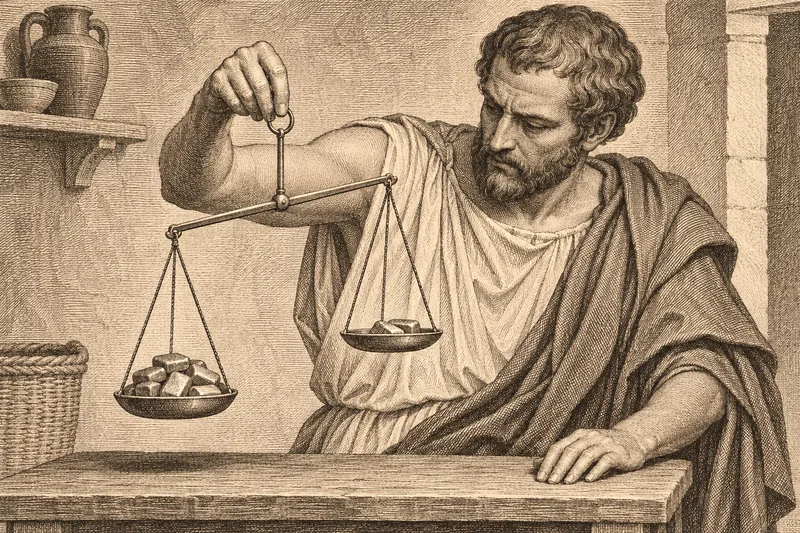
“‘Now let us change the names again and apply pleasant and distressing to these same things. Let us say that someone does things—we previously called them bad, but now let us call them distressing—knowing that they are distressing, because he is overcome 356a by pleasant things, which clearly are not worth enough to defeat them. And what else makes pleasure worth less than pain except their excess and shortfall in relation to one another? That means one is larger or smaller than the other, or they are more or fewer, or more intense or less intense. For if someone said, “But, Socrates, there is a great difference between what is pleasant now and what will be pleasant or painful later,” I would say, “Do they differ in anything other than pleasure and pain? There is nothing else.
“‘“But like 356b someone skilled in weighing, gather the pleasant things together and the painful things together, put both the near and the distant on the scales, and say which amount to more. If you weigh pleasant things against pleasant things, you must always take the larger and more numerous; if painful against painful, the fewer and smaller. If you weigh the pleasant against the painful, you must carry out the action if the pleasant outweighs the distressing, whether the nearer outweighs the more distant or the more distant the nearer; 356c but if the distressing outweighs the pleasant, you must not.” Things aren’t in any way otherwise, are they, everyone?’ I would ask. I know they could give no other account.”
He agreed too.
“I will say, ‘Since that is how things stand, answer me this: do the same sizes look larger to you from nearby and smaller from far away, or not?’ They will say yes. ‘And is the same true of thicknesses and quantities? And do sounds of equal volume seem louder nearby and quieter far away?’ They would say yes. ‘Suppose, then, 356d that faring well depended on acting on and choosing long lengths,ba while avoiding short ones and not acting on them: what would prove to be the means of saving our lives—the art of measurement,112 or the power of appearance? Wouldn’t appearance lead us astray, often making us reverse our judgments about the same things and regret our actions and our choices between large and small, while the art of measurement would strip this illusionbb of its power and, by revealing 356e the truth, bring calm to the soul as it held to the truth, and save our lives?’ Would people agree, in response to this, that the art of measurement would save us, or some other art?”
“The art of measurement,” he agreed.
“‘And what if saving our lives depended on choosing odd and even numbers, choosing correctly when we needed more and when we needed fewer, either within one kind or between the two, whether near or far away? What would save our 357a lives? Wouldn’t it be knowledge? And wouldn’t it be some art of measurement, since it is an art concerned with excess and deficiency? Since it concerns odd and even, could it be anything other than arithmetic?’ Would people agree with us or not?”
Protagoras too thought they would agree.
“‘All right, everyone. Since saving our lives has proved to depend on the right choice of pleasure and pain—of more and less, 357b larger and smaller, farther and nearer—isn’t it clear, first of all, that this is measurement, since it examines their excess, deficiency, and equality in relation to one another?’”
“It must be,” Protagoras said.
“‘And since it is measurement, it must surely be both an art and a kind of knowledge.’”
“They will agree,” he said.
“‘Exactly which art and kind of knowledge this is, we will consider another time. The fact that it is knowledge is enough for the demonstration that Protagoras and I 357c must give in answer to your question. You asked it, if you remember, when we were agreeing with one another that nothing is stronger than knowledge, and that wherever knowledge is present, it always prevails over pleasure and everything else. But you said that pleasure often prevails even over someone who has knowledge, and when we disagreed, you then asked us, “Protagoras and Socrates, if this experience is not being overcome by pleasure, what is it, and what do you say it is? Tell 357d us.” If we had immediately told you then that it was ignorance, you would have laughed at us; but now, if you laugh at us, you will be laughing at yourselves too. For you too have agreed that those who go wrong in choosing pleasures and pains—and these are good and bad things—go wrong for lack of knowledge, and not just any knowledge, but the knowledge of measurement you also agreed on earlier. You yourselves surely know that a mistaken action 357e done without knowledge is done through ignorance. So this is what being overcome by pleasure is: the greatest ignorance, for which Protagoras here claims to be a doctor, as do Prodicus and Hippias. But because you think it is something other than ignorance, you neither go yourselves nor send your children to these sophists who teach these things, assuming it cannot be taught; instead, you guard your money and refuse to give it to them, and fare badly both in private and in public.’
358a “That would be our answer to the many. Now I ask you, Hippias and Prodicus, along with Protagoras—for all of you are to share in the argument—do you think what I say is true or false?”
They all thought that what I had said was absolutely true.
“Then you agree,” I said, “that the pleasant is good and the distressing bad. But I ask to be spared the distinctions between names drawn by Prodicus here: whether you say pleasant or delightful or enjoyable, or wherever you draw the name from and however you enjoy naming such things, 358b my excellent Prodicus, answer the point I have in mind.”
Prodicus laughed and agreed, as did the others.
“Then what about this, gentlemen?” I said. “Aren’t all actions directed toward this—toward living pleasantly and without pain—admirable?bc And isn’t an admirable deed good and beneficial?”
They agreed.
“Then if the pleasant is good,” I said, “no one who knows or believes that other actions are better than 358c the ones he is doing, and are possible, continues doing these when he can do the better ones. Nor is being overcome by oneself anything but ignorance, nor being master of oneself anything but wisdom.”
They all agreed.
“Then is this what you mean by ignorance: having a false opinion and being mistaken about matters of great importance?”
They all agreed to this too.
“Isn’t it true, then,” I said, “that no one willingly goes toward bad things, or toward things he thinks bad, and that 358d apparently it is not in human nature to be willing to go toward what one thinks bad instead of what is good? And when someone is forced to choose one of two bad things, no one will choose the greater when he can choose the lesser?”
All of us agreed to all this.
“Then,” I said, “is there something you call dread113 and fear? And is it just what I mean? I am speaking to you, Prodicus. I mean a kind of expectation of something bad, whether you call it fear or dread.”
Protagoras and Hippias thought this was both dread and fear, 358e but Prodicus thought it was dread, not fear.
“But that makes no difference, Prodicus,” I said. “Consider this: if what we said earlier is true, will anyone be willing to go toward what he dreads when he can go toward what he does not? Or is that impossible, given what we have agreed? For we have agreed that he thinks the things he dreads are bad, and that no one willingly goes toward or takes what he thinks bad.”
They all 359a agreed to this too.
“With these things established, Prodicus and Hippias,” I said, “let Protagoras here defend his first answer and show how it was right—though I do not mean his very first answer. Then he said that there were five parts of excellence, none like any other, and each with its own distinct power. But I do not mean that; I mean what he said later. Later he said that four were fairly similar to one another, 359b but that one, courage, differed very greatly from the others, and he said I would recognize this from the following evidence: ‘You will find people, Socrates, who are most impious, most unjust, most dissolute,bd and most ignorant, yet most courageous; from this you will know that courage differs greatly from the other parts of excellence.’ I was very surprised by that answer at the time, and still more after working through these matters with you. So I asked him whether he called courageous people bold. He said, ‘Yes, and 359c ready to advance.’be Do you remember giving that answer, Protagoras?” I asked.
He agreed.
“Come, then,” I said, “tell us what you say the courageous are ready to advance toward. The same things as the cowardly?”
He said no.
“Different things, then?”
“Yes,” he said.
“Do the cowardly go toward what can be faced boldly, and the courageous toward what is dreadful?”bf
“That is what people say, Socrates.”
“True,” I said, “but that is not 359d what I am asking. What do you say the courageous are ready to advance toward? Dreadful things, thinking them dreadful, or things that are not?”
“But the first of those,” he said, “was shown to be impossible in the arguments you gave just now.”
“That is true too,” I said. “So if that was correctly demonstrated, no one goes toward what he thinks dreadful, since being overcome by oneself was found to be ignorance.”
He agreed.
“And yet everyone, both cowardly and courageous, goes toward what they are bold about; in this respect, the cowardly and the courageous 359e go toward the same things.”
“But, Socrates,” he said, “the things the cowardly and the courageous go toward are complete opposites. For example, some are willing to go to war, and others are not.”
“Is going to war admirable,” I asked, “or shameful?”
“Admirable,” he said.
“Then if it is admirable, we agreed earlier that it is also good, since we agreed that all admirable actions are good.”
“That is true, and I always think so.”
“Quite right,” I said. 360a “But which people do you say are unwilling to go to war, although doing so is admirable and good?”
“The cowardly,” he said.
“Then,” I said, “if it is admirable and good, is it also pleasant?”
“That, at least, has been agreed,” he said.
“Then do the cowardly knowingly refuse to go toward what is more admirable, better, and more pleasant?”
“But if we agree to that too,” he said, “we will overturn our earlier agreements.”
“What about the courageous person? Doesn’t he go toward what is more admirable, better, and more pleasant?”
“We must agree that he does,” he said.
“In general, then, 360b courageous people have no shameful fears when they feel fear, and show no shameful boldness?”
“True,” he said.
“And if these are not shameful, aren’t they admirable?”
He agreed.
“And if admirable, good too?”
“Yes.”
“And the cowardly, the reckless, and the mad, on the contrary, feel shameful fears and show shameful boldness?”
He agreed.
“Do they show boldness about shameful and bad things for any reason other than lack of awareness and ignorance?”
“That 360c is so,” he said.
“Then what makes the cowardly cowardly—do you call that cowardice or courage?”
“Cowardice,” he said.
“And weren’t they shown to be cowardly because of ignorance about dreadful things?”
“Certainly,” he said.
“So they are cowardly because of this ignorance?”
He agreed.
“And you agree that what makes them cowardly is cowardice?”
He agreed.
“Then ignorance of what is dreadful and what is not would be cowardice?”
He nodded.
“But courage,” I said, “is the opposite 360d of cowardice.”
He said it was.
“Then wisdom about what is dreadful and what is not is the opposite of ignorance about these things?”
At this he still nodded.
“And ignorance about these things is cowardice?”
At this he nodded with great reluctance.
“Then wisdom about what is dreadful and what is not is courage, since it is the opposite of ignorance about these things?”
At this he would no longer even nod, and remained silent.
So I said, “Why, Protagoras, do you neither affirm nor deny what I ask you?”
“Finish it yourself,” he said.
“After just one 360e more question,” I said. “Do you still think, as you did at first, that some people are most ignorant, yet most courageous?”
“You seem bent on winning, Socrates,” he said, “on making me the one who answers. So I will oblige you: I say that, given what we have agreed, it seems impossible to me.”
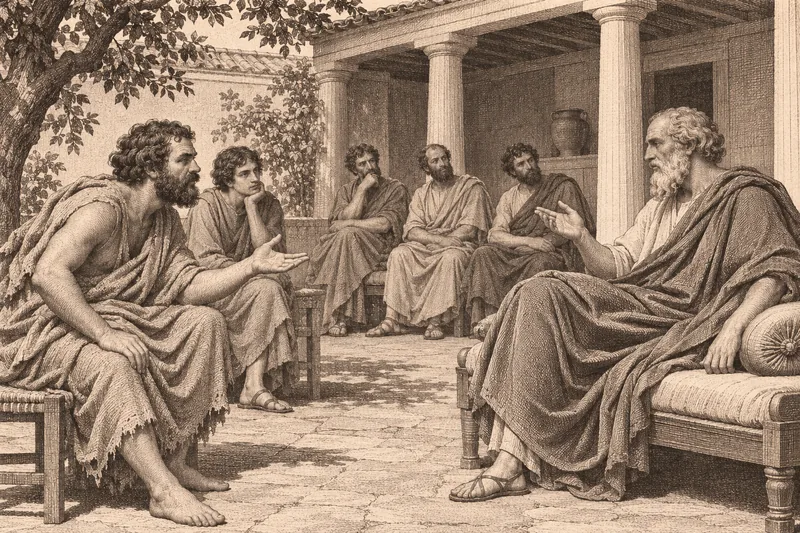
“I am asking all this,” I said, “for no other reason than a wish to examine how things stand with excellence, and just what excellence itself is. For I know that making this clear 361a would do most to clarify the question on which you and I have each made a long speech, I arguing that excellence cannot be taught, and you that it can.
“The present outcome of our argument seems to me to accuse and laugh at us, as though it were a person; if it could speak, it would say, ‘What strange people you are, Socrates and Protagoras! You, Socrates, said earlier that excellence cannot be taught, yet now you are eagerly arguing against yourself, 361b trying to show that everything—justice, moderation, and courage—is knowledge, which is how excellence would most clearly appear teachable. If excellence were something other than knowledge, as Protagoras tried to say, it clearly could not be taught; but if it now proves to be entirely knowledge, as you are eager to show, Socrates, it will be remarkable if it cannot be taught. Protagoras, in turn, began by assuming it was teachable, but now seems eager to show the opposite—that it is almost anything 361c rather than knowledge; and that is how it would be least teachable.’
“So, Protagoras, seeing all this turned terribly upside down, I am very eager to have it made clear. I would like us to work through these matters, go on to find what excellence is, and then consider again whether or not it can be taught, lest that Epimetheus perhaps deceive us in our inquiry too 361d and trip us up, just as he neglected us in the distribution, according to your account. So in the myth too I liked Prometheusbg better than Epimetheus, and with him as my guide I work at all these questions, thinking ahead about my whole life. If you were willing, as I said at the start, I would be very glad to investigate these things together with you.”
“Socrates,” Protagoras said, “I praise your eagerness and your way of working through the arguments. For I think I am not 361e a bad man in other respects either, and am less envious than anyone. After all, I have told many people that, of everyone I meet, you are by far the one I admire most—most certainly among people your age. And I say that I would not be surprised if you became one of those renowned for wisdom. We will discuss these matters another time, whenever you wish; now it is time to turn to something else.”
362a “Then that is what we should do,” I said, “if you think so. It was time long ago for me too to go where I said I was going, but I stayed to please handsome Callias.”bh
After saying and hearing all this, we left.