9.1 Whoever acts unjustly acts impiously. For universal nature has made rational creatures for one another, to help one another as each deserves and never to harm one another; anyone who defies her purpose plainly acts impiously toward the eldest of the gods.1
Whoever speaks falsely also acts impiously toward the same goddess, because universal nature is the nature of everything that exists, and existing things are closely connected with everything that is actual.a She is also called truth and is the first cause of everything true. So whoever speaks falsely deliberately acts impiously, since by deceiving he acts unjustly; whoever does so unwittingly acts impiously by being at odds with universal nature and creating disorder through conflict with the nature of the universe. For anyone who goes against the truth through his own fault fights against her: nature had already given him resources,b but he neglected them and now cannot distinguish falsehood from truth.
Anyone who pursues pleasures as good things and avoids pains as bad things also acts impiously. For such a person must often blame common nature for giving bad and good people what they do not deserve, since bad people often enjoy pleasures and possess what produces them, while good people encounter pain and what produces it. Furthermore, anyone who fears pain will one day fear something that is going to happen in the universe, and that in itself is impious; anyone who pursues pleasures will not refrain from acting unjustly, and that is plainly impious.
But those who want to follow nature and think as she does must regard alike the things common nature regards alike—she would not produce both if she did not regard both alike. So anyone who does not regard pain and pleasure, death and life, or a good reputation and a bad one alike, although universal nature uses them alike, plainly acts impiously.
By saying that common nature uses these alike, I mean that they happen alike, in due sequence, to things that come into being and those that follow them, through a certain original impulse of providence. Following this impulse, nature set out from a certain beginning to establish this order, having conceived certain rational principlesc of what would exist and determined the powers that would generate such existences, changes, and successions.
9.2 It would be finer to leave human company without ever tasting falsehood or any hypocrisy, luxury, or conceit; but to breathe your last once you have had your fill of them is the next best voyage.2 Or have you chosen to sit beside vice, and does not even experience yet persuade you to escape the plague? For corruption of the thinking part is far more a plague than any such fouling and alteration of the air around us: the latter is a plague of living creatures as living creatures, the former of human beings as human beings.
9.3 Do not despise death, but be content with it, since this too is one of the things nature wills. For as with being young and growing old, growing and reaching maturity, growing teeth, a beard, and gray hair, begetting, carrying, and giving birth to a child, and all the other natural activities that the seasons of life bring, so it is with dissolution. So a thoughtful human being should face death neither heedlessly nor impatiently nor arrogantly, but wait for it as one of nature’s activities. And just as you now wait for a child to leave your wife’s womb, wait for the hour when your little soul slips out of this sheath.
But if you also want an ordinary prop that touches the heart, what will most reconcile you to death is to look closely at the things you are about to leave and the characters your [soul]d will no longer be entangled with. It is not that you should take offense at them in the least; you should care for them and bear with them gently. Still, remember that you will not be leaving people who share your convictions. After all, that alone, if anything, could pull you back and hold you to life: being allowed to live with people who have acquired the same convictions. But as it is, you see how exhausting the discord of life together is, enough to make you say, “Come quickly, death, for fear I too might forget myself.”
9.4 Anyone who does wrong does wrong to himself; anyone who acts unjustly acts unjustly toward himself—himselfe—by making himself bad.
9.5 Often someone acts unjustly by leaving something undone, not only by doing something.
9.6 A present judgment that grasps the facts, a present action that serves the community, and a present disposition content with everything that happens through the external cause: that is enough.
9.7 Erase the impression; stop the impulse; extinguish desire; keep the ruling part under your own control.
9.8 One soul is shared out among creatures without reason, and one soul endowed with mind is distributed among rational creatures, just as there is one earth for everything made of earth, and all of us with sight and life see by one light and breathe one air.
9.9 Everything that shares in something common hastens toward its own kind. Everything earthy tends toward earth; everything liquid flows together; the same holds for everything airy, so barriers and force are needed to keep them apart. Fire rises because of the elemental fire,3 yet it is so ready to join in burning with any fire here that even matter only a little drier catches fire easily, because less of what prevents ignition is mixed into it. So everything that shares in the common nature endowed with mind likewise hastens toward its kin, or does so still more strongly: the more it surpasses other things, the readier it is to mingle and merge with its own kind.
Already, then, among creatures without reason we find swarms, herds, the rearing of nestlings, and something like love. For souls are already present here, and in this higher form of life the force that brings things together is stronger, in a way not found in plants, stones, or wood. But among rational creatures there are civic communities, friendships, households, associations, and, in war, treaties and truces. Among still higher beings, such as the stars,4 a kind of unity exists even across distances. So the ascent to something higher could produce a mutual connection even between things far apart.
Look, then, at what happens now: only creatures endowed with mind have forgotten their eagerness and inclination toward one another, and only here is the flowing together unseen. Yet even as they flee, they are caught and held, because nature prevails. Watch closely and you will see what I mean: you would sooner find something earthy touching nothing earthy than a human being cut off from other human beings.
9.10 A human being, a god, and the universe all bear fruit; each bears it in its own seasons. If ordinary usage has reserved the term for vines and the like, that changes nothing. Reason too bears fruit both for everyone and for itself, and from it come other things of the same sort as reason itself.
9.11 If you can, teach people to change their minds; if not, remember that kindness was given to you for this. The gods too are kind to such people, and even help them in some things—with health, wealth, reputation. That is how good they are. You can do the same; or say who is stopping you.
9.12 Work hard without feeling wretched or seeking pity or admiration; want just one thing: to act and hold back as civic reason requires.
9.13 Today I escaped every difficulty—or rather, I threw every difficulty out, because it was not outside but within, in my judgments.
9.14 All these things are familiar from experience, fleeting in duration, filthy in their matter. Everything now is as it was for those we buried.
9.15 Things stand outside the door, by themselves, knowing nothing about themselves and declaring nothing. What, then, declares something about them? The ruling part.
9.16 The good and evil of a rational, social creature lie not in what happens to it but in what it does, just as its excellence and vice lie not in what happens to it but in what it does.
9.17 For a stone thrown upward, falling is nothing bad, and rising is nothing good.
9.18 Go inward, deep into their ruling parts, and you will see what judges you are afraid of, and what sort of judges they are of themselves.
9.19 Everything is changing. You yourself are continually being transformed and, in a way, perishing, and so is the whole universe.
9.20 Leave another person’s wrongdoing with that person.
9.21 An activity ends, an impulse or judgment stops and, so to speak, dies: nothing bad in that. Now turn to stages of life, such as childhood, boyhood, youth, old age: here too every change is a death. Anything terrible in that? Now turn to your life under your grandfather, then your mother, then your father;5 as you find many other destructions, changes, and endings, ask yourself, “Anything terrible in that?” Then there is nothing terrible in the ending, stopping, and changing of your whole life either.
9.22 Hurry to your own ruling part, that of the whole, and this person’s: your own, to make it a just mind; that of the whole, to remind yourself what you are part of; this person’s, to see whether he acts in ignorance or knowingly and to consider, at the same time, that his ruling part is kin to yours.
9.23 Just as you yourself help complete a civic whole, let every action of yours help complete a civic life. So any action of yours that does not relate, directly or indirectly, to the common goal tears your life apart, prevents it from being one, and is rebellious, like someone in a public assembly who breaks, for his own part, with such harmony.
9.24 Children’s tantrums and games, and “little breaths carrying corpses”6—so the scene of the visit to the dead7 comes more vividly to mind.
9.25 Go straight to the character of the cause and examine it, separating it from the material; then determine the longest time this thing with its particular character can naturally last.
9.26 You have endured countless troubles because you were not content with your ruling part doing what it was made to do. But enough.
9.27 When someone blames you or hates you, or people voice feelings like these, go to their little souls, get inside, and see what they are like. You will see that you need not strain to shape what these people think of you. Still, you must wish them well, for they are friends by nature; the gods too help them in all kinds of ways, through dreams and oracles,8 toward the very things they set their hearts on.
9.28 The cycles of the universe are the same, up and down, from eternity to eternity. Either the thinking part of the whole acts on an impulse in each case—if so, accept what its impulse brings—or it acted on an impulse once, and the rest follows as a consequence. And why strain yourself? For in a sense: atoms or things without parts.f In short, if there is a god, all is well; if everything is random, do not be random yourself.
Soon the earth will cover us all; then it too will change, and what it becomes will change endlessly, and what that becomes will change endlessly in turn. For anyone who considers the waves of change and transformation and their speed will despise everything mortal.
9.29 The substance of the whole is a torrent; it sweeps everything along.g How paltry these little men are, busy with public affairs and, so they think, putting philosophy into practice—full of snot!
Man, what is all this? Do what nature asks of you now. Set yourself in motion, if you are allowed to, and do not look around to see whether anyone will know. Do not expect Plato’s commonwealth,9 but be content if there is the smallest advance, and regard that very outcome as something small.h For who will change their convictions? Without a change of convictions, what is there but the slavery of people who groan and pretend to obey? Go on, then, tell me about Alexander the Great, Philip,10 and Demetrius of Phalerum. It is for them to judge whether they saw what common nature wanted and disciplined themselves accordingly; but if they were playing tragic heroes, no one has sentenced me to imitate them. The work of philosophy is simple and modest. Do not lead me into pompous conceit.
9.30 Look down from above on countless herds, countless ceremonies, every kind of voyage in storms and calms, and the differences among those being born, living together,i and dying. Think too of the life others lived long ago, the life people will live after you, and the life now being lived among barbarian peoples;11 of how many do not even know your name, how many will forget it very soon, and how many who perhaps praise you now will very soon blame you; and of how neither remembrance nor reputation nor anything at all is worth much.
9.31 Calmj about what happens through the external cause, but justice in the actions that come from the cause within you—that is, impulse and action whose end is the very act of serving the community, since this is in line with nature for you.
9.32 You can strip away many needless troubles that depend entirely on your judgment. And you will give yourself ample room at once by taking in the whole universe in thought, contemplating everlasting time, and considering how quickly every single thing changes: how short the interval from birth to dissolution, how vast the time before birth, and how equally boundless the time after dissolution.
9.33 Everything you see will perish very soon, and those who watch it perish will very soon perish themselves; whoever dies in extreme old age will end up in the same condition as someone who dies too soon.
9.34 What are their ruling parts like, what have they devoted themselves to, and what makes them give love and honor? Imagine seeing their little souls naked. When they think their blame harms or their lavish praise helps—what conceit!
9.35 Lossk is nothing but change. Universal nature delights in it; in accordance with her, everything happens well and has happened in the same way from eternity, and more things of the same kind will follow without end. What are you saying, then—that everything has happened badly and will always happen badly, and that no power has ever been found among so many gods to put things right, but the universe is condemned to remain caught in unending evils?
9.36 The rottenness of the matter underlying each thing: water, dust, little bones, stench. Or again: marble is calluses on the earth, gold and silver are sediment, clothes are little hairs, purple dye12 is blood, and everything else is of the same sort. And the little breath is another such thing, changing from these things back into them.
9.37 Enough of this miserable life, grumbling, and aping. Why are you disturbed? What here is new? What unsettles you? The cause? Look at it. The matter, then? Look at it. There is nothing besides these. But at last be more straightforward and better disposed toward the gods too. It is all the same whether you observe these things for a hundred years or for three.
9.38 If he did wrong, the evil lies with him. But perhaps he did not do wrong.
9.39 Either everything happens from one source endowed with mind, as in one body, and the part must not blame what happens for the sake of the whole; or there are atoms and nothing but a jumble and scattering. Why, then, are you disturbed? Are you saying to the ruling part, “You are dead, you are ruined, you have become a wild beast, you are playacting, you join the herd and graze”?
9.40 Either the gods can do nothing, or they can do something. If they can do nothing, why pray?13 But if they can, why not pray that they grant you this: to fear none of these things, want none of them, and grieve over none of them, rather than that any of these things be absent or present? For surely, if they can help human beings, they can help with these things too.
But perhaps you will say, “The gods have left these things up to me.” Then is it not better to use what is up to you in freedom than to struggle over what is not up to you in slavery and abjection? And who told you the gods do not also help with what is up to us? At least start praying for these things, and you will see.
Someone prays, “How can I sleep with that woman?” You: “How can I keep from wanting to sleep with her?” Another: “How can I be rid of that man?” You: “How can I keep from needing to be rid of him?” Another: “How can I keep from losing my little child?” You: “How can I keep from fearing the loss?” In general, turn your prayers this way and watch what happens.
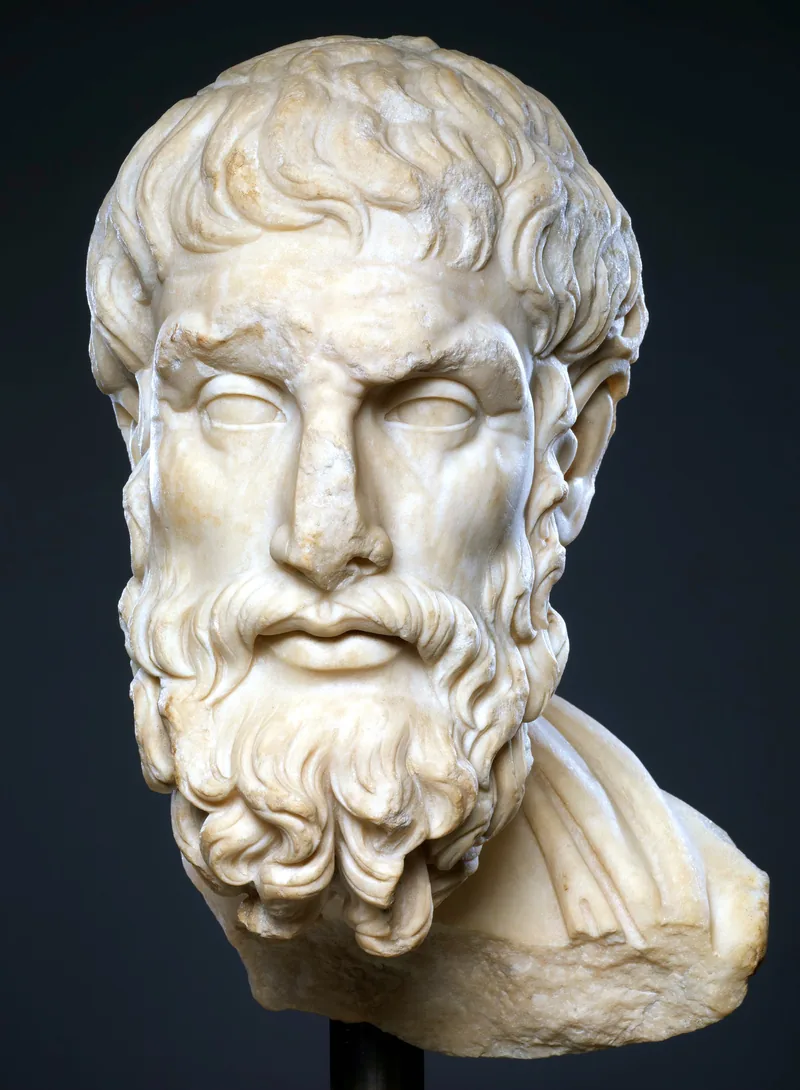
9.41 The Greek philosopher Epicurus14 says, “During my illness my conversations were not about the sufferings of my little body, nor did I,” he says, “talk about such things to my visitors, but I kept examining the main questions about nature and focused on this in particular: how the thinking part shares in these movements in the scrap of flesh, yet remains calm, preserving its own good. Nor did I,” he says, “give the doctors a chance to swagger as though they were accomplishing something, but life went on well and nobly.”
So do as he did, in illness if you are ill, and in any other difficult circumstance. For every philosophical schooll has this in common: not abandoning philosophy whatever happens to you, and not joining in the chatter of a layman ignorant of nature. Concentrate only on what you are doing now and the instrument you do it with.
9.42 Whenever you take offense at someone’s shamelessness, ask yourself at once, “Is it possible, then, for there to be no shameless people in the universe?” It is not possible. So do not demand the impossible, for this person too is one of the shameless people who must exist in the universe. Keep the same thought ready for the scoundrel, the untrustworthy person, and anyone who does anything wrong: once you remember that people of this kind cannot fail to exist, you will be kinder to each individual.
It is also useful to consider at once what excellence nature has given human beings to meet this wrong. For against the unfeeling personm she has given gentleness as an antidote, and against a different person a different power. In any case, you can teach someone who has gone astray to change his mind, because anyone who does wrongn misses his aim and has gone astray.
And how have you been harmed? For you will find that none of those you are angry with has done anything that would make your thinking part worse; but everything bad or harmful to you has its entire existence there.
What has happened that is new or strange, if an uneducated persono acts like an uneducated person? See whether you should rather blame yourself for not expecting him to do this wrong: reason had given you the resources to consider it likely that he would do this wrong, yet you forgot and are surprised that he did.
Above all, when you blame someone for being untrustworthy or ungrateful, turn to yourself. For the fault is plainly yours, whether you trusted a person with that disposition to be trustworthy, or gave a favor not as an end in itself, nor in such a way that you received its whole fruit at once from the action itself. What more do you want after benefiting someone? Is doing something in line with your own nature not enough—do you ask to be paid for it? As if the eye demanded a reward for seeing or the feet for walking. For just as these were made for a particular task and get what belongs to them by carrying it out as they were built to, so a human being, made by nature to benefit others, whenever he benefits someone or otherwise helps the common good,p has done what he was made for and has what belongs to him.

