Chanakya Niti · Chanakya

Chapter 1

Translated by The Modern Translation Project (2026)

2 min read
Listen · 3 min

1 Bowing my head to Vishnu,1 the lord who rules the three worlds, I will set out a collection of teachings on statecraft drawn from various Shastras, authoritative treatises.

2 An excellent mana who studies this treatise as prescribed—a work renowned for its teaching of dharma,2 the moral order—knows what should and should not be done, what is good and bad.

3 For people’s benefit, I will explain this teaching fully: merely understanding it makes a person all-knowingb.

4 Even a wise man comes to grief by teaching a foolish pupil, supporting a wicked wifec, and keeping company with people in misery.dprintings differHere we follow the Mathura printing (1914)
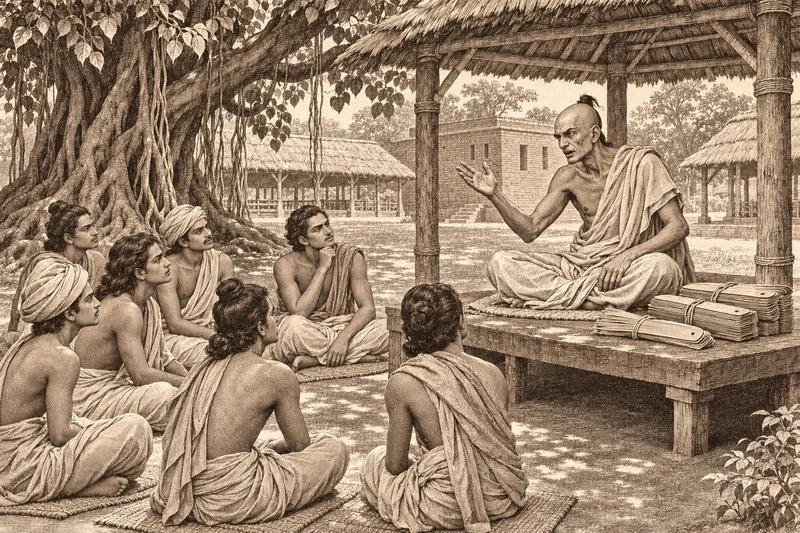
An older teacher with a shaved head and a tuft of hair sits cross-legged on a low platform under a thatched pavilion beside a banyan tree, raising a hand as he speaks to young pupils seated on mats, with bundles of palm-leaf manuscripts beside him.
This imagined scene shows a teacher of statecraft with his pupils in ancient India, about 300 BCE. Tradition names the author of these sayings as Chanakya, adviser to the king Chandragupta Maurya; the opening verses promise teachings gathered from many older treatises. Books were written on bundles of palm leaves tied with cord. It is an AI illustration; no ancient picture of Chanakya exists.
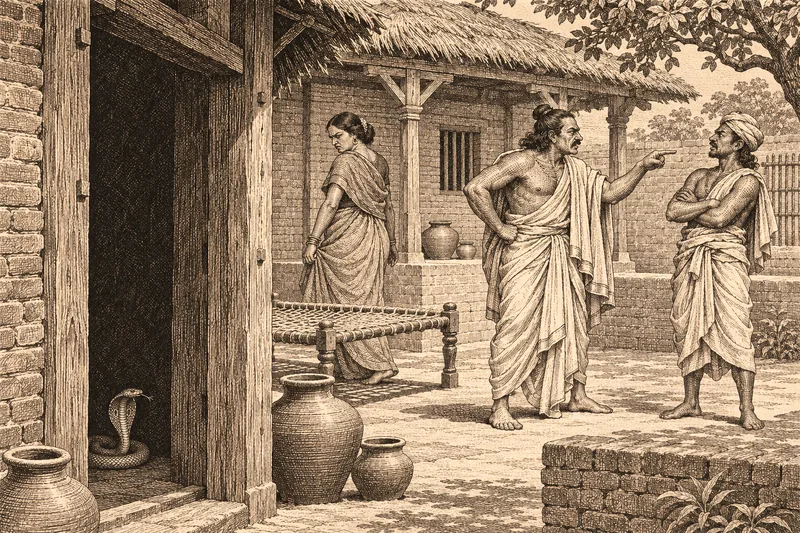
In the courtyard of a brick-and-thatch house a cobra with raised hood rests by a doorway, while a man points angrily at a servant standing with folded arms and a woman turns away.
This imagined scene illustrates the saying that a wicked wife, a deceitful friend, a servant who answers back and a house with a snake in it are death itself. A cobra waits by the doorway while the householder quarrels with his servant. It is an AI illustration.

5 A wicked wife, a deceitful friend, a servant3 who answers back, and living in a house with a snake in it are death itselfe, without a doubt.

6 Guard your wealth for hard times; guard your wife even at the cost of your wealth; always guard yourself, even at the cost of your wife and even at the cost of your wealthf.

7 Guard your wealth for hard times. You may ask, “Where would trouble come from for the wealthy?” But Lakshmi,4 the goddess of fortune, sometimes moves away, and what has been saved perishes.g

8 Avoid a countryh where you are not respected, have no livelihood or relatives, and have no access to learning of any kind.

9 A wealthy man, a Brahmin5 versed in the sacred Vedas, a king, a river, and, fifth, a physician—where these five are absent, do not stay there a day.

10 A means of livelihood, fear of wrongdoing, a sense of shame, courtesy, and generosityi—where these five are absent, do not settle there.printings differ

11 Judge servantsj when you send them on a task, relatives when misfortune comes, a friend in hard times, and a wife when wealth is lost.

12 Whoever stands by a man in sickness, when misfortune strikes, in famine, under threat from enemies, at the royal court,6 and at the cremation ground is his kinsman.

13 Whoever gives up what is certain to pursue what is uncertain loses the certain, and the uncertain is certainly lost.

14 A wise man should choose a girl of good family,7 even if she is ugly, not a beautiful girl of low birth; marriage should join families of equal standing.

15 Put no trust at all in clawed beasts, rivers, horned beasts, armed men, women, or royal households.8

16 Take the nectar of immortality9 even from poison, gold even from filth, excellent learning even from a lowly personk, and a jewel of a woman even from a bad family.

17 Women eat twice as much as men, have four times their intelligencel and six times their recklessness, and are said to have eight times their desire.printings differ


Notes

  1. Vishnu is the god who preserves the world. The three worlds are commonly heaven, earth and the lower world in traditional Indian cosmology, so calling Vishnu their ruler presents his authority as extending throughout the universe. The Shastras are authoritative Sanskrit treatises on subjects such as religion, law, government and conduct; the speaker presents their teachings as the sources of this collection. “A collection of teachings on statecraft” renders rajaniti-samuchchaya, “a compendium of royal policy.” Rajaniti here is the policy and conduct of kings; modern Hindi rajniti means politics in general. The niti of the book’s title is broader: sound policy and prudent conduct in everyday life. Collections of niti sayings traditionally set advice for rulers beside advice on family, friendship, money and learning, which is why so much of this book is about private life. The verse does not name its speaker; tradition takes him to be Chanakya. ↩
  2. Dharma includes the moral and religious order, the duties it imposes, and the conduct that sustains it. No single English word covers its range here. ↩
  3. A household servant was a dependent subordinate expected to obey the master. Answering back challenges that relationship. ↩
  4. Lakshmi is the goddess of wealth and fortune and Vishnu’s wife. Her departure represents the loss of prosperity. ↩
  5. Brahmins were the priestly and learned class, highest in the traditional fourfold order of society. The Vedas are the oldest and most sacred Hindu scriptures, containing hymns, ritual instructions and religious teachings; the Sanskrit here, shrotriya, names a Brahmin trained in reciting them and performing their rites, who represents the learning and ritual expertise a community should possess. The king was responsible for protecting his subjects and administering justice; he stands for royal protection, not necessarily for a king living in the town. Dhanika, “a wealthy man,” also commonly means a lender: such a man could lend in hard times and support trade, though the verse does not say what role it has in mind. The river supplies water for drinking, farming, bathing and ritual, and a route for travel. The physician, vaidya, is a practitioner of traditional Indian medicine (Ayurveda). Together the five stand for wealth, sacred learning, government, water and medical care. ↩
  6. “At the royal court” renders rajadvara, literally “the king’s door,” where lawsuits were heard and petitions made. The royal court was a place where a person might face judgment or seek protection. Attendance at the cremation ground, where the dead were burned, demonstrated loyalty through bereavement and death. Bandhava ordinarily means a relative, but the verse gives the word to anyone who stands by a person in these crises, so kinship is defined by loyalty rather than by blood alone; many versions translate it “true friend.” The Sanskrit says only “whoever stands by”; the English adds “a man” for clarity. ↩
  7. Marriage was commonly arranged with attention to inherited family standing. The saying recommends a match between families of comparable status. Kulaja, “of good family,” means born into a good lineage. Nichasya, “of low birth,” is literally “of a low man,” that is, a beautiful girl whose father is of low standing. Nicha can mean low in birth or standing or low in character, and it names no particular caste; set against kulaja and “families of equal standing,” the contrast here is one of family status, not of the girl’s own character. Modern Hindi neech usually means vile or contemptible, but here the Sanskrit concerns inherited standing. Virupa, “ugly,” is literally “misshapen” or “ill-formed.” Kanyaka means an unmarried girl, a maiden; it gives no age in years. 1.16 gives the opposite advice (“a jewel of a woman even from a bad family”): the collection does not always agree with itself. ↩
  8. The royal household includes the ruling family and its powerful dependents. The warning concerns the dangers of trusting people close to royal power. The warning about women is separate and general: the Sanskrit says strishu, “in women,” with no qualifier such as “bad” or “unfamiliar,” and the translation keeps it that broad. It sets women beside dangerous animals, unpredictable rivers, and those who hold weapons or royal power; distrust of women is a recurring theme of Sanskrit niti sayings, and it returns in 1.17 and 2.1. Rivers are on the list because floods and currents can turn dangerous without warning. ↩
  9. Amrita is the nectar of immortality in Indian myth. The word rendered “filth” can also denote material considered ritually impure. ↩

Translation notes

  1. Nara, “man,” is grammatically masculine and is the ordinary word for a man, but it is also used of any human being. Works of this kind generally assume a male reader, so the English keeps “man,” though the Sanskrit also allows “person.” “As prescribed” renders yatha, “duly, properly,” standing beside shastram, “the treatise”; the two words can also be read together as yatha-shastram, “as the rules direct.” Either way the sense is to study it as it should be studied. The verse does not describe a particular way of studying. “Good and bad” renders shubha and ashubha, which cover right and wrong but also lucky and unlucky, favorable and unfavorable; the English keeps the pair broad. ↩
  2. The Sanskrit really does say sarvajnatva, “knowing everything.” “Understanding” renders vijnana, which here means understanding or discernment, not science as in modern Hindi. Opening a work with sweeping praise of what it will do for its reader is a common convention in Sanskrit writing, and the claim is usually read as that kind of hyperbole rather than as a literal promise. ↩
  3. The Sanskrit compound is dushta-stri-bharana, literally “maintaining a wicked woman.” Stri means both “woman” and “wife,” and bharana, feeding and providing for someone, was the duty a householder owed to the women of his own household, so “wife” is the natural reading. The qualifier dushta, “wicked, corrupt, ill-natured,” is in the Sanskrit, and the same word returns in 1.5: the clause is about a bad wife, not about supporting women in general. Pandita, “wise man,” here means a learned or discerning person, not specifically a priest. ↩
  4. Here we follow the 1914 Mathura printing, which reads duhkhitaih samprayogena, “by association with afflicted people,” that is, people who are suffering or in misery. Our main text, Sternbach’s edition, reads dvipada, “with a two-footed creature.” Every person is two-footed, and nothing in the verse says which kind of person is meant or why such company does harm, so the line makes no clear sense as it stands. 3.7 calls a fool a two-legged beast, but this verse has no such qualifier. The 1925 Bombay printing has the singular duhkhitah, “afflicted,” which would describe the wise man himself rather than his company. ↩
  5. The Sanskrit is emphatic: mrityur eva, “death itself,” not merely “like death.” The saying treats these four situations as mortal danger or ruin. The qualifiers are in the Sanskrit too: the wife is dushta, “wicked, corrupt, ill-natured,” and the friend shatha, “deceitful.” Here the word for wife is bharya, which means only “wife,” while 1.4 used stri, which can mean either “woman” or “wife.” ↩
  6. Literally: “for misfortune guard wealth; guard your wife even with wealth; always guard yourself even with your wife, even with your wealth.” The same construction (“with, by means of”) runs through both lines, so the English renders it the same way each time: wife and wealth are things you may have to spend or lose to protect yourself. The order of priority, yourself first, is the Sanskrit’s own. Some modern versions take atman, “yourself,” as “the soul,” which turns the line into spiritual advice; in a verse about wealth and hard times, the plain sense is one’s own life and person. The word for wife, dara, is normally plural in form in Sanskrit even when one wife is meant, so the plural here does not show that several wives are meant. Much the same verse appears in the Manusmriti, an ancient law book. ↩
  7. “You may ask” and “But” are added to show the shape of the verse. The middle question is an imagined objection (surely the rich have nothing to fear?), and the second line answers it. Fortune is fickle: Lakshmi sometimes moves away, and accumulated wealth can perish. So even the rich should prepare for hard times, as the first line advises. The Sanskrit sanchitam is simply “what has been accumulated”; wealth is understood from the context. The older printings word the verse slightly differently without changing its sense; the 1925 printing says “even hoarded fortune perishes.” ↩
  8. Desha means a land, region or place, the place where one lives, not a modern nation-state; “country” is meant in its older sense of a district or land. Our text says to avoid such a place. The 1925 printing says instead vasam tatra na karayet, “do not make your home there”; the 1914 printing gives the same advice but prints vasas where the verb calls for vasam. The practical sense is the same. ↩
  9. Lokayatra, literally “the course of the world,” means making a living and keeping life going. It also means the ordinary business and social life of a place; “means of livelihood” chooses the first sense. The Sanskrit says only “fear” (bhaya) and “shame” (lajja). “Of wrongdoing” and “a sense of” are added because both are listed as restraints: where people fear doing wrong and its consequences and feel shame, they behave decently. The verse does not say whether the fear is of the law, of punishment or of God. Dakshinya is courtesy and considerateness, and tyagashilata a habit of giving freely. ↩
  10. Janiyat, “one should judge,” literally “one should know”: these situations show what people are really like, and the verse does not tell you to create them. Vyasana, “misfortune,” usually means an addiction or bad habit in modern Hindi, but in classical Sanskrit it also means calamity or distress, and that is the sense here, beside “hard times.” The last clause looks at the wife from the husband’s side: her loyalty shows when his wealth is gone. ↩
  11. Nicha, “lowly,” can mean low in birth or social standing or low in character; the Sanskrit does not say which and names no caste. The English “lowly” leans toward social rank, whereas modern Hindi neech is a harsher word, commonly used as an insult for a base or vile person. Striratna, “a jewel of a woman,” is a stock phrase for an excellent woman, and taking her from a family implies taking her as a wife. Dushkula, “a bad family,” is a disreputable lineage; the phrase says nothing against the woman herself. This saying lets personal worth outweigh family background, the opposite of 1.14’s advice. A similar saying appears in the Manusmriti, an ancient law book. ↩
  12. Our text has buddhi, “intelligence,” “understanding” or “cleverness”; the word does not by itself imply cunning or deceit. Both older printings have lajja, “modesty,” the reading found in many popular versions. The translation follows our text. “Recklessness” renders sahasa. In modern Hindi sahas means courage, a virtue, but in classical Sanskrit sahasa often means rashness or a daring, violent act; 2.1 lists it among faults, and “recklessness” gives that sense, though popular versions often say “boldness” or “courage.” The Sanskrit gives only the multiples (“twofold, fourfold, sixfold, eightfold”); “than men” is understood, not written. Kama can mean desire or wanting broadly, as well as sexual desire, and this verse is often read in the sexual sense; this translation keeps the broader sense, “desire.” Uchyate, “is said,” stands at the end and presents the last item, and perhaps the whole list, as a common saying. The multiples are a sweeping stereotype, not a measurement, and the English gives them as bluntly as the Sanskrit does. ↩

Where the printings differ

Where the three printings of the Sanskrit disagree in meaning: the words of each, a literal rendering, and the printed page.

Picture credits

  1. The teacher of statecraft (AI illustration, labelled): The teacher of statecraft (AI illustration, labelled), The Modern Translation Project, AI-generated, 2026; The Modern Translation Project. Owned by the project; AI-generated. Modifications: resized.

    Made with Codex image generation in the project's black-ink engraving style; an imagined scene, not an ancient picture.

  2. A snake in the house (AI illustration, labelled): A snake in the house (AI illustration, labelled), The Modern Translation Project, AI-generated, 2026; The Modern Translation Project. Owned by the project; AI-generated. Modifications: resized.

    Made with Codex image generation in the project's black-ink engraving style; an imagined scene, not an ancient picture.

Translated by The Modern Translation Project (2026). The Sanskrit text on this site (Sternbach 1963; Internet Archive in.ernet.dli.2015.117099) (archive.org). Public domain in the US. A modern translation is in progress.

Found a mistake in this translation? Email admin@lifemathmoney.com with the passage.

Chanakya NitiModern

Translations

Theme

Text size

100%






