Chanakya Niti · Chanakya

Chapter 10

Translated by The Modern Translation Project (2026)

2 min read
Listen · 4 min

1 A man without wealth is not destitute—he is certainly rich;a a man without the jewel of learning is destitute in every respect.

2 Take steps purified by sight, drink water purified by cloth,1 speak words purified by the Shastras2 and perform deeds purified by the mind.

3 If a man seeks comfortb, he should give up learning; if he seeks learning, he should give up comfort. What learning is there for someone who seeks comfort, and what comfort for someone who seeks learning?

4 What do poets not see, what do women not doc, what do drunkards not say, and what do crows not eat?

5 Fated makes a beggar a king and a king a beggar, a rich man poor and a poor man rich.

6 A beggar is a miser’s enemy, a teacher a fool’s enemy, a husband an adulterous woman’s enemy, and the moon a thief’s enemye.

7 Those with no learning, no austerity, no giving, no good character, no good qualities and no dharma roam this mortal world as beasts in human formf, a burden on the earth.

8 Advice has no effect on those who are hollow within;g bamboo does not become sandalwood even through contact with sandalwood-clad Mount Malaya.3

9 What can the Shastras do for a man with no judgment of his own, and what can a mirror do for a man with no eyes?

10 There is no way on earth to make a wicked man good; washing the anus a hundred times will not make it a superior organh.

11 Hatred of oneselfi can bring death, hatred of others loss of wealth, hatred of the king destruction, and hatred of Brahmins the end of one’s lineage.printings differ

12 It is better to have a tree for a home in a forest frequented by tigers and mighty elephants, leaves, fruit and water for food, grass for a bed and bark clothing4 worn through in a hundred places than to live penniless among relatives.

13 A Brahmin is a tree: his root is sandhya,5 the twilight worship; his branches are the Vedas; his leaves are acts of dharma and the like. Therefore he should carefully guard the root: when the root is cut, neither branches nor leaves remain.

14 The goddess Lakshmij is my mother, the god Vishnu my father, Vishnu’s devotees my relatives, and the three worlds my homeland.6

15 Birds of many colors gather in one tree; at dawn they go in the ten directions7—what is there to grieve about?8

16 Whoever has intelligence has strength; how can a man without intelligence have strength? In the forest, a lion maddened by pride was brought down by a hare.9kprintings differ

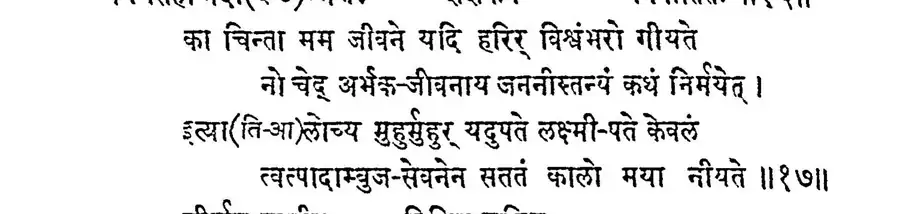
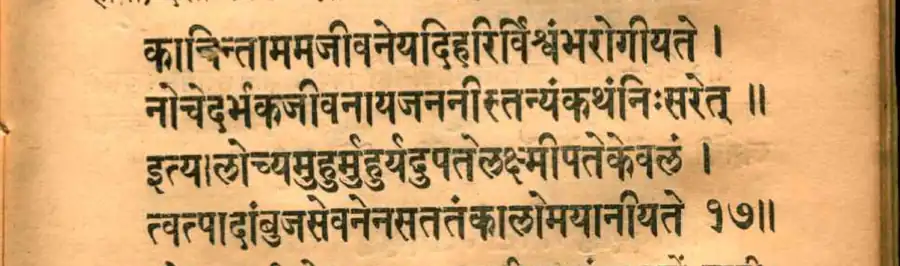
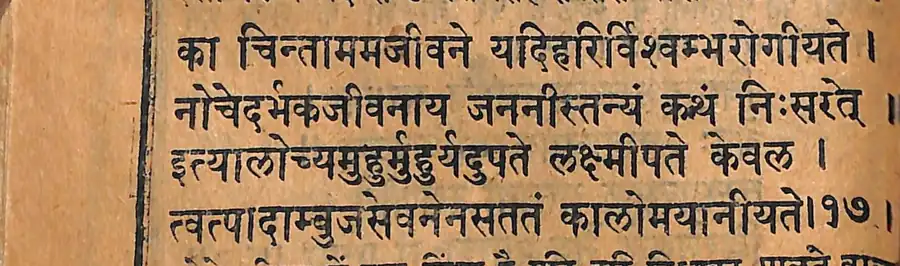
17 Why should I worry about my livelihood if Vishnul is sung of as the sustainer of the world—otherwise, how would he have made milk in a mother’s breast to keep her baby alive? Reflecting on this again and again, lord of Yadu’s clan,10 husband of Lakshmi, I spend all my time solely in serving your lotus feet.printings differ

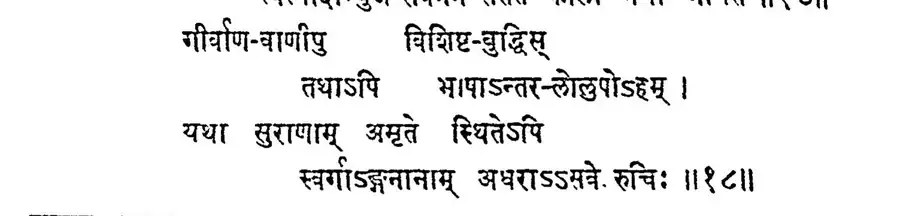
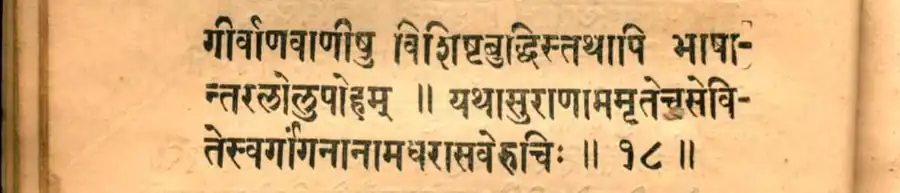
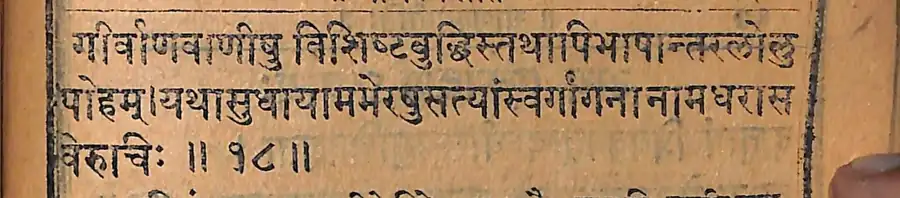
18 I have exceptional command of Sanskrit,11 the language of the gods, yet I crave another language,m as the gods, though they have nectar, have a taste for the wine of heavenly women’s lips.printings differ

19 Flour is ten times as nourishing as grain,n milk ten times as nourishing as flour, meat eight times as nourishing as milk12, and clarified butter ten times as nourishing as meat.

20 With leafy greens diseases growo, with milk the body grows, with clarified butter virilityp grows, and with meat flesh grows.


Notes

  1. A step “purified by sight” is one taken after looking where the foot will go, and a deed “purified by the mind” is one first thought through. Drinking water was strained through cloth to remove impurities; this literal purification supports the surrounding comparisons. The verse closely parallels the Laws of Manu (6.46), a rule for the wandering renouncer, where checking the ground and straining water also served to avoid harming tiny creatures, a concern Jain practice shares. There the third rule is speech “purified by truth” (satyaputa); our text has “purified by the Shastras.” ↩
  2. The Shastras are the authoritative Sanskrit treatises on religious duty, law, conduct and the traditional branches of knowledge; the word means authoritative teaching, not one particular book, and is wider than the Vedas. Speech “purified by the Shastras” is speech checked against what they teach. ↩
  3. Malaya is a southern mountain region associated with sandalwood. Other trees were said to acquire sandalwood’s fragrance, while hollow bamboo remained unchanged. ↩
  4. Rough garments made from tree bark are associated with forest ascetics and the renunciation of household comforts. ↩
  5. Sandhya is prescribed worship at the junctions of the day, especially dawn and dusk. The tree image makes this observance the support of the Brahmin’s religious life. ↩
  6. The three worlds are heaven, earth and the underworld: the whole universe. ↩
  7. The ten directions are the eight compass directions together with above and below. ↩
  8. This is a traditional image for the shortness of human ties: people gather for a time in one household or one life, like birds roosting overnight in a single tree, and then go their separate ways; the verse does not say whether the parting is death or some other separation. Varna here means color, not social class. The verb “go” is understood in our text; the 1925 printing states it (yanti) and asks “why lament?” ↩
  9. In the Panchatantra telling of this fable, a hare tricks the lion Bhasuraka into attacking his own reflection in a well, where he falls to his death; the Hitopadesha tells a version with a differently named lion. Nipatitah means “felled, brought down,” and can also mean “struck down, slain”; in the story the fall kills the lion. Mada covers intoxication, the frenzy of an animal in rut, and arrogance; “maddened by pride” takes it as the lion’s arrogance about his own strength, which the story bears out, though the verse does not spell it out. ↩
  10. Yadu is the legendary royal ancestor of Krishna’s clan; “lord of Yadu’s clan” addresses Krishna, an incarnation of Vishnu. “Husband of Lakshmi” identifies him with Vishnu: Lakshmi is the Hindu goddess of wealth and good fortune and Vishnu’s wife. “Lotus feet,” likening a deity’s feet to the lotus, a flower associated with divine beauty and purity, expresses the devotee’s reverence and loving devotion. ↩
  11. Sanskrit is the classical language of ancient Indian learning and sacred literature, traditionally called the language of the gods; the verse’s own word for it is girvanavani, “speech of the gods.” In Sanskrit, bhasha often means everyday spoken language as opposed to learned Sanskrit, so the “other language” (bhashantara) is most likely a spoken regional tongue, though the verse names none. The gods’ nectar is amrita, the drink of immortality, not the nectar of flowers. The heavenly women are celestial companions, commonly imagined as apsaras, whose kisses furnish the erotic comparison: the gods own the supreme drink and still crave this one. Asava means fermented liquor, so “wine” follows the Sanskrit. The playful, first-person voice is unlike most of the collection’s sayings. ↩
  12. The Sanskrit plainly says mamsa, “meat,” and ranks it above milk; ghrita is clarified butter, or ghee, which tops the scale. Mamsa can mean the flesh of a fruit in other settings, but nothing here points to that. Classical Indian medicine (Ayurveda) counted meat broth and ghee among the most strengthening foods, and the verse reflects that old view of diet; it makes no religious recommendation. The collection gathers sayings from many sources, and it also keeps 11.5, which says a meat eater has no compassion. ↩

Translation notes

  1. Hina, “destitute,” means lacking or deprived, and also inferior or low; repeating it lets the verse set lack of money against the deeper lack of learning. Calling the penniless man “rich” assumes he has the “jewel of learning” of the second half. Sunishchayat can mean “certainly,” as translated, or “through firm resolve,” which would explain why the penniless man is rich. The older printings read sunishchayah, which favors resolve. ↩
  2. Sukha ranges from pleasure and ease to happiness. “Comfort” fits because the saying sets ease and leisure against the hard discipline of study; it does not say that a student can never be happy. Vidyarthi, a “seeker of learning,” is anyone who wants to learn, not only someone enrolled in school. ↩
  3. The Sanskrit is exactly this open question; yoshitah simply means “women.” The four questions share the idea of knowing no limits, but their tone differs: poets’ imagination reaches everywhere (as in the Hindi saying that a poet goes where even the sun cannot), drunkards babble and crows eat anything. The question about women is traditionally read as saying they will dare or contrive anything, a stock misogynistic stereotype; it names no particular act. Jalpanti, “say,” can also mean chatter or babble. ↩
  4. Vidhi means fate or destiny, and also the Ordainer, Brahma the creator, who is said to write each person’s lot. “Fate” takes the impersonal sense while keeping the idea of an ordering power. Here it does not have its common modern Hindi sense of “method” or “procedure.” ↩
  5. Yachaka is anyone who asks for something, a petitioner or beggar; lubdha means greedy, and faced with a beggar the greedy man is the one who clings to his money, hence “miser.” Bodhaka is anyone who instructs or advises, not necessarily a professional teacher. Jarastri literally means a woman who has a jara, a lover outside marriage; the concern with infidelity is one-sided, as elsewhere in the collection. The moon is the thief’s enemy because moonlight exposes him. ↩
  6. Mriga usually means “deer” in modern Hindi, but in Sanskrit it often means any wild animal; here it means beasts as opposed to humans, as in the “beasts in human shape” of 8.21. Dharma here means ethical and religious duty, not membership of a particular faith. A version of this saying also appears in Bhartrihari’s Nitishataka, a famous collection of verses on worldly wisdom, often with jnana, “knowledge,” among the missing virtues. ↩
  7. Sara can mean inner substance or solid core as well as worth or excellence. “Hollow within” carries both the human judgment and the bamboo image. ↩
  8. The blunt image comes straight from the Sanskrit: apana here means the anus (in yoga the same word names the downward-moving breath). Indriya means a sense organ or an organ of action; in traditional Indian classifications the anus is one of the five organs of action. The verse treats it as lowly: washing it a hundred times cannot raise its status, just as nothing can change a wicked man’s nature. ↩
  9. Dvesha means hatred, aversion or active hostility; “hatred of oneself” is not a modern psychological diagnosis. Atma is read as “oneself”; the alternative “one’s own people” gives hostility to kin rather than self-directed hatred. Brahma can also mean sacred lore or the divine, but in compounds such as this one it regularly stands for Brahmins as a group, and here it is paired with the king just before it. Kulakshaya is the extinction of a family line; the warning reflects the traditional belief in the ruinous power of offended Brahmins. The verse does not say how these results come about. ↩
  10. The Sanskrit names Lakshmi as Kamala, “she of the lotus,” and Vishnu as Janardana, one of his traditional titles. The translation uses the established familiar names for the same two deities. Lakshmi is the goddess of fortune and prosperity and Vishnu’s consort; Vishnu is the preserver god. The Sanskrit has no verb and no word for “my”; the devotee claims the divine couple as parents, and the verse tells us nothing about any historical speaker. ↩
  11. Our text and the Mathura printing name a hare. The Bombay printing substitutes a jackal. ↩
  12. The Sanskrit calls Vishnu by his name Hari, here and in 11.4. ↩
  13. The printed bhashantar- is a shortened, unclear form; we read bhashantara, “another language,” as the older printings spell it. Vishishtabuddhi, literally “of distinguished intellect,” is taken here as mastery of Sanskrit; it could also mean “holding Sanskrit in special regard,” which would match the gods, who have nectar and still crave lips. ↩
  14. Anna can mean food in general, especially cooked grain or rice; it is taken here as grain in contrast with pishta, flour or ground grain. The Sanskrit gives the ratios without naming a measured nutrient; “as nourishing” expresses the comparison of food strength suggested by the context. The numbers are literally ten, ten, eight and ten, each item measured against the one before; they are traditional claims, and no method of measuring is given. ↩
  15. The Sanskrit really does say this: our text and both older printings read shakena roga vardhante, “with shaka diseases grow.” Shaka centers on leafy greens and pot-herbs cooked as food (Hindi saag), but it can also cover vegetables more broadly; “leafy greens” gives its central sense. Old Indian medical writing often describes such greens as dry and hard to digest, and it counts milk, ghee and meat, the foods named next, as strengthening. The verse states its claim flatly, without saying how much, how prepared or which illness. ↩
  16. Virya can mean vigor, sexual potency or semen; “virility” retains its reproductive force without fixing the narrowest meaning. Mamsa is repeated for both meat eaten and flesh on the body, an echo that natural English divides between two words; the first mamsa is animal meat, not a plant food. The line matches the idea, familiar from classical Indian medicine, that like increases like: eating flesh builds the body’s flesh. It is a claim about the body, not a religious ruling; compare 11.5. ↩

Where the printings differ

Where the three printings of the Sanskrit disagree in meaning: the words of each, a literal rendering, and the printed page.

Translated by The Modern Translation Project (2026). The Sanskrit text on this site (Sternbach 1963; Internet Archive in.ernet.dli.2015.117099) (archive.org). Public domain in the US. A modern translation is in progress.

Found a mistake in this translation? Email admin@lifemathmoney.com with the passage.

Chanakya NitiModern

Translations

Theme

Text size

100%