Chanakya Niti · Chanakya

Chapter 6

Translated by The Modern Translation Project (2026)

2 min read
Listen · 4 min

1 By listening a man understands dharma, by listening he abandons wicked thoughts, by listening he gains knowledge, and by listening he may gain liberationa.

2 The crow is the Chandala,1 the outcaste, among birds, and the dog2 among beasts; an angry sageb is the Chandala among sages, despised [even] by all Chandalas.printings differ

3 Ash purifiesc bronze, a sour substance purifies copper, menstruation3 purifies a woman, and the force of its current purifies a river.

4 A king is honored as he roams, a Brahmind is honored as he roams, and a yogi,4 a spiritual practitioner, is honored as he roams; a woman who roams is ruinede.

5 As events are destined to unfold, so a man’s thoughts take shape, so too do his effortsf, and just so are his helpers.

6 Time5 cooksg living beings, Time destroys creatures, Time stays awake while they sleep, for Time is hard to escape.

7 A man born blind does not see, a man blinded by lust does not see, a man drunk with prideh does not see, and a man intent on gain does not see faults.

8 The self6 itself performs deedsi, itself experiences their fruit, itself wanders through the cycle of rebirth, and itself is freed from that cycle.

9 A king bears his people’s wrongdoing, a royal priest7 bears the king’s wrongdoing, a husband bears his wife’s wrongdoing, and a teacher bears his pupil’s wrongdoing.j

10 A father who incurs debt8 is an enemy, an adulterous mother is an enemy, a beautiful wife is an enemyk, and a son without learning is an enemy.

11 Win over a greedy man with money, a proud man with palms joined9, a fool by going along with his wishes, and a wise man with the truthl.

12 Better no kingdom than a bad king’s kingdom, better no friend than a bad friend, better no pupil than a bad pupil, and better no wife than a bad wife.

13 What happiness comes to subjects from a bad king’s rule, what contentment from a bad friend’s friendship, what joy at home from a bad wife, and what fame from teaching a bad pupil?
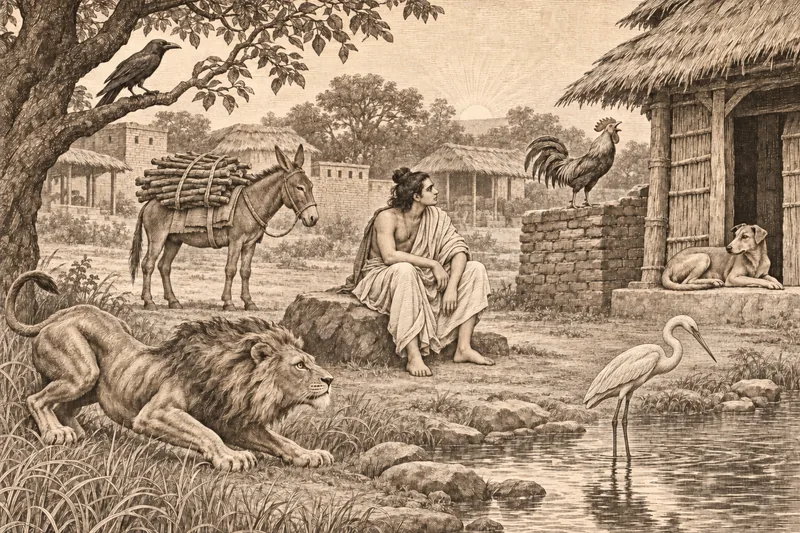
At the edge of a village a lion crouches in the grass ready to spring, a white egret stands in the shallows, a rooster crows on a wall, a crow perches on a branch, a dog lies in a doorway and a donkey carries firewood, while a young man sits watching.
This imagined scene shows the six animals the sayings teach us to learn from: the lion, who puts all its strength into a task; the heron, who waits with its senses held still; the rooster; the crow; the dog; and the donkey, who carries its load without complaint. It is an AI illustration.

14 Learn one thing from a lion,10 one from a heron, four from a rooster,11 five from a crow, six from a dog, and three from a donkey.12

15 A man who wants to do a task, large or small, should put all his might into it; this is said to be the one lesson from the lionm.

16 A wise man should restrain his senses like a heron and, knowing the place, time, and his strengthn, accomplish all his tasks.

17 Learn four things from a rooster: rising,o fighting, sharing with kin, and eating what one has seized oneselfp.

18 Learn five things from a crow: mating in secret13, boldness,q storing up supplies from time to time, watchfulness, and distrust.printings differ

19 Eating heartily yet being content with little, sleeping soundly yet waking quicklyr, loyalty to its master, and courage—these are the six qualities to learn from a dog.

20 Learn three things from a donkey: carrying a load even when exhausted, taking no notice of cold or heat, and always going about content.

21 A man who practices these twenty qualities will be invincible at every stage of his work.

Notes

  1. Chandalas were hereditary outcastes placed outside the four-class social order and associated with work such as handling corpses. Their excluded status supplies the verse’s degrading comparison. The verse uses the name as an insult, and “chandal” is still used as an insult in Hindi today; untouchability itself was abolished by the Indian Constitution (Article 17). Crows, like dogs, were associated with scavenging carrion and refuse. A muni is a holy man or ascetic, someone expected above all to master anger. ↩
  2. Dogs were associated with scavenging and ritual impurity in parts of the social tradition reflected here. That association explains this degrading comparison with an excluded human community. ↩
  3. Rajas has several meanings, including dust and menstrual flow; with a woman as its subject it means the latter, so the Sanskrit literally says “by menstrual flow a woman is purified.” Traditional law texts treated a woman as ritually impure during her period, but held that the monthly flow washed away earlier taint, so that once it ended and she had bathed, her ritual purity was restored. The Laws of Manu (5.108) has a similar line, saying that menstruation purifies a woman who has sinned in her mind. That ritual claim is placed alongside the cleansing of metals and flowing water: ash was traditionally used to scour bronze vessels, and sour substances such as tamarind or lemon juice to clean copper. ↩
  4. A yogi practices spiritual disciplines aimed at mastery of the body and mind or liberation. Here the yogi belongs to the tradition of wandering religious practitioners. ↩
  5. Kala means both time and death, and personified it is Time the universal destroyer; Yama, the god of death, is also called Kala. Both senses are at work here, as Time ripens and destroys all living beings. The same verse also appears in the Mahabharata. ↩
  6. Atman is often translated “soul.” We use “self” because the word can also simply mean “oneself,” and here it is the individual embodied self that acts and reaps the results of its deeds, not the ego or personality. The atman is the enduring self that passes through successive lives. It remains the subject of action, experience, and release throughout the verse. The next saying, 6.9, sets beside this a different idea: that rulers and guardians share in the wrongdoing of those in their charge. ↩
  7. A purohita was a priest attached to a king or household. The saying makes rulers, priests, husbands, and teachers share the religious burden of wrongdoing committed by those they govern or guide, unlike 6.8, which makes each self answer for its own deeds. Classical law texts say something similar of kings: the Laws of Manu hold that a king who fails to protect his subjects or punish wrongdoers takes on a share of their sin (for example 8.304 and 8.308). The verse gives no reasons for any of its four cases. Stri, “woman,” means a wife here because it is paired with bharta, “husband,” and grouping her with subjects and pupils reflects the traditional view of a husband’s authority over his wife. ↩
  8. The saying assumes a son’s obligation to discharge his father’s debts. Classical Hindu law made sons liable for their father’s debts, with exceptions such as debts for immoral or illegal purposes. In India the Hindu Succession (Amendment) Act of 2005 ended this “pious obligation” as a ground for recovering debts taken on after the Act came into force; claims for earlier debts were preserved. Apandita, “without learning,” literally means “not a pandita”: not learned, and so also lacking sound judgment. Pandita here is not a priest or caste title. ↩
  9. Anjali is the gesture of joining the palms in greeting, reverence, or supplication. Here it acknowledges the proud man’s claimed superiority. ↩
  10. The following six sayings draw twenty lessons from these animals: one, one, four, five, six, and three. The lion’s lesson, explained in 6.15, is to put all one’s might into every task. Baka is the heron or egret (Hindi bagula), the bird that stands motionless in shallow water waiting for fish; older English versions often call it a crane. Its stillness supplies the image of controlled attention in 6.16. The same stillness also made the bird an image of hypocrisy: Sanskrit bakavrata, “the heron’s vow,” means sham piety (Laws of Manu 4.196), and Hindi bagula bhagat, “heron-saint,” is a hypocrite who looks devout while waiting to strike. Here the verse praises only the bird’s self-control. ↩
  11. A rooster is a male domestic chicken. Its behavior supplies four practical lessons spelled out in 6.17: rising, fighting, sharing with kin and securing food. ↩
  12. The donkey is presented as a model of endurance and contentment. Its three lessons are carrying burdens despite exhaustion, tolerating heat and cold, and remaining content. ↩
  13. Gudhamaithuna literally means “secret sexual union,” mating hidden from view; it says nothing of adultery. Crows were popularly believed never to be seen mating, and the lesson usually drawn is that one’s sexual life should be kept private. Avishvasa, “distrust,” means not trusting others; it has nothing to do with religious belief. ↩

Translation notes

  1. The repeated word shrutva literally means “having heard.” The verse does not say what is heard; in a tradition where teaching was passed on mainly by word of mouth, it naturally means hearing instruction from a teacher or the wise, and hearing sacred teaching recited and explained. The Vedas themselves are called shruti, “what is heard,” and later Vedanta made hearing (shravana) the first of three steps toward liberation. Durmati, here “wicked thoughts,” literally means a bad mind and covers folly as well as wickedness. ↩
  2. Our text describes an angry sage and ends with the compound sarvachandalanindita, “despised by all Chandalas.” We take it to mean that a sage ruled by anger sinks so low that even those the verse places lowest despise him. “Even” is in brackets because the Sanskrit does not say it; we add it to make that point clear. Both older printings have a sinful sage instead of an angry one. The 1925 printing ends by making the slanderer the Chandala, either “the slanderer among all” or “the one who slanders everyone.” The 1914 printing has a rooster instead of a dog and an unclear ending. ↩
  3. The repeated Sanskrit verb covers both physical cleaning and ritual purification. Repeating “purifies” preserves that range. ↩
  4. The Sanskrit word is dvija, literally “twice-born”: the second birth is initiation into Vedic study. The term can cover men of all three upper classes (Brahmins, Kshatriyas and Vaishyas), but it most often means a Brahmin, and we take it that way here. ↩
  5. The Sanskrit uses the same verb, bhram-, “to wander, roam, travel about,” for all four; it does not itself suggest sexual misconduct. Vinashyati literally means “perishes,” “is destroyed” or “comes to ruin,” so “ruined” is not stronger than the Sanskrit. Kings traveled to govern, Brahmins to teach or on pilgrimage, and yogis wandered as ascetics; for women the verse reflects an ideal that kept them close to home. It sets honor for wandering men against ruin for a wandering woman without saying what form the ruin takes. ↩
  6. Vyavasaya, “efforts,” here means effort, resolve or purposeful undertaking, not business as in modern Hindi. Bhavitavyata literally means “what is bound to happen,” destiny. The saying is fatalistic: a person’s thinking, efforts and helpers all fall in line with what is fated. Hindi has a proverb with the same idea, jaisi honhar vaisi buddhi. Other sayings in the collection stress human effort instead. ↩
  7. The verb literally means “cooks” and can also mean ripens or brings to maturity. The image leads directly into Time’s destruction of living beings. ↩
  8. Jatyandha means blind from birth; jati here means birth, not caste, and the older printings use another word with the same meaning. Kama can mean desire in general or sexual desire; “lust” takes the sexual sense, while a broader reading would be “blinded by desire.” Mada can mean intoxication or pride; “drunk with pride” preserves their overlap, and “a man maddened by drink” is also a possible reading. Arthi is someone seeking something, so the following “gain” need not mean money. ↩
  9. Here “deeds” translates karma in its religious sense: actions whose consequences are experienced through the cycle of rebirth. ↩
  10. Papa, the general word for evil or sin in a religious sense, is rendered “wrongdoing” to avoid Christian overtones. The verse has no verb; “bears” supplies the sense that each answers for the other’s wrongdoing. ↩
  11. The Sanskrit is just as stark: bharya rupavati shatruh, “a wife possessed of beauty is an enemy.” Shatru is the ordinary word for an enemy; there is no “too,” no word for vanity and no charge of misconduct, whereas the mother is explicitly called unfaithful (vyabhicharini). The verse does not explain itself. The usual explanation is that a strikingly beautiful wife was thought to draw other men’s desire and so bring her husband jealousy, danger and quarrels; on that reading she is an “enemy” because she brings trouble, not because she means harm. ↩
  12. Grihniyat literally means “one should take hold of” someone, here in the sense of winning him over or gaining influence; these are ways of handling different kinds of people, not necessarily of making friends. Stabdha, “proud,” literally means “stiff,” hence obstinate or arrogant. Chando’nuvrittena, “by following someone’s chandas,” means going along with a person’s wishes; chandas can mean wish or will as well as poetic meter, and the older printings use the related word chanda, “wish” (chandanuvrittya). Pandita here means a learned or discerning person, not a priest or caste title. ↩
  13. Sarvarambhena literally means “with complete exertion” or “with every effort.” The verse does not say why this is the lion’s lesson; the image it calls up is of a lion that hunts with its full strength, whatever the size of its prey. ↩
  14. Restraining the senses means mastering one’s impulses and attention so as to act deliberately; the heron standing still supplies the image of concentrated waiting. Desha-kala-bala, “place, time and strength,” is a standard set of considerations in Sanskrit statecraft for weighing circumstances before acting. The Sanskrit does not say whose strength: “his” takes it as one’s own, though it could also include the strength of others involved. ↩
  15. Pratyutthana means getting up, or rising to meet or confront someone. The rooster suggests early rising, but “early” is not in the Sanskrit. ↩
  16. Akramya literally means “having attacked, overpowered or seized”: the rooster takes its food by force. The lesson is to secure one’s own food boldly rather than wait to be fed; the wording is stronger than simply “work for one’s food.” ↩
  17. Dharshtya ranges from boldness and audacity to impudence and brazenness, and is often a word of blame. “Boldness” takes the milder end of that range, since the verse counts it among things worth learning; “audacity” or “brazenness” would keep more of its usual note of blame. Our text names boldness and gathering from time to time among its five. The 1925 printing keeps boldness but has securing a dwelling in due time in place of gathering from time to time, while the 1914 printing omits boldness as a separate item. ↩
  18. The pairs are not contradictions: a dog eats a great deal when food is there and is satisfied with little when it is not, and it sleeps deeply yet wakes at the slightest sound. Laghuchetana, “waking quickly,” means light, easily roused awareness, not limited intelligence. This praise of the dog contrasts with 6.2, where it stands for the lowest among beasts. ↩

Where the printings differ

Where the three printings of the Sanskrit disagree in meaning: the words of each, a literal rendering, and the printed page.

Picture credits

  1. Lessons from the animals (AI illustration, labelled): Lessons from the animals (AI illustration, labelled), The Modern Translation Project, AI-generated, 2026; The Modern Translation Project. Owned by the project; AI-generated. Modifications: resized.

    Made with Codex image generation in the project's black-ink engraving style; an imagined scene, not an ancient picture.

Translated by The Modern Translation Project (2026). The Sanskrit text on this site (Sternbach 1963; Internet Archive in.ernet.dli.2015.117099) (archive.org). Public domain in the US. A modern translation is in progress.

Found a mistake in this translation? Email admin@lifemathmoney.com with the passage.

Chanakya NitiModern

Translations

Theme

Text size

100%




