1 For someone whose heart has melted with compassion for all creatures, what need is there of knowledge or liberation, or of matted hair1 and smearing the body with ashes?
2 No gift of wealth on earth can free a pupil from his debt2 to the teacher who has taught him just one syllable.
3 There are only two ways to deal with wicked people and thorns: smash their facesa with a shoe3, or keep well away from them.
4 Lakshmi abandons anyone who wears filthy clothesb, has dirty teeth, eats too much, speaks harshly and sleeps at sunrise and sunset, even if he is Vishnu, bearer of the discus4.
5 Friends, a wife, servants and well-wishersc abandon a man who has no wealth and turn to him again when he has money, for money is a man’s kinsman in this world.
6 Wealth gained unjustly lasts ten years; when the eleventh year comes, it perishes, roots and alld.
7 For a master, even what is improper counts as proper; for a lowly mane, even what is proper counts as a fault: the nectar5 of immortality brought death to the demon Rahu, while poison became an ornament on Shiva’s throat.
8 Food is what remains after Brahmins6 have eaten; friendship is what one shows to a strangerf; wisdom is what avoids wrongdoing; dharma is what one practices without pretenseg.
9 A gem rolls at one’s feet and glass is worn on the head7; when it is time to buy and sell, glass is glass and a gem is a gem.
10 The Shastras8 are endless, the branches of learning many, time short and obstacles many; seek their essence, as a swan9 takes milk from a mixture of milk and water.
11 Whoever eats without honoring a guesth who has come by chancei to his house from afar, weary from the road, is indeed called a Chandala10.
12 They read the four Vedas11 and the Dharma Shastras12, the treatises on dharma, again and again, yet do not know the Selfj at all, like a ladle that does not know the flavor of the food.
13 Blessed is the boat made of Brahmins, which works in reversek on the ocean of worldly existence: all who bow low beneath it cross over, while those who set themselves above it sink.
14 Though the moon13 is a storehouse of nectar and lord of medicinal plants, though its body is made of nectar and shines with radiance, it loses its rays when it enters the sun’s sphere; who does not lose stature when he lodges in another’s house?
15 This bee, once drowsy and drunk on lotus nectar among the lotus petals, has come to a strange land at fate’s bidding and now prizes the juice of the humble kutaja14 flower.
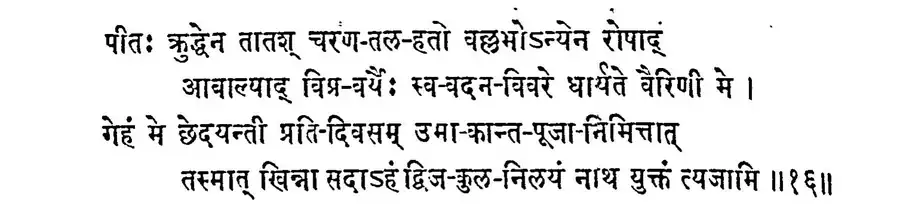
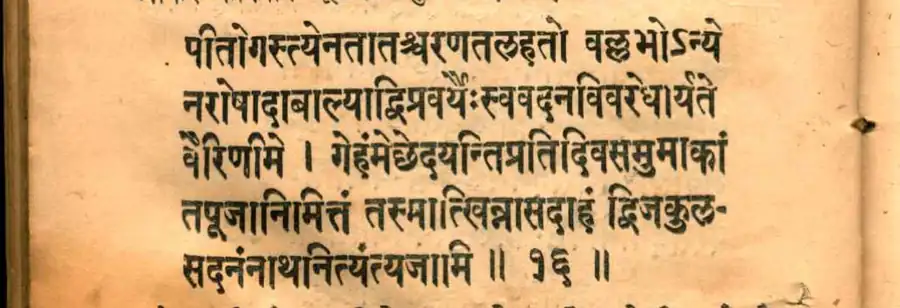
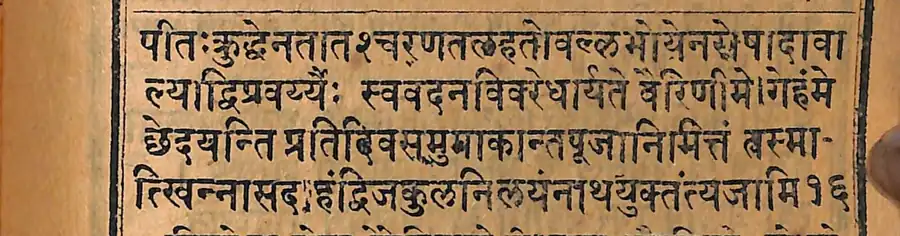
16 Lakshmi, goddess of wealth, says15: “The sage Agastya drank up my father, the ocean; another sage kicked my beloved Vishnu in anger; eminent Brahmins have carried my rival, the goddess of learning, in their mouths since childhood, and every day theyl cut my lotus dwelling to worship Shiva, Uma’s beloved. That is why, my lord, I am always grieved and continually leave the homes of Brahmins.”printings differHere we follow the Bombay printing (1925–26)
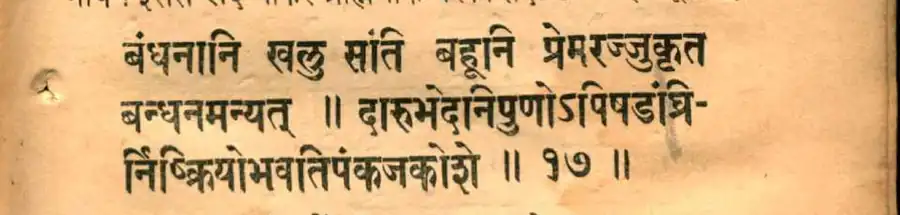
17 There are certainly many bonds, but the tight bond of love’s rope is another matter: the six-legged bee, though skilled at boring through wood, lies motionless, held by love, inside a lotus that has closed around it16.printings differ
18 A sandalwood tree does not give up its scent even when cut; an elephant king does not give up his playfulnessm even when old; sugarcane does not give up its sweetness in a press; a well-born man17 does not abandon his character and virtues even when impoverished.
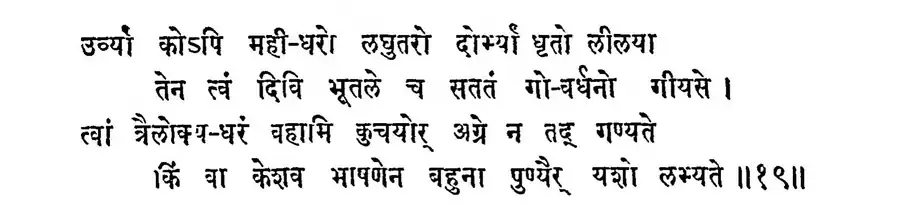
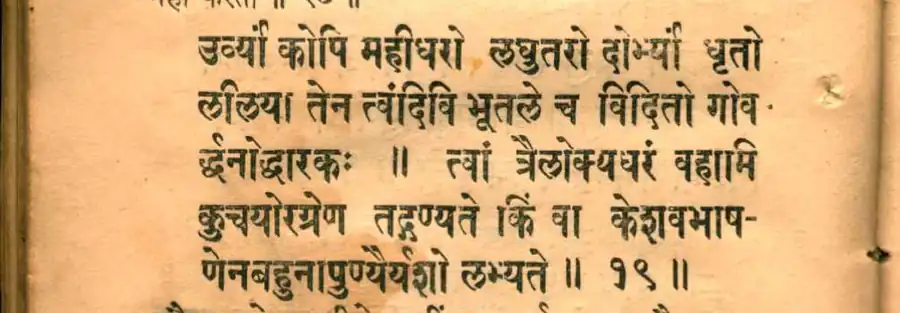
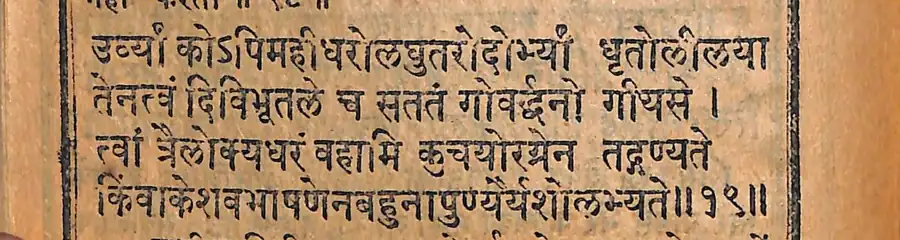
19 “You lifted some quite light mountain18 on earth effortlessly in your arms, and for that you are always sung of in heaven and on earth as Govardhanan; I carry you, bearer of the three worlds, on the tips of my breasts, and that counts for nothing. Why say more, Krishna? Fame comes from merit stored up by past good deeds.”printings differ