Show original scansSternbach 1963, p. 86Bombay printing, 1925–26, p. 116Mathura printing, 1914, p. 87Tap a scan to enlarge it. Scans: Internet Archive (Digital Library of India; eGangotri, CC0).
3 खलानां कण्टकानां च द्विविधैव प्रतिक्रिया ।उपानन्मुखभङ्गो वा दूरतो वा विवर्जनम् ॥ ३ ॥1
Show original scansSternbach 1963, p. 86Bombay printing, 1925–26, p. 117Mathura printing, 1914, p. 87Tap a scan to enlarge it. Scans: Internet Archive (Digital Library of India; eGangotri, CC0).
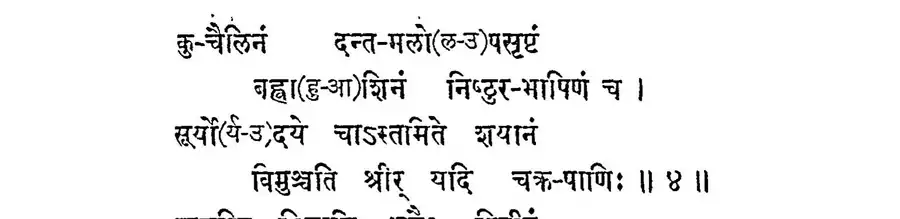
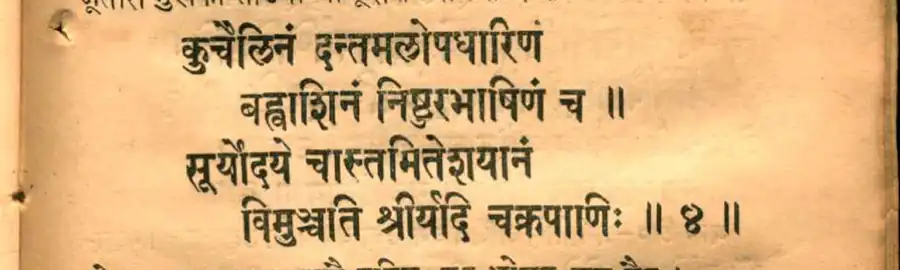
4 कुचैलिनं दन्तमलोपसृष्टंबह्वाशिनं निष्ठुरभाषिणं च ।सूर्योदये चास्तमिते शयानंविमुञ्चति श्रीर्यदि चक्रपाणिः ॥ ४ ॥2
Show original scansSternbach 1963, p. 87Bombay printing, 1925–26, p. 117Mathura printing, 1914, p. 87Tap a scan to enlarge it. Scans: Internet Archive (Digital Library of India; eGangotri, CC0).
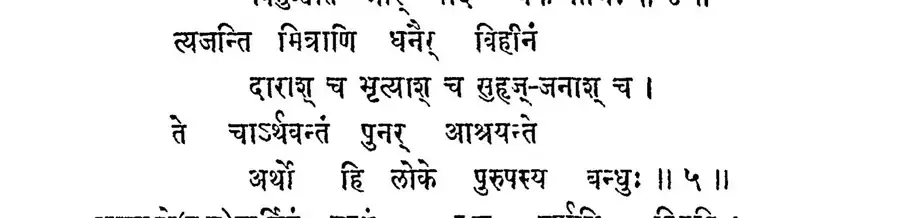
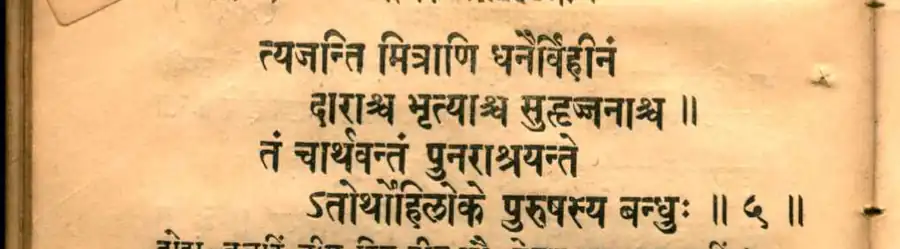
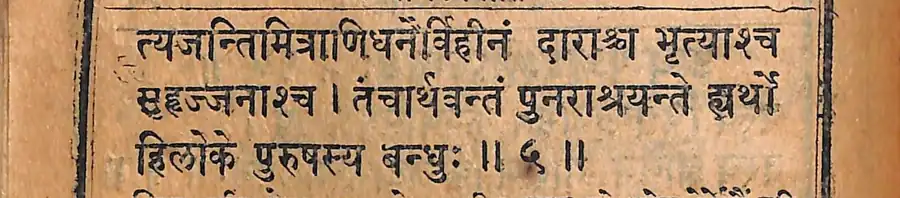
5 त्यजन्ति मित्राणि धनैर्विहीनंदाराश्च भृत्याश्च सुहृज्जनाश्च ।ते चार्थवन्तं पुनराश्रयन्तेअर्थो हि लोके पुरुषस्य बन्धुः ॥ ५ ॥
Show original scansSternbach 1963, p. 87Bombay printing, 1925–26, p. 118Mathura printing, 1914, p. 88Tap a scan to enlarge it. Scans: Internet Archive (Digital Library of India; eGangotri, CC0).
6 अन्यायोपार्जितं द्रव्यं दश वर्षाणि तिष्ठति ।प्राप्ते चैकादशे वर्षे समूलं च विनश्यति ॥ ६ ॥
Show original scansSternbach 1963, p. 87Bombay printing, 1925–26, p. 118Mathura printing, 1914, p. 88Tap a scan to enlarge it. Scans: Internet Archive (Digital Library of India; eGangotri, CC0).
Show original scansSternbach 1963, p. 88Bombay printing, 1925–26, p. 118Mathura printing, 1914, p. 88Tap a scan to enlarge it. Scans: Internet Archive (Digital Library of India; eGangotri, CC0).
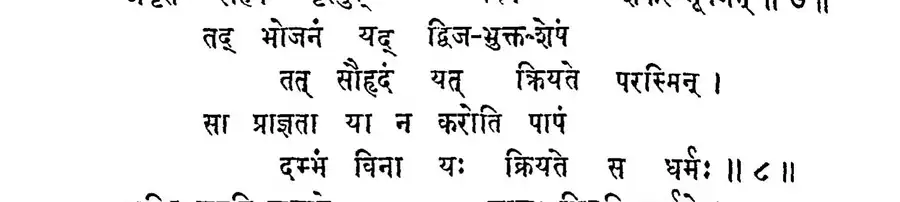
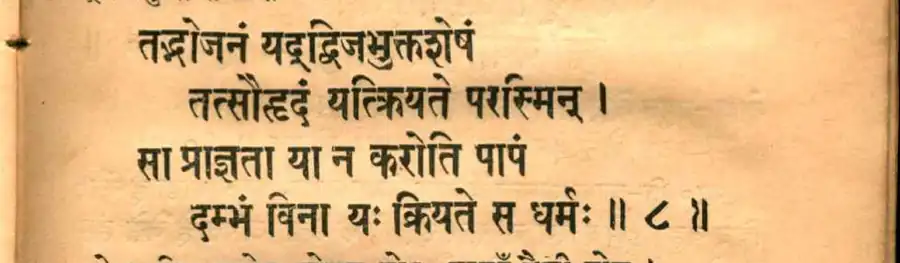
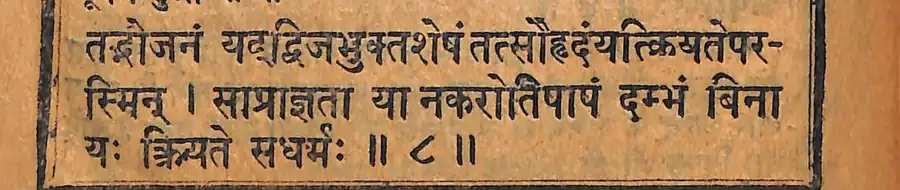
8 तद्भोजनं यद्द्विजभुक्तशेषंतत्सौहृदं यत्क्रियते परस्मिन् ।सा प्राज्ञता या न करोति पापंदम्भं विना यः क्रियते स धर्मः ॥ ८ ॥
Show original scansSternbach 1963, p. 88Bombay printing, 1925–26, p. 119Mathura printing, 1914, p. 88Tap a scan to enlarge it. Scans: Internet Archive (Digital Library of India; eGangotri, CC0).
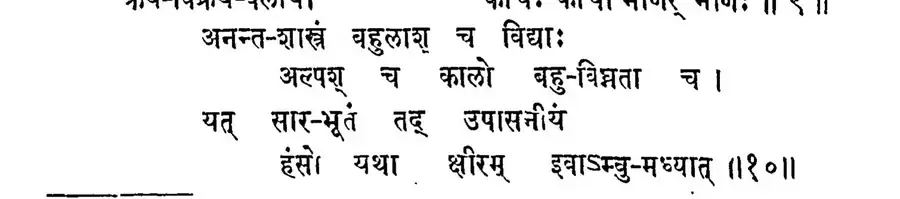
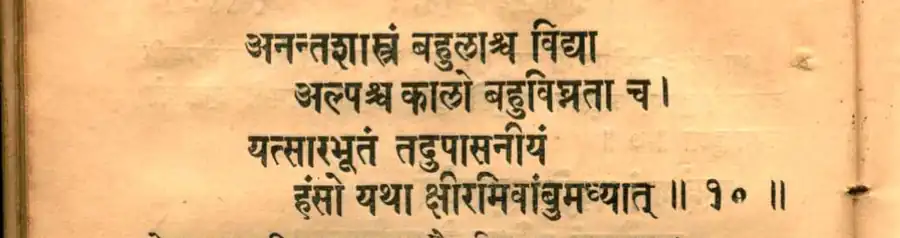
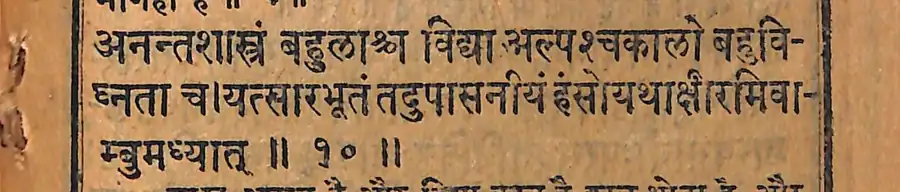
Show original scansSternbach 1963, p. 88Bombay printing, 1925–26, p. 119Mathura printing, 1914, p. 89Tap a scan to enlarge it. Scans: Internet Archive (Digital Library of India; eGangotri, CC0).
10 अनन्तशास्त्रं बहुलाश्च विद्याःअल्पश्च कालो बहुविघ्नता च ।यत्सारभूतं तदुपासनीयंहंसो यथा क्षीरमिवाम्बुमध्यात् ॥ १० ॥
Show original scansSternbach 1963, p. 88Bombay printing, 1925–26, p. 120Mathura printing, 1914, p. 89Tap a scan to enlarge it. Scans: Internet Archive (Digital Library of India; eGangotri, CC0).
11 दूरागतं पथि श्रान्तं वृथा च गृहमागतम् ।अनर्चयित्वा यो भुङ्क्ते स वै चाण्डाल उच्यते ॥ ११ ॥
Show original scansSternbach 1963, p. 89Bombay printing, 1925–26, p. 120Mathura printing, 1914, p. 89Tap a scan to enlarge it. Scans: Internet Archive (Digital Library of India; eGangotri, CC0).
13 धन्या द्विजमयी नौका विपरीता भवार्णवे ।तरन्त्यधोगताः सर्वे उपरिस्थाः पतन्त्यधः ॥ १३ ॥
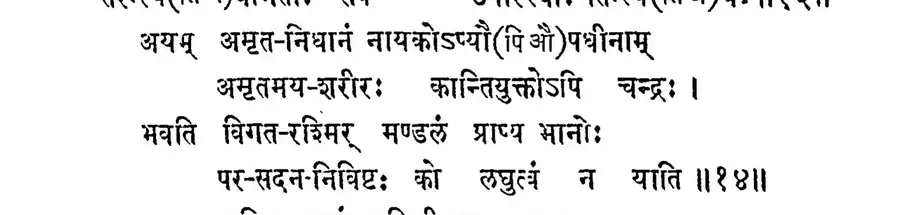
Show original scansSternbach 1963, p. 89Bombay printing, 1925–26, p. 121Mathura printing, 1914, p. 90Tap a scan to enlarge it. Scans: Internet Archive (Digital Library of India; eGangotri, CC0).
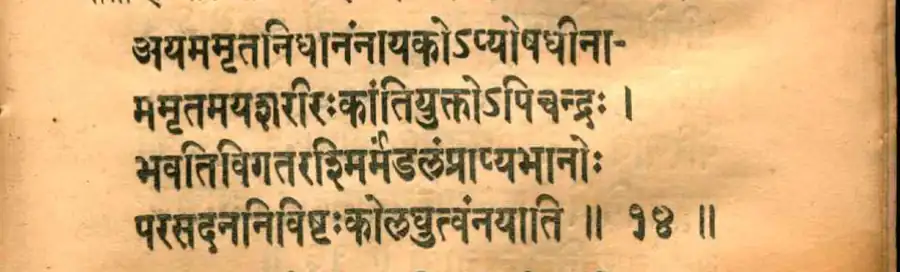
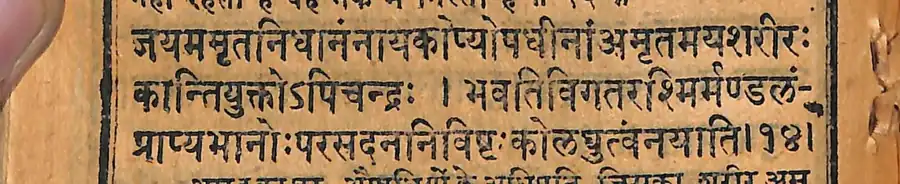
14 अयममृतनिधानं नायकोऽप्यौषधीनाम्अमृतमयशरीरः कान्तियुक्तोऽपि चन्द्रः ।भवति विगतरश्मिर्मण्डलं प्राप्य भानोःपरसदननिविष्टः को लघुत्वं न याति ॥ १४ ॥
Show original scansSternbach 1963, p. 89Bombay printing, 1925–26, p. 121Mathura printing, 1914, p. 90Tap a scan to enlarge it. Scans: Internet Archive (Digital Library of India; eGangotri, CC0).
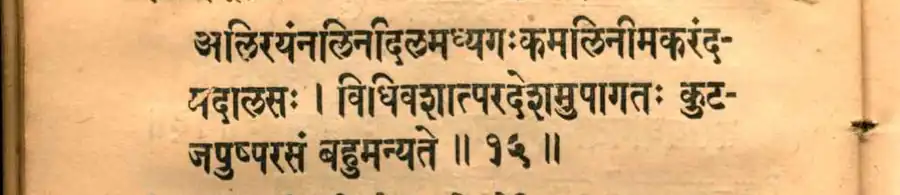
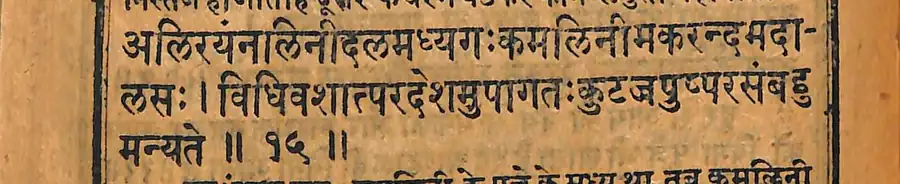
15 अलिरयं नलिनीदलमध्यगःकमलिनीमकरन्दमदालसः ।विधिवशात्परदेशमुपागतःकुटजपुष्परसं बहु मन्यते ॥ १५ ॥
Show original scansSternbach 1963, p. 89Bombay printing, 1925–26, p. 122Mathura printing, 1914, p. 90Tap a scan to enlarge it. Scans: Internet Archive (Digital Library of India; eGangotri, CC0).
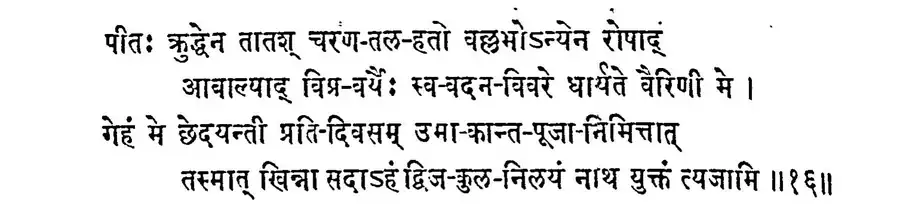
16 पीतः क्रुद्धेन तातश्चरणतलहतो वल्लभोऽन्येन रोषाद्आबाल्याद्विप्रवर्यैः स्ववदनविवरे धार्यते वैरिणी मे ।गेहं मे छेदयन्ती प्रतिदिवसमुमाकान्तपूजानिमित्तात्तस्मात्खिन्ना सदाहं द्विजकुलनिलयं नाथ युक्तं त्यजामि ॥ १६ ॥3printings differHere we follow the Bombay printing (1925–26)
Show original scansSternbach 1963, p. 90Bombay printing, 1925–26, p. 122Mathura printing, 1914, p. 91Tap a scan to enlarge it. Scans: Internet Archive (Digital Library of India; eGangotri, CC0).
Show original scansSternbach 1963, p. 90Bombay printing, 1925–26, p. 123Mathura printing, 1914, p. 91Tap a scan to enlarge it. Scans: Internet Archive (Digital Library of India; eGangotri, CC0).
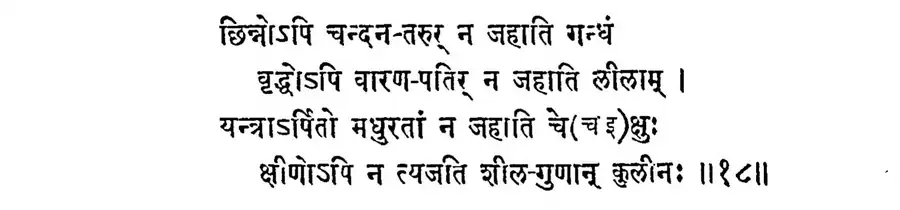
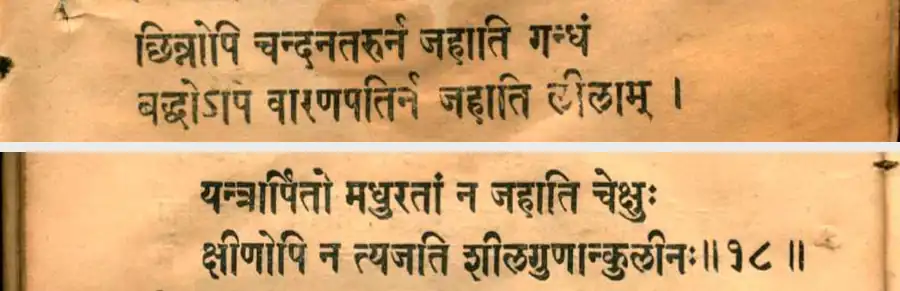
18 छिन्नोऽपि चन्दनतरुर्न जहाति गन्धंवृद्धोऽपि वारणपतिर्न जहाति लीलाम् ।यन्त्रार्पितो मधुरतां न जहाति चेक्षुःक्षीणोऽपि न त्यजति शीलगुणान्कुलीनः ॥ १८ ॥
Show original scansSternbach 1963, p. 90Bombay printing, 1925–26, pp. 123–124Mathura printing, 1914, p. 91Tap a scan to enlarge it. Scans: Internet Archive (Digital Library of India; eGangotri, CC0).
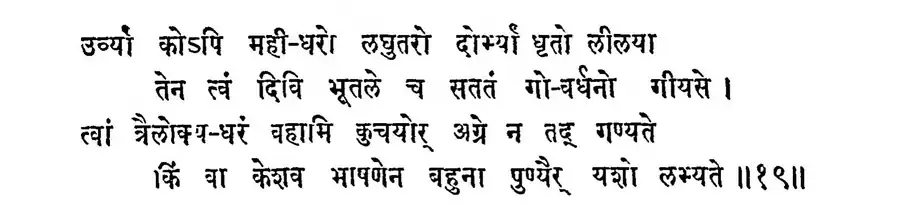
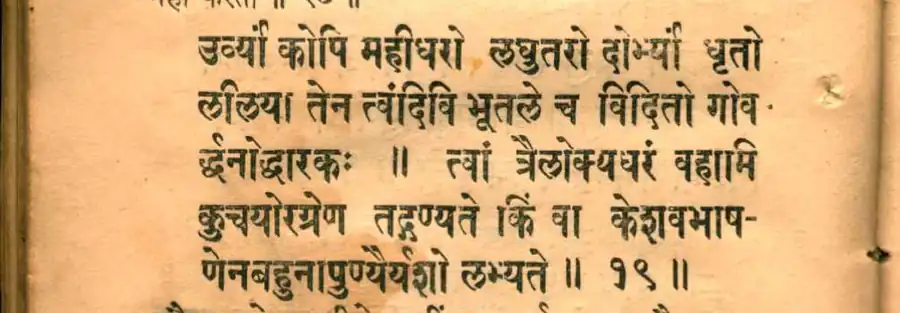
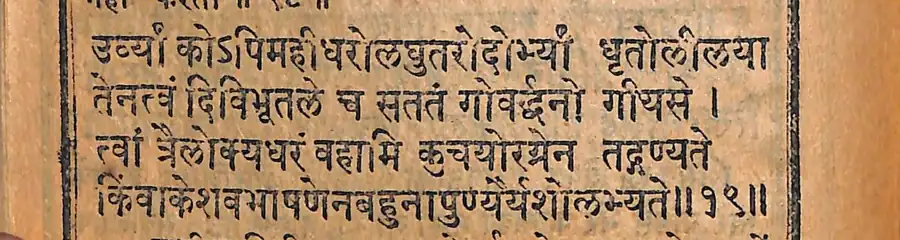
19 उर्व्यां कोऽपि महीधरो लघुतरो दोर्भ्यां धृतो लीलयातेन त्वं दिवि भूतले च सततं गोवर्धनो गीयसे ।त्वां त्रैलोक्यधरं वहामि कुचयोरग्रे न तद्गण्यतेकिं वा केशव भाषणेन बहुना पुण्यैर्यशो लभ्यते ॥ १९ ॥4printings differ
Show original scansSternbach 1963, p. 91Bombay printing, 1925–26, p. 124Mathura printing, 1914, p. 92Tap a scan to enlarge it. Scans: Internet Archive (Digital Library of India; eGangotri, CC0).
Notes
Bombay printing of 1925: खलानांकण्टकानां च द्विविधैव प्रतिक्रिया ॥ / उपानन्मुखभंगोवा दूरतो वा विसर्जनम् ॥ ३ ॥. Mathura printing of 1914: खलानांकण्टकानां च द्विविधैवप्रतिक्रिया । / उपानहास्यभंगोवा दूरतोवाविसर्जनम् ॥ ३ ॥. Both printings give “sending them away” for “avoiding them” at a distance. In the other remedy the 1914 printing also uses another word for “face” in “smashing the face with a shoe.” The two remedies concern both wicked people and thorns.↩
Bombay printing of 1925: कुचैलिनं दन्तमलोपधारिणं / बह्वाशिनं निष्ठुरभाषिणं च ॥ / सूर्योदये चास्तमितेशयानं / विमुञ्चति श्रीर्यदि चक्रपाणिः ॥ ४ ॥. The Mathura printing of 1914 has the same words. Both printings describe someone “carrying dirt on his teeth” where this text says “afflicted with dirt on his teeth.” In either case the person has dirty teeth.↩
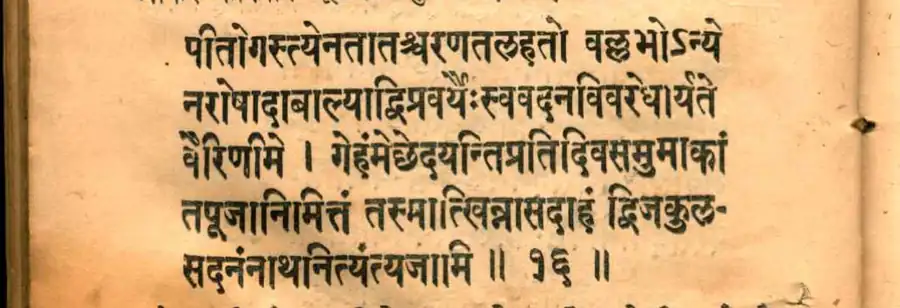
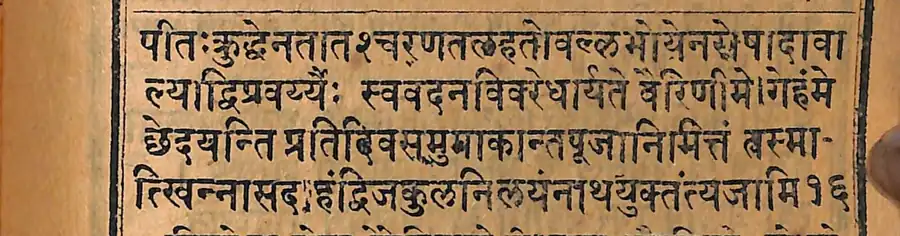
Bombay printing of 1925: पीतोगस्त्येनतातश्चरणतलहतो वल्लभोऽन्ये / नरोषादाबाल्याद्विप्रवर्यैःस्ववदनविवरेधार्यते / वैरिणीमे । गेहंमेछेदयन्तिप्रतिदिवसमुमाकां / तपूजानिमित्तं तस्मात्खिन्नासदाहं द्विजकुल- / सदनंनाथनित्यंत्यजामि ॥ १६ ॥. Mathura printing of 1914: पीतःक्रुद्धेनतातश्चरणतलहतोवल्लभोयेनरोषादावा / ल्याद्विप्रवर्य्यैः स्ववदनविवरेधार्यते वैरिणीमे।गेहंमे / छेदयन्ति प्रतिदिवसमुमाकान्तपूजानिमित्तं तस्मा- / त्खिन्नासदाऽहंद्विजकुलनिलयंनाथयुक्तंत्यजामि१६. Both printings change “she cutting my home” to “they cut my home” and rephrase “for worship.” The 1925 printing names “Agastya” for “an angry man,” uses another word for “house,” and gives “always” for “rightly.” The 1914 printing says the beloved was kicked “by whom” for “by another.”↩
Bombay printing of 1925: उर्व्यां कोपि महीधरो लघुतरो दोर्भ्यां धृतो / लीलया तेन त्वंदिवि भूतले च विदितो गोव / र्द्धनोद्धारकः ॥ त्वां त्रैलोक्यधरं वहामि / कुचयोरग्रेण तद्गण्यते किं वा केशवभाष- / णेनबहुनापुण्यैर्यशो लभ्यते ॥ १९ ॥. Mathura printing of 1914: उर्व्यां कोऽपिमहीधरोलघुतरोदोर्भ्यां धृतोलीलया / तेनत्वं दिविभूतले च सततं गोवर्द्धनो गीयसे । / त्वां त्रैलोक्यधरं वहामि कुचयोरग्रेन तद्गण्यते / किंवाकेशवभाषणेनबहुनापुण्यैर्यशोलभ्यते॥१९॥. The 1925 printing gives “known as the lifter of Govardhana” for “always sung of as Govardhana.” For “on the tips of my breasts, and that goes uncounted,” it reads “with the tips of my breasts, and that is counted.” The 1914 printing has the same words as this text, running अग्रे न (“on the tips … not”) together as अग्रेन.↩
Where the printings differ
Where the three printings of the Sanskrit disagree in meaning: the words of each, a literal rendering, and the printed page.
Verse 16Here we follow the Bombay printing (1925–26)Bombay names Agastya instead of an angry man and says always instead of rightly, both older printings make the house-cutters plural, and Mathura replaces by another with by whom.Sternbach 1963 (our main text)पीतः क्रुद्धेन ; वल्लभोऽन्येन ; छेदयन्ती ; युक्तंpītaḥ kruddhena ; vallabho 'nyena ; chedayantī ; yuktaṃ“drunk by an angry one; beloved by another; she cutting; rightly”The whole verse in this printing: My father was drunk up by an angry man, my beloved was struck with the sole of a foot by another in rage, and from childhood the best Brahmins keep my rival in their mouths. She cuts up my home every day to worship Uma’s beloved, so, lord, ever distressed, I rightly leave the Brahmins’ abode.Bombay printing, 1925–26 (followed here)पीतोगस्त्येन ; वल्लभोऽन्येन ; छेदयन्ति ; नित्यंpīto 'gastyena ; vallabho 'nyena ; chedayanti ; nityaṃ“drunk by Agastya; beloved by another; they cut; always”The whole verse in this printing: My father was drunk up by Agastya, my beloved was struck with the sole of a foot by another in rage, and from childhood the best Brahmins keep my rival in their mouths. They cut up my home every day to worship Uma’s beloved, so, lord, ever distressed, I always leave the Brahmins’ abode.Mathura printing, 1914पीतःक्रुद्धेन ; वल्लभोयेन ; छेदयन्ति ; युक्तंpītaḥ kruddhena ; vallabho yena ; chedayanti ; yuktaṃ“drunk by an angry one; beloved by whom; they cut; rightly”The whole verse in this printing: My father was drunk up by an angry man, by whom my beloved was struck with the sole of a foot in rage, and from childhood the best Brahmins keep my rival in their mouths. They cut up my home every day to worship Uma’s beloved, so, lord, ever distressed, I rightly leave the Brahmins’ abode.Sternbach 1963, p. 90Bombay printing, 1925–26, p. 122Mathura printing, 1914, p. 91Tap a page to enlarge it. Scans: Internet Archive (Digital Library of India; eGangotri, CC0).↩
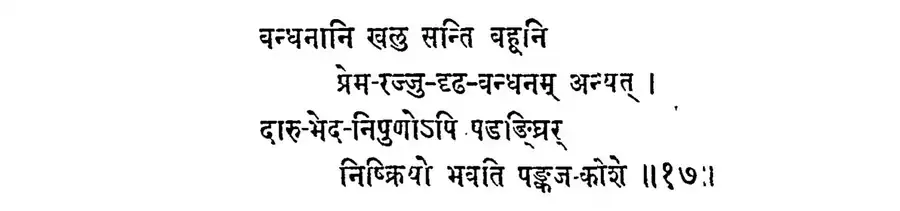
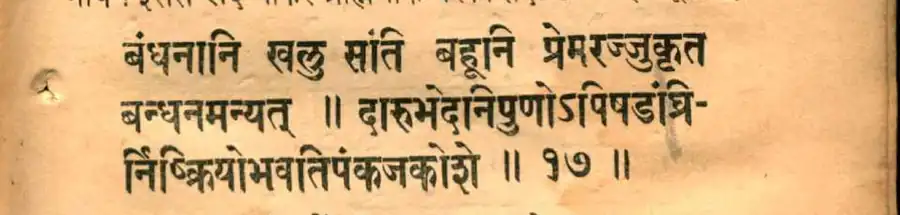
Verse 17Both older printings replace the firm bond of love's rope with the bond made by love's rope.Sternbach 1963 (our text)प्रेमरज्जुदृढबन्धनमन्यत्premarajjudṛḍhabandhanam anyat“the firm bond of love's rope is different”The whole verse in this printing: There are indeed many bonds, but the firm bond of love’s rope is different; even the six-legged bee, skilled at boring through wood, becomes inactive inside a lotus bud.Bombay printing, 1925–26प्रेमरज्जुकृत बन्धनमन्यत्premarajjukṛtabandhanam anyat“the bond made by love's rope is different”The whole verse in this printing: There are indeed many bonds, but the bond made by love’s rope is different; even the six-legged bee, skilled at boring through wood, becomes inactive inside a lotus bud.Mathura printing, 1914the same as the Bombay printingSternbach 1963, p. 90Bombay printing, 1925–26, p. 123Mathura printing, 1914, p. 91Tap a page to enlarge it. Scans: Internet Archive (Digital Library of India; eGangotri, CC0).↩
Verse 19Bombay says Krishna is known as the lifter of Govardhana instead of always being sung of as Govardhana, and its अग्रेण replaces अग्रे न, so "that is not counted" becomes "that is counted".Sternbach 1963 (our text)सततं गोवर्धनो गीयसेsatataṃ govardhano gīyase“you are always sung as Govardhana”The whole verse in this printing: You playfully held up some rather light mountain on earth with your two arms, and for that you are always sung of as Govardhana in heaven and on earth. I carry you, who bear the three worlds, on the tips of my breasts, but that is not counted; why say much, Keshava, when fame is gained through merit?Bombay printing, 1925–26विदितो गोवर्द्धनोद्धारकः ; कुचयोरग्रेणvidito govarddhanoddhārakaḥ ; kucayor agreṇa“known as the lifter of Govardhana; with the tips of the breasts”The whole verse in this printing: You playfully held up some rather light mountain on earth with your two arms, and for that you are known as the lifter of Govardhana in heaven and on earth. I carry you, who bear the three worlds, with the tips of my breasts, and that is counted (?); why say much, Keshava, when fame is gained through merit?Mathura printing, 1914the same as SternbachSternbach 1963, p. 91Bombay printing, 1925–26, p. 124Mathura printing, 1914, p. 92Tap a page to enlarge it. Scans: Internet Archive (Digital Library of India; eGangotri, CC0).↩
Sanskrit text, ed. Ludwik Sternbach (1963). Internet Archive scans of Sternbach's edition (Digital Library of India) and of the 1925 and 1914 printings (archive.org, archive.org, archive.org). The ancient verses are in the public domain; the editor's notes and apparatus are not reproduced.