Sanskrit text, ed. Ludwik Sternbach (1963) · 1 min read
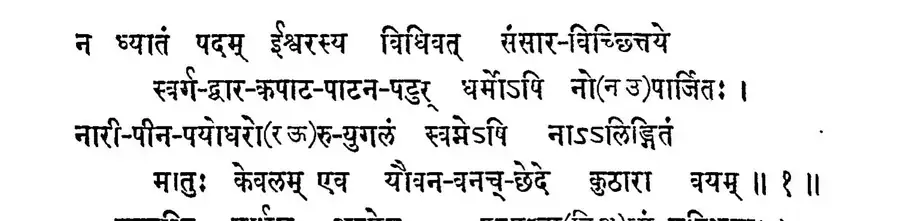
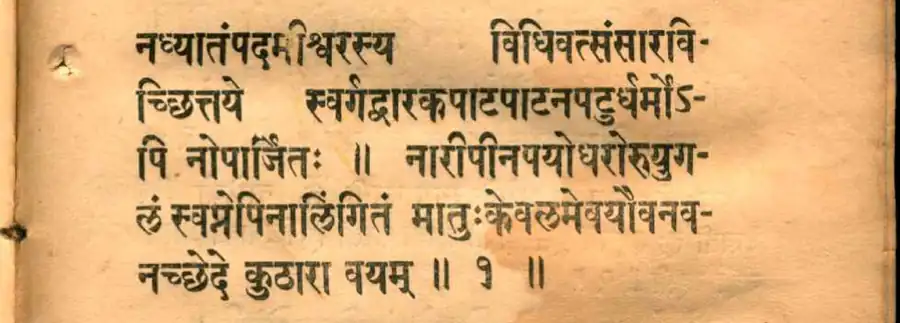
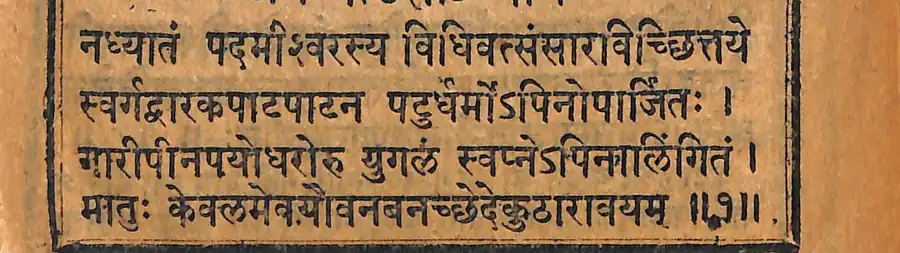
1 न ध्यातं पदमीश्वरस्य विधिवत्संसारविच्छित्तयेस्वर्गद्वारकपाटपाटनपटुर्धर्मोऽपि नोपार्जितः ।नारीपीनपयोधरोरुयुगलं स्वप्नेऽपि नालिङ्गितंमातुः केवलमेव यौवनवनच्छेदे कुठारा वयम् ॥ १ ॥
Show original scansSternbach 1963, p. 92Bombay printing, 1925–26, p. 125Mathura printing, 1914, p. 92Tap a scan to enlarge it. Scans: Internet Archive (Digital Library of India; eGangotri, CC0).
2 जल्पन्ति सार्धमन्येन पश्यन्त्यन्यं सविभ्रमाः ।हृदये चिन्तयन्त्यन्यं न स्त्रीणामेकतो रतिः ॥ २ ॥
Show original scansSternbach 1963, p. 92Bombay printing, 1925–26, p. 126Mathura printing, 1914, p. 93Tap a scan to enlarge it. Scans: Internet Archive (Digital Library of India; eGangotri, CC0).
3 यो मोहान्मन्यते मूढो रक्तेयं मयि कामिनी ।स तस्या वशगो भूत्वा नृत्येत्क्रीडाशकुन्तवत् ॥ ३ ॥
Show original scansSternbach 1963, p. 93Bombay printing, 1925–26, p. 126Mathura printing, 1914, p. 93Tap a scan to enlarge it. Scans: Internet Archive (Digital Library of India; eGangotri, CC0).
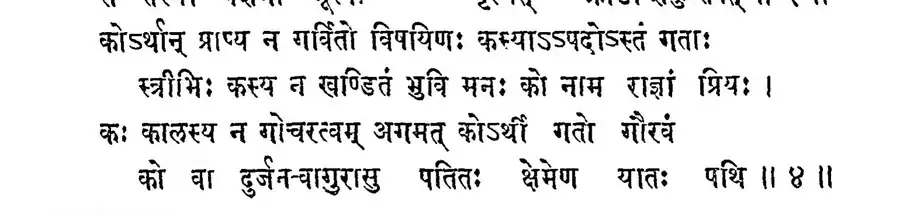
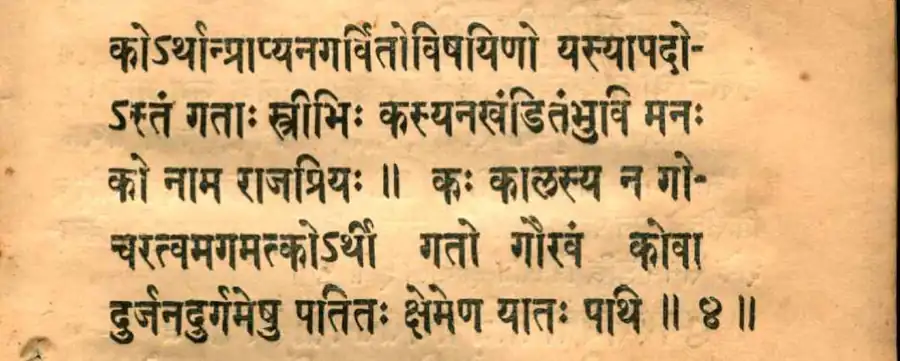
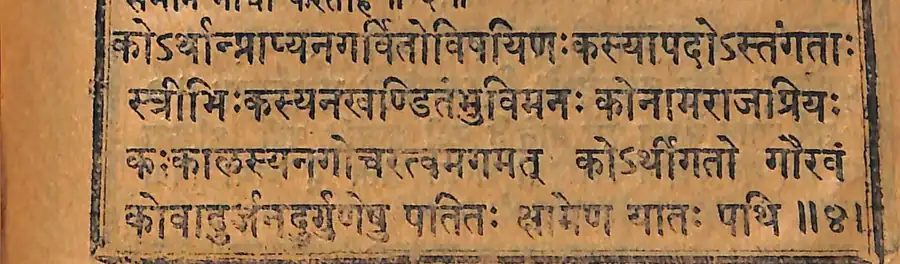
4 कोऽर्थान्प्राप्य न गर्वितो विषयिणः कस्यापदोऽस्तं गताःस्त्रीभिः कस्य न खण्डितं भुवि मनः को नाम राज्ञां प्रियः ।कः कालस्य न गोचरत्वमगमत्कोऽर्थी गतो गौरवंको वा दुर्जनवागुरासु पतितः क्षेमेण यातः पथि ॥ ४ ॥1printings differ
Show original scansSternbach 1963, p. 93Bombay printing, 1925–26, p. 127Mathura printing, 1914, p. 93Tap a scan to enlarge it. Scans: Internet Archive (Digital Library of India; eGangotri, CC0).
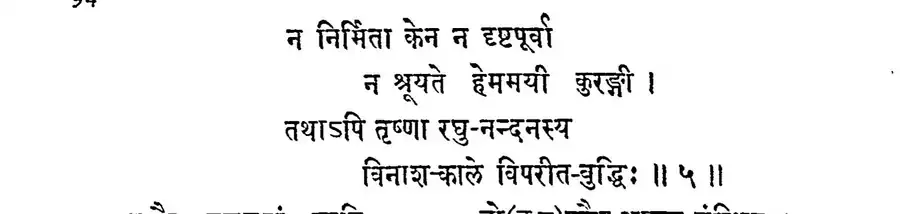
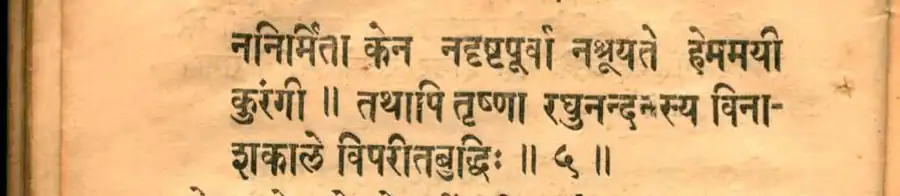
5 न निर्मिता केन न दृष्टपूर्वान श्रूयते हेममयी कुरङ्गी ।तथापि तृष्णा रघुनन्दनस्यविनाशकाले विपरीतबुद्धिः ॥ ५ ॥
Show original scansSternbach 1963, p. 94Bombay printing, 1925–26, p. 128Mathura printing, 1914, p. 94Tap a scan to enlarge it. Scans: Internet Archive (Digital Library of India; eGangotri, CC0).
7 गुणाः सर्वत्र पूज्यन्ते न महत्योऽपि संपदः ।पूर्णेन्दुः किं तथा वन्द्यो निष्कलङ्को यथा कृशः ॥ ७ ॥
Show original scansSternbach 1963, p. 94Bombay printing, 1925–26, p. 128Mathura printing, 1914, p. 94Tap a scan to enlarge it. Scans: Internet Archive (Digital Library of India; eGangotri, CC0).
8 परप्रोक्तगुणो यस्तु निर्गुणोऽपि गुणी भवेत् ।इन्द्रोऽपि लघुतां याति स्वयं प्रख्यापितैर्गुणैः ॥ ८ ॥2
Show original scansSternbach 1963, p. 94Bombay printing, 1925–26, p. 129Mathura printing, 1914, p. 95Tap a scan to enlarge it. Scans: Internet Archive (Digital Library of India; eGangotri, CC0).
Show original scansSternbach 1963, p. 95Bombay printing, 1925–26, p. 129Mathura printing, 1914, p. 95Tap a scan to enlarge it. Scans: Internet Archive (Digital Library of India; eGangotri, CC0).
Show original scansSternbach 1963, p. 95Bombay printing, 1925–26, p. 130Mathura printing, 1914, p. 95Tap a scan to enlarge it. Scans: Internet Archive (Digital Library of India; eGangotri, CC0).
11 अतिक्लेशेन ये ह्यर्था धर्मस्यातिक्रमेण तु ।शत्रूणां प्रणिपातेन ते अर्था मा भवन्तु मे ॥ ११ ॥
Show original scansSternbach 1963, p. 95Bombay printing, 1925–26, p. 130Mathura printing, 1914, p. 95Tap a scan to enlarge it. Scans: Internet Archive (Digital Library of India; eGangotri, CC0).
12 किं तया क्रियते लक्ष्म्या या वधूरिव केवला ।या तु वेश्येव सामान्या पथिकैरपि भुज्यते ॥ १२ ॥printings differ
Show original scansSternbach 1963, p. 96Bombay printing, 1925–26, p. 130Mathura printing, 1914, p. 95Tap a scan to enlarge it. Scans: Internet Archive (Digital Library of India; eGangotri, CC0).
13 धनेषु जीवितव्येषु स्त्रीषु चाहारकर्मसु ।अतृप्ताः प्राणिनः सर्वे याता यास्यन्ति यान्ति च ॥ १३ ॥
Show original scansSternbach 1963, p. 96Bombay printing, 1925–26, p. 131Mathura printing, 1914, p. 96Tap a scan to enlarge it. Scans: Internet Archive (Digital Library of India; eGangotri, CC0).
15 तृणं लघु तृणात्तूलं तूलातपि च याचकः ।वायुना किं न नीतोऽसौ मामयं याचयिष्यति ॥ १५ ॥
Show original scansSternbach 1963, p. 96Bombay printing, 1925–26, p. 131Mathura printing, 1914, p. 96Tap a scan to enlarge it. Scans: Internet Archive (Digital Library of India; eGangotri, CC0).
Show original scansSternbach 1963, p. 96Bombay printing, 1925–26, p. 132Mathura printing, 1914, p. 96Tap a scan to enlarge it. Scans: Internet Archive (Digital Library of India; eGangotri, CC0).
Show original scansSternbach 1963, p. 97Bombay printing, 1925–26, p. 132Mathura printing, 1914, p. 97Tap a scan to enlarge it. Scans: Internet Archive (Digital Library of India; eGangotri, CC0).
18 संसारकटुवृक्षस्य द्वे फले अमृतोपमे ।सुभाषितं च सुस्वादु संगतिः सुजने जने ॥ १८ ॥3printings differ
Show original scansSternbach 1963, p. 97Bombay printing, 1925–26, p. 133Mathura printing, 1914, p. 97Tap a scan to enlarge it. Scans: Internet Archive (Digital Library of India; eGangotri, CC0).
19 जन्मजन्मन्यभ्यस्तं यद्दानमध्ययनं तपः ।तेनैवाभ्यासयोगेन तदेवाभ्यस्यते पुनः ॥ १९ ॥4printings differ
Show original scansSternbach 1963, p. 97Bombay printing, 1925–26, p. 133Mathura printing, 1914, p. 97Tap a scan to enlarge it. Scans: Internet Archive (Digital Library of India; eGangotri, CC0).
20 पुस्तकेषु च या विद्या परहस्तेषु यद्धनम् ।उत्पन्नेषु च कार्येषु न सा विद्या न तद्धनम् ॥ २० ॥
Show original scansSternbach 1963, p. 98Bombay printing, 1925–26, p. 133Mathura printing, 1914, p. 97Tap a scan to enlarge it. Scans: Internet Archive (Digital Library of India; eGangotri, CC0).
Notes
Bombay printing of 1925: कोऽर्थान्प्राप्यनगर्वितोविषयिणो यस्यापदो- / ऽस्तं गताः स्त्रीभिः कस्यनखंडितंभुवि मनः / को नाम राजप्रियः ॥ कः कालस्य न गो- / चरत्वमगमत्कोऽर्थी गतो गौरवं कोवा / दुर्जनदुर्गमेषु पतितः क्षेमेण यातः पथि ॥ ४ ॥. Mathura printing of 1914: कोऽर्थान्प्राप्यनगर्वितोविषयिणःकस्यापदोऽस्तंगताः / स्त्रीभिःकस्यनखण्डितंभुविमनः कोनामराजप्रियः / कःकालस्यनगोचरत्वमगमत् कोऽर्थीगतो गौरवं / कोवादुर्जनदुर्गुणेषु पतितः क्षेमेण यातः पथि ॥४।. Both printings give “a royal favourite” for “dear to kings.” For “the snares of the wicked,” the 1925 printing has “the hard-to-cross places of the wicked,” the 1914 printing “the vices of the wicked.” The 1925 printing also makes “whose troubles have ended” a description of the pleasure-seeker instead of a question.↩
Bombay printing of 1925: परस्तुतगुणैर्यस्तुनिर्गुणोपिगुणीभवेत् ॥ / इंद्रोऽपिलघुतांयातिस्वयंप्रख्यापितैर्गुणैः ॥ ८ ॥. Mathura printing of 1914: परमोक्तगुणो यस्तु निर्गुणोपि गुणोभवेत् । / इन्द्रोपि लघुतां याति स्वयं प्रख्यापितैर्गुणैः॥८॥. For “one whose virtues others mention,” the 1925 printing says “through virtues others praise.” The 1914 printing’s opening may mean “whose virtues the highest proclaims,” but the wording is unclear. It says someone without virtue “would become a virtue” where this text says he “would be considered virtuous.”↩
The Bombay printing of 1925 has the same words as this text. Mathura printing of 1914: संसारकूटवृक्षस्य द्वेफलेत्वमृतोपमे । / सुभाषितंचसुस्वादु संगतिःसज्जनेजने ॥ १८ ॥. The 1914 printing calls worldly existence a “poison tree” where this text calls it a “bitter tree.” It adds “yet” before “like nectar” and uses another word for the “good person” whose company is one of the two fruits.↩
Bombay printing of 1925: बहुजन्मसुचाभ्यस्तंदानमध्ययनंतपः ॥ / तेनैवाभ्यासयोगेनदेहमभ्यस्यतेपुनः ॥ १९॥. Mathura printing of 1914: जन्मजन्मयदभ्यस्तं दानमध्ययनंतपः । / तेनैवाभ्यासयोगेन देहीचाभ्यस्यतेपुनः ॥ १९ ॥. The 1925 printing has “and in many births” for “in birth after birth” and drops “what.” The 1914 printing rephrases “what was practised birth after birth.” For “that very thing is practised again,” the 1925 printing has “the body,” the 1914 printing “and the embodied person.” Both endings are awkward.↩
Where the printings differ
Where the three printings of the Sanskrit disagree in meaning: the words of each, a literal rendering, and the printed page.
Verse 4The wicked people's snares become their difficult terrain in Bombay and their vices in Mathura.Sternbach 1963 (our text)दुर्जनवागुरासुdurjanavāgurāsu“in wicked people's snares”The whole verse in this printing: Who has gained wealth without growing proud; which pleasure seeker’s troubles have come to an end; whose heart on earth has not been broken by women; who is dear to kings? Who has not come within Death’s reach; what beggar has gained respect; who, having fallen into wicked people’s snares, has gone safely along his way?Bombay printing, 1925–26दुर्जनदुर्गमेषुdurjanadurgameṣu“in wicked people's difficult places”The whole verse in this printing: Who has gained wealth without growing proud—a pleasure seeker whose (?) troubles have come to an end; whose heart on earth has not been broken by women; who is dear to a king? Who has not come within Death’s reach; what beggar has gained respect; who, having fallen into wicked people’s difficult terrain, has gone safely along his way?Mathura printing, 1914दुर्जनदुर्गुणेषुdurjanadurguṇeṣu“in wicked people's vices”The whole verse in this printing: Who has gained wealth without growing proud; which pleasure seeker’s troubles have come to an end; whose heart on earth has not been broken by women; who is dear to a king? Who has not come within Death’s reach; what beggar has gained respect; who, having fallen into wicked people’s vices, has gone safely along his way?Sternbach 1963, p. 93Bombay printing, 1925–26, p. 127Mathura printing, 1914, p. 93Tap a page to enlarge it. Scans: Internet Archive (Digital Library of India; eGangotri, CC0).↩
Verse 12Bombay says publicly available wealth is honoured by travellers instead of enjoyed by them.Sternbach 1963 (our text)भुज्यतेbhujyate“is enjoyed”The whole verse in this printing: What use is wealth that is exclusive like a wife? Wealth that is shared like a prostitute is enjoyed even by travellers.Bombay printing, 1925–26पूज्यतेpūjyate“is honoured”The whole verse in this printing: What use is wealth that is exclusive like a wife? Wealth that is shared like a prostitute is honoured even by travellers.Mathura printing, 1914the same as SternbachSternbach 1963, p. 96Bombay printing, 1925–26, p. 130Mathura printing, 1914, p. 95Tap a page to enlarge it. Scans: Internet Archive (Digital Library of India; eGangotri, CC0).↩
Verse 18Mathura describes worldly existence as a deceptive tree instead of a bitter tree.Sternbach 1963 (our text)संसारकटुवृक्षस्यsaṃsārakaṭuvṛkṣasya“of the bitter tree of worldly existence”The whole verse in this printing: The bitter tree of worldly existence has two fruits like nectar: sweet, well-spoken words and the company of good people.Bombay printing, 1925–26the same as SternbachMathura printing, 1914संसारकूटवृक्षस्यsaṃsārakūṭavṛkṣasya“of the deceptive tree of worldly existence”The whole verse in this printing: The deceptive tree of worldly existence has two fruits like nectar: sweet, well-spoken words and the company of good people.Sternbach 1963, p. 97Bombay printing, 1925–26, p. 133Mathura printing, 1914, p. 97Tap a page to enlarge it. Scans: Internet Archive (Digital Library of India; eGangotri, CC0).↩
Verse 19Bombay changes successive births to many births and replaces repeated practices with the body, while Mathura substitutes the embodied person in an irregular construction.Sternbach 1963 (our text)जन्मजन्मन्यभ्यस्तं ; तदेवाभ्यस्यते पुनःjanmajanmany abhyastaṃ ; tad evābhyasyate punaḥ“practised in birth after birth; that very thing is practised again”The whole verse in this printing: The giving, study, and austerity practised in birth after birth are practised again through the force of that same habit.Bombay printing, 1925–26बहुजन्मसुचाभ्यस्तं ; देहमभ्यस्यतेपुनःbahujanmasu cābhyastaṃ ; deham abhyasyate punaḥ“and practised in many births; the body is practised again (grammatically irregular)”The whole verse in this printing: Giving, study, and austerity have been practised over many births; through the force of that same habit, the body is practised (?) again.Mathura printing, 1914जन्मजन्मयदभ्यस्तं ; देही चाभ्यस्यतेपुनःjanmajanma yad abhyastaṃ ; dehī cābhyasyate punaḥ“what was practised birth after birth; and the embodied person is practised again (grammatically irregular)”The whole verse in this printing: Whatever giving, study, and austerity have been practised in birth after birth—through the force of that same habit, the embodied person is practised (?) again.Sternbach 1963, p. 97Bombay printing, 1925–26, p. 133Mathura printing, 1914, p. 97Tap a page to enlarge it. Scans: Internet Archive (Digital Library of India; eGangotri, CC0).↩
Sanskrit text, ed. Ludwik Sternbach (1963). Internet Archive scans of Sternbach's edition (Digital Library of India) and of the 1925 and 1914 printings (archive.org, archive.org, archive.org). The ancient verses are in the public domain; the editor's notes and apparatus are not reproduced.