Show original scansSternbach 1963, p. 28Bombay printing, 1925–26, p. 30Mathura printing, 1914, p. 25Tap a scan to enlarge it. Scans: Internet Archive (Digital Library of India; eGangotri, CC0).
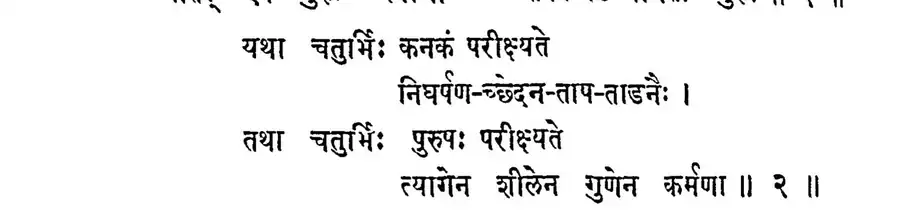
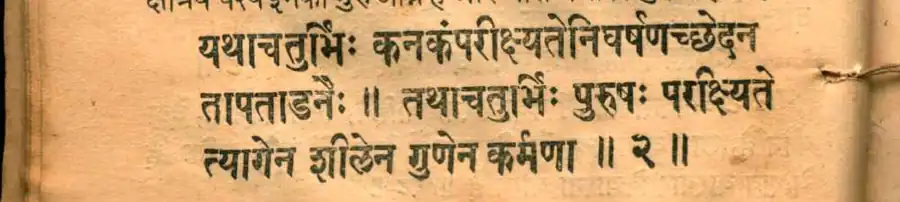
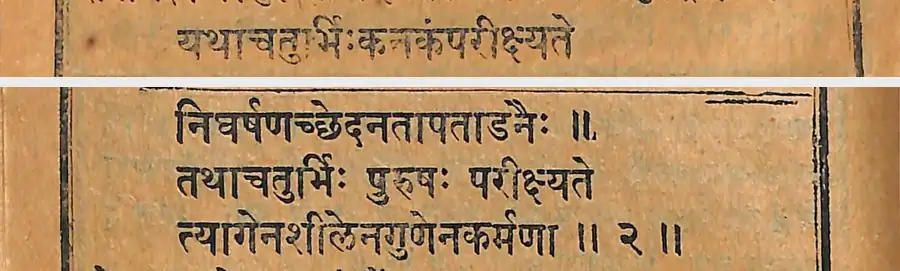
Show original scansSternbach 1963, p. 28Bombay printing, 1925–26, p. 30Mathura printing, 1914, pp. 25–26Tap a scan to enlarge it. Scans: Internet Archive (Digital Library of India; eGangotri, CC0).
Show original scansSternbach 1963, p. 29Bombay printing, 1925–26, p. 31Mathura printing, 1914, p. 26Tap a scan to enlarge it. Scans: Internet Archive (Digital Library of India; eGangotri, CC0).
5 निःस्पृहो नाधिकारी स्यान्नाकामी मण्डनप्रियः ।नाविदग्धः प्रियं ब्रूयात्स्फुटवक्ता न वञ्चकः ॥ ५ ॥3
Show original scansSternbach 1963, p. 29Bombay printing, 1925–26, p. 31Mathura printing, 1914, p. 26Tap a scan to enlarge it. Scans: Internet Archive (Digital Library of India; eGangotri, CC0).
6 मूर्खाणां पण्डिता द्वेष्या अधनानां महाधनाः ।वाराङ्गनाः कुलस्त्रीणां सुभगानां च दुर्भगाः ॥ ६ ॥4printings differ
Show original scansSternbach 1963, p. 30Bombay printing, 1925–26, p. 32Mathura printing, 1914, p. 27Tap a scan to enlarge it. Scans: Internet Archive (Digital Library of India; eGangotri, CC0).
Show original scansSternbach 1963, p. 30Bombay printing, 1925–26, p. 33Mathura printing, 1914, p. 27Tap a scan to enlarge it. Scans: Internet Archive (Digital Library of India; eGangotri, CC0).
Show original scansSternbach 1963, p. 30Bombay printing, 1925–26, p. 33Mathura printing, 1914, pp. 27–28Tap a scan to enlarge it. Scans: Internet Archive (Digital Library of India; eGangotri, CC0).
Show original scansSternbach 1963, p. 31Bombay printing, 1925–26, p. 33Mathura printing, 1914, p. 28Tap a scan to enlarge it. Scans: Internet Archive (Digital Library of India; eGangotri, CC0).
11 दारिद्र्यनाशनं दानं शीलं दुर्गतिनाशनम्अज्ञाननाशिनी प्रज्ञा भावना भयनाशिनी ॥ ११ ॥
Show original scansSternbach 1963, p. 31Bombay printing, 1925–26, p. 34Mathura printing, 1914, p. 102Tap a scan to enlarge it. Scans: Internet Archive (Digital Library of India; eGangotri, CC0).
Show original scansSternbach 1963, p. 31Bombay printing, 1925–26, p. 34Mathura printing, 1914, p. 28Tap a scan to enlarge it. Scans: Internet Archive (Digital Library of India; eGangotri, CC0).
13 जन्ममृत्यू हि यात्येको भुनक्त्येकः शुभाशुभम् ।नरकेषु पतत्येक एको याति परां गतिम् ॥ १३ ॥
Show original scansSternbach 1963, p. 31Bombay printing, 1925–26, p. 34Mathura printing, 1914, p. 29Tap a scan to enlarge it. Scans: Internet Archive (Digital Library of India; eGangotri, CC0).
Show original scansSternbach 1963, p. 32Bombay printing, 1925–26, p. 35Mathura printing, 1914, p. 29Tap a scan to enlarge it. Scans: Internet Archive (Digital Library of India; eGangotri, CC0).
15 विद्या मित्रं प्रवासेषु भार्या मित्रं गृहेषु च ।व्याधितस्यौषधं मित्रं धर्मो मित्रं मृतस्य च ॥ १५ ॥8
Show original scansSternbach 1963, p. 32Bombay printing, 1925–26, p. 35Mathura printing, 1914, p. 29Tap a scan to enlarge it. Scans: Internet Archive (Digital Library of India; eGangotri, CC0).
16 वृथा वृष्टिः समुद्रेषु वृथा तृप्तेषु भोजनम् ।वृथा दानं धनाढ्येषु वृथा दीपो दिवापि च ॥ १६ ॥
Show original scansSternbach 1963, p. 32Bombay printing, 1925–26, p. 36Mathura printing, 1914, p. 29Tap a scan to enlarge it. Scans: Internet Archive (Digital Library of India; eGangotri, CC0).
Show original scansSternbach 1963, p. 33Bombay printing, 1925–26, p. 36Mathura printing, 1914, p. 30Tap a scan to enlarge it. Scans: Internet Archive (Digital Library of India; eGangotri, CC0).
19 सत्येन धार्यते पृथ्वी सत्येन तपते रविः ।सत्येन वाति वायुश्च सर्वं सत्ये प्रतिष्ठितम् ॥ १९ ॥
Show original scansSternbach 1963, p. 33Bombay printing, 1925–26, p. 37Mathura printing, 1914, p. 30Tap a scan to enlarge it. Scans: Internet Archive (Digital Library of India; eGangotri, CC0).
20 चला लक्ष्मीश्चलाः प्राणाश्चलं जीवितयौवनम् ।चलाचले च संसारे धर्म एको हि निश्चलः ॥ २० ॥9printings differ
Show original scansSternbach 1963, p. 33Bombay printing, 1925–26, p. 37Mathura printing, 1914, p. 30Tap a scan to enlarge it. Scans: Internet Archive (Digital Library of India; eGangotri, CC0).
21 नराणां नापितो धूर्तः पक्षिणां चैव वायसः ।चतुष्पदां शृगालस्तु स्त्रीणां धूर्ता च मालिनी ॥ २१ ॥
Show original scansSternbach 1963, p. 34Bombay printing, 1925–26, p. 37Mathura printing, 1914, p. 31Tap a scan to enlarge it. Scans: Internet Archive (Digital Library of India; eGangotri, CC0).
Notes
In both the Bombay printing of 1925 and the Mathura printing of 1914 the two lines of this verse come in the opposite order, starting with पतिरेव गुरुः स्त्रीणां; the words are the same.↩
The Bombay printing of 1925 has the same words as this text. Mathura printing of 1914: तावद्भयेषुभेतव्यं यावद्भयमनागतम् । / आगतंतुभयंवीक्ष्य प्रहर्तव्यमशंकया ॥ ३ ॥. The 1914 printing uses another word for “seeing” the danger once it has come. The advice is the same.↩
Bombay printing of 1925: निःस्पृहोनाधिकारीस्यान्नाकामीमंडनप्रियः ॥ / नाविदग्धःप्रियं ब्रूयात्स्पष्टवक्तानवंचकः ॥ ५ ॥. Mathura printing of 1914: निस्पृहोनाधिकारीस्यान्नाकामोमण्डनप्रियः । / नाविदग्धः प्रियंब्रूयात् स्पष्टवक्तानवञ्चकः ॥५॥. Both printings use another word for “plain-speaking.” The 1914 printing also uses another form of “free of desire” in the remark about liking ornaments. The sense is the same.↩
Bombay printing of 1925: मूर्खाणांपंडिताद्वेष्याअधनानांमहाधनाः ॥ / दुर्भगाणांचसुभगाः कुलटानांकुलांगनाः ॥ ६ ॥. Mathura printing of 1914: मूर्खाणांपण्डिता द्वेष्या अधनानांमहाधनाः । / परांगनाः कुलस्त्रीणां सुभगानांचदुर्भगा ॥ ६ ॥. This text says respectable wives hate “courtesans” and favoured women hate the unlucky. The 1925 printing reverses both contrasts and their order. “The unlucky hate the favoured” comes before “unfaithful women hate respectable wives.” The 1914 printing has “other men’s wives” for “courtesans” and ends with “an unlucky woman.”↩
Bombay printing of 1925: आलस्योपहताविद्यापरहस्तगतंधनम् ॥ / अल्पबीजंहतंक्षेत्रंहतंसैन्यमनायकम् ॥ ७ ॥. Mathura printing of 1914: आलस्योपगताविद्या परहस्तेगतधनम् । / अल्पबीजंहतंक्षेत्रं हतंसैन्यमनायकम् ॥ ७ ॥. Both printings give “money in someone else’s hands” for “women in someone else’s hands.” The 1914 printing also changes “learning ruined by laziness” to “learning overtaken by laziness.” Its wording for the money having passed into another hand is grammatically uneven.↩
Bombay printing of 1925: अभ्यासाद्धार्यतेविद्याकुलंशीलेनधार्यते ॥ / गुणेनज्ञायतेत्वार्यः कोपोनेत्रेणगम्यते ॥ ८ ॥. The Mathura printing of 1914 has the same words. This text says “virtues keep friends, and a look holds anger in check.” Both printings say “but a noble person is known by a good quality” and then “anger can be told from the eye.”↩
Bombay printing of 1925: अन्यथावेदपाण्डित्यंशास्त्रमाचारमन्यथा ॥ / अन्यथायद्वदच्छांतंलोकाःक्लिश्यन्तिचान्यथा १०. Mathura printing of 1914: अन्यथा वेद पाण्डित्यं शास्त्रमाचारमन्यथा । / अन्यथावदनाःशान्तंलोकाःक्लिश्यंतिचान्यथा१०. Where this text has “harsh speech” alongside “quiet,” the 1925 printing has words for “what” and “speaking.” The 1914 printing has a word related to “face” or “mouth.” Both keep “quiet.” How the words fit together is unclear in all three.↩
The Bombay printing of 1925 gives this verse twice, as its 5.15 and again as its 12.17.↩
Bombay printing of 1925: चलालक्ष्मीश्चलाःप्राणाश्चलेजीवितमंदिरे ॥ / चलाचलेचसंसारेधर्मएकोहिनिश्चलः ॥ २० ॥. The Mathura printing of 1914 has the same words. For “life and youth are fleeting,” both printings say “life and home are fleeting.” The word for “fleeting” changes form to agree with the pair.↩
Where the printings differ
Where the three printings of the Sanskrit disagree in meaning: the words of each, a literal rendering, and the printed page.
Verse 6Bombay reverses who hates whom in both final pairs and replaces courtesans with unchaste women, while Mathura substitutes other men's wives for courtesans.Sternbach 1963 (our text)वाराङ्गनाः कुलस्त्रीणां सुभगानां च दुर्भगाःvārāṅganāḥ kulastrīṇāṃ subhagānāṃ ca durbhagāḥ“courtesans to respectable wives, and the unfortunate to the fortunate”The whole verse in this printing: The learned are hated by fools, the very rich by the poor, courtesans by women of good families, and unfortunate women by fortunate women.Bombay printing, 1925–26दुर्भगाणांचसुभगाः कुलटानांकुलांगनाःdurbhagāṇāṃ ca subhagāḥ kulaṭānāṃ kulāṅganāḥ“and the fortunate to the unfortunate, respectable wives to unchaste women”The whole verse in this printing: The learned are hated by fools, the very rich by the poor, fortunate women by unfortunate women, and women of good families by unchaste women.Mathura printing, 1914परांगनाः कुलस्त्रीणां सुभगानांचदुर्भगाparāṅganāḥ kulastrīṇāṃ subhagānāṃ ca durbhagā“other men's wives to respectable wives, and the unfortunate to the fortunate”The whole verse in this printing: The learned are hated by fools, the very rich by the poor, other men’s wives by women of good families, and unfortunate women by fortunate women.Sternbach 1963, p. 30Bombay printing, 1925–26, p. 32Mathura printing, 1914, p. 27Tap a page to enlarge it. Scans: Internet Archive (Digital Library of India; eGangotri, CC0).↩
Verse 7Both older printings replace women in another's hands with wealth in another's hands, and Mathura says learning is overtaken by laziness rather than ruined by it.Sternbach 1963 (our text)परहस्तगताः स्त्रियःparahastagatāḥ striyaḥ“women gone into another's hand”The whole verse in this printing: Learning is ruined by laziness, and women in another’s hands are ruined; a field with too little seed is ruined, and an army without a leader is ruined.Bombay printing, 1925–26परहस्तगतंधनम्parahastagataṃ dhanam“wealth gone into another's hand”The whole verse in this printing: Learning is ruined by laziness, and wealth in another’s hands is ruined; a field with too little seed is ruined, and an army without a leader is ruined.Mathura printing, 1914आलस्योपगता ; परहस्तेगतधनम्ālasyopagatā ; parahaste gatadhanam“overtaken by laziness; wealth gone into another's hand”The whole verse in this printing: Learning is overtaken by laziness, and wealth in another’s hands is ruined; a field with too little seed is ruined, and an army without a leader is ruined.Sternbach 1963, p. 30Bombay printing, 1925–26, p. 32Mathura printing, 1914, p. 27Tap a page to enlarge it. Scans: Internet Archive (Digital Library of India; eGangotri, CC0).↩
Verse 8Both older printings replace retaining friends through virtues with recognizing a noble person through virtue, and restraining anger with perceiving it through the eye.Sternbach 1963 (our main text)गुणैर्मित्राणि धार्यन्ते अक्ष्णा क्रोधश्च धार्यतेguṇair mitrāṇi dhāryante akṣṇā krodhaś ca dhāryate“friends are retained through virtues, and anger is restrained by the eye”The whole verse in this printing: Learning is retained through practice, a family is sustained through good conduct, friends are retained through virtues, and anger is restrained through the eye.Bombay printing, 1925–26गुणेनज्ञायतेत्वार्यः कोपोनेत्रेणगम्यतेguṇena jñāyate tv āryaḥ kopo netreṇa gamyate“a noble person is known by virtue; anger is understood through the eye”The whole verse in this printing: Learning is retained through practice, a family is sustained through good conduct, a noble person is recognized through virtue, and anger is perceived through the eye.Mathura printing, 1914 (followed here)the same as the Bombay printingSternbach 1963, p. 30Bombay printing, 1925–26, p. 33Mathura printing, 1914, p. 27Tap a page to enlarge it. Scans: Internet Archive (Digital Library of India; eGangotri, CC0).↩
Verse 10The three printings diverge in the third quarter, with Sternbach mentioning quieted ill speech, Bombay speaking what is calm, and Mathura giving an irregular phrase with mouths.Sternbach 1963 (our text)कुवचःशान्तंkuvacaḥśāntaṃ“ill speech, quieted (syntax unclear)”The whole verse in this printing: Those who twist the learning of the Vedas, who misrepresent the scriptures and right conduct, and who speak ill of a calm man (?), only trouble themselves for nothing.Bombay printing, 1925–26यद्वदन्छांतंyad vadan chāntaṃ“speaking what is calm”The whole verse in this printing: Those who twist the learning of the Vedas, who misrepresent the scriptures and right conduct, and who speak wrongly of what is calm, only trouble themselves for nothing.Mathura printing, 1914वदनाःशान्तंvadanāḥ śāntaṃ“mouths, calm (grammatically irregular)”The whole verse in this printing: Those who twist the learning of the Vedas, who misrepresent the scriptures and right conduct, and whose mouths (?) speak wrongly of a calm man, only trouble themselves for nothing.Sternbach 1963, p. 31Bombay printing, 1925–26, p. 33Mathura printing, 1914, p. 28Tap a page to enlarge it. Scans: Internet Archive (Digital Library of India; eGangotri, CC0).↩
Verse 14Bombay describes mastery of desire instead of mastery of the senses or eyes.Sternbach 1963 (our text)जिताक्षस्यjitākṣasya“of one whose senses (or eyes) are mastered”The whole verse in this printing: For one who knows Brahman, heaven is straw; for a brave man, life is straw; for one who has mastered his senses, a woman is straw; for one without desire, the world is straw.Bombay printing, 1925–26जिताशस्यjitāśasya“of one whose desire is mastered”The whole verse in this printing: For one who knows Brahman, heaven is straw; for a brave man, life is straw; for one who has mastered his desire, a woman is straw; for one without desire, the world is straw.Mathura printing, 1914the same as SternbachSternbach 1963, p. 32Bombay printing, 1925–26, p. 35Mathura printing, 1914, p. 29Tap a page to enlarge it. Scans: Internet Archive (Digital Library of India; eGangotri, CC0).↩
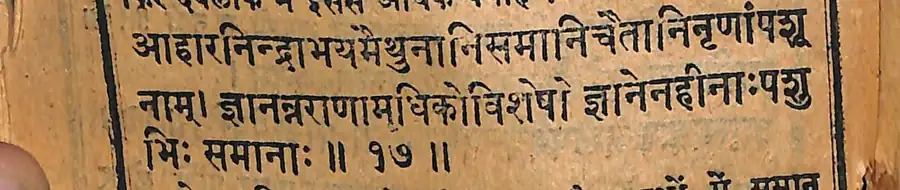
Verse 17Bombay compares dearness with food instead of grain.Sternbach 1963 (our text)धान्यसमंdhānyasamaṃ“equal to grain”The whole verse in this printing: There is no water like rainwater, no strength like one’s own, no light like the eye, and nothing as dear as grain.Bombay printing, 1925–26चान्नसमंcānnasamaṃ“and equal to food”The whole verse in this printing: There is no water like rainwater, no strength like one’s own, no light like the eye, and nothing as dear as food.Mathura printing, 1914the same as SternbachSternbach 1963, p. 33Bombay printing, 1925–26, p. 36Mathura printing, 1914, p. 30Tap a page to enlarge it. Scans: Internet Archive (Digital Library of India; eGangotri, CC0).↩
Verse 20Both older printings replace unstable life and youth with unstable life and dwelling (or the unstable dwelling of life).Sternbach 1963 (our text)चलं जीवितयौवनम्calaṃ jīvitayauvanam“life and youth are unstable”The whole verse in this printing: Wealth is unstable, life’s breaths are unstable, life and youth are unstable; in this world of moving and unmoving things, duty alone is stable.Bombay printing, 1925–26चलेजीवितमंदिरेcale jīvitamandire“life and dwelling are unstable (or: in the unstable dwelling of life)”The whole verse in this printing: Wealth is unstable, life’s breaths are unstable; in life’s unstable dwelling and in this world of moving and unmoving things, duty alone is stable.Mathura printing, 1914the same as the Bombay printingSternbach 1963, p. 33Bombay printing, 1925–26, p. 37Mathura printing, 1914, p. 30Tap a page to enlarge it. Scans: Internet Archive (Digital Library of India; eGangotri, CC0).↩
Sanskrit text, ed. Ludwik Sternbach (1963). Internet Archive scans of Sternbach's edition (Digital Library of India) and of the 1925 and 1914 printings (archive.org, archive.org, archive.org). The ancient verses are in the public domain; the editor's notes and apparatus are not reproduced.