Chanakya Niti · Chanakya

Chapter 16

Translated by The Modern Translation Project (2026)

2 min read
Listen · 4 min

1 We have not properly meditated on the Lord’s1 feet to end the cycle of rebirth; we have not even acquired the dharma that can force open heaven’s gates; we have not embraced a woman’s full breasts and her two thighs even in a dream: we have been nothing but axes cutting down the forest of our mother’s youth2.

2 Women talk with one man, look flirtatiously at another and think of another in their hearts; women’s desire is not fixed on one mana.

3 The fool who thinks in his delusion, “This woman loves me,” dances like a pet birdb once under her power.

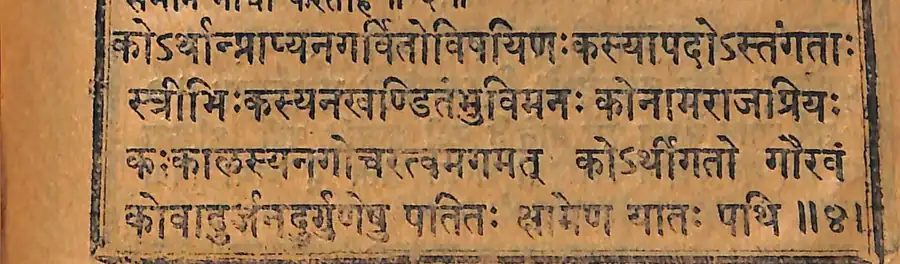
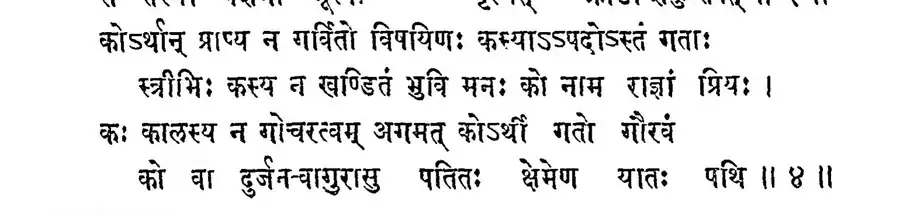
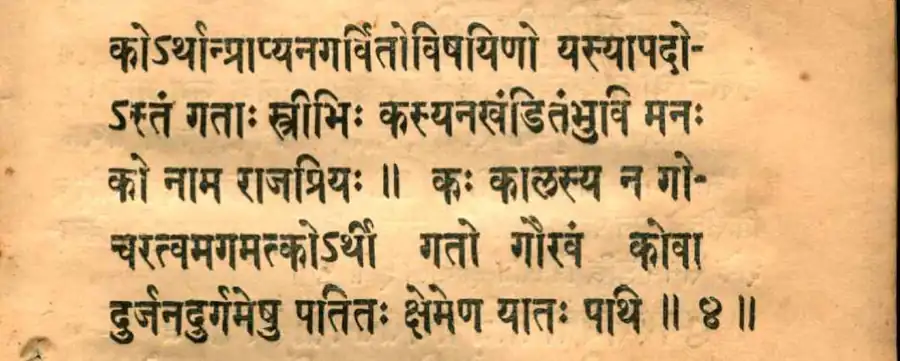
4 Who has gained wealth without growing proud; what lover of pleasure has seen his troubles end; whose heart on earth has not been broken by women; who, indeed, is dear to kingsc; who has not come within Time’sd reach; what beggare has won respect; or who has fallen into the snaresf of the wicked and gone safely on his way?printings differ

5 No one has made a golden doe3 or seen one before, nor is one heard of; yet Rama longed for one: when ruin comes, judgment goes awry.

6 People rise through their good qualities, not by sitting on high seats; does a crow become Garuda4, king of birds, even when perched on a palace’sg pinnacle?

7 Good qualities are honored everywhere, not wealth, however great; is the full moon5, with its dark markings, as worthy of reverence as the slender, spotless crescent?

8 A man whose good qualities others proclaim would be thought to have themh even if he has none; even Indra6 loses stature when he proclaims his own.

9 Good qualities gain charm in a discerning mani; a jewel shines far brighter when set in gold.

10 Even a man whose good qualities equal those of the all-knowing onej languishes alone without support; even a priceless ruby needs the support of goldk.

11 Wealth gained through excessive hardshipl, through violating dharma or through bowing down to enemies—let none of it be minem.

12 What use is wealth that, like a bride, belongs to one man alone? Better is wealth that, like a prostitute, is common to all7 and enjoyed even by passing travelers.printings differ

13 All living beings have died, will die and are dyingn unsatisfied with wealth, life, women and eating.

14 The merit of all gifts, sacrifices8, fire offerings and offerings to gods and spirits runs outo; the merit of a gift to a worthy recipient, and of protecting all living beings, does not.

15 Grass is lightp, cotton lighter than grass, and a beggar lighter still than cotton; why does the wind not carry him off? It fears, “He will beg from me.”

16 Better to give up life than live in dishonorq: giving up life brings pain for a moment; dishonor brings it day after day.

17 All creatures are pleased by the gift of pleasant words; therefore speak only pleasant words—why be miserly in speechr?

18 The bitters tree of worldly existence bears two fruits like nectar: sweet, well-spoken words and the company of good people.printings differ

19 The giving, study and austerity practiced birth after birth9 are the very things practiced againt, through the power of that same practice.printings differ

20 Learning that stays in books and wealth in other people’s hands are neither learning nor wealth when something needs doing.
Notes

  1. Ishvara means the supreme Lord; no particular deity is identified. Pada, singular in the Sanskrit, can mean a foot or step, or a station, abode or state; “feet” follows the common devotional use for the object of reverence and meditation, while “the Lord’s abode” or “supreme state” is also a possible reading. Ending samsara means release from the recurring cycle of worldly existence and rebirth. ↩
  2. The verse, also found in Bhartrihari’s verses on renunciation (the Vairagya-shataka), laments a life that achieved none of three traditional aims: liberation (moksha), religious merit (dharma) or even pleasure (kama); the fourth aim, wealth (artha), is not mentioned. The erotic line therefore stands for pleasure never enjoyed. Its compound pina-payodhara-uru-yugalam can be read as “full breasts and pair of thighs,” as here, or as “pair of full, broad breasts,” since uru can also mean “broad.” Dharma is “acquired” because good conduct is thought to bear later results. The closing image means that by being born the speaker only used up his mother’s youth, without making anything worthwhile of the life she gave him. ↩
  3. In the Ramayana, the epic of Rama, the demon Maricha takes the form of a golden deer to lure Rama away from Sita, allowing Ravana to abduct her. The Sanskrit uses the feminine kurangi, hence “doe,” though the epic usually speaks simply of a golden deer. It calls Rama Raghunandana, “joy of the Raghu line,” his family, and gives the longing (trishna) to him, although in Valmiki’s Ramayana it is Sita who first asks for the deer. The verse uses even Rama’s lapse to illustrate the proverb vinasha-kale viparita-buddhih, “when ruin is near, judgment turns upside down,” still common in Hindi and other Indian languages. ↩
  4. Garuda is the divine bird who carries Vishnu and rules the birds. His rank supplies the contrast with the crow’s merely elevated perch. ↩
  5. The full moon’s visible dark markings, seen in India as a hare or a deer, are treated as blemishes: the Sanskrit word kalanka means both a dark spot and a disgrace. The slender crescent is praised as spotless; the newly visible crescent is traditionally greeted as auspicious, and Shiva wears one in his hair. Full-moon days are honored too, but in this comparison the small, unmarked crescent ranks above the great, marked full moon, as good qualities rank above wealth. ↩
  6. Indra is king of the gods in Hindu tradition, lord of heaven, rain and thunder. As their king he stands for the highest rank, so even his standing shrinks when he praises himself. ↩
  7. Lakshmi here means wealth, a feminine word, which suggests the two similes. Vadhu is a bride or young wife, and veshya is the ordinary word for a courtesan or prostitute. Kevala means belonging to one alone, and samanya means shared by all. Bhujyate, “is enjoyed,” is used both of using wealth and of sexual enjoyment. The Sanskrit states no explicit verdict on the second kind of wealth. Its tu, “but,” sets it against the first, and “Better” is added in the English to make that contrast explicit. The provocative comparison assumes that a wife is for one man and a prostitute for all. It criticizes hoarded wealth that serves one man and praises wealth spent so that even passing strangers benefit; it is not approval of prostitution. The translation keeps the comparison as it is. ↩
  8. A sacrifice, or yajna, is a ritual offering to the gods; homa is an offering into consecrated fire, and bali an offering to deities or other beings. Bali often means food set out for gods and spirits, but it can also mean an animal offering, and Vedic sacrifice did at times include animals; the verse does not say what is offered. A worthy recipient, patra, literally “vessel,” is someone fit to receive a gift and use it well; dharma texts often mean a learned and virtuous Brahmin, but this verse names no caste, class or other test. Abhaya is a pledge to protect living beings from fear or harm, a gift often praised as the highest of all. ↩
  9. The saying assumes repeated births and the carrying over of habits and dispositions (samskaras) formed in earlier lives. Adhyayana, “study,” is especially the study and recitation of sacred learning such as the Vedas. Tapas, “austerity,” literally “heat,” is religious discipline such as fasting and endurance, believed to generate spiritual power; it has nothing to do with saving money. Abhyasa-yoga, “the power of practice,” is the built-up force of repeated practice; yoga here means application, not physical exercises. ↩

Translation notes

  1. The Sanskrit says strinam, “of women,” in general, with no qualifier such as “some” or “unfaithful.” Savibhramah means “with coquetry” or “with amorous playfulness,” here describing how they look at a man, so “flirtatiously” is neither stronger nor weaker than the original, and rati covers love, attachment and sexual desire. Sweeping claims that women are inconstant are a stock theme of old Sanskrit wisdom and story literature, usually meant to warn men against infatuation; the verse is translated as it stands. ↩
  2. Kamini is a woman seen in a setting of desire, an amorous or desirable woman, and also a common poetic word for women in general; it does not by itself mean a prostitute or a wife. Rakta, literally “colored, dyed,” means attached or in love. Moha here is delusion or infatuation, a sharper sense than the “fond attachment” of modern Hindi moh. A krida-shakunta is a bird kept for amusement, such as a tame parrot or myna, made to hop and perform; the image mocks the deluded man who dances at a woman’s will, continuing the warning of 16.2. ↩
  3. All seven questions expect the answer “no one.” Manas is mind or heart, and khandita means split, broken or disrupted: a mind unsettled through attraction to women, not only heartbreak in the modern romantic sense, and the blame on women (stribhih, “by women”) is explicit in the Sanskrit. “Who is dear to kings?” warns that royal favor never lasts; both older printings read “a royal favorite.” The 1925 printing also reads yasya, “whose,” for kasya, “whose?”, turning the second question into a description of the pleasure-seeker. ↩
  4. Kala means both time and death; here it is Time the destroyer, which spares no one. ↩
  5. Arthin means anyone who asks for something, a petitioner or suppliant as well as a beggar; the question reflects the classical belief that asking others for anything lowers one’s standing (gaurava). Vishayin, “lover of pleasure,” comes from vishaya in its older sense of the objects of the senses and the pleasures they give, a sense modern Hindi keeps in compounds such as vishaya-vasana beside its common meaning “subject.” ↩
  6. Sternbach reads “snares of the wicked”; the older printings have “the rough places” or “the vices” of the wicked. ↩
  7. Here we follow the Mathura (1914) printing. It reads प्रासाद, with a long first vowel, “palace,” and puts the first half in the plural (“people rise … not those seated high”). Sternbach prints प्रसाद, with a short first vowel, meaning “favor” or “clarity.” That makes no sense with a crow perched on its peak and is almost certainly a misprint. Sternbach also has the first half in the singular, “a man rises.” The Bombay printing also reads प्रासाद. The word can mean a palace, a lofty building or a temple, and shikhara a peak or spire, so some translations say “on a temple spire.” ↩
  8. Literally, someone without qualities (nirguna) “would become one with qualities” (guni bhavet); the phrase means he passes for virtuous, so the translation speaks of reputation. The 1925 printing reads “through qualities praised by others,” the same point. The 1914 printing’s paramokta and guno, “a quality,” are probably misprints for paraprokta and guni. ↩
  9. Anuprapta, “having reached,” lets the line mean either that good qualities found in a discerning person gain charm, as translated, or that talent gains charm when it reaches a discerning judge who sees its worth, as a jewel shines when set in gold. Viveka is discernment and sound judgment, broader than “conscience,” one of its modern Hindi senses. ↩
  10. Sarvajna means “all-knowing” and can be a title of a deity or enlightened teacher. The verse does not identify a particular figure. ↩
  11. The Sanskrit uses the same word, ashraya, in both halves: for a person it means shelter, backing or patronage, and for a gem the gold setting that holds and displays it. A loose ruby needs a mount before it can be worn; a gifted person needs backing to flourish. The verse does not say what form that support takes. ↩
  12. Atiklesha means “excessive distress or hardship.” It is usually taken as the cost to oneself, but the Sanskrit does not say whose distress is meant, so wealth won by making others suffer could also fall under it. ↩
  13. The particles hi and tu here only add stress; they set up no cause or contrast between the clauses, so “for” and “but” are not used. ↩
  14. Yata, yasyanti and yanti literally mean “have gone, will go and are going,” a standard way of speaking of death, kept here in the Sanskrit order. Strishu, “in women,” stands for sexual pleasure: the list is written from a man’s point of view, as the collection usually is, even though it speaks of “all living beings.” ↩
  15. The Sanskrit says only that the gifts and rites themselves wane (kshiyante, “wane, are used up”). “The merit of” is added in the English, as the verse is traditionally understood. In a familiar Brahmanical account, the merit (punya) from ordinary rites and gifts earns a temporary reward, such as a stay in heaven. That merit is then exhausted, after which the soul is born again. Giving to a worthy recipient and protecting living beings are said to yield merit that never runs out. ↩
  16. Laghu means both light in weight and low in standing, so the beggar is “lighter” in both senses. Yachaka is anyone who asks for something, a petitioner as well as a beggar. The satire is aimed at asking, which in this tradition strips a person of dignity. The closing words are the wind’s imagined thought: it will not carry him off for fear he will ask something of it too. Sternbach prints tulat api, “than cotton,” and the older printings print tulad api, the regular joined form before a vowel. The words and meaning are the same. ↩
  17. Prana-parityaga literally means “giving up the breath of life”; the verse says nothing of how or when. Its “better X than Y” formula (varam) is a common emphatic device in Sanskrit epics and wisdom verse; here it ranks death above a life of dishonor, setting a moment’s pain against pain day after day. Mana is honor, dignity or self-respect, and mana-bhanga its breaking; no particular kind of honor is named. ↩
  18. Daridrata literally means “poverty”: the Sanskrit asks “why be poor in words?”, picking up pradana, “giving,” in “the gift of pleasant words.” Kind words cost nothing and never impoverish the giver, so the sense is stinginess. The point is readiness to speak kindly, not the amount of talk; other sayings in this tradition add that one should speak the truth pleasantly. ↩
  19. Sternbach’s text and the 1925 printing describe a “bitter tree” (katu-vriksha). The 1914 printing reads kuta-vriksha, “tree of deceit” or “tree of illusion,” perhaps a misprint for katu, “bitter,” and adds a contrasting “yet” before the nectar-like fruits. A widely memorized version of the saying has a poison tree (visha-vriksha) and makes the first fruit the taste of poetry. Subhashita, “well spoken,” means good or wise speech and is also the name for a polished saying of wisdom, the kind collected in this book, so the line praises both kind speech and sayings like these. ↩
  20. Where our text says the same things, giving, study and austerity, are practiced again, the 1925 printing reads “the body” (and “in many births” at the start) and the 1914 printing “the embodied person”; both older endings sit awkwardly in the sentence. ↩

Where the printings differ

Where the three printings of the Sanskrit disagree in meaning: the words of each, a literal rendering, and the printed page.

Translated by The Modern Translation Project (2026). The Sanskrit text on this site (Sternbach 1963; Internet Archive in.ernet.dli.2015.117099) (archive.org). Public domain in the US. A modern translation is in progress.

Found a mistake in this translation? Email admin@lifemathmoney.com with the passage.

Chanakya NitiModern

Translations

Theme

Text size

100%