1 Generosity, pleasant speech, fortitudea and a sense of what is fitting are four inborn qualities; they are not acquired through practice.
2 Whoever abandons his own group and takes refuge with another brings about his own ruin, like a king who follows a duty not his own.bprintings differ
3 An elephant has a huge body and obeys a goad1—is the goad as big as the elephant; darkness vanishes when a lamp is lit—is the darkness as small as the lamp; mountains fall when struck even by a thunderbolt2—is a mountain as small as the thunderbolt? The man whose power shines forthc is strong; what trust can be placed in bulk?
4 After ten thousand years of Kali Yuga,3 the present age, Vishnu leaves the earth; after half that time, the river Ganga’s water; after half that again, the village deityd.
5 A man attached to homee has no learning, a meat eater no compassion4, a man greedy for wealth no truthfulness, and a man in thrall to women no purityf.
6 A wicked man does not become good, even when taught in many ways; a neem tree5 does not become sweet when watered down to its roots with milk and clarified butter.
7 A wicked man whose filth is within is not purified even by a hundred baths at sacred places,6 just as a pot that has held liquor remains ritually impure even when it is fired.
8 A man always disparages someone whose excellence he fails to recognize; there is nothing strange in this, just as a woman of the Kirata7 forest people throws away a pearl found in an elephant’s forehead and wears gunja seeds instead.
9 Whoever eats in silence each day for a full year is honored in heaven for ten billiong world ages.8printings differ
10 A student should avoid eight thingsh: desire, anger, greed, delicacies, adornment, amusements, too much sleep and too much service.i
11 A Brahmin who always delights in forest life and makes daily offerings to the ancestors9 with wild fruit and roots is called a rishi, a sage.
12 A Brahmin who is content with one meal a day, always devotes himself to the six duties10 and has intercourse during his wife’s fertile period is called twice-born.
13 A Brahmin who engages in worldly work, tends livestock and practices trade and farming is called a Vaishya.11
14 A Brahmin who sells lac resin12 and similar products, oil, indigo, safflower, honey, clarified butter, liquor and meat is called a Shudra.
15 A Brahmin who obstructs others’ work—a hypocrite, intent on his own gain, deceitful, spiteful, gentle yet cruel—is called a cat.13
16 A Brahmin who has no qualms about destroying stepwells,14 wells, reservoirs, gardens and temples is called a mleccha, an outsider.
17 A Brahmin who steals what belongs to the gods or to his teacher, has relations with other men’s wives, and lives by eating any creature at all is called a Chandala15.j
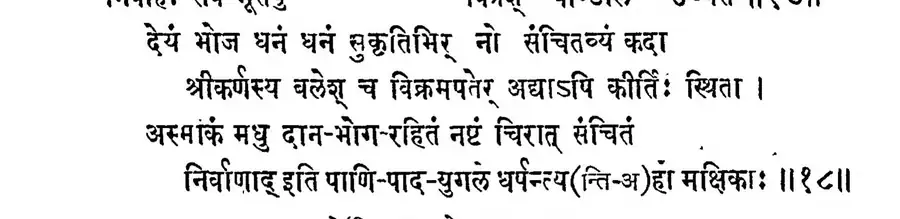
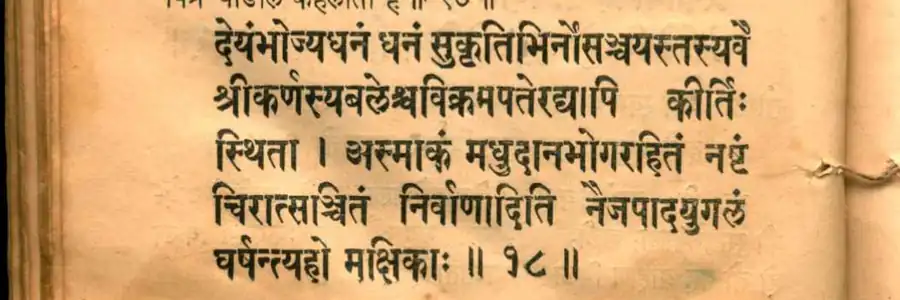
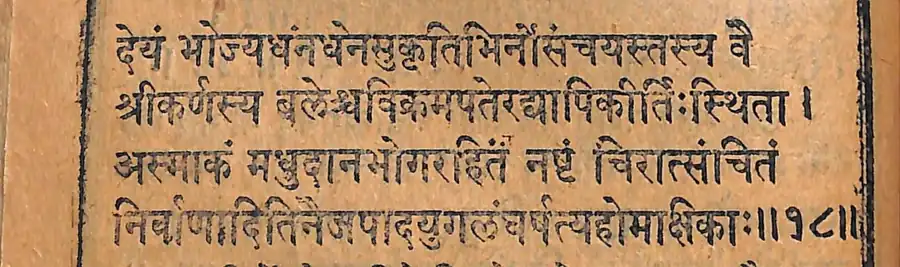
18 Bhoja,16 good men should give away wealth, and wealth should never be hoarded;k the fame of illustrious Karna, Bali and King Vikramaditya still endures today. “Our honey, stored for so long, neither given away nor enjoyed, is lost”—ah, at its destruction the bees rub their hands and feet.lprintings differ