Chanakya Niti · Chanakya

Chapter 2

Translated by The Modern Translation Project (2026)

2 min read
Listen · 4 min

1 Lying, recklessness, deceit, foolishness, excessive greed, impurity,a and cruelty are faults women have by natureb.

2 Food and the ability to eat it, fine women and the potency to enjoy themc, wealth and the ability to give it away are the fruits of no small austerity.1

3 A man whose son obeys him, whose wife follows his wishesd, and who is content with his wealth has heaven2 right here.

4 Sons are those devoted to their fathere, but a father is one who provides for them; a friend is one who is trusted, a wife one who brings contentment.

5 Avoid a friend who wrecks your work behind your back and speaks sweetly to your face—a jar of poison topped with milk.

6 Do not trust a bad friend, and do not trust even a friendf; an angry friend may one day reveal every secret.

7 Do not speak of a task you have planned in your mind; keep it hidden through private counselg and put it into action.

8 Foolishness is a hardship indeed, and youth is a hardship indeedh, and living in another’s house is a greater hardship still.

9 Not every mountain holds a ruby, not every elephant a pearl in its head3; good people are not everywherei, and sandalwood does not grow in every forest.

10 Wise men should continually train their sonsj in good habits of many kinds; those with practical wisdom and good characterk are honored by their families.

11 A mother is an enemy, a father an enemy, if they leave their childl untaught; he does not shine in an assembly, like a crane4 among swans.

12 Indulgence brings many faults, beating5 brings many virtues; therefore beat a son and a pupil, but do not indulge them.

13 Make the day fruitful through acts of giving and studym—a verse6 or half a verse, a quarter, or a syllable.

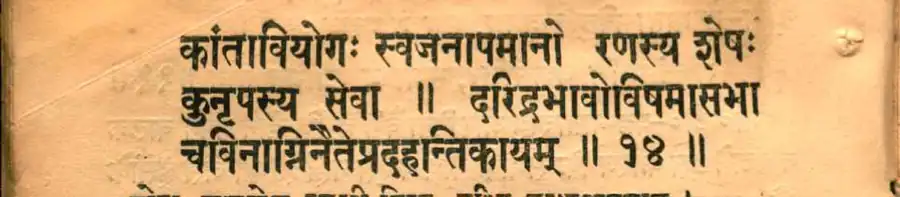
14 Separation from a beloved womann, humiliation by one’s own people, an unpaid debt,o service to a bad king, and a friend who turns away because of poverty—these five burn the body without fire.printings differ

15 Trees on a riverbank, a woman who lives in other people’s housesp, and kings without ministers7 soon come to ruin, without a doubt.

16 Learning is the strength of Brahmins, an army the strength of kings, wealth the strength of Vaishyas,8 farmers and traders, and serviceq the strength of Shudras, the serving class.printings differHere we follow the Mathura printing (1914)

17 A prostitute9 leaves a penniless man, subjects a defeated king, birds a tree that has lost its fruit, and guests a house once they have eaten.

18 Brahmins leave the patron of a sacrifice10 after taking their fee, pupils leave their teacher once they have gained learning, and wild animals leave a burned forest.

19 A man soon perishes through friendshipr with someone who behaves badly, has an evil gazes, lives in a bad place, and is wicked.

20 Affection shines between equals, service shines when given to a king, trade shines in worldly affairst, and a splendid woman shines in the homeu.

Notes

  1. Austerity means religious disciplines such as fasting and self-denial, believed to produce spiritual merit. Here their rewards include wealth and bodily enjoyment. ↩
  2. Svarga is a heavenly existence within the cycle of rebirth, rather than final liberation from it. Here domestic contentment is described as heaven already present. ↩
  3. Traditional lore held that a rare, exceptional elephant carries a precious pearl, the gajamukta or “elephant-pearl,” inside its head, in the swellings of the forehead. “In its head” is added for that reason; the Sanskrit says only “not in every elephant a pearl.” Sandalwood is a tree prized for its fragrant heartwood, used in perfumes, cooling pastes, and worship. Its uneven distribution, like that of rubies and such pearls, illustrates the rarity of exceptional people. ↩
  4. The hamsa, conventionally called a swan in English (it may also be a goose), is a waterbird associated with grace and spiritual discernment. The baka, “crane,” is usually identified as a heron or egret (Hindi bagula); “crane” is the conventional English rendering. Standing motionless while it waits to snatch fish, the baka is a stock image of hypocrisy and cunning in Indian lore, and the usual plain foil to the hamsa. The learned assembly is compared to these distinguished birds, and the crane supplies the contrasting image. ↩
  5. Tadana and tadayet mean striking or beating, not merely scolding: the verse recommends physical punishment as part of a father’s or teacher’s authority over the young. Lalana, “indulgence,” is fondling, petting or pampering; the verse condemns it outright and does not limit its criticism to excess. 3.18 sets out stages: indulgence for the first five years, beating for the next ten, and friendship once the son enters his sixteenth year. ↩
  6. A shloka usually consists of four quarters of eight syllables each. The prescribed portion of study decreases from a whole verse to a half, a quarter, and a syllable. ↩
  7. Royal ministers were counselors who advised the ruler on government and policy. Their counsel is presented here as essential to his survival. ↩
  8. Vaishyas, the third class in the traditional fourfold social order, were traditionally farmers, cattle keepers, and traders; Shudras were the fourth class, assigned service to the other three. The verse reflects that hierarchy when describing their strength. ↩
  9. The term denotes a professional sexual companion supported by paying patrons. The loss of payment ends the relationship in this comparison. Welcoming and feeding an arriving guest (abhyagata, “one who has come”) was a sacred duty of the householder. The list sets mercenary, political and ordinary departures side by side, all examples of leaving once the benefit is gone. ↩
  10. The patron of a Vedic sacrifice commissioned the rite and gave its priests dakshina, a customary payment or gift, at its close. A guru was a teacher to whom a pupil owed study, service, and respect. Receiving the fee and gaining the learning can mark the completion of the rite or of the pupil’s studies; the verse’s point is that an association ends when its purpose ends. Mriga, “wild animal,” most often means a deer or antelope, its usual sense in modern Hindi, but it is also used of any wild animal. ↩

Translation notes

  1. Ashaucha can cover physical uncleanness, ritual impurity and, occasionally, a general lack of purity in conduct. In the traditional law books women were held ritually impure during menstruation, and after childbirth (an impurity that also touched the whole family), but the verse does not say which sense it means. “Impurity” retains that range without restricting the accusation to any one sense. ↩
  2. “By nature” renders svabhavaja, “born of their own nature, innate,” so the Sanskrit itself calls these faults inborn, and it speaks of “the faults of women” with no word limiting them to some women. Lists of this kind are a commonplace of Sanskrit sayings. Sahasa, “recklessness,” is again rash or violent conduct, not the courage of modern Hindi sahas (see 1.17), and maya, “deceit,” here means trickery, not the philosophical idea of the world as illusion. Calling women foolish (murkhatva) sits awkwardly beside 1.17’s “four times their intelligence”; the collection gathers sayings that do not always agree. ↩
  3. The Sanskrit pairs ratishakti, “the capacity for sexual pleasure,” with varastriyah, “excellent women,” plural in our text; both older printings have the singular varangana, “a fine woman,” which many versions take as “a good wife.” The Sanskrit names the capacity first; the English reverses the pair and links them with “to enjoy them.” Like the whole verse, the line speaks from a man’s point of view, listing what he receives as the reward of austerity. ↩
  4. Vashibhuta, “obeys him,” is literally “brought under his control,” and chhandanugamini, “follows his wishes,” is literally “going along with his will.” The Sanskrit is as plain as the English. It describes the ideal household of its time, centered on the authority of father and husband, and sees it entirely from the man’s side. ↩
  5. These are definitions of what a true son, father, friend and wife should be, not rules about who legally counts as one, and the father too is given a duty: providing for his children. Bhakta, “devoted,” means loyal and attached and has no religious sense here, unlike modern Hindi bhakt, which usually means a religious devotee. Nirvriti, “contentment,” is peace, ease and happiness in general. ↩
  6. The second “friend” is plain mitra; the Sanskrit has no word for “good,” as some familiar versions add. The first line forbids trust outright, and the second gives the reason: a friend who turns angry may reveal your secrets. The collection sets this practical warning beside the ideal of 2.4, where “a friend is one who is trusted.” ↩
  7. Mantra is best known as a sacred chant, but in Sanskrit writing on statecraft it also means confidential deliberation, counsel or a plan; the word for a king’s minister, mantri (2.15), comes from it. Here mantrena means keeping a plan secret by thinking it through privately, alone or with trusted advisers, instead of talking about it, and that is how private counsel fits with the first line. Versions that say “guard it like a mantra” take the word in its sacred sense. ↩
  8. Yauvana means “youth,” and kashta, here “hardship,” covers pain, trouble and difficulty of every kind, not only physical pain. The saying does not explain why youth is a hardship. Sanskrit poems of advice often treat youth as a dangerous time of passion and rashness, which lead the young into trouble. Living in another’s house means living as a dependent on someone else’s support, at the cost of one’s independence and dignity. ↩
  9. “Good people” renders sadhavah, the plural of sadhu, which in classical Sanskrit chiefly means a good, upright or virtuous person. The word can also mean a holy man, its usual sense today (see 4.2), but here it simply means good people. ↩
  10. Putra means “son.” The plural can sometimes cover children in general, but these verses have sons in mind, and the translation says “son” wherever the Sanskrit has this word. A son was his father’s heir and would carry on the family rites, so his upbringing was a family concern. “Practical wisdom” renders nitijna, “knowing niti,” sound practical and moral conduct, not only state policy (see 1.1). Shila, “character,” is habitual conduct in general, not only sexual modesty. ↩
  11. The printed word for “endowed with good character” appears to lack a nasal; we read it as shilasampanna, which gives the expected sense. ↩
  12. Our text prints valo where the sense requires balo, “child,” and uses singular “by whom” with the two parents, understood here as applying to each. The older Bombay printing uses the explicit dual, “by both.” Readers who know the line as “mata shatruh pita vairi yena balo na pathitah” (“a mother is an enemy, a father a foe, by whom the child was not taught”) will find that form in the 1914 printing. Our text has ripu and shatru, both meaning “enemy,” and the present “is not taught”; the sense is the same. ↩
  13. The closing compound can be read as “acts of giving and study,” as here, or as three things: “giving, study, and ritual acts.” ↩
  14. Kanta, “a beloved woman,” is the woman a man loves; the word is often used of a wife, but the verse does not say whether she is one. In the next item, svajanapamana joins “one’s own people” and “humiliation” without saying how they relate: it can mean humiliation by one’s own people, humiliation of them, or humiliation in front of them. The English takes the first. ↩
  15. Our text has an unpaid debt and a friend who turns away because of poverty, explicitly counting five afflictions. Both older printings instead have unfinished fighting, poverty, and a hostile assembly. ↩
  16. Kamini, “woman,” is a common poetic word for a woman. It literally means “a woman who desires,” that is, a loving or passionate woman, but it is often used for any attractive woman. Parageheshu, literally “in others’ houses,” refers to living there, away from her own household, not to visiting. Nashyanti, here “come to ruin,” also means “perish” or “are lost.” Trees on a riverbank are worn away by floods and the current. The verse does not say why a woman living in another’s household comes to ruin. A likely background is the view of the traditional law books. They held that a woman should always be under the guardianship of her father, her husband or her sons (Manu 9.3), and they listed living in another’s house among six things that corrupt a woman (Manu 9.13). In that outlook, such a woman was thought to be at risk of losing her virtue and her good name. ↩
  17. Here we follow the 1914 Mathura printing, which reads paricharyika, “service.” Our main text, Sternbach’s edition, reads cha akanishthata, “and not being the lowest,” that is, not being inferior. It is unclear what that adds to a list that names each class’s own source of strength in a verse that assumes the class hierarchy. With a short vowel instead of a long one, the same letters would read cha kanishthata, “and lowliness” or “lowest standing,” which fits the same subordinate role as Mathura’s “service.” The 1925 Bombay printing reads cha kanishthika; kanishthika usually means “little finger,” literally “the smallest.” It may be related, but it does not settle either reading. Which reading is oldest cannot be shown. ↩
  18. The syntax is uneven: the opening descriptions are nominatives, and plural “by men” is followed by singular “a man.” We take the opening words as descriptions of the person whose friendship brings ruin. ↩
  19. Durdrishti, “an evil gaze,” is literally “bad sight”: a malicious, envious or lustful look, or a warped way of seeing things; it need not mean the magical evil eye. Duravasi, “lives in a bad place,” is less certain: it may mean someone who lives in a disreputable place, or someone hard to live with. The Sanskrit names no particular place or group. All four descriptions begin with dur-, “bad,” a deliberate repetition. ↩
  20. Vyavahara has a wide range: dealings, transactions, worldly affairs and occupations, and also lawsuits. “Worldly affairs” keeps the broad sense. The point seems to be that trade is at its best, and earns respect, in the ordinary business of life; it may also mean that trade is an honorable calling among occupations. The clause is compressed and its exact point is uncertain. ↩
  21. Divya, “splendid,” literally means “divine” or “heavenly” and is used as high praise; it does not single out beauty or virtue. Shobhate, “shines,” also means “looks fitting” or “suits.” It runs through the verse: each thing appears at its best in its proper setting. Samana, “equals,” means people of similar standing or circumstances, and priti, “affection,” includes friendship. ↩

Where the printings differ

Where the three printings of the Sanskrit disagree in meaning: the words of each, a literal rendering, and the printed page.

Translated by The Modern Translation Project (2026). The Sanskrit text on this site (Sternbach 1963; Internet Archive in.ernet.dli.2015.117099) (archive.org). Public domain in the US. A modern translation is in progress.

Found a mistake in this translation? Email admin@lifemathmoney.com with the passage.

Chanakya NitiModern

Translations

Theme

Text size

100%