1 If you want liberation,1 my sona, give up the pleasures of the sensesb as poison and cherish forbearance, honestyc, compassion, contentment and truth as nectar.printings differ
2 Those vile men who reveal one another’s secrets themselves perish, like the two snakes in the fable—one in an anthill and one in a prince’s belly.d
3 Gold was given no fragrance, sugarcane no fruit, sandalwood2 no flowers, a learned man no wealth and a king no long life; Brahma, the creator, had no one to advise him in the beginning.
4 Of all medicinal plants, the amrita vine3 is foremost; of all pleasures, eating is foremost; of all the sense organs, the eye is foremost; of all the body’s parts, the head is foremost.
5 No messenger travels through the sky, no news passes, there has been no prior talk of this, and no meeting takes place; how can an excellent Brahmin4 who knows how to predict eclipses of the sun and moon in the sky fail to be learned?eprintings differ
6 One should wake these seven sleepers: a student, a servant, a traveler, a hungry man, a terrified man, a storekeeper5 and a gatekeeper.
7 One should not wake these seven sleepers: a snake, a king, a tiger, a boarf, a child, someone else’s dog and a fool.
8 Brahmins who have half learned the Vedas and eat food supplied by Shudras6 are like snakes without venom—what can they accomplish?printings differ
9 If a man’s anger inspires no fear, his pleasure brings no wealth, and he has neither punishment nor favor to give, what will he accomplish by getting angry?
10 Even a snake without venom should spread its hood wide; venom or no venom, the display of its hood is frightening7.printings differ
11 The wiseg spend the morning discussing gambling, midday discussing women and the night discussing thieves.printings differ
12 Translated by our AI: A garland strung by one’s own hand,8 sandalwood ground by one’s own hand and a hymn written by one’s own hand can strip even Indra,9 king of the gods, of his fortune.
Translated by our Sanskrit scholar: A garland strung by one’s own hand, sandalwood ground by one’s own hand and a hymn written by one’s own hand can take away even Indra’s wealth. (Meaning: beside these things, even Indra’s wealth is nothing.)
13 Sugarcane stalks, sesame, Shudras, a beloved woman, gold, earth, sandalwood, curds and betel—their qualities improve with pounding.h
14 Poverty shines with fortitude, shabby clothes shine when cleani, poor food shines when hot, and ugliness shines with good character.
Where the printings differ
Where the three printings of the Sanskrit disagree in meaning: the words of each, a literal rendering, and the printed page.
- Verse 1 Both older printings replace contentment with purity and tell the reader to drink these virtues instead of cultivating them.Sternbach 1963 (our text)तोषं ; भजtoṣaṃ ; bhaja“contentment; cultivate”The whole verse in this printing: If you want liberation, my dear, give up sense pleasures as you would poison; embrace forgiveness, straightforwardness, compassion, contentment, and truth like nectar.Bombay printing, 1925–26शौचं ; पिबśaucaṃ ; piba“purity; drink”The whole verse in this printing: If you want liberation, my dear, give up sense pleasures as you would poison; drink forgiveness, straightforwardness, compassion, purity, and truth like nectar.Mathura printing, 1914शौच ; पिबśauca ; piba“purity; drink”The whole verse in this printing: If you want liberation, my dear, give up sense pleasures as you would poison; drink forgiveness, straightforwardness, compassion, purity, and truth like nectar.
 Sternbach 1963, p. 54
 Bombay printing, 1925–26, p. 64
 Mathura printing, 1914, p. 53Tap a page to enlarge it. Scans: Internet Archive (Digital Library of India; eGangotri, CC0). ↩
- Verse 5 Both older printings describe the eclipse as celebrated or auspicious instead of describing the ability to proclaim it.Sternbach 1963 (our text)प्रशस्तुंpraśastuṃ“to proclaim”The whole verse in this printing: No messenger travels in the sky, no news passes, this was not spoken of beforehand, and there is no meeting; how is that excellent Brahmin not learned, who knows how to announce an eclipse of the sun or moon taking place in the sky?Bombay printing, 1925–26प्रशस्तंpraśastaṃ“praised, auspicious”The whole verse in this printing: No messenger travels in the sky, no news passes, this was not spoken of beforehand, and there is no meeting; how is that excellent Brahmin not learned, who knows the auspicious eclipse of the sun or moon taking place in the sky?Mathura printing, 1914the same as the Bombay printing
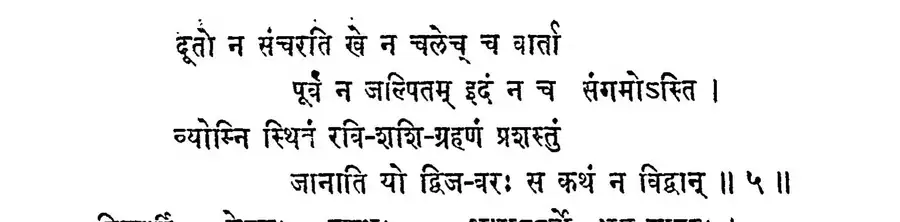 Sternbach 1963, p. 55
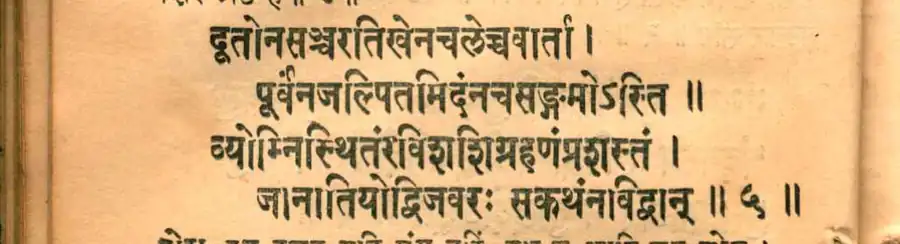 Bombay printing, 1925–26, p. 66
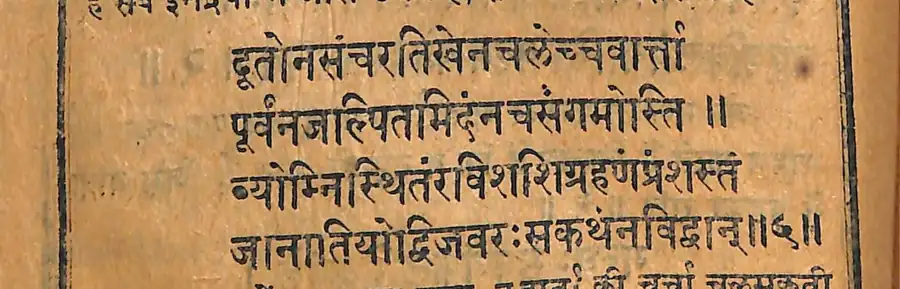 Mathura printing, 1914, p. 54Tap a page to enlarge it. Scans: Internet Archive (Digital Library of India; eGangotri, CC0). ↩
- Verse 8 Both older printings replace half-studied Vedas with Vedas studied for gain or meaning.Sternbach 1963 (our text)अर्धाधीताश्चardhādhītāś ca“and half-studied”The whole verse in this printing: Those twice-born men who have half studied the Vedas and eat Shudras’ food—what can they do, like snakes without venom?Bombay printing, 1925–26अर्थाधीताश्चarthādhītāś ca“and studied for gain or meaning”The whole verse in this printing: Those twice-born men who have studied the Vedas for gain (?) and eat Shudras’ food—what can they do, like snakes without venom?Mathura printing, 1914the same as the Bombay printing
 Sternbach 1963, p. 55
 Bombay printing, 1925–26, p. 67
 Mathura printing, 1914, p. 55Tap a page to enlarge it. Scans: Internet Archive (Digital Library of India; eGangotri, CC0). ↩
- Verse 10 Mathura replaces the display of the snake's hood with a more general imposing display, while Bombay uses a synonym for hood.Sternbach 1963 (our text)फणाटोपोphaṇāṭopo“display of the hood”The whole verse in this printing: Even a snake without venom should spread its hood wide; whether or not it has venom, the display of the hood is frightening.Bombay printing, 1925–26फटाटोपोphaṭāṭopo“display of the hood”The whole verse in this printing: Even a snake without venom should spread its hood wide; whether or not it has venom, the display of the hood is frightening.Mathura printing, 1914घटाटोपोghaṭāṭopo“imposing display”The whole verse in this printing: Even a snake without venom should spread its hood wide; whether or not it has venom, an imposing display is frightening.
 Sternbach 1963, p. 56
 Bombay printing, 1925–26, p. 68
 Mathura printing, 1914, p. 56Tap a page to enlarge it. Scans: Internet Archive (Digital Library of India; eGangotri, CC0). ↩
- Verse 11 Both older printings attribute this use of time to the wise instead of the unwise and replace involvement in theft with association with or talk of thieves. Our translation follows the older printings here (“of the wise”), as most manuscripts do according to Sternbach’s own notes.Sternbach 1963 (our main text)चौर्यप्रसङ्गेन ; कालो गच्छत्यधीमताम्cauryaprasaṅgena ; kālo gacchaty adhīmatām“through involvement in theft; time passes for the unwise”The whole verse in this printing: The time of the unwise passes in gambling in the morning, association with women at noon, and involvement in theft at night.Bombay printing, 1925–26चोरप्रसंगेन ; कालोगच्छतिधीमताम्coraprasaṅgena ; kālo gacchati dhīmatām“through association with (or talk of) thieves; time passes for the wise”The whole verse in this printing: The time of the wise passes in gambling in the morning, association with women at noon, and association with thieves at night.Mathura printing, 1914 (followed here)चौरप्रसंगेन ; कालोगच्छतिधीमताम्cauraprasaṅgena ; kālo gacchati dhīmatām“through association with (or talk of) thieves; time passes for the wise”The whole verse in this printing: The time of the wise passes in gambling in the morning, association with women at noon, and association with thieves at night.
 Sternbach 1963, p. 56
 Bombay printing, 1925–26, p. 68
 Mathura printing, 1914, p. 56Tap a page to enlarge it. Scans: Internet Archive (Digital Library of India; eGangotri, CC0). ↩
Translated by The Modern Translation Project (2026). The Sanskrit text on this site (Sternbach 1963; Internet Archive in.ernet.dli.2015.117099) (archive.org). Public domain in the US. A modern translation is in progress.