1 Learning taken on trust from books, without study in a teacher’s presence1, does not shine in an assembly, like a woman’s child conceived in adultery.printings differ
2 Repay a favor with a favor and harm with harma; no blame attaches to that—treat the wicked wickedly.
3 Whatever is far away, whatever is hard to win over, whatever is near at handb: all of it can be attained through austerity, for austerity is hard to overcome2.printings differ
4 If there is greed, what need of vicec; if there is slanderd, what need of sins; if there is truthfulness, what need of austerity; if the mind is pure, what need of pilgrimage3; if there is goodness, what need of virtues; if there is great glory, what need of ornaments; if there is sound learning, what need of wealth; if there is disgrace, what need of death?
5 Though the conch’s4 father is the ocean, the mine of jewels, and its sister is Lakshmi, goddess of wealth, it goes begging with mendicants; what one has not given does not come to onee.
6 A powerless man becomes good, a penniless man celibate5, a sick man devoted to the gods and an old woman faithful to her husband6.
7 No gift equals food and water; no lunar day7 equals the twelfth; no sacred formula surpasses the Gayatri; no deity surpasses one’s mother.
8 A snakef has poison in its fang; a fly8 has poison in its head; a scorpion has poison in its tail; a wicked man has poison throughout his body.
9 A woman who fasts and keeps a vow without her husband’s permission9 shortens his life; that woman goes to hell.
10 Neither gifts nor even hundreds of fasts nor visits to holy places purify a woman as water10 used to wash her husband’s feet does.
11 Water11 left from washing feet, left from drinking and left from twilight worship is no different from dog’s urine; anyone who drinks it should perform chandrayana, the lunar penance.
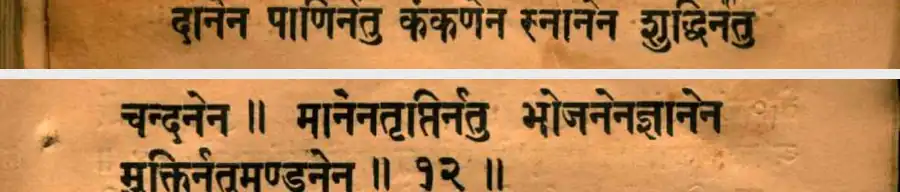
12 Giving adorns the hand, not a bracelet; bathing brings purity, not sandalwood paste12; respect brings satisfaction, not food; knowledge brings liberation, not shaving the head13.printings differ
13 Having a shave in a barber’s house14, smearing fragrant paste on a stoneg and looking at one’s own reflection in water would rob even Indra, king of the gods, of his fortune.
14 Ivy gourd15 immediately takes away intelligence; sweet flag immediately brings intelligence; a woman immediately takes away strength; milk immediately brings strength.
15 For good people whose hearts are awake to helping others, troubles vanish, and good fortune is theirs at every step.
16 If there is a beautiful womanh and if there is wealthi, if there is alsoj a son16 endowed with modesty, and if that son has a son, what more is there in Indra’s city?
17 Eating, sleep, fear and sex are common to humans and animals; knowledgek is what sets humans above them, and humans without knowledge are equal to animals.
18 If a great elephant, his mind blinded by rutl, flaps his ears and drives away the bees that come asking for a gift—the fragrant fluid on his temples—it is only his own two temples that lose their adornment; the bees, for their part, live in a forest of fully opened lotuses.
19 A king, a prostitute, the death god Yama17, fire, a thief, a child and a beggar know nothing of others’ sufferingm; the village oppressorn is the eighth.
20 Someone teases an old woman bent with age: “Why are you looking down, girlo—what of yours has fallen to the ground?” She replies: “Oh, you fool, don’t you know? The pearl of my youth is gone.”
21 Though you shelter snakes, though you bear no fruit, though you have thorns, though you are crooked, though you grow in mud, though you are hard to approach, screw-pine18, your scent makes you kin to every creature; a single good quality surely wipes out every fault.