Chanakya Niti · Chanakya

Chapter 7

Translated by The Modern Translation Project (2026)

2 min read
Listen · 4 min

1 A wise man should not reveal his loss of wealth, his distress, misdeeds at home, being cheated or being humiliated.aprintings differ

2 Whoever sets aside embarrassmentb in dealings with money and grain, in acquiring learning, in eating and in business lives happily.

3 The happiness of those whose minds are at peacec, satisfied with the nectar1 of contentment, is not for those who run here and there in their greed for wealth.

4 A man should be content with three things—his own wifed, food and wealth—and should not be content with three things: study, austerity2 and giving.printings differ

5 One should not pass3 between two Brahmins, between a Brahmin and a fire, between husband and wife, between master and servant, or between a plow and an ox.

6 One should not touch4 fire, a teacher or a Brahmin with one’s feet, nor a cow, an unmarried girl, an old person or a child.

7 Keep clear of a cart by five cubits,5 a horse by ten cubits, an elephant by a hundred cubits,e and a wicked man by leaving the country.printings differ

8 A man strikes an elephant with a goad6 in hand, a horse with his hand, a horned animal with a club in hand, and a wicked man with a sword in hand.fprintings differ

9 Brahmins are pleased by food7, peacocks8 by thunder’s roar, good people by others’ prosperity, and the wicked by others’ misfortunes.

10 Deal with a powerful man through compliance, a wicked man through resistance, and an enemy of equal strength through courtesy or forceg.printings differ

11 A king’s strength is the might of his arms; a Brahmin is strong through sacred knowledgeh; women’s unsurpassed strength is beauty, youth and sweetnessi.
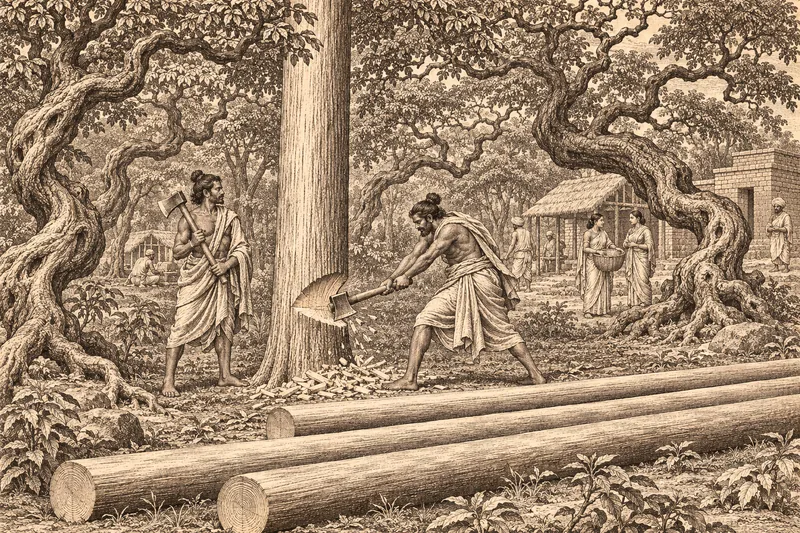
In a forest clearing two woodcutters with axes fell a tall straight tree beside straight logs on the ground, while twisted, crooked trees stand untouched around them.
This imagined scene illustrates the saying that one should not be too upright: in the forest the straight trees are cut down and the crooked ones are left standing. It is an AI illustration.

12 One should not be too upright:j go and look at the forest, where upright trees are cut down and crooked trees remain standing.
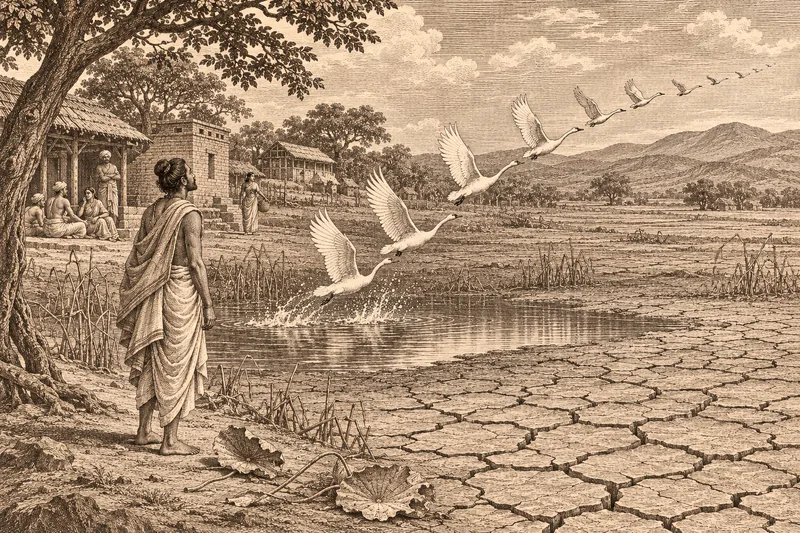
Swans rise from the last pool of a drying lake with cracked mud around it and fly toward distant hills, while a man in a shawl watches from the bank.
This imagined scene illustrates the saying that swans live where there is water and leave when it dries up, and that a person should not keep leaving one shelter for another like them. In Sanskrit poetry the swan, the hamsa, is a bird of lakes and a symbol of grace. It is an AI illustration.

13 Where there is water, there swans9 live, and they leave a place when it dries up. A man should not be like the swans, now leaving, now coming back.

14 Giving away the wealth one has earned is its only protection, as an overflow channelk is for the water held in a pond.

15 Whoever has wealth has friends; whoever has wealth has relatives; whoever has wealth is a man in this worldl; whoever has wealth lives.

16 In this world of the living, four signs appear in the bodies of those who have dwelt in heaven:10 fondness for giving, sweet speech, worship of the gods and feeding Brahmins.

17 Fierce anger, bitter speech, poverty, hostility toward one’s own people, the company of the low and service to those of base birth are the signs borne in the bodies of those who have dwelt in hell11.

18 If one goes to a lion’s den, one finds the fabled pearls from an elephant’s temples;12 at a jackal’s lair, one finds a calf’s tail and a scrap of donkey hide.

19 A life without learning is as useless as a dog’s tail, which can neither cover its private parts nor keep biting insects awaym.

20 Purity of speech, purity of mind, restraint of the senses and compassion for all beings—this is purity, the purity of those who seek the highest good.n

21 Through discernment, see the selfo in the body as fragrance in a flower, oil in sesame, fire in wood, clarified butter13 in milk and jaggery, unrefined sugar, in sugarcane.


Notes

  1. Nectar is the gods’ drink of immortality, used here as an image of sustaining delight. ↩
  2. Austerity means tapas, disciplined religious practices such as fasting and bodily restraint. Not being content with study, austerity and giving means never feeling one has done enough of them. Our text’s tapa-danayoh uses tapa, a less common Sanskrit word for austerity (a compound with tapas would read tapo-danayoh), and the widely known version reads japa-danayoh, “prayer and giving”; japa is the repeated recitation of a prayer or mantra. ↩
  3. The rule is about physically walking between the members of each pair, and the verse gives no reasons. A Brahmin beside a fire suggests a sacred fire during worship, and a plow with the ox pulling it suggests work in progress and the danger of getting in the way. In general, passing between them would interrupt relationships or activities entitled to respect. ↩
  4. Touching these people or things with the feet violates customary respect: in Indian etiquette, touching someone with one’s foot is a serious slight. Fire (Agni) is sacred in household and ritual life, and the cow also has a revered religious status. Guru means a teacher or spiritual guide, and more widely anyone owed senior respect, such as parents and elders. Kumari means a young girl before marriage and can imply virginity; such girls are honored as pure and auspicious, and in some rites worshiped as forms of the Goddess. ↩
  5. A cubit, called a hasta, is a measure based on the forearm’s length, roughly 18 inches (45 centimeters), though it varied. Five cubits is thus about 7.5 feet (2.25 meters) and a hundred about 150 feet (45 meters). The cart (shakata) is usually an ox-drawn wooden cart. Desha can mean a region or locality as well as a whole country, so the last advice need not mean crossing a border. ↩
  6. An elephant goad is a hooked implement used to direct and control an elephant. ↩
  7. The Sanskrit says just this: vipras, Brahmins, are pleased by a meal. Feeding Brahmins was an established act of hospitality and religious giving at rites and feasts, and Sanskrit literature also jokes about Brahmins’ fondness for a good meal. The verse lists each one’s typical source of delight and does not call anyone greedy. Sadhavah, “good people,” means the virtuous in general, not monks or ascetics as Hindi sadhu often does. ↩
  8. Peacocks are conventionally associated with the coming rains. Thunder is imagined as prompting their delighted display. ↩
  9. The hamsa is conventionally translated “swan” but can also mean a goose or similar waterbird; it is often identified with the bar-headed goose, which migrates with the seasons. Swans are conventional waterbirds in Sanskrit poetry, associated with ponds and seasonal movement. Elsewhere the hamsa stands for wisdom and discernment, but here only its habit of leaving is in view: its departure when water disappears supplies the image of an attachment that does not endure hardship. ↩
  10. Svargasthita means “dwelling in heaven”; it is traditionally read in terms of rebirth, as people who lived in heaven before this birth, and the common Hindi gloss is “those who have come from heaven.” Present conduct is thus treated as a mark of a former heavenly existence (compare 7.17 on hell). “In the bodies” places the signs in embodied people and their conduct, not in marks on the skin. Brahmanatarpana literally means “satisfying Brahmins,” in practice by feeding them and giving gifts; it is not the water offering to ancestors that tarpana also names. ↩
  11. In most Hindu belief hell, naraka, is not eternal: it is a realm of punishment from which beings are eventually reborn into this world, as with heaven in 7.16. The Sanskrit itself lists poverty (daridrata) among the signs. Nicha, “the low,” can mean morally base or low in social rank and does not name a caste; kulahina, “those of base birth,” literally means “lacking (good) family,” so family standing is explicitly in view, though the word matches no modern caste category. On this rebirth reading, the verse treats present hardship as the result of past wrongdoing, within a hierarchy of birth, but names no particular act as the cause. The Sanskrit is as harsh as our wording. ↩
  12. Elephants were believed to carry rare pearls, called gajamukta, in their heads. Kapola, literally “cheek,” also covers the temples, beside the domes of the forehead where poets imagined such pearls. In Sanskrit poetry lions kill elephants and split open their heads, so such pearls might be found in a lion’s den, while a jackal’s lair holds only scraps. The verse leaves its lesson unstated. It is usually taken to be that what one gains depends on whom one goes to, so it is better to seek out the great than the petty. ↩
  13. Clarified butter, or ghee, is butter with its water and milk solids removed, used in food and sacred offerings. Jaggery is unrefined sugar made by concentrating sugarcane juice; both images concern something present but not yet extracted from its source. ↩

Translation notes

  1. Our text has “misdeeds at home” and “being cheated” (vanchana, literally “deception,” here taken as deception suffered). The older printings instead specify a wife’s conduct and a vulgar person’s words. ↩
  2. Tyaktalajja literally means “one who has given up lajja.” Lajja covers shyness, bashfulness and embarrassment as well as moral shame, and the practical settings point to the first: for example, not being too shy to ask for money owed, to ask questions when learning, to eat properly as a guest, or to bargain. The word is sometimes translated “shameless,” which can wrongly suggest giving up moral restraint. Prayoga, “dealings,” includes lending and other uses of money and grain, and vyavahara, “business,” is wider than trade: it covers dealings with others, legal affairs and everyday practical matters. ↩
  3. Our text speaks of the happiness of those whose minds are at peace (shantachetasam). Both older printings read instead “happiness and peace itself,” naming two things the contented enjoy. ↩
  4. Svadara means “one’s own wife.” Being content with her implies not seeking other women; the verse does not say whether it also rules out taking more than one wife. Its point of view, like most of the collection’s, is a man’s. ↩
  5. Our text gives a hundred cubits for the elephant; both older printings give a thousand. ↩
  6. The Sanskrit repeats hasta, “hand,” in every item (goad in hand, hand, club in hand, sword in hand); the English keeps the repetition. Both older printings have “with the goad alone” for the elephant, so the full repetition belongs to our text. The verb tadyate literally means “is struck” or “is beaten”; it does not itself mean “is killed,” though a sword implies lethal force. Durjana means a wicked person; the verse names no particular offense and no court or procedure. ↩
  7. Anuloma and pratiloma literally mean “with the hair” and “against the hair,” like stroking an animal the right way or the wrong way: with the powerful one goes along, with the wicked one pushes back. In law texts the same pair names marriages between classes, but that sense is not in play here. Vinaya, “courtesy,” can mean discipline and humility as well as a conciliatory manner; here it is tact or diplomacy, the alternative to force. The Sanskrit has no verb; “deal with” is added. ↩
  8. Brahmavid literally means “knower of brahman.” Brahman can mean sacred knowledge, that is, the Veda, or the supreme reality; we take the first sense, though the second is also possible. ↩
  9. The Sanskrit names exactly these three: rupa, beauty; yauvana, youth; and madhurya, sweetness or charm of manner and speech. It calls them anuttama, “unsurpassed,” so the strong ranking is in the original. Bala, “strength,” here means a source of power or influence, not physical strength; the verse matches each group with the power traditionally assigned to it. ↩
  10. Sarala means both straightforward in conduct and straight in shape. “Upright” preserves the double application to people and trees. ↩
  11. Tyaga means parting with something, which includes giving and spending; “giving away” takes it as generosity rather than hoarding, not as an ascetic renouncing everything. Parivaha is a tank’s overflow channel or outlet, which lets surplus water run off; this protects the banks and is commonly taken to keep the water fresh. Both older printings have parisrava, “outflow” or “seepage,” but the image is the same. The verse does not explain how giving protects wealth. It is usually understood to mean that wealth put to use in giving keeps its worth in merit, good name and benefit to others, as a tank kept flowing stays sound, while hoarded wealth, like water with no outlet, is spoiled or lost. ↩
  12. Puman literally means “a man,” here in the emphatic sense of someone who counts, a man of standing, and perhaps also “a real man.” The verse leaves the converse unspoken but plain: without wealth one has no friends, no relatives, no standing and, in effect, no life. Our text ends sa cha jivati, “he lives”; another well-known form of the saying, found in the Panchatantra, ends sa cha panditah, “he is (thought) wise.” ↩
  13. The earthy wording comes from the Sanskrit: guhya means the private parts, and damsha means biting flies such as gadflies. A cow’s or horse’s long tail can cover the hindquarters and brush off flies; the verse treats a dog’s tail as able to do neither, a proverbial exaggeration. “Useless” renders vyartha directly. Vidya, “learning,” means knowledge in a broad sense, not just literacy. ↩
  14. Pararthin can mean someone who seeks the highest good or someone who seeks others’ welfare; the translation retains the first reading. The repeated word for purity presents compassion as part of purity, rather than as something that itself requires purification. ↩
  15. Atman here means the inner spiritual self, not personality or self-interest. Viveka, “discernment,” is discriminating insight; here it likely means telling the lasting self apart from the perishable body, not just everyday good sense. Fire was made by rubbing wood with a fire-drill (arani), so fire was thought to lie hidden in wood. A similar list (oil in sesame, ghee in curd, fire in the fire-sticks, as the self within oneself) appears in the Shvetashvatara Upanishad (1.15). ↩

Where the printings differ

Where the three printings of the Sanskrit disagree in meaning: the words of each, a literal rendering, and the printed page.

Picture credits

  1. The straight trees are cut (AI illustration, labelled): The straight trees are cut (AI illustration, labelled), The Modern Translation Project, AI-generated, 2026; The Modern Translation Project. Owned by the project; AI-generated. Modifications: resized.

    Made with Codex image generation in the project's black-ink engraving style; an imagined scene, not an ancient picture.

  2. Swans leave the dry lake (AI illustration, labelled): Swans leave the dry lake (AI illustration, labelled), The Modern Translation Project, AI-generated, 2026; The Modern Translation Project. Owned by the project; AI-generated. Modifications: resized.

    Made with Codex image generation in the project's black-ink engraving style; an imagined scene, not an ancient picture.

Translated by The Modern Translation Project (2026). The Sanskrit text on this site (Sternbach 1963; Internet Archive in.ernet.dli.2015.117099) (archive.org). Public domain in the US. A modern translation is in progress.

Found a mistake in this translation? Email admin@lifemathmoney.com with the passage.

Chanakya NitiModern

Translations

Theme

Text size

100%












